| Home | About ARMA | Where to Start | What's New | Forum | Spotlight | Articles & Essays | Research & Reading | RMA Web Documentary | Index |
|---|

|
|
|
|
NEW BOOK REVIEWS
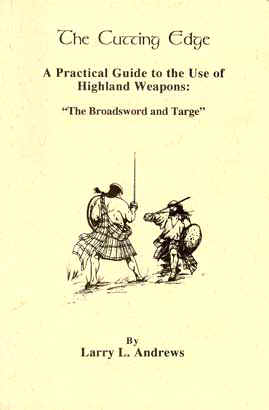
This interesting little booklet of a mere 42 pages consists of ten short sections covering guards, blocks and wards, footwork, striking, grips, basic cuts, lessons, and training tips. It includes a handful of simple but effective sketch illustrations of postures and actions. Right off, it states it is a "manual on the proper use" of the title weapons. Although very short, it is written with sincerity and a clear martial spirit --and that on its own deserves respect. The Scott broadsword and targe is not my field of specialty, however it is close enough to the use of the medieval sword & shield in universal principles as to allow myself a good deal of room to consider the material presented. I did not want to be intentionally critical of the author’s effort or results, and I would much rather end up learning something new. At the least, the author clearly understands the necessity of using the flat to parry with and knows about using the face as well as the edge of the shield in parrying. The footwork chapter itself is also actually pretty good. Strangely, the booklet doesn’t offer any background on the subject weapons themselves such as describe their origin, development, history, or conditions of use by Highland warriors. Perhaps this is already considered generally known by the book’s Scottish heritage audience? Regardless, the limited approach reduces the overall value of the work. In fact, one complaint I have is that it’s all written almost too casually, which makes appear as simply a student’s training notes or an instructor’s brief class outline. It also doesn't really discuss anything on blade characteristics, weapon construction, handling aspects, hilt configuration, etc. Cuts are covered but they surprisingly include diagonal and vertical descending strikes as being the same and do not even separate between left and right versions. The targe is a small round shield, yet is its use is mentioned for only two blocks and a handful of minor actions. No mention is made either of its classic center-spike. He also does not discuss its origins or period of use. Fortunately, the author does avoid professing most of the various common myths and familiar misconceptions about European weaponry --and with the mass of misinformation readily available, this alone is an accomplishment. Of course, I did not agree with all his theories and findings, but I do think it is easy to see how they were reasonably arrived at and where they have merit. I can say without doubt that I recognize and respect the author’s methodology of reconstructing his interpretation of the use of these weapons. It’s obvious he sparred and trained, read historical sources, tested their instructions, practiced again, and followed his instincts to discern a general method which he then set out to explain with confidence. Indeed, this is an admirable, commendable, and reasonable way to proceed in reconstructing and replicating a reliable facsimile of a lost historical fighting art. Sadly, there was no mention of the important element of test-cutting with sharp blades (or of just drilling and exercising with blunts or wooden weapons). The publication also did seem somewhat too loose with its amalgam terminology, and would have been better served again to have used additional source material by other 18th &19th century authors (such as those from an array of related books on similar broadswords and cutlasses by C. Phillips Wooley, C. Roworth, John Taylor, H.C. Wayne, J.M. Waite, and Antoine J. Corbesier). It’s possible to see where the author over generalized somewhat from his references, several of which reflect fighting methods and styles and even blade formss quite unlike the Scottish one of his subject (i.e., Lebkommer, Sutor, Meyer, Talhoffer, Capo Ferro, etc.). Some of his interpretation of these manuals suffers and is even superficial (focusing on postures rather than on the whole form). Additional sources (such as Swetnam, Pallas Armata, Castle, Burton, and others) would have been of more benefit in supporting his ideas if he better understood their weapons and styles or included more of them. His ideals on the "low ward" and "on guard" are almost incomprehensible. Still, while limited in comparison they are legitimate and understandable source material for supporting a basic system of broadsword & targe, especially when the Scot weapons themselves are fairly simple and without any sophisticated method of their own. Still, he perhaps tried a bit too hard to force analogies or synthesize ideals among unrelated historical manuals when in fact they reflect wholly different philosophies of fighting. The most disturbing part of the pamphlet however, is an odd comment about how "the iron clad knight stood erect with a straight back to maximize the force of his attack against his enemies armor", and "while a warrior clad only in leather had to use crouching stances to diminish his total target area". This kind of unsubstantiated nonsense reveals the author’s profound misunderstanding of fundamental aspects of medieval fighting and weapon use and serves to undermine his credibility. Still, some factual errors cab be overlooked if his other judgments otherwise seems sound. But another strange comment reads that it is not true that there is "a standard method of sword tactics", followed later by a statement that the reader should seek to master tactics appropriate for his weapon" so as to "be able to recognize when they are losing". Hunh? Statements like these are just confusing. Overall though, this short work does present some fundamental advice that while perhaps not so detailed or eloquently written, is generally sound, reasonable and undoubtedly acquired directly from experience in sparring and fighting. The pamphlet also states it is volume 1 of a supposed 5 volume set on Highland weapons that includes (or will include) editions on two-handed claymore, lochaber and sparth axe, and also padded weapons (presumably sparring gear?). Oddly, it also makes the claim the author has "20 years of research into old manuals as well as more than 25 years of actual field combat." I suppose by this they mean simulated sparring? In conclusion, the practical advice offered on the title weapons while legitimated in principle, is hindered by lack of supporting information and an assortment of minor mistakes and historical errors. This is forgivable though, and given the scarcity of respectable titles on Western fighting arts I for one would not mind seeing more in the future from this author. He seems to have some genuine insight waiting to be refined and articulated. As a writer on historical Western martial arts myself, I am all too aware of how a person’s fighting knowledge and understanding of weapons skills often cannot come out easily in words. So then, while it is possible to pick this booklet apart, for a mere $11 is it worth adding to your library for the merit of its contents alone? I have to say, sure. The Medieval Soldier in the Wars of the Roses
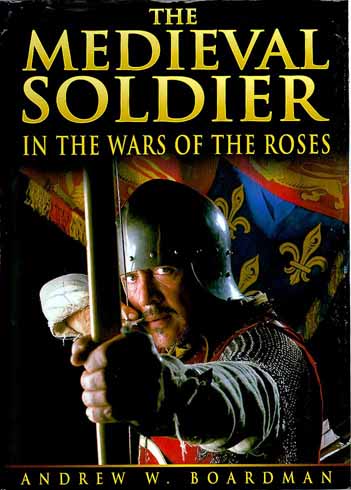
Various sections cover the changing value of cavalry, the long-bow and its use, artillery and firearms, and hand-to-hand combat of the time. The book consists of seven short chapters covering historical and political background, the nature of English warfare then, logistics and recruitment, equipment and arms, fighting in battle, and most interestingly information from the recent mass grave findings in 1996 near the battle site in north Yorkshire. Forensic analysis are presented of skeletal remains which are said to rival the famous Wisby finds of the 1930’s. Strangely though, early on the author states that this is "the best evidence yet to the "brutality of medieval warfare" and to the "experience of medieval soldiers". But later he reveals that the 36 or so corpses the grave contains appear to have been common soldiers massacred en route, rather than killed in heated melee during the snowy battle of March 29, 1461. Still, it is all interesting and useful information. He also includes material from historical letters describing the kinds of injuries suffered in battle (which effected almost entirely the head, face, and limbs). Pictures of several skulls damaged by blade cuts and thrusts are also presented. The book makes a point to emphasize the grim reality of late medieval warfare. It contains some interesting detail on fighting in plate armor and the effects of weaponry against it. Primarily the subject focuses on the common soldier in battle, his equipment, training (or lack of) and methods of fighting, recruitment, supply, and attitude. Interestingly, he acknowledges the value of modern research and experiment with medieval arms and armor as being important now for military historians and scholars. Strangely, after offering up considerable details he declares half way
through that there is no historical account of the actual battle he references repeatedly.
The book probably could also have provided greater details on the arms and weaponry used,
but then this material is easily available elsewhere from other sources and there is not a
lot more that can be said. The book also would have been even stronger if it had included
pictures or illustrations of soldiers and knights of the Wars of the Roses. More artwork
of warriors or better still, photos of reenactors, would have gone a long way to fleshing
out the subject. Overall, Boardman has done a fine job and this book will make a good
addition to the library of historical combat enthusiasts. |
|||||||||||
| Talhoffer’s Fechtbuch Carl Schmidt & Torsten Verhulsdonk. VS Books, 1998 GBR. ISBN 3-932077-03-2. Reviewed by J. Clements A new modern-German language translation has just been printed of the famous fighting manual by Hans Talhoffer. This is from the Fechtmeister’s earliest edition of 1467 and includes for the first time in modern print almost all the more than 260 plates illustrating langenschwert (long-sword) techniques as well as various other weaponry. Each plate contains short descriptive captions on the moves or action. Several plates cover dagger fighting as well as some sword & buckler. The artwork is crisp and clear and offers a valuable reference for today’s student of medieval long-swords, great-swords, and two-handed swords. This is an excellent resource so far available only from Germany. Hopefully an English language version will appear soon followed by several other translated manual reprints. Fiore De’ Liberi Flos Duellatorium – in armis,
sine armis equester et pedester A brand new modern Italian translation of Dei Liberi’s indispensable manuals on long-sword/great-sword, dagger, wrestling, and other weapons. Beautifully rendered in old style ink. Although not in English, the many illustrations are indicative of the sophistication of medieval swordsmanship and fighting arts at the time. To obtain a copy contact: zorro@abc.net. Via Faccioloti, 75 – 35127, Padua, Italy. The Modern Swordsmen – Realistic Training
for Serious Self-Defense It’s not easy what to make of this odd short book. There is no doubt the author is serious and means well and its hard to really say anything particularly bad about it, but there’s not a whole lot to commend either. It does offer some practical suggestions are how to go about training and practicing alone. But it also offers some very impractical advice. The basic premise is supposedly "actual self-defense" with a sword. The author purports to suggest a sword is "ideal for home defense" (one would have thought a good 9mm or shot-gun would do that). Some of the advice is strange, almost silly. The few illustrations rendered are cartoonish and often entirely irrelevant (such as drawings of flashlights and other tools). The information on sword forms is severely limited and contains misleading inaccuracies (such as including "Norman" and "Viking" swords as "long-swords" alongside katanas, but excluding true two-handed European long-swords such as spadones, bastard-swords, war-swords, etc.). The Asian-centric reference material of the bibliography is weak and culled mostly from Martial arts magazines (which are poorly edited and written mostly for juvenile audiences). There is little or nothing from historical Western sources on the *use* of Western swords themselves. Two major problems the book has are: (1) The title, which is completely misleading. This book has nothing to do with self-defense. It is about training to become generically more proficient with your sword style and offers almost no information on sword technique for self-defense. And (2) The assumption that the reason to train with the sword is modern self-defense leads to some fairly improbable material, like using a pistol as a "left-hand weapon" in partnership with a sword, or using your dog as a weapon, etc. He has tried to make his book (or at 80 pages, a long pamphlet) too generic, and in doing so has stretched things beyond his knowledge. Still, it has some merit for a person trying to train on his own, and could be a somewhat useful companion volume, but all in all is not intended as a stand-alone work. Suspiciously, there is no biographical information about the author included. He appears to be someone with some experiences in Japanese swordsmanship and perhaps sport fencing (not necessarily that much) and with a lot of his own ideas about things. Overall, the book seems worthwhile for beginners without any teacher, or the opportunity for practicing with others, or to train with an active group. The advice is useful, the drills are interesting (if sometimes a little bizarre), and the emphasis on cutting and training is good. This book is apparently trying to say to take the material you’re studying and adapt it to what you do. It’s not my personal approach or any preferred method I would advocate. But, at least it’s not more stage-combat theory or fantasy role-playing nonsense. Jihad in the West - Muslim Conquests from the
7th to the 21st Century This engrossing new book offers factual accounts of the little known immense Islamic invasions of Europe. It compiles historical accounts of Muslim holy wars against Europe that have actually raged for more than 1,300 years (including occupation of Spain and Portugal for 800 years, attacks and invasions of France, Italy, and European coasts all the way up to Ireland and Iceland as well as repeated attempts to conquer Austria and Russia!). This unrecorded "hole" in Western history has often been censored and stifled by political & literary authorities fearing angry reprisals from those still trying to hide a legacy of atrocities far more brutal, bloody, and ironically six times longer than anything from the Crusades. The Muslims destroyed the Byzantines and swept over the Balkans, besieged Vienna, and even controlled Greece, Bulgaria, Romania, and Hungary in to the 1800s. As it destroys the modern myth of barbaric Westerner knights invading culturally superior, peace-loving Arabs, it traces campaigns to "convert the infidels" from the 600s to today’s random acts of international terrorism today all in the name of religion. The History of Fencing: Foundations of Modern
European Swordplay As a sword researcher and active practitioner, as well as an author, I
looked forward to this book’s release with great anticipation. My review here (for
historical swordsmanship enthusiasts) is limited exclusively to *only* the book’s
first section, my area of particular concern, namely historical fencing methods prior to
c. 1700. The rest of the book covering 1700 to present sport fencing is outside my
interest and not reviewed. The contents of the book's first section consist of some very exciting albeit brief material on renaissance fencing manuals. The author’s overviews of the leading Italian masters of the 1500’s and 1600’s are the book’s greatest value to those interested in historical swordsmanship. Fortunately, translations of several important terms and phrases from manuals are included. It is very sad material like this has not already been made easily available. Of course, an entire book could (and should) be presented on this early historical fencing material alone. However, for some reason the 16th and 17th century section reads as if
still incomplete. It comes across as if we were getting a look only at a professor’s
lecture notes. Overall the section left me wanting much more. I found myself wishing for
more footnotes on many of the short descriptions of what would seem to be important
elements. There is also a lack of accompanying illustrations, which would have made a
tremendous difference. This is also reflected in the choice of reference material on weapons
cited in the bibliography. Surprisingly it includes none of the many important titles by
the world’s leading sword authority, Ewart Oakeshott, yet it does include the 1961
edition of G. C. Stone’s notoriously flawed work (originally first printed in 1933).
Ironically, for a expert who has access to original materials in their native languages,
Gaugler also cites N. Evangelista’s sword encyclopedia, which itself relied on
entirely second and third hand sources without offering new research or insights (but
then, William Gaugler wrote the introduction to that work and Evangelista was his
student). It is even reported that thee author's own research into early fighting manuals
was begun only failry recently in preparation for writing the book (!). The History of Fencing: Foundations of Modern European
Swordplay While Dr William Gaugler’s The History of Fencing promised to be the long-awaited successor to Egerton Castle’s Schools and Masters of Fence, (1885) it has proved a disappointment to the historical fencing community. My first impression upon opening the book was surprise at the fact that the amount of space devoted to each century seemed to be in inverse proportion to the importance of fencing in that century. There are 29 pages on the 16th century, the same number on the 17th, a mere 19 pages on the 18th century, 205 pages on the 19th century and 148 on the 20th. As well, not only does Dr Gaugler begin, as did Castle (Schools and Masters of Fence, 1885) before him, with Marozzo, but we have only the barest mention of anything that went before. Anyone without a knowledge of the scores of great masters who went before Marozzo, masters whose work Marozzo undoubtedly drew from, could be mistaken for thinking that fencing sprung fully formed from the brow of Zeus (as it were) in 1536. To add to this we are told in the Preface that "Since all contemporary schools of fencing in the western world are derived from Italian and French sources, focus in this work is on treatises published in those countries. Rapier play in the other two early schools, the German and the Spanish, in fact, closely resembles the Italian model." (p. xv) Quite apart from the fact that this statement has taken us from The History of Fencing to "The History of Those Bits of Fencing From Which Modern Sport Fencing is Descended", the statement is wrong. While German rapier play drew heavily on Italian, Spanish did not. In fact the teachings of the Spanish school of rapier play are remarkably different to those of the Italian, as anyone who has studied both will attest. The main body of the book is separated by century; I’m not sure why as it introduces artificial boundaries within reasonably static periods of fencing and fails to recognise the true periodisation of fencing history, that is by weapon. On the subject of weapons, one would expect in a history of fencing to see at least some discussion of the weapons, how they changed and how these changes affected fencing styles. Instead in the first chapter we are limited to the following "The simple type of rapier shown in the illustrations to Achille’s text has a short grip, large spherical pommel, crossbar, and long, slim straight blade that tapers to a point." (p.2). In the second chapter we receive another tidbit "It should be noted that the author is one of the first Italian masters to mention in his text both the practice rapier (smarra) and the foil (fioretto). The introduction of the lighter practice weapon, that is to say, the foil, is, of course, important, since it contributed to the development of the fast and complex fencing technique we employ today..." (p. 47). Later on we are told that "In many respects Francesco’s Regole della Scherma represents the final major work on Italian rapier play. Within a century modern Italian foil technique is taught in virtually all fencing schools from Milan to Palermo." (p.56) Yet at no point have we been told what a rapier or a foil is. Anyone unfamiliar with historical fencing will almost certainly assume that the word foil refers to the modern sport fencing implement. A rapier foil is a quite different beast to a modern foil. Dr Gaugler should know this, and should have been aware of the confusion the name would cause. Throughout The History of Fencing there seems to be an almost conscious effort to avoid the issue of weapons and their effect on style. Without examination of the physical characteristics of the weapons, many of the developments in fencing style seem inexplicable. In this sense the book is a retrograde step from Castle’s Schools and Masters of Fence (1885), which, despite criticising the use of long, heavy rapiers, at least correctly identified the limitations that a weapon heavier than a modern foil or epee placed on the practicality of certain techniques. A reader unfamiliar with even the basics of fencing history could be forgiven for believing that the weapons used in fencing have remained fundamentally the same since 1536. Within each chapter are sections on individual fencing masters. The basic teachings of each master are summarised. A great deal of this material is useful, particularly as much of it comes from untranslated Italian manuals. However, the material from each manual is treated in isolation. Only rarely are techniques compared with those of other masters and interpretation of any kind is rare. The one occasion on which Dr Gaugler ventures into analysis is in the section on Camillo Palladini (pp.10-15). Dr Gaugler interprets a fencing phrase. He states... "When the weapon has been drawn from the scabbard to form the first guard Palladini recommends crossing blades on the outside; and, as the opponent moves to thrust in the low line, the point of one's own weapon should be dropped, and a beat in second executed, succeeded by a thrust to the adversary's chest, while stepping forward with the left foot. Two phases of the action are shown in drawings. In the first illustration both fencers are depicted on guard with swords crossed, points up; and in the second, the action is shown completed with one fencer having run the other through. Today we would describe this action as a beat in second in time (hand position in second) and thrust to the outside low-line with a cross-step forward." The two illustrations in question do not appear in the book but they are included (alongside the identical text) in an article by Dr Gaugler in the In Ferro Veritas Online Journal Vol.1 No. 3. The first illustration show the two fencers in a low or terza ward with rapiers crossed. The second illustration shows the losing fencer having dropped his point and commenced a disengage to the inside line. The victorious fencer has his hand in seconda (palm down), his forte against the forte of his opponent, his left leg forward and his point in his opponent's belly. My first reaction upon seeing this was to ask "If this is indeed as a result of a beat then why are the two blades in contact?" A beat "succeeded" by a thrust is also a defence in double time, the beat being one time and the thrust being the second. Double time defences are extremely rare in rapier fencing and are almost never used where a single time defence is possible. Based on the data available to me I made my own interpretation of the technique. My interpretation of the sequence was that the victorious fencer had counterthrust in single time, doing so in seconda in order to provide opposition to his opponent's initial thrust. The losing fencer had thrust and the victorious fencer simultaneously counterthrust with opposition while passing forward and to the left with the left leg (this takes him outside the line of the losing fencer's attack). An almost identical sequence is described by Vincentio Saviolo in his manual of 1595 (page 20 verso (also 14 verso - some of the pages, including this one, are double numbered)). Saviolo described the technique as an "imbroccata in the manner of a stoccata" or in other words a blow delivered with the hand prone, nevertheless striking below the opponent's rapier hand. I have successfully used this defence in many rapier bouts and consider it far better than the variant suggested by Dr Gaugler. Now just to complicate matters, I sent some of my thoughts to Dr Gaugler. Apparently he was greatly offended by my tone which is a pity as Dr Gaugler has much to contribute to any discussion of rapier fencing. Anyway, Dr Gaugler replied, stating amongst other things that what Palladini intended was indeed a beat and he included the relevant passage in which Palladini does indeed use the Italian term for a beat, battere. It looks as if his interpretation was correct. This however leads me to another question. This sequence is the only rapier fencing sequence described by Dr Gaugler. Why has he chosen one so uncharacteristic of rapier fencing as a whole and more importantly, given that he chose so uncharacteristic a move why didn't he see fit to state that it was uncharacteristic? This brings me to another point. While Dr Gaugler has a great many useful quotes from rapier fencing manuals it is immediately apparent to anyone familiar with the rapier that he has ignored or misinterpreted many techniques not still used in modern fencing. Taking, for instance Fabris (1606) Dr Gaugler appears to cover the contents of each chapter in some detail, but does he? Principles and techniques still used in modern fencing are dealt with competently. However, in chapter six we come to a principle that is quite different to modern sport fencing practice, that of defence in single time. Fabris spends most of the chapter telling us how simultaneous defence and counterattack is more effective with a rapier than a modern fencing style parry-riposte. Fabris’ preferred method of single-time defence is the counterthrust with opposition, a counterthrust which closes the line of the attack, simultaneously parrying an opponent’s attack and striking him. Dr Gaugler summarizes the bulk of this chapter in one sentence, in which he demonstrates that he has misunderstood what Fabris was teaching. "In this chapter he also remarks that ‘it is better to parry and riposte at the same time;’ in other words, the riposte should be immediate." (p.33). Dr Gaugler has translated the word ferire to mean riposte which is odd since it is clear from the use of the word earlier in the chapter that Fabris intends it to simply mean ‘hit’. In his own Dictionary of Universally Used Fencing Terminology, Dr Gaugler defines a riposte as "the attack that follows the parry" (p.52) and goes on to say that the riposte may be immediate or delayed. So clearly Dr Gaugler assumes that Fabris is recommending a modern-style parry-riposte despite the fact that the bulk of the chapter is explaining exactly why Fabris thinks that this technique is flawed. In chapter eight Fabris tells us about parrying with the hand. Dr Gaugler makes no mention of this. In Chapter 13 Dr Gaugler translates the word passare as advance rather than pass. This is despite the term being defined as a pass in the English language manual Pallas Armata (1639). A pass of course is a foot movement where one foot moves past the other, as in a normal walking motion. It is as fundamental to rapier fencing as the lunge is to modern sport fencing. Part Two of the manual, dealing with rapier and dagger and Book Two, discussing for the most part advanced uses of thrusts with opposition are not even mentioned. The uninformed reader would have no way of knowing that Fabris’ manual contained anything other than an incomplete collection of imperfectly explained modern fencing techniques. So much for Fabris. Other authors, like Saviolo (who I have worked with extensively) contain so many techniques foreign to modern fencing that Dr Gaugler simply glosses over their works. In the three pages which Dr Gaugler devotes to Saviolo he doesn’t progress past describing the first ward and mentioning that Saviolo advises against the use of cuts. Most of the three pages consist of quotes from that great opponent of rapier fencing, George Silver which is like summarizing a book by Robert E. Lee and only including quotes from Ulysses S. Grant. The greatest fault that I find in the first two chapters of Dr Gaugler's book are the omissions and the message that those omissions will send to people with an interest in rapier fencing. While these omissions do not constitute mistakes as such, I believe the failure by Dr Gaugler to adequately describe the fact of, and the reasons for those omissions constitutes a grave error. To start with I find the title of this book misleading. On the one hand we have 'The History of Fencing' and on the other we have 'Foundations of Modern European Swordplay'. Putting both of these statements together suggests to me a work which describes the history of fencing and which draws special attention to the roots of modern practice. In fact Dr Gaugler's book does not do that. He describes selective parts of the history of fencing, down to the level of describing only those aspects of an individual master's work relevant to modern practice and ignoring the rest, thus leaving the uninitiated with a completely false picture of what that master's style was like. Even if Dr Gaugler had once said that there were other principles and techniques not relevant to modern fencing and hence to his thesis; but he doesn't. For all he says one could assume that nothing different to modern practice existed; and that's just it, people will assume that. People looking for an excuse to think that rapier fencing was simply a dumbed down version of modern fencing will find nothing in this book to suggest that their view is not entirely valid. One single line saying that material not relevant to the thesis was being ignored would have sufficed but now those people who do poorly researched historical fencing have a work by an eminent man which appears to defend their ahistorical practices. In his Preface Dr Gaugler states that "I have selected works that, in my opinion, will best help the reader follow the evolution of fencing theory and practice in those two schools." (French and Italian) (p.xv). As Dr Gaugler has not adequately described fencing theory and practice in the Italian rapier school (if it can be described in such a monolithic fashion) then he has failed to do what he said he would. He also says that "I have sought to provide the reader both with insight into technical matters, and if possible, a flavour of the historical period in question." (p.xv) By ignoring those techniques unique to the rapier 'period' Dr Gaugler has failed to give any flavour of the period. Historical Fencing is a discipline struggling to be recognised as a legitimate pursuit. The vast majority of its practitioners, while well meaning, have little experience and have no access to competent tuition. These people are in desperate need of authoritative secondary source material to assist them. If secondary sources give an inaccurate or biased picture of historical fencing systems this information will be used by those enthusiasts who sadly know no better and historical fencing will be the worse for it. Unfortunately, by omitting material critical to a proper understanding of the rapier and by virtue of the errors present in the material that is included in The History of Fencing Dr Gaugler has, in my opinion, done historical fencing a disservice, by reinforcing the preconceptions that many aspiring historical fencers have about the rapier. Stephen Hand is one of the instructors at the Stoccata School of Defence
in Sydney, Australia. The school teaches rapier and sword. Medieval Swordfighting - VHS Video |
|||||||||||
|
|
|||
|
|
|||
|
|||
 Anglo-Saxon Weapons & Warfare