The
Schoole of the Noble and Worthy Science of Defence
Joseph
Swetnam - Biographical Sketch
Advice
and Ethics in Joseph Swetnam's Schoole of Defence
Study
Guide for the Single Sword Play of Joseph Swetnam's Schoole of
the Noble and Worthy Science of Defence
Study
Guide for the Staffe Play of Joseph Swetnam's Schoole of the Noble
and Worthy Science of Defence
ARMA
International Gathering 2011
PBS Nova:
Secrets of the Viking Sword
Video
Review - National Geographic Channel's Medieval Fight Book
Sword
Talk with John Clements - Podcast
ARMA
on National Geographic's "Medieval Fight Book"
ARMA
Inducted into the World Martial Arts Union
Volta,
Key and Scale
Chivalry
Today - Podcast 39: Chivalry in Renaissance Martial Arts
ARMA
International Gathering 2009
ARMA
Memorium Tribute to swordsmith Paul Champagne
Renaissance
Martial Arts -
The Web Documentary
Opining
on the State of the Art - A Conversation with ARMA Director John Clements
Top
Myths of Renaissance Martial Arts
ARMA
International Gathering 2007
The
Passing of Hank Reinhardt
The
Burrell Collection at Glasgow Museums
Ashokan
Sword 2005 Conference Review
Adventures
in Edge Bashing
The
Sword Show - Flats & Edges
Interview
with Master Bladesmith Kevin Cashen
How
Were Swords Really Made?
Fiore
Dei Liberi Study Guide PDF
Interview
with swordsmith Peter Johnsson
Interview
with swordsmith Paul Champagne
Five
Questions II
Some
Historical Swiss Swords Examined
Armor
Research Society Conference; Chicago 2005
The
Physical Reality of Forceful Edge Impacts
Hanko
Döbringer's Fechtbuch from 1389
Martin
Siber's Fechtlere of 1491
Hundsfleder's
shorttened-sword c. 1491
Hugues
Wittenwiller's Fight-book
ARMA
Southern Knights 2004 Review
New
Youth Q&A Article: All About Rapiers
Oakeshott's
Typology - An Introduction
"Hey
Mister, ...is that sword real?"
Arms
Research Report - Swiss FAH
Late
16th Century German Fencing from the Codex Guelf 83
First
ARMA International Gathering 2003
Sweden
Event 2003
Sword
Show 2003 Orlando
Sword
Motions & Impacts
Codex
Wallerstein Book
Tribute
to Ewart Oakeshott
Wasters
- the history of wooden swords
Italian
Rapier Glossary
2002
Interview with Dr. Sydney Anglo
Newcastle's
'Lost" Fencing Book
Introduction
to HEMA
Renaissance
Martial Arts Literature
Replica
Sword Definitions
Armored
Thoughts interviews
5
Questions on HEMA Study
Wurm's
Ringbuch Translation
Sword
Show 2002 - Las Vegas
Interview
with Hank Reinhardt 2001
Atlanta
Med & Ren Expo 2001
Fillipo Vadi's Manual c.1480s
European
Historical Combat Guild
Inaugural Seminar 2001
Summer
'01 Test-Cutting Gathering Report
Schola St. George Medieval Swordsmanship
Symposium Pics
Sword
2000 Event Special Report
New
Orleans Sword Show Special Report
Historical
Fencing: The Year 2000 in Review
Euro-Trip
2000Report!
Swordplay
Symposium Intl. Event Report!
Keith
Ducklin, Royal Armouries-ARMA Seminar
The
Martial Arts of Renaissance Europe!
Plus interview with the
author!
John
Waller
- Head of Fight Interpretation,
Royal Armouries
1999
Sword Research Trip to the
UK!
Unarmed
Medieval & Renaissance Combat
Ewart
Oakeshott: "Dean of Swords"
Interview
with Hank Reinhardt
'98
Atlanta Excursion:
Practicing with
Hank Reinhardt & Antique Weapons!
Examining
Antique Swords!
Medieval
Swordsmanship Book - 2nd Edition Supplement
Profile:
Hank Reinhardt - Senior Mentor
'97
European Sword Research Trip &
Real Weapon Photos!
Del
Tin Armi Antiche
Arms
& Armor Craftsmen
|
|
|
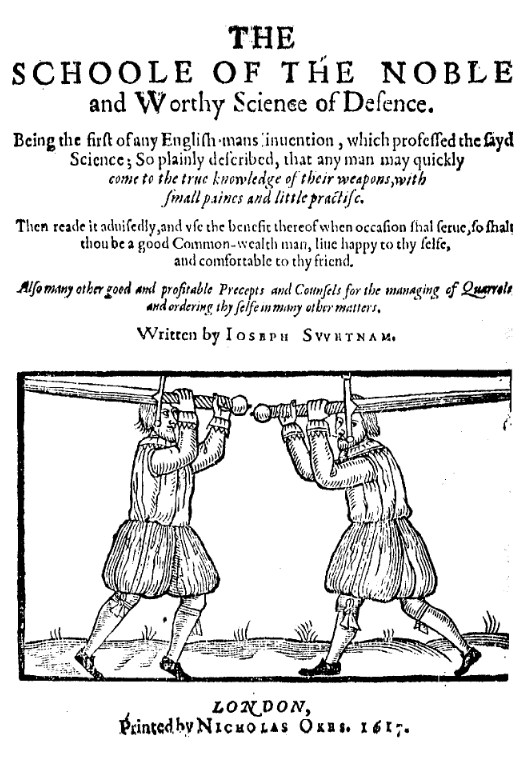
The Schoole
of the Noble and Worthy Science of Defence, 1617 - 2017
A 400th Anniversary Look at Joseph Swetnam's Fight Book
The year 2017 marks the quatercentennial of Joseph
Swetnam's The Schoole of the Noble and Worthy Science of Defence.
Swetnam's book holds the honor not only of being the earliest
known printed fight book "of any English man's invention,"
but also the only known treatise authored by a member of the
English Masters of Defense, a guild of professional fencers
who flourished during the Tudor and Stuart eras. Writing his
book over the course of twenty years, Swetnam's martial career
spanned a period when English attitudes toward fencing styles
and theories were becoming influenced by those of Italy and
France. Swetnam's book, however, remained remarkably indigenous
in both thought and execution. Four centuries later, its enduring
value is the unadulterated glimpse it provides of the English
martial arts at the turn of the seventeenth century, as well
as Swetnam's own perspective on the social and moral context
of interpersonal violence, particularly in regards to honor
and the duel.
To commemorate the 400th anniversary, the Association for Renaissance
Martial Arts presents here a modernized transcription and analysis
of Joseph Swetnam and his work, in order to make his somewhat
archaic language more accessible to a modern audience, and study
guides to offer a framework from which to study and understand
his system.
David Kite, December 2017
1. The
Schoole of the Noble and Worthy Science of Defence
- By Joseph Swetnam
(Modernized transcription by David Kite)
2. Joseph
Swetnam - Biographical Sketch
- By David Kite
3. Advice
and Ethics in Joseph Swetnam's Schoole of Defence
- By Matt Bryant
4. Study
Guide for the Single Sword Play of Joseph Swetnam's Schoole
of the Noble and Worthy Science of Defence - By
Brian Kirk
5. Study
Guide for the Staffe Play of Joseph Swetnam's Schoole of
the Noble and Worthy Science of Defence - By Stacy
Clifford
|
