|
||||||||
|
|
||||||||
|
a thesis on the Fechtlehre from Handschrift M I 29 (Codex Speyer) at
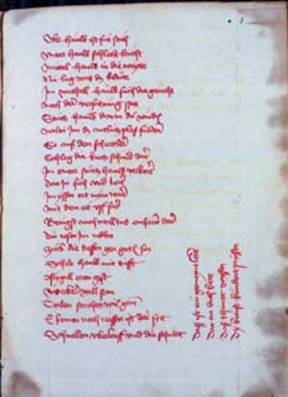
the University of Salzburg in Austria by Jeffrey Hull Foreword: The Fechtlehre (fight-lore) of Mertin Siber is part of the Handschrift M I 29 now residing at Universitätsbibliothek Salzburg. This Fechtbuch
(fight-book) was originally put to paper by Hans von Speyer, its compiler and
editor, in the southwestern area of Germany in 1491 AD, and hence we may call
this Codex Speyer. I have made transcription
of Siber’s part of that Middle High-German manuscript and translations into
New High-German and into New English. I interpreted Siber’s fight-lore for longsword by
assuming it to be in the tradition of Johannes
Liechtenauer. I have striven to
render the text with regard for the literary, the historic and the
martial. Although its wording is
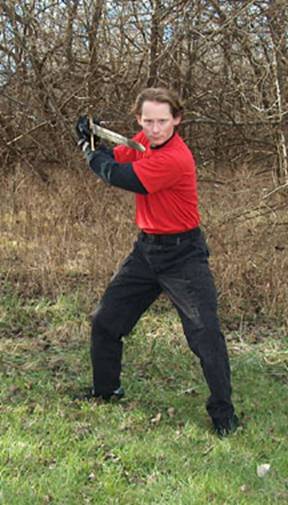
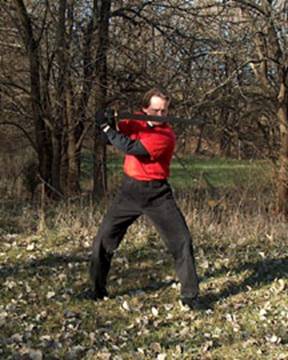
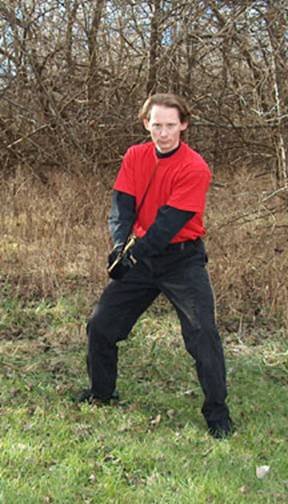
lively, this fight-lore unfortunately has no original pictures to go along
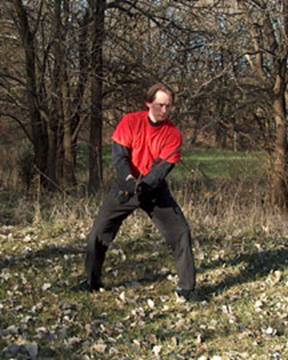
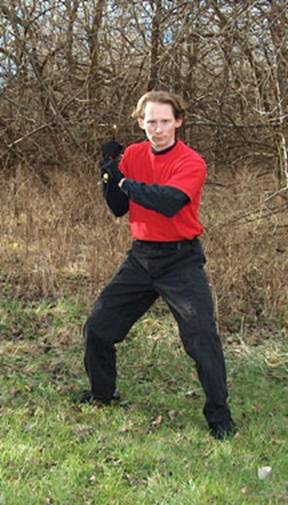
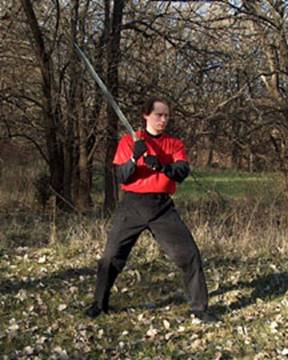
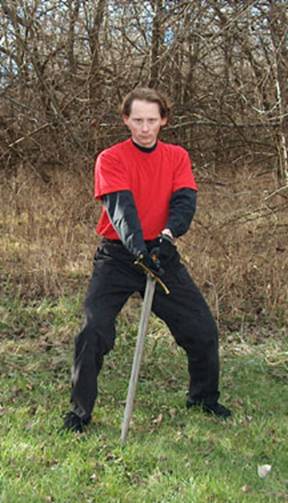
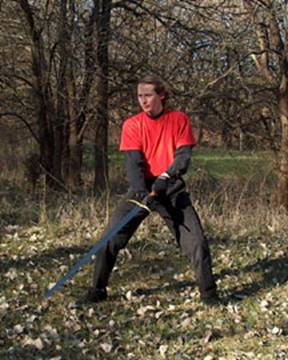
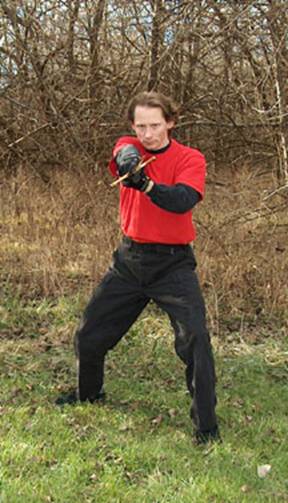
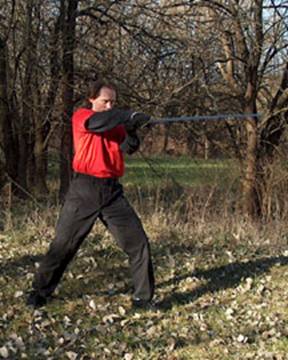
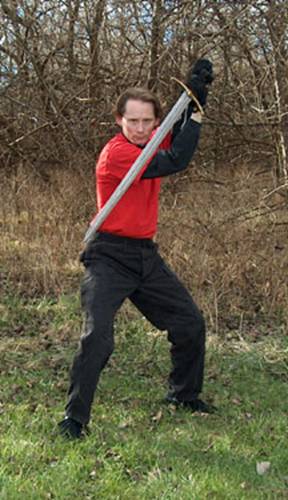
with it – and thus I provide some interpretive photographs as well. I also made a prose rendering as
training-regimen. I have done my best to understand the fight-lore and to present
such to the reader by this thesis. Any mistakes
are mine. Of great help for
comparison and reference were the following: 1) A manuscript-facsimile of the entire Codex Speyer at Universitätsbibliothek Salzburg, and a fine
transcript thereof by Beatrix Koll. I thank her for inspiring work and
gracious help.
At one time Uni-Salz itself
had posted this high-quality colour facsimile within the Web. Now sadly, Uni-Salz no longer does –
hopefully someday they may post it again for all to see. Her transcript is
posted at: http://www.ubs.sbg.ac.at/sosa/webseite/fechtbuch.htm 2) A fine transcript of Siber from Codex Speyer by Monika Maziarz at
ARMA-Poland, which is posted at: http://www.arma.lh.pl/zrodla/traktaty/vonspeyer/siber.htm 3) A confidentially shared manuscript-facsimile
(Manuscript E.1939.65.341) of a
later similar version of “Martein Syber” from Fecht und Ringerbuch (1508 AD) at Glasgow Museums courtesy of
Tobias Capwell. They hope to publish
the whole manuscript sometime in the future.
Their resource-center web-site is at:
http://www.glasgowmuseums.com/venue/index.cfm?venueid=8 I offer this
thesis as a working interpretation for Langenschwert
(longsword) as may be gleaned from Siber’s obscure and laconic
fight-lore. However, I do this with
acknowledgement of my previously released work where I interpreted the text
rather for Schwert & Schild
(sword & buckler). Even with
advantage of fight-books and training partners, today’s regaining of
forgotten Medieval & Renaissance European fencing often involves
self-teaching, hence one can lead oneself astray however well-meaning, and
should try to correct his or her interpretive errors. Thus as the fight-books warn against false
teaching, I must offer what I now think is the true teaching – this longsword
interpretation. It is also the
fulfillment of my own challenge to critics who never produced a longsword interpretation
of their own to match my sword & shield interpretation. Actually,
this longsword thesis was my original intent, and now I appreciate it more
after doing the sword & buckler thesis.
I have tried to fully explore Siber’s fight-lore for longsword and
have proven its likelihood and workings to myself, and now hopefully I may
prove it to you. If my erstwhile
interpretation was wrong, then may this new interpretation be right. What matters most in this undertaking is to
try to find the truth of Siber’s fight-lore. I hope to show Siber’s
fight-lore was part of the greater German Kunst
des Fechtens (art of fighting) of his time. Siber’s fight-lore has wry poetry, ironic
verse and prose, its wording starkly free-flowing, earnest yet playful. It stands astride the blurred border
betwixt the Medieval and the Renaissance, as a cryptic yet distilled nexus of
the variety of European sword-fighting, bidding one to make further study of
the larger fight-books, even as it stands on its own as esoteric lore. Hopefully my interpretation is faithful to
the original meaning of Siber, and shall prove worthy to the scholar, the
fighter, and the poet. Jeffrey Hull Kansas February 2005 ***** Transcription:
Translations:
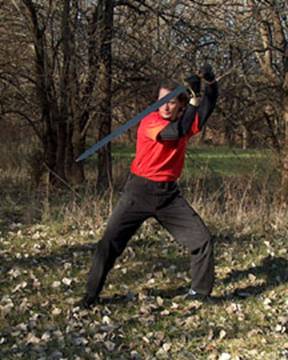
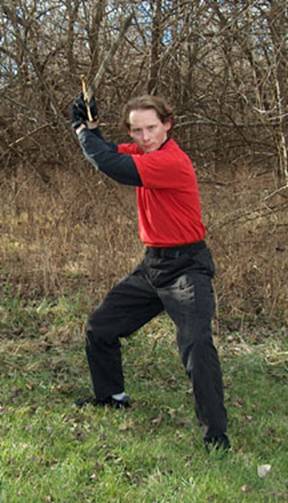
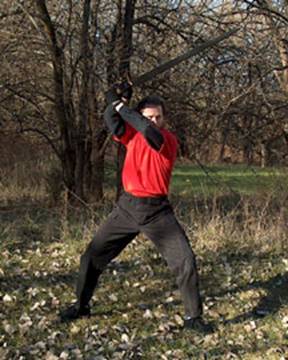
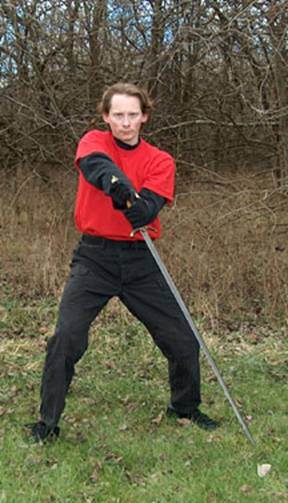
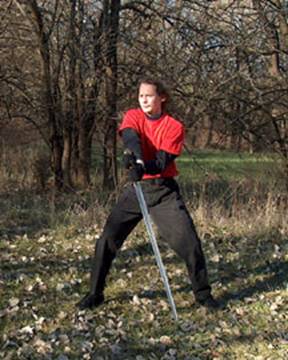
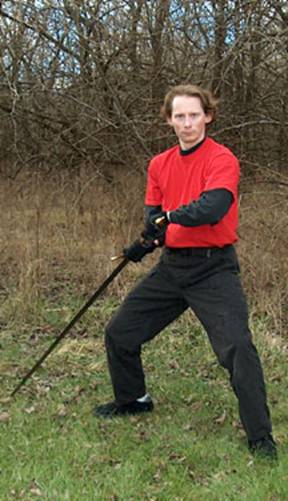
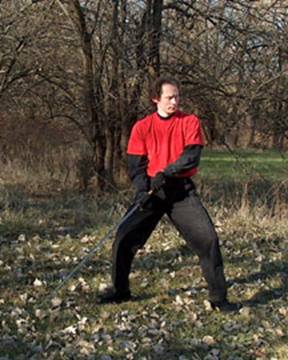
Pictures: As there were
no original pictures for Siber’s fight-lore, I went ahead and had some made
of myself doing his nine wards as best I understood them. Two pictures of each ward are offered from
alternate angles. These pictures are
meant to serve as guides for how the main wards were likely to have been
done, and indeed, can be done today.
The fighter’s own body, experience and idiosyncrasies may call for
some variation. In the course of
moving the body and weapon through the wards in offence and defence – which
still-frames cannot show – one may go more deeply or more upright into
stance. Also, one moves and balances
differently depending upon whether he is unarmoured or armoured. The pictures should be taken as working
guides which are meant as workable portrayal.
These wards are more or less ambidextrous, working decently enough on
either right or left, though not always equally so from each side at all
times. Please do these wards in solo
practice, drills and sparring to realise them for yourself.
Interpretation: By “interpretation” I mean this: to explain the meaning of something as best
I know or think. The fight-lore of Mertin
Siber should be realised by live training at speed and strength. As the text is obscure, even cryptic, no
absolutist claim should be made by anyone.
As the text of the fight-lore has no illustrations, we cannot see with
some visualised
certainty what is meant by the words.
Indeed, we cannot train now with Siber, nor with anyone living or dead
who unbrokenly followed his martial tradition. I interpreted Siber’s fight-lore for longsword according to what works in a struggle versus another
swordfighter and by assuming it to be in the tradition of Johannes Liechtenauer.
The first method is self-evident and should be beyond dispute. The second method seems reasonable as
Liechtenauer’s teachings are generally accepted as the foundation of German
longsword, and indeed, a late version of his work is found in the same Codex Speyer as Siber’s teachings. However, my full
comparison to other texts consists of the early Johannes Liechtenauer and
Sigmund Ringeck (JLSR) (1389 & 1440 AD), Hans Talhoffer (HT) (1467 AD)
and Joachim Meyer (JM) (1570 AD). Also
I make reference to two other relevant works:
To another version of Hans Talhoffer (HT-1459-Thott), from 1459 AD
residing at Copenhagen; its page 1r shares 10 matching lines and 8 key-terms
total with page 3r of the Siber – go to Appendix
III for my transcript of that page 1r.
And also to the similar later manuscript of fight-lore by “Martein
Syber” from Fecht und Ringerbuch (1508 AD) (FuRb-Syber) – go to Appendix IV for my transcript of pages
24v & 25r. The congruence of
content amongst all these are remarkable and would doubtlessly put Siber in
the tradition of Talhoffer and Liechtenauer.
Incidentally, both Codex Speyer and
Fecht und Ringerbuch call
Liechtenauer a master and present versions of his teachings. I think that by contextual reading and
philological comparison; and by safe, authentic, earnest physical practice of
likely techniques and tactics; we may have then a valid, accurate, and worthy
rendering of what Siber meant. Thus my
rendering serves as a guide rather than the final word. Indeed, as hopefully my understanding of
the art of fighting grows, I may need to change my thinking as time passes to
better fit the truth of Siber’s teaching. Lastly, as this fight-lore was indeed
for fight-training, then be warned that any and all training at things
described herein is strictly and rightfully one’s own responsibility. Whether with wasters, blunts, or sharps,
training is at the fighter’s own risk.
Safety, trust, and awareness betwixt training partners are
paramount. This lore was for teaching
men how to fight, indeed, how to kill.
Anyone who misunderstands this warning should not take up the
longsword. Mertin
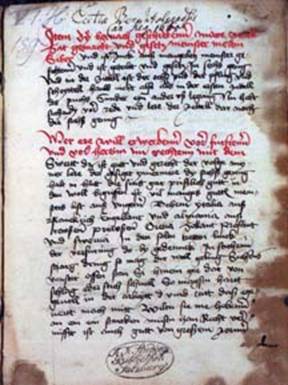
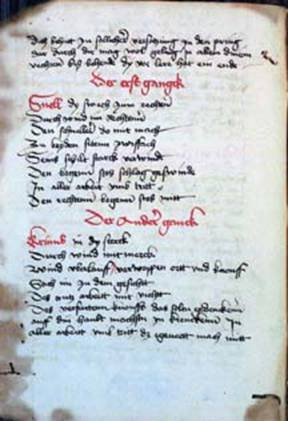
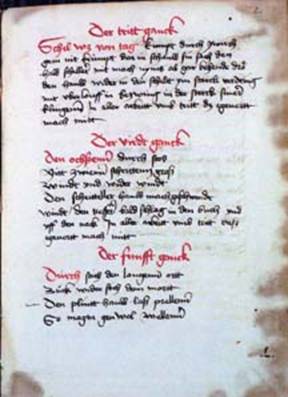
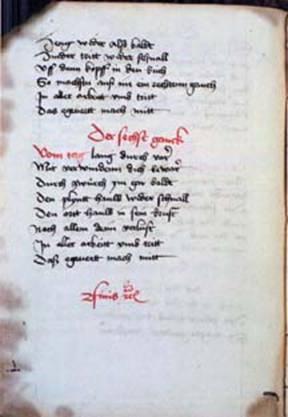
Siber: Fight-Lore (1r-3r from Codex
Speyer of 1491 AD) Siber’s Fight-Lore was written down in a
manuscript of 1491 AD now residing at the Universitätsbibliothek
Salzburg. It consists of foreword,
goings, and poem (which itself bears same title), and could be thought of as
a small yet dense fencing work-book.
It is 5 pages (1r-3r) over 3 leaves of an unnamed 158 leaf manuscript
which may be called the Codex Speyer,
as it is a compendium of works by various masters as scribed by Hans von
Speyer (`ha:nz fa:n `shpai-er – also called Hans von Spier), his name
indicating that he hails from the city on the Rhein. The fight-lore is written in the more
literary manner of its day, in rather cryptic verse. It probably gave the egevertt (“daring fellow”)(dealt with later – dwl) the barest
minimum needed of what Siber had taught him, in an appealing form for
memorising. Speyer gives credit to
those masters for their respective parts, as listed in Appendix I. Perhaps it is safe to conjecture that
Speyer chose the works he did for their utility. Some contest
the correctness of associating the poem with Siber’s foreword and
goings. Such thinking does not
acknowledge that this untitled poem of page 3r is clearly associated with the
foreword & goings of pages 1r-2v before the clear-cut division of the
blank pages 3v-4v. It should be good
enough that Herr von Speyer relates this triad by proxy, whatever be the
similarity of any given section to other manuscripts. Hence, I chose to translate & interpret
all three contiguous sections. Siber’s fight-lore
would have been part of the greater German Kunst des Fechtens (KdF) (art of fighting) of his time. Throughout this thesis, comparisons between
Siber and other KdF longsword fechtbücher
(fight-books) of JLSR, HT, and JM shall suggest continuity of martial arts
techniques and tactics over centuries in Medieval & Renaissance
Europe. For those who care, documental
notes and translative & interpretive reasoning have been relegated to Appendix
V. Siber does not indicate manner of
clothing, though it must have helped to practice wearing some sort of special
fight-clothing. Indeed, it may
interest one to wear the equivalent of Siber’s day, as amply illustrated in
other contemporary manuals. In these
one sees basically full-body tailored outfits, often paneled, gusseted and/or
padded, amounting to wambeson-suits, which may have been worn under Gothic
plate-armour (harnisch or rüstung), hence arming-clothes,
and/or simply for sparring, hence sweat-suits – as seen in HT, Codex
Wallerstein (1470 AD), Fecht und
Ringerbuch and Dürer (1520 AD). It
is reasonable to imagine Siber and his egevertt
dressed as such for their praxis.
In any case, the text implies that the fencers are unarmoured, and
that they are most definitely afoot. The following
luminaries lived within three generations or so, either side of 1491 AD in
Europe: Bosch; Botticelli; Charles V
of Spain; Copernicus; Dürer; Elizabeth I of England; Erasmus; Giorgio;
Grünewald; Gutenberg; Henry VII & Henry VIII of England; Ivan III of
Russia; Jeanne d’Arc; Leo X; Leonardo; Louis XI of France; Loyola; Luther;
Machiavelli; Malory; Matthias of Hungary; Maximillian I of Austria; Medici
Cosimo & Lorenzo; Michelangelo; More; Nostradamus; Pius II (Sylvius);
Rabelais; Raphael; Titian; and Vlad IV of Walachia. Events such as the Capture of Byzantium by
the Turks happened 38 years before, the Battle of Bosworth ended the English
Wars of Roses just 6 years before, the Granada Conquest of the Spaniards
finished the next year, the German & Austrian civil-wars were ongoing,
the German-French Wars for Burgundy & Italy were ongoing, and the
Teutonic Order waned to extinction within 34 years after centuries of
warfare. Siber
introduces his method, gives encouragement, and some techniques & tactics
in the foreword; he provides technical scenarios or matches in the goings,
with reference to tactics; and he gives tactical advice in the poem, with
reference to technique. If Siber’s
fight-lore has to do with Medieval & Renaissance European longsword
fighting, then he does so using only the term Swertt (sword) but once
to let us know – yet here we shall take Swertt
to mean “longsword”. The However, we
must also then contend with the sticky wicket of the term schilt or schiltt
thrice; and the term redlin once.
Here schilt or schiltt shall be taken contextually to
mean “ward”, and redlin to mean
“wheeling”, as can be justified vis-à-vis
Liechtenauer, rather than literally “shield” or “buckler”. Thus perhaps I shall show how one could
nonetheless interpret the fight-lore for longsword. Now, the
fight-books generally assume longsword for the right-handed fighter, and all
techniques seem described accordingly, though one can certainly do them
left-handed. Especially with this
weapon, one can make most wards from either side in a somewhat symmetrical
fashion. Naturally, one can wield the
longsword to both “strike” and “forset” (dwl). According to
Siber there are three basic ways of schlagen or streichen (striking), as
are well-known in KdF: Hew (hauw):
cleaving by a sundering edge-strike of the blade. Slash (schnidtt): cutting by a drawing, pushing or raking
edge-strike of the blade. Thrust or Stab
(stich): piercing by a penetrating point-strike of
the blade. These strikes
are the drei wunder (three-wonders or three-wounders) of KdF. It is worth considering the serious nature
of the ubiquitous schlag in Siber, as I think Teutonic linguistics
reveal: schlag is akin to UT slahan and OE slean = slaying;
OE slecg = hammer; ON slatr = slaughter and NHD schlachten =
slaughtering. Though usually it
indicates a strike done by swinging a weapon, Siber utilises schlag contextually
to mean any of the various drei wunder. Sometimes Siber tells the fighter to smite
the foe with a single decisive strike, sometimes with multiple attritional
strikes. JLSR and JM likewise advise
such variety. Really striking is any
deadly hit with the longsword. It should go
without saying that striking is the utmost thing to do in swordsmanship – for
it is how the fighter fells the foe.
One should fight the foe with the sword, not fight the foe’s
sword. This may seem obvious in
theory, but often it is misunderstood in practice. Proper striking
requires doing so by test and practice cutting against reasonably challenging
targets. I should mention current
displays of sword strike-trauma against deer carcass are quite impressive. By and by,
Siber deals with the same five hews that are JLSR’s fünff hew, which Siber terms identically as scheyttell, zornn, krümb, zwirch & schiller – skuller,
wrather, crumpler, thwarter & squinter. In KdF there are three basic “timings”
of vor, indes, nach (before,
during, after) which are all found in some fashion in Siber’s lessons. JLSR, JM and Wallerstein all deal with vor,
indes, and nach. These ideas of
timing are throughout KDF. Simply put,
the timings tell you when to attack relative to when the foe may or does
attack. JLSR maintain that all strikes
should be “during-time”, and indeed, that: Indes tut in der kunst waß dein hertz
begert During-time does in the art what desires
your heart Siber’s tactics
tend to agree. Thusly Master Mertin Siber has made and
set the new summary written hereafter. It seems that Mertin
Siber (`me:r-ti:n `zi:-ber) was a master
(meinster) of fighting or
fencing. Hardly anything is known of
Mertin Siber beyond his fight-lore. If
his surname means “sifter”, thus some sort of flour-miller, then perhaps he
came from a humble working family, of lower or middle class. It is unknown whether he was the
free-fighter over his own fight-school, or the master-of-arms for the army of
some atheling. Or maybe Siber was
simply some nameless backcountry fighter.
However, a comparison of Master Siber’s work to the aforesaid works of
other masters finds them in much agreement about how to fight. Mertin Siber is also called Martein Syber
or Martin Siber. Note that the
title of Master or Meister in
Europe of this time held weight of living unbroken martial tradition – unlike
the relatively meaningless and over-bandied modern sporting title of maestro. Now the new summary (dÿ...nüwe zettel) implies concise or condensed “lessons or teaching” presented
in revised fashion – in other words, Siber’s fight-lore. The zettel
or zedel of JLSR and other KdF
share with Siber this sense of summary
– for a given master can write down only so much of his lore, hence at best a
summary of his greater knowledge no matter how big the work. Also, Siber has made and set this new summary, implying
personally putting it forth the way he wanted. It is a teaming of manifold masterly
skirmishes. It seems the
summary is a teaming (zuck) of masterly skirmishes (meinster gefechtenn) fought by many unnamed masters. Maybe this lore is based upon specific
fights that Siber himself had fought and/or witnessed. Note here that zuck (like NHD Zug)
implies meaning of “draught-animals”,
indicating the harnessing together of powerful ideas that work. Siber’s summary seems a distillation of
advanced or esoteric fighting, and admittedly, due to his obscure phrasing, is
open to a variety of interpretation. It is dealt and set into six goings. The summary is
based closely upon the skirmishes which are dealt and set into six
goings (geteiltt und gesetz In sechß geng).
Each of the goings (geng or genng) is a set of moves or play of conflict, in active
attack-versus-counter between fighter and foe, which are meant for practice
of useful techniques and tactics in order to teach the fighter how to control
sparring and thus win a fight. A going (ganck) implies a struggle in motion, not in stasis, also
understood as “play; bout; set; match; scenario”. It is basically the same as stück (play) of other KdF sources –
although FuRb-Syber numerates how many stück
(techniques) each ganck
contains in its version. Also,
FuRb-Syber deals only with the six goings and not any poem. It is of note that the Fechtbuchleinn of Wolfenbüttel (16th CentAD) calls its
scenarios gangg. Note also the related Old Icelandic
saga-words atgangur (attack or
fight) and holmganga (island-going
or duel). The six goings
are set in verse which must have helped the fighter achieve memorising, as
was commonly done at that time with a great deal of various lore. During this time such often was both poetry
and song. The couplets in each going are
always of related techniques or concepts, serving as rubrics within the
larger going. Even if all couplets in
each going are not necessarily contiguous, they seem at least somewhat
related. The fencing which Siber’s
goings relate seems to be of an advanced nature. Siber’s goings
try to help one resolve specific conflicts but also to dispel general
misconceptions – being not indecisive fencing tic-tac-to, but rather decisive
fighting know-how. Realise that any
given going means to describe but one likely or desired course from amongst
manifold undescribed possibilities.
These goings present short scenarios much like the many stücke of JLSR, though their brevity
makes not for a whole system like JLSR or JM.
The couplets of the goings and later poem more or less rhyme auf Deutsch, if not in English, which
generally gives some reference to which lines belong together. And in the summary are the ox, the
plough, and the skull-hew – not thus as in the first summary of the book,
rather together in explanation. Now
heave yourself at the foreword and the lore of the summary, and thereafter,
the six goings. So in
the summary (zittell) are both ox and plough – which
are each wards (dwl) or stances of KdF swordsmanship. The ox
(ochß) is a ward
whereby you stand left-leg forward and hold the sword with hilt high and
back, beside the head, such that the point is aimed at the foe’s face or
chest with the long-edge horizontally upward – like a bovine horn. It is found in JLSR and JM as ochs, and Wittenwiller (1462 AD) calls
it üchsen. From ox one can thrust well, striking with
“pouncer” or “squinter” (both dwl), or unwind and swing into hewing with
“wrather” or “thwarter” (both dwl). On
the right the arms are crossed, on the left apart. It is the ward into which one flows
naturally after drawing his blade from a sheath at his left-hip. Such rigging is seen in pictures of German ritter by Dürer. The plough (pflug) is a ward whereby you stand left-leg
forward and hold the sword with hilt at waist-height and pommel at hip, blade
angled forward and point aimed upwards at the foe’s face or chest – the
fighter and his sword looking like the tillman at the plowshare. This ward is
about as basic as you can get, and is helpful as a centering stance,
something to withdraw to as needed.
Versions of pflug are found
in JLSR and JM, and it seems to be in HT.
As a basic centering ward, it provides a launch for a great variety of
strikes – especially thrusts, skuller and “speeder” (dwl). It is a ward into which one flows naturally
after drawing his blade from a sheath at his back & shoulder. Such rigging is seen in English pictures of
Irish galloglach. Also in the
summary is skull-hew (scheyttell hauw) or skuller, which is
a basic deadly strike. It is the
apex-vertical long-edge “overhew” (dwl), whereby the fighter brings the sword
aloft above his own skull, and hews down into the top of the foe’s skull. This term is akin to NHD Schädel (skull). Hence, the origin and the aim of the deed
lead to this translation – physiology and philology united. It is found in JLSR, HT, JM and indeed
quite frequently throughout KDF.
Perhaps Siber groups these three techniques together as the bare
minimum needed to fight by longsword, or because these were done in most
swordfights of his day. The phrase not
thus as in the first summary (nicht also alß in der ersten zettell) seems to tell of an earlier summary
which was part of the book (des puchß), some unknown and unnamed work, not the Codex Speyer
itself in which this new summary
appears. If the presumption of
Liechtenauer tradition is correct, then perhaps the book was one of the versions of his work – or just as well,
due to obvious similarity as shown in Appendix
III, one of the versions of Talhoffer’s work. Yet this in turn really leads us back to
Liechtenauer. Or maybe the book was an earlier version of Codex Speyer, one that also dealt with
Siber’s teachings? However, that
they are presented rather together in
explanation (Sunder eyn ander uß legüng) is clear enough – Siber wants to present the aforesaid three
techniques (ox, plough, skull-hew) here in unity, or at least in more
condensed or concise fashion, and not isolated as apparently they were in
whatever earlier book, to help the fighter learn them as united techniques of
changing tactics in the fight.
Although it is difficult to really say, it seems that Siber considers
this new summary in the Codex Speyer
better than that undetermined first summary. One may note
that FuRb-Syber states that its version is
ain newe zetl ...ein auß zug aus der voririgen zetl (a new summary...an
abridgement of the previous erroneous summary) – hence Syber’s new summary
abridges and/or claims to correct either Siber’s new summary, or the same
unknown summary as Siber’s new summary tries to correct. In context of fight-book history, such
confusion is hardly surprising – considering that Talhoffer, for example, had
multiple versions of his lessons made.
However, FuRb-Syber has some of the same mistakes as Speyer-Siber, and
also has some unique to itself. Thus,
just what-when-where-who-why was wrong and which is setting which right is
arguable. So Siber tells
you now heave yourself at the foreword and
the lore of the summary, and thereafter, the six goings (Nu hebt sich an dy vor rede und
lere der zettell dar noch die sechß genng) perhaps as pun: Heave your mind into the summary, as you
would your weapon into the fight. He
may also be suggesting that technique follows tactics, that is, learn the
foreword & poem first (the “lore” per se) and then the goings
afterwards. Whosoever will earn honour before
princes and before lords in fighting with the sword, he is good and rightful,
who follows my lore, he is blessed evermore. Whosoever
will earn honour is simple yet
deep. It seems rather inclusive,
especially for its time, speaking to whatever man (wer) is willing to
undertake swordsmanship, be he high or low.
The word will (will), whether as
modal verb or noun, with its related meanings of “want to; intend to; desire
to; would”, is the cogency of erstwhile philosophy. Though now ignored or belittled by the
modernist, to Medieval man it was meaningful.
It explains, for example, why Cheyenne outfought Americans with US
sabres during warfare of 1865-80 AD.
All things being equal (or even unequal), he who has the will to fight
when he must do so, whether with specific weapon or generally, shall more
likely win. “Will” may not be the only
thing a fighter should have for winning a fight, yet there is truth to what
one of my older brothers said when we wrestled: You have got to want it. Next Siber deals with honour (ere). That “honour” had great meaning during his time is
beyond doubt, arguably more so than in modern popular culture, and needs no
ruminating in this present thesis, other than that a fight-master dealt with
it daily more so than most of his contemporaries. In context of his chivalrous Christian
German world, ere could, however,
have double meaning here – manifestly the virtue itself of honour and metaphorically lady. Primarily,
Siber says that you may earn (erwerbenn) honour in
war, without some need to be born with it, even before princes and before
lords in fighting with the sword (vor furstenn und vor hereim Im vechtenn mit
dem Swertt) by learning his
fencing lore (lere),
as perhaps hitherto most men had been outlawed to do. This is the idea of a man of lower class
earning honour, which actually would have been part of renewed thinking of
the early Renaissance, whereby a lower-born man need not stay locked in
fealty or thralldom, yet could now better his lot in life with the implicit
right to defend himself. Even the
lowest born man, bereft though he be of aristocratic lineage, could advance
himself if by bravery, talent, need or chance he had proven himself a real
fighter, whether in homeland’s militia or as a freebooting mercenary. Indeed, by the 15th CentAD,
noble knights and peasant levies were giving way to mercenary soldiery as the
preferred sort of army fielded by European princes & lords. We may note Machiavelli’s praise of German
cites as having an intertwining of strength and freedom for their citizenry;
and of his reference to an Italian soldier rising to duke. Perhaps a picture of longsword-armed
Irish fighters by Dürer, from 1521 AD, treats of this idea of the armed
common man, as its caption tells: Dy Krigermen in
Irlandia hinde England [sehen so aus]...also gend dy Armen in Irlandia. The warriors in Ireland, beyond England,
[look as such]...thus go the poor in Ireland. Additionally,
Siber perhaps says you may earn [your]
lady in tourney when he says ere. Such a metaphor for “woman” or “lady” has
been upheld for centuries in the German world, as this typical spiritual
phrase indicates: Marie die Ehre unseres Volkes Mary the Honour of our Folk Now, what Siber
meant by sword (Swertt)
could have been any longsword (langenschwert of KdF) of
Oakeshott-Type XVa, XVIa, XVIIIa, XIX or XX.
Such twain-handed well-tapering double-edged swords were generally of
34-44 inches (86-112 cm) blade-length, of 3.0-4.0 pounds (1.4-1.8 kg) weight,
and were fine for hew, slash, or thrust, whether fullered, diamond, or
mixed-section. It should be noted that
longswords of earlier OT-XIIa or XIIIa could just as well be plied in the
manner of the fight-lore, especially as some of these undoubtedly survived
rehilted in later fashion into later times.
FuRb-Syber makes quite clear that its lore is about des langen schwerts (the
longsword). Such are illustrated by
HT, Dürer, Wallerstein, Gladiatoria (1420-1440 AD), Goliath (1500-1520 AD), and other
KdF. These were often called
“war-swords” or “great-swords”. A
famous historical example of the sort of weapon meant would be the sword of
Albrecht II (about 1440 AD). In the
coeval Bavarian work Liber Chronicarum (1493 AD) we can see
woodcut-prints featuring Austro-Germanic longswords and “bastard-swords”
among its cornucopia of arms and armour.
JM, Mair (1540 AD), and even HT show a specialised fight-school
permutation, the fechtfeder
(fight-feather), its narrow blade sporting a flanged crux. By Siber’s time
the langenschwert was a common
enough weapon which a man of high and middle classes could own, whether he
was knight or freeman on the battlefield or judicial grounds, though it was
generally not to be had by a man of low class, unless he had acquired it by
brave national or mercenary service.
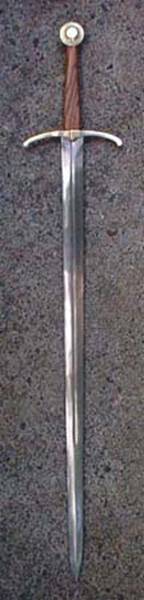
Note that image, measures and
remarks for the actual weaponry that I utilised are in Appendix II. Amid the many
wars around Siber’s time – for example, during the Wars of Roses (1399-1486
AD) – there were many men armed with the longsword. Yet this weapon may have existed as early
as 1100 AD in Germany whence it quickly spread to England, Denmark, France,
Ireland, Italy, Scotland, Spain, Sweden – indeed most of Europe – and would
hold popularity until about 1600 AD, although it would not be completely
missing from battlefields until after 1750 AD. It was most
likely that any KdF fighter who
fought with longsword also knew dagger, and maybe falchion and sword &
buckler (degen, messer, schwert &
bückler), for the manifold fight-books make quite clear that KdF was a
whole myriad of martial arts. These
diverse weaponry shared many of the same techniques & tactics. I hasten to emphasise that the Teutonic
swordsman was also a wrestler – he would have been one from childhood. This was doubtlessly the norm of Siber’s
time, as clearly witnessed by manifold cunning techniques of KdF ringen (wrestling) similar and equal
to the best Japanese jujitsu. More of wrestling later. In wielding the
longsword, I suggest a firm yet supple grip, like a flexible hammer-grip –
certainly not a useless foiling-grip.
Grasp the longsword for striking like this: Your dominant (right) hand grasps the hilt
just behind the crossguard, while your other (left) grasps the hilt just
before the pommel or on the pommel itself.
You can vary your sword-grip with a “thumb-press” as shown in HT,
whereby you slip your thumb over the cross and press at the ridge or fuller
of the blade; or by
“slipping” the ring-finger over the cross, either of which may give better
control to certain strikes. One may
release the back-hand to strike single-handed and/or to grapple as needed. Siber also
tells the fighter he shall be good and
rightful (gutt und gerecht) if
he follows (volge) the fight-lore (lere),
that he shall be blessed evermore (gesiget ymermere). Here also gerecht may have meaning of lawful. Such claims were made commonly enough
during the Medieval & Renaissance for all sorts of undertakings, and seem
to reflect Siber’s presumed earnest desire to relate such a major undertaking
to Christian holyness during that age of faith. The six goings hold wards which are
quite preciously good, wherein is wealful comprehension of the cunning of
quite many goodly masters: from
Hungary, Bohemia, Italy; from France, England and Alemania; from Russia,
Prussia, Greece, Holland, Provence and Swabia. The six goings hold wards which are
quite preciously good (dy sechß
genng halt in huott die sintt gar prißlich gutt), being wieldy & useful. Now the wards
(huott) are “fighting-stances”
or “guards” made in balance with sword in both hands ready to strike yet ready
to forset. The word is akin to AHD hutta
(hut or shelter) and to OE hod (hood). By and by, Siber deals with four main
wards, which he calls ochß (ox), pflug (plough), tag (roof) and ÿssen ort (iron-point). These are basically the same as the vier
leger (four stances) of JLSR, JM and other KdF. Siber also deals with others which have
their time and place, such as langenn ortt (long-point), heng (hanging), and einhorn (unicorn). Siber can be said to have two more unnamed
wards, by virtue of how a fighter gets into them when doing his various
techniques: schrank (barrier)
and neben (nearby). All these
nine wards may be done with ambidexterity, working more or less from or upon
right or left as needed, though not always equally so from each side at all
times. A ward on one side shall have a
given leg forward and arms apart, while on the other side the other leg is
forward and the arms are crossed. It
is wise to learn to strike well from both sides. Wards are
dynamic and not static – when standing these are filled with potential
energy, ready to release kinetic energy when driving (dwl) your strikes. Siber’s wards are not merely defence yet
offence. These wards were customarily
taught – as per genetic majority, for sake of simplicity, and by need of
uniformity of training – right-hand dominant, though they could be done from
either side, more or less identically.
Hence this thesis presents right-side wards as standard, unless
indicated otherwise. The symmetry of
longsword does allow for much ambidexterity.
The reality of geometry and physiology are such that a given ward
lends its best defense and offense to certain situations – hence no single
ward is almighty. The colourful names
of the wards in KdF are indeed poetic in that they are metaphoric. It makes sense
to take stance neither too upright nor too deep, yet with resolve to maintain
integrity of your center and your flanks, as it seems HT portrays. But then again, one may find need for JM’s
sort of deep stances as well, and that some stances call for you to shift
more weight to either leg. The idea of
“balance”, standing in an even harmony of one’s body-weight, though not
stated by Siber is common enough to KdF, as waage or vaage. Auerswald advised that wage (balance) lets one wrestle well – and likewise, balance lets
one sword-fight well. Also, Siber is
not so much talking up the worth of his own “style” of fighting or fencing,
but the worthiness of the six goings as he says again that within these are the wealful comprehension (woll begriffen) of the cunning (list) of many goodly masters (vil mangeß gutte meinsterß) from throughout Europe, as witnessed by
the dozen named countries which spanned that warlike continent (auß Ungern Behem ÿtalia auß Franckrich Engellant und
almania auß rewßen prewßen Gretia Hollant Profant Und swevia). Though all the
named countries are significant, of special note in the list are the lands of
Alemania and Prussia. Firstly is Alemania
(almania), which
was most of the Alpenland and where
Siber seems to have lived, and in whose dialect of German (Alemannisch) the fight-lore is written. It is a name used in English as late as
1588 AD by Marlowe in Doctor Faustus where he refers to Almaine
rutters (Alemanic riders), and in 1598 AD by George Silver in Paradoxes when he referred to the
esteemed high Almaine fencers.
Secondly is Prussia (prewßen),
which was the fortress-state by which coeval Europe measured its
military ability. Its warrior-monks
and armed vassals were often foes to its worthy eastern neighbors of Poland,
Lithuania, Ukraine, Russia, and Hungary (at times an ally). It served as proving grounds for the young
knights of its western neighbors of the other Germanys, and of England,
Sweden, Denmark, Scotland, Italy, and even France (especially after the purge-royale
against the Templars in 1307 AD), who would join their ranks either
permanently or as allies in one of their many reysen (more about that
later). German crusaders had achieved
their lordship of Prussia by means of the Teutonic Order, founded in the Outremer
about 1190 AD, which eventually became the war-machine of Siber’s time,
albeit then waning. Although the
significance of each named country could be elaborated, we must leave it at
that. Lastly, a
query: By casually delineating three country-groupings
(each beginning with auß = from), does Siber suggest three main
traditions, styles or schools of European fencing, similar yet distinct,
which existed around 1491 AD? I think
this is of interest for further study, and can only conjecture here. In the goings, should you tread left,
while then, bethink the misleading. In
thrusting press strongly, so may you achieve it well. In
the goings (In den), and again assuming a right-hander, you tread or step mostly
to the right, as this allows you to put the most might into most strikes from
your wards. This is addressed by HT,
JM and throughout KdF, and is described broadly by JLSR regarding one’s
first-strike: Aber
ein lere: höre waß da schlecht ist ficht
nitt oben link so du recht bist und
ob du link bist im rechten auch ser hinckest. Yet
more lore: hear what the strike is – fight
not from over left if you are right-handed, and
likewise remain not over right if you are left-handed. And in phrasing by HT to rival Siber’s
own laconity: Link
gen rechten das must Stark vechten Left
going right must strongly fight But should
you tread left (soltu tretten linck) then bethink
the misleading (der verfurüng do by gedennck) the foe– to “feign or fake” valid
attack at one opening where the foe is vulnerable only to strike another – as
you may be less adept from that side.
Misleading involves not just “ploys and tricks” of weaponry, but also
of bearing and movement – quickly creating “illusion” for the foe. Your “work” (dwl) tends to be weaker from
your “off-side”, so if you do strike therefrom, then it helps to mislead, but
not overly so. Generally, your sword
can mislead by moving falsely by “changing” (dwl) in mid-swing – but of
course, the foe’s weaponry can do the same.
Thus the fighter finds one of the foe’s “openings” (blößen in JLSR, HT, JM and KdF generally), or sets up work that
leads to such. JLSR refer to feler (feinting) as fryen ober haw (free overhew) to the
foe’s high left-side only to strike lower. These openings are basically four (hence
the vier blößen of JLSR and JM),
corresponding to the body quartered by either “+” or “x” – which are simply
the “gaps or targets” for striking.
One could think of eight openings by combining the two markers, thus
making the segno of Italian fencing. Really any gap big or small that is open or
bare to a strike can be a opening. It
should be realised that anything in swordsmanship – ward, strike, forset –
leaves some opening, even as it covers or seeks them. In thrusting (In
stichenn) at such openings, the fighter should press strongly (starg dring)
into the foe with his body behind the strike, to really pierce him
through. This goes for a great deal of
striking in general, such that you should put as much of your body with
needed torque – arms, legs, waist, hips, shoulders – into it as you wisely
can. So may you achieve it well (so mag
dir woll geling). It should be remarked that Siber’s fight
seems most likely to be what KdF generally distinguishes as bloßfechten (unarmoured fighting)
rather than harnischfechten (armoured
fighting) – though these so share commonality as well as divergence. When you sight through the window, stand
open, see through it, go to it, strike or stab swiftly, so may you be
hard-felled. In the work tread roundabout
– thus the daring fellow wins out. When you
sight through the window (Sichstus venster) with longsword, the “space” around or
between your weapon, then it is best to stand
open (offen stan), to see through it (Si hinein) properly, such that it is not held tightly to your own body,
and tangle or stifle, and you must go
to it (gee dar von) without
tarry or balk so you may strike (schlag) with edge or stab (oder stich) with point swiftly (schnell) the foe at best chance, and thus you
shall be hard-felled (hart gevell) by felling the foe. Try not to lose
sight of everything your window, by narrowly focusing, as you may fall prey
to misleading yourself – rather see the big picture as you sight the foe’s
openings and any counters he tries.
The idea is not to miss chances to strike when you see them – for to
tarry is draining. This hardly differs
from the doubly-meant observation written about 1595 AD by a certain English
raider named John Donne, in his poem To His Mistress Going to Bed: The foe oft-times, having the foe in
sight, Is tired with standing though he never
fight. The idea of “open-standing” in Siber is
to take stance just out of “range”
(dwl) where the fighter has one or both his arms above, hence sword aloft,
making the body open, to aid a variety of moves and allow sighting of foe’s
openings. Siber’s open-stance exposes
yet deceives: the fighter can mark the
foe therefrom, with vantage of much retaliatory potential should the foe
beset him before he besets. Perhaps
Siber’s offen stan (stand open)
could be regarded as counterpart to his durch
var (fare through) in his sixth going. Siber’s offen stan seems the same as that of stand freylich (stand
freely) in JLSR and HT; and use of fry, fryes, freyen
(free) for stances, strikes, and forsetting (dwl) is found in JLSR &
shown and described by HT – whether for longsword, falchion, sword &
buckler, or cavalry sword – and seems the same as offen (open) in Siber’s sense.
The equivalency of offen and frei is demonstrated by the
German idioms: es steht ihm offen
zu gehen and es steht ihm frei zu gehen – either phrase meaning in
English: as it stands he may go.
The illustrious Silver speaks of the open fight. When the fighter and the foe are in
the work (in der arbeÿt) they are basically at “infighting”, struggling at
close range. In work they find
themselves at some sort of mutual opposition in binding, winding and
wrestling. When work is at crossed swords locked at
an impasse near crossguards, or simply blade against blade, it is
“binding”. Although Siber’s method
makes no direct reference to binden,
it does indeed happen in his goings, particularly the third, during
“offtaking” (dwl) , and it does happen in sparring often enough. Again, such is found in JLSR, HT and JM as either
binden or anbinden, or as krieg (war). Siber tells one to do work called
“winding”, which is found later in text as wind (wind or windt). This means you wind, twist or
turn your blocked sword quickly at the fulcrum of where the blades touch, or
even at your elbow or wrist, to bring it around to strike from another angle,
often pivoting your sword either at or around foe’s ward or sword. JLSR, JM and Wallerstein speak explicitly of winden or winten and
much of HT’s ryszen (wrenching)
equates with this. In doing Siber’s method, there indeed
arises “wrestling”, which is to grapple, wrap or throw the foe; and more
broadly can involve trapping or taking the foe’s sword, and even punching
& kicking him. It can be utilised
alone or in unison with armed moves.
Wrestling is taught by multiple KdF sources such as JLSR, HT, JM, and
is the ringkampf (battle-wrestling) of Ott in Codex Speyer, the
ringerkunst (art of wrestling) of
Auerswald (1539 AD), and the unique ringen
of Wallerstein & Dürer.
Frightening description of deadly Teutonic wrestling goes back many
centuries, notably in hero-sagas like Beowulf. Wrestling is universal to all KdF, where it
is dealt with as the natural base of all weaponry fighting. This triad of binding, winding and
wrestling (binden, winden, ringen)
are common to JLSR, HT and all KdF; and along with striking and forsetting,
you get what constitutes Siber’s work (arbeitt), which later he more or less equates with “fight” (vichtt) itself in his second going. While at work, the fighter should tread roundabout (umb tritt) and should be a daring
fellow (egevertt) who initiates
not just responds, whereby he treads lively, to flanks, past or behind, and
so forth, rather than just moving linearly or standing in place, in order to win out (mach mitt) – not to show nice form, nor to entertain, nor to be genteel –
but to win the fight. Wittenwiller
often states tritt umb (tread
about) in his longsword fencing. By treading (tretten or tritt) Siber
generally means to step by traversing one foot forward or backward past the
other, from balance to balance.
Treading helps keep you from being hit and helps you to hit
mightily. It should also be realised
that “footwork” – whether standing or stepping – can vary situationally, and
that no absolute should be maintained, whether in my descriptions of the
goings or in one’s sparring experience.
Just be ready to tread roundabout as you deem best – whether this
means treading, hintertreading, hop-stepping, side-stepping, cross-stepping
or switching (all dwl). The idea is
that real historical fencing tends to be as circular as linear, if not more
so, really “fighting in the round”, which includes awareness of front and back
attacks (as in HT), above or below, and from sides or flanks. Footwork such as JLSR’s and Wittenwiller’s springen (springing or leaping), or
JM’s triangel (triangle) and
Wittenwiller’s similar drig angel can
be reasonably utilised for different situations in Siber’s goings. Really treading is any footwork which works
to keep you alive and win the fight. Siber speaks directly to the fighter, by
imperative second-person familiar voice now lost to modern English – thou
& ye – as befits a teacher to student or friend to friend. Now egevertt or “daring fellow”
(like NHD Gefährte) has a mixed
sense of “comrade, risker, danger-mate”, akin to JLSR’s use of gefer (danger). In context of the stricter sense of mach
mitt as “going through (hardship)” or “taking part in (group)”, we arrive
at my rendering that indicates Siber speaking to some fellowship of those who
understand true fighting – whether his students or fighters generally. Again, Siber is concerned that the fighter
win the struggle. The term genoß (comrade) from HT-1459-Thott is
similar. It is interesting that congruent to this
passage is a line from FuRb-Syber which seems to combine ideas of “striking”
and “roundabout”: schlache
oder stich umb schnele strike
or stab roundabout quickly Will you raise and strengthen yourself –
then you must have the right, yet reason is also good. Siber then offers some ethical yet
utilitarian advice, perhaps with regard to both natural and secular law, to
accompany the ruthless combat techniques.
He asks will you raise (wiltu hebenn an) and strengthen (ein
starcken) yourself – better
your lot in life and make your body stronger by physical rigors of
fight-training – then you should fight when it is warranted, that you must (müstu) have the right (Recht) to fight, only for heavy reason (vernüfft). I think that
Siber means his fencing should be wielded, both practically and ethically, in
training salon, for self-defense upon streets or highways, within judicial
dueling yard, or upon battlefield. Perhaps Siber would have agreed with
Talhoffer that the same seven verbieten
(forbidden) misdeeds were grounds for one man to challenge another man to
fight, which are paraphrased as mortt; verräterniß; ketzerÿ; wölher an
sinem herrn trulos wirt; sanckniß in striten oder sunßt; valsch; junckfrowen
oder frowen benotzogt (murder; treason; heresy; urging disloyalty
to one’s lord; betrayal in strife or otherwise; falsehood; and using maidens
or ladies). These were things that a
worthy master would not have tolerated a student ever to do. The reality of Siber’s Austro-Germanic
world was chaotic indeed with manifold internal & external threats to a
person’s life often making for self-defensive need. Yet I think that here also a certain
morality is addressed at least briefly, as it was by JLSR’s vorrede regarding
the morality needed for chivalry, by poet-knights like Eschenbach, and
likewise through the changing ages of German warriorhood into modern
times. With that in mind, if we accept
that a man’s ethics and craft are one (as that soldier Wittgenstein
maintained); and that martial virtues are worthy only when furthering good in
the world (as eventually Rommel concluded); we may be aware then of the
ethical difference between military science and martial art. Similar ethos, whatever its stark utility,
is actually behind the venerable Silver’s advocacy of sword over rapier,
when he says to train for slaying foes on the battlefield rather than
murdering one’s fellows in the streets, and likewise when JLSR say that his
longsword art is meant for furthering one’s honour in kriegen (war). It is
simply this question: What is the
worthwhile fight? Ward yourself from great wrath, bring
forsetting to such, thereby may you achieve it well when in all your fighting
you are nimble. When Siber tells you to ward (behutt) yourself from great
wrath (großem zornn), it could
be twofold. Firstly, Siber tells you to ward
yourself from KdF strikes such as “wrath-hew” or “wrath-point” – either could
be called “wrather”. Here ward (behutt) means utilising any defense you may – whether wards
themselves, forsetting or avoiding. The wrath-hew is a diagonal long-edge
overhew with arms apart, driven from behind the shoulder with all the body
fully, while treading either forward or backward, swinging from high right to
low left, ideally through foe’s torso.
It is typically driven from the ward of “roof” (dwl). Zorn
haw is described by JLSR, and zornhauw
is shown by JM, also called vatterstreich
(father-strike) or streithauw (strife-strike)
in KdF. The wrath-point is a high thrust with
arms apart, from your right-side, whereby you drive the point into the upper
breast, and end up in much the same stance as thwarter (dwl). It may be driven from roof, barrier or
nearby (all dwl), or by “offtaking” (dwl) from binding. HT shows such as zorn ortt, and JM seems to portray a similar scene. It really differs little from the “pouncer”
(dwl). Also, Siber seems to tell you to ward
yourself from being filled with great
wrath (großem zornn), so that
your mind is not unbalanced, so as not to make mistakes, but clear as you
fight – like mushin (empty mind) of
kenjitsu. Despite the danger of wrath, it is
something you can counter if you bring forsetting (versatzung)
to such – which means to put foe’s strike out of the way from hitting
you, by your sword and body-movement.
It can be thought of as “displacing, parrying, deflecting”, or even
“intercepting, moving, setting aside”, or seldomly “blocking”. Now forsetting (versatzung) is readily understood to
mean setting the foe’s ward or strike out of the way, by driving your sword
to meet & divert his sword, which is best done dynamically not
statically, and while treading, shifting or torquing. So – you put foe’s weapon away with your
weapon before his ever reaches you.
Furthermore, forsetting can be understood in three ways, relative to
the timings of KdF: Before-time (vor) – you set aside foe’s warding sword with your striking
sword. During-time (indes) – you set aside foe’s striking sword with your striking
sword. After-time (nach) – you set aside foe’s striking sword with your warding
sword. If the fighter forsets the foe’s sword
with his sword, then he does so best if he strikes the foe as well in the
same movement, if possible, or forthwith following. Incidentally, JLSR seem to maintain that
before-time is the ideal way of forsetting with longsword, as per his vier versetzen (four forsettings)
(dwl) which attack the foe’s wards before he attacks, although JLSR give
ample examples of doing so in during-time and after-time as reality
demand. Versetzen or verseczen
are fundamental to KdF. Again, JLSR,
HT, JM, Dürer, Wallerstein and
Wittenwiller all deal with them in their own yet similar ways. Forsetting by sword works best when the
blade-to-blade contact involves the “flat”
(flech of KdF – one of its
broad unsharpened planes or faces), of at least one of the blades, and not by
opposing one blade’s “edge” (schnid – the sharpened bevel – dwl)
against the other’s edge. The flat of
your blade allows you the advantage of the steel’s flexibility and lets you
get rid of foe’s blade by gliding away quickly to strike him. Your sword’s edge remains sharper, its
blade lasts longer and healthier, and has far less chance of shattering. It seems shown by HT for longsword, and by
such manuals as Goliath. Utilising the flat to forset is shown
clearly by HT for falchion, sword & buckler, and cavalry sword, who calls
it gewenter hand (wended-hand) or epicher
hand (ebbing-hand), whereby the fighter forsets by “ebbing” or curling
his sword-hand at the wrist to meet the edge of the foe’s blade with the flat
of his own blade – and each time associated with versetzt (forset) by HT. Furthermore, JLSR make it quite clear
that flat-use is the masterly way to forset, for example with crumpler: Haw krump zu den flechen den maistern,
wiltu sy schwechen. Hew
crumpler to the flats of masters – thus you will weaken them. Thus flat-to-flat, edge-to-flat, or
flat-to-edge – but not edge-to-edge – is the best way to go in forsetting. For those who need further convincing, see
the third going below. Lastly, you are reminded that you may achieve well (wol geling) forsetting of wrath and so forth when in all your fighting (vechten)
you are nimble (behende). What Siber relates here is that not just
strength and might but also dexterity and precision are needed well to
fight – indeed, nimbleness of both
body and mind – when dealing with wrath of sword or wrath of mind. Some thoughts about Siber’s vechten: I render it as fighting because that
says it best. Although “fencing” is
not wrong, it is not as right as “fighting”, which is truer to Siber’s
meaning of vechten than the sadly corrupted and blanded meaning of
“fencing” today. Fighting means
striving to win by savage ruthless combat.
In this case, it is however the longsword lets one do so. This forelore ends. Thus Siber’s statement of purpose, as it
were, now ends. The first going This may begin
as fighter wards in plough and foe wards in plough. Speed the weak to the right Wind
through amid the fight
Do
the speeder with might To
both sides twice If however the foe treads back and
avoids, then tread forth and do the
speeder (schneller), overhewing diagonally in successive bisecting
circles through the foe’s body. The speeder is basically round-striking,
in large arcs and often multiple times, meant to overwhelm foe with strikes
or at least repel him. Such a flurry
can launch attack in before-time, and can break binding, but must be done with might (mach) by treading forth
(as here) or back, lest it be useless.
It should not be done to establish a pattern but to hit the foe in
flurry, and hence to both sides twice (Zu beyden sitenn zwiffach) is quite enough, perhaps ended by a
skuller. The speeder is like swinging the blade
in a “round”, thus comparable to rownd for English great-sword of Man Who Wol (1450 AD), and probably rundstreich of other KdF.
Indeed, the speeder to both sides twice, equaling four strikes in the
round, is perhaps the same as “two double-rounds” (ij. doubyl rowndys). The
speeder can be done from many angles & either side, over or under, with or
without treading, and often amount to either crumpler (dwl) or wrather. Such striking combinations are wise to have
in one’s arsenal along with decisive single attacks. JM’s confusing schneller may be such a flurry of strikes to different openings. Speeding
is not so much a strike itself as a way of striking. Similar sequences called gefuge (joining)
or schlag creutzwyß (crosswise strikes) are advocated by JLSR,
specifically for zwerch (thwart) and krump (crumple), to attack
each of the vier bloßen (four openings), the pattern finished by an oberen
haw (overhew) to foe’s head. In
any case, HT-1459-Thott gives
us a similar idea to this Siber couplet: Zu baiden siten uber schiessen To both sides shoot above Recalling a previously referred line
from FuRb-Syber, one may find alternately it combines ideas of “around” and
“speeding”: schlache
oder stich umb schnele strike
or stab, speed around Overwind
his ward strongly Shove-strike
his elbow swiftly Yet if the foe avoids
these and closes and/or your blades bind, then you overwind (verwindt)
or “get over” the foe’s ward strongly (Seinß
schilt starck) by driving to
make a “pouncer” (dwl), yet if the foe tries to put aside that thrust, then
you flow and tread forth your left foot betwixt his footing as your left hand
releases its grip so you can reach his nearest elbow (bogenn) to shove-strike (stoß schlag) him aside swiftly (geswinde) as you twist to trip him over your leg
to throw and thence to strike with your sword. “Overwinding”
seems to be “through-faring” (dwl) – closing & entering – and “getting
over” the foe’s ward, thus his sword & arms with your sword & arms,
whereupon you strike or grapple. This
can involve any winding at the sword, or withdrawing or shifting thereof,
which lets you overcome the foe’s defenses.
JLSR describe such a sequence with.stos
(shove) of foe’s elbow (elebogen)
followed more or less by pouncer, and relate such to spring, wage, verkerer and ringet
(spring, balance, inverting and wrestling).
A similar sequence is implied by HT called hinwegstoszen (shoving away), but differs in that fighter steps
behind foe. At times Wittenwiller
tells one to stöst (shove) the
foe. HT and Wallerstein also deals with werffen
(throwing) to put the foe on the ground.
Note that in this case, stoß indicates
“shoving or pushing” with the hand & arm and not “ramming” with the
pommel. By schilt
it seems that Siber means ward. This seems found at the beginning of JLSR
when one is warned: Haw nachent, waß du wilt, kain wechsel kumpt in dein schilt. Hew
as you near, is what you will, so no change comes within your ward. And as repeated in the later version of
Liechtenauer from Codex Speyer: Hauw
nohent was du wilt Keyn
wechsell kümpt dir an din scheltt Hew
as you near is what you will Thus
no change comes at your ward However, schilt could instead mean specifically “defending sword”; or
emphatically the “flanged crux” of JM’s fechtfeder,
which he calls schilt or gehültz; or even a looped or lobed
“compound-hilt”, which JM calls kreutzstang. Wittenwiller seems to use schiltes in some related sense. Anyway, this use of “shield” to mean “ward”
is thus what I think Siber means here in context of longsword, and does give
a broader perspective on the techniques and tactics. See the sixth going for more about
overwinding, avoiding, and speeding. In
all work tread roundabout Shove
away the right-elbow Again, as dealt
with previously, be active and moving, in
all work tread roundabout (In aller arbeit umb
tritt). FuRb-Syber echoes with In aller arbait umb tritt. And in context of this particular going,
proper footwork is key to shove (stoß) away the right-elbow (rechtenn bogenn) of foe in such work. The
second going This may begin as fighter wards in roof
and foe wards in roof. Crumple
within your strong Wind
through with marking The foe
overhews, so you tread or
leap forth right and crumple (krümb) within your strong (sterk), which is to “crumple-hew”
inside the “strong” – the half
between cross & middle – of your blade at the weak of his blade, at the
flat of either blade or both, in order to forset his blade during-time. Then you wind through (Durch wind) your sword against his to get around the bind while turning
the point against him, with marking (merk) – notice, awareness – of next opening for you to thrust,
most likely to his chest or belly, as you hop-step. In the text “your strong” is literally dy
sterck or “the strong” – hence judgement-call at interpreting, which is reasonable
here. This is similar to JLSR advising
counter to overhew by: ...windt im mitt dem krumphaw die
kurtzen schnyden an sin schwert und stich im zu der brust. ...within the crumple-hew wind the
short-edge at his sword and stab him to the breast. Purely speaking
the “crumple-hew” (krümpthauw) or
“crumpler” is a diagonal overhew with either edge and arms crossed, to the
foe’s right side, whereby you crumple your sword-arms across your centerline
to strike and/or forset. The idea is
that you drive your sword to reach an oblique attack. JLSR, HT and JM all deal with crumpler, and
rather similarly – however, JLSR are ambiguous as to which edge; HT shows use
of short-edge; whereas JM advises long-edge but shows short-edge. It seems either edge has its place. Usually this strike comes out of roof
(dwl), and flows into a ward unnamed by Siber but called schrankhut (barrier-ward) by JLSR and JM or geschrenckt (set) by HT.
The unnamed but oft-happening “barrier-ward” in Siber shall be
explored more later. What Siber
seems to advocate for countering foe’s tactic of “erstcoming” is the tactic
of “nextraiding” (both dwl in poem). Again, this
compares closely to JLSR: so ainer zu
dir schlecht, so far im krump daruff: vnd so haust du daßeekomen so someone strikes at you, so fare him
crumpler thereupon: and so you hew that erstcoming Wind
and overlope Forweaponed
point and knop Stab
him in the face But if you fail at that and ward now in
plough and foe wards in “iron-point” (dwl), and then he hop-steps to stab you
low, to the bollix or guts, then you must “avoid” (dwl) his strike by tread
back, “gather-step” (draw one foot to the other) back, or “cross-step” (step
behind yourself) left as you wind (wind) your sword high to overlope (uberläuff) his attack with
your forweaponed point and knop (verwoppen
ortt und knouff) – your strike-ready sword – to stab (Stich) him in the face (gesichtt), helped by torquing your body to drive it. Now, this happens because foe mistakenly
thinks that he can low-thrust under your ward by driving only so far as he
needs to keep from running into your sword yet still undercut you. However, you must high-thrust – which can
indeed outreach him. Thus Siber’s
“overloping” means overreaching a low-strike with a high-strike, helped by
“avoiding” (dwl). It is to lope your
blade over the foe’s blade to attack his nearer opening – you hew or thrust
high as he does so low – to counter-strike him during-time. One may think of overloping as
“overpassing” or “surpassing”. It is
seen in HT as gryffen über (reaching
over). JLSR call it uberlauffe and describes it well for longsword: Wer
unden remet uberlauffe den der wirt beschemet... wann
alle ober haw und all ober ansetzen überlangen die undern. He
becomes shamed who paddles below... because
all overhews and overthrusts outreach those underneath. In actual practice any given high-hew or
thrust can drive further than its counterpart low-hew or thrust by the length
of one hand-width – which one may confirm himself from a given stance by
comparing a thrust at navel-level to one at face-level. This sort of counter-strike is as hazardous
as it is hard-to-stop. You may lessen
the hazard by avoiding as you overlope.
All this assumes fighter and foe are about equal size of body and
weaponry. Note the translative choice
of archaic knop meaning “pommel”
(OE cnop > ME knop = knob), said [`kno:p] or [`kna:p]. Now “avoiding” is the great unspoken
presence of KdF fight-books. It is the
unnamed yet logical outrider of many other named moves in the fight-books,
and is worthy alone. Avoiding is
simply “dodging” – the fighter keeps from being stricken by not being there. By turning, twisting or treading he “makes
a void” where he was, and hence where the foe’s strike harmlessly goes. However, avoiding can and should set up
other moves – letting you flow away from a strike to drive a counter-strike
at the same time. Avoiding is found in
JLSR longsword as what one may paraphrase as laß nider (netherletting) –
the idea being that the fighter lets the foe’s strike go down unhindered to
its nullifying nadir, by simply treading or shifting out of harm’s way. JLSR also associate this with “nextraiding”
(dwl – full quote there). Such
downright implication of avoiding is found throughout KdF sources. Thus you must not be afraid to sense when
avoiding should be done, even when Siber or other masters do not come right
out and say it. With
the cross work and fight Should
you bethink the misleading knop Then
you make him ill upon his top Yet if foe
treads back and overhews, then you can intercept his sword with yours as you
hop-step, gather-step, or stand ground by catching his blade with the
cross (crutz) of yours, to work and fight (arbeitt...vichtt), by pushing it up and winding it aside as if to
then thrust downwards from above with “pounce-hew” (dwl). Yet instead should you bethink (soltu
gedenckenn) that your knop
(Deß...knouffß) is misleading (verfurtenn) to the foe, then you free your blade by treading either forth
or back and dropping the pommel down and back to let your blade drive a
skuller upon his top (haubt = head), instead
of foreseen parryable point-attack, and thus make him ill (machstu
yn krenckenn). Siber’s forsetting here seems to be what
JLSR call kron (crown), and maybe
how one achieves JM’s kronhauw or
Wittenwiller’s kron. This is useful but the clever foe can trap
or disarm below it to counter. As here
the cross may help you at work in
“offtaking”, or elsewhere fight by
smiting with it and/or pommel in “ramming” or “morte” (both dwl). I determined the manuscript in error and
translated the possessive article from second-person (din) into
third-person (seinem/his) – for you would hardly be advised
to strike your own head. Here again is
the common KdF idea of misleading or “trickery”. In
all work tread roundabout Thus
the daring fellow wins out Again, do not
stay still – in all work tread
roundabout, thus the daring fellow wins out (In aller
arbeitt umb tritt dz egevertt mach mitt). Try always to tread as you work,
or for that matter, when you strike, to fight mightily and cunningly, and
thus you are most likely win out. These two lines repeat as refrain
throughout. The
third going In the manuscript this stanza has a
scrunched text-body if not a downright mess of syntax. To make syntactical and tactical sense I
had to move one line which seemed a scribal misplacement to make a meaningful
couplet. Otherwise, it seemed nonsequiter if not nonsensical. Thus corrected, it rhymes and seems
sensible kinetic advice (a significant goal).
My translative amending was to put the last and orphaned line (In/Within...) and pair it with a previous
line (Ab-nimm/Offtake...),
which left a final triplet before refrain.
Such jumbles of phrasing, even downright misplacement of whole
paragraphs are known, for instance, in Wallerstein, and other KdF
sources. The amending should thus
square the stanza with martial reality. Thus said, this going may begin as
fighter wards in roof and foe wards in roof. Squint
at what comes from roof Through
thwarter goes not crumpler You squint
(schil) at the foe to counter an
overhew he makes from roof (tag).
What happens is foe overhews by wrather or skuller so you thrust to
his upper-right opening as you either hop-step forth left or cross-step left
– thus in during-time. This
“squint-hew” (schilhauw) or
“squinter” is a high-thrust with arms crossed, whereby you end up squinting
along the length of your lofted sword, as you drive it by striking with the
short-edge and/or point upon your left-side, in a quick snapping manner that
also turns the hew into a high stop-thrust/slash at its nadir. FuRb-Syber agrees with Schil (squint) – but not later (dwl). The roof (tag) is a ward whereby you stand left-leg forward and hold the
sword overhead or overshoulder, the blade angled upward and back – hence your
sword is above you like the roof of a house. From roof you may strike with any
overhew. Whether one does roof
overshoulder or overhead is preferential if not situational. JLSR and JM call it tag and HT calls it tach. The roof is a common ward to KdF and
swordsmanship worldwide. Now the squinter is a contentious one – definitions
in KdF are divergent as to what it is exactly, and modern interpretations can
be conflicting. Sometimes a KdF master
gives barely any description, or he gives one that is confusing if not
pointless. Sometimes an interpreter
provides a controversial yet workable version, such as with a low-pending
blade. It seems that JLSR advise you
to tread right, though this is not certain, yet do describe the strike
distinctively from others. JM shows a
version which seems hardly different from thwarter. My version of squinter is probably no less
troublesome, but I think it does allow for a fast strike. It would be similar to HT’s geschrenckt ortt (set-thrust) and
interestingly, to his sturtzhow;
presumably it resembles his mentioned but unportrayed schilher (squinter); and perhaps to strikes shown by Dürer. In this sequence, you stop foe’s overhew
by beating him to the punch at his right-side, because you go left not right
from/in your stance. If you did tread
forth right in this sequence, you would no longer be driving squinter, but
rather a sort of crumpler which foe could more easily out-time. Also foe does some of the work of his own
demise by running into your point as he tries to drive his overhew. Compare to what JLSR state: Schill in den ober haw behend, blyb
daruff wilt du end Squint into the overhew nimbly,
whereupon you would remain until end However, if you ward in roof and the foe
wards in roof and strikes by crumpler
(krümpt) instead, then you can stop
it from going through by the thwarter
(zwirch). The thwarter (zwirch) or thwart-hew (zwirchhauw)
is a high “middlehew” or even a high “underhew” (both dwl) with either edge
to foe’s upper openings and crossguard aloft.
Upon your right-side (as here) it is done by striking with your short-edge
into his unfinished crumpler to his head, arms or body – so you may undercut
him before he comes round to overcut you as here you tread back left, driven
by your swinging arms and turning body.
If you strike it upon your left-side, then you must use the
long-edge. Criss-crossing quickly from
one side to another makes for a fearsome flurry. Note that your crossguard is high to
shelter your head from foe’s overhews.
JLSR, JM and Dürer all show or describe it. Wittenwiller’s zwaiger may be the same, and arguably HT shows it. Perhaps Wittenwiller presents a similar
scenario when he states stechen krum
(stab crumpler). The thwarter tends to break any overhew,
as JLSR maintain: Zwerch
benymp was von tag her kümpt – Merck, der zwerhaw bricht alle hew die von
oben nyder gehawen werden Thwarter
counters what comes from roof – Mark the thwart-hew breaks all hews that are hewn from above to below Look
into his tactics Then
hew squinter with might Hence, you must look into foe’s tactics
(dar in schauw sin sach) to deem what maneuvering foe’s betrays
from roof and thus reckon what best to do from your high-ward – either
squinter breaking skuller or wrather; or thwarter breaking crumpler. Here sach
may be a pun upon MHD schach (chess). Note that Siber’s schauw sin sach hardly differs from JLSR’s besich sin sach (behold his tactics); and is again
suggestive of open-standing, as the latter associate it with stand
freylich (stand freely). You may think of “look into his tactics” as
analogous to “taking his measure”. You
then hew squinter (den
haw schiller) with might (mit mach – like
NHD Macht), by putting as much of your body into it by stepping
as you may and torquing into the strike.
This sequence here has you doing squinter from roof, but under other
circumstances you can also do squinter from “nearby” (dwl). Here FuRb-Syber disagrees, stating hawschaittler (hew skuller), which I
think was miscopied somehow, for its inconsistency with its own previous Schil.
However, skuller could work too. Offtake
rather nimbly Within
the strong of his blade If you ward in
roof and foe overhews from roof then forset his weapon by wrather while either treading forth right or
“switching” (to stay in place yet exchange precedence of feet without
passing); and then from the resultant hard-binding at the strong of
your blade, you offtake rather
nimbly (nymß ab gar behende)
within the strong of the his
blade (in der sterck siner klingenn).
Thus in this going you offtake your weapon from binding with foe’s weapon
quickly to smite him. Siber’s offtake (nymß ab) is to make your sword
“take off” from the foe’s sword, to launch your own strike from binding by
shifting or winding, perhaps by pivoting at the strong and/or cross. It can be thought of also as “offnimming,
negating, abating, outcasting”. Even
if you fail to hit, offtaking may allow you to carry-through & fall back
into an open-stance to regain yourself, mark a new opening, or start a new
gambit. It is found in various KdF
longsword as abnehmen (offtaking). JLSR’s schnappen
(snapping) seems like a variant.
Like much of fencing, it may be harder to understand by describing
than doing. There are two
ways for offtaking to deal with the bind in this going: If foe wanes,
then offtake at the flat of his blade
with your long-edge, to take off quickly from his weapon with your weapon and
shift or wind precisely to thrust and/or slash to his upper openings while
you either tread again (and thus pounce-hew), stay put, or “side-step”
(stepping laterally to a flank). Yet if foe
forsets this and waxes, then offtake by pulling back your blade and in
return-arc to overhew him. HT’s zorn ortt may be achieved by
such. This is similar to the ab nym (offtake) sequence for zorn haw of JLSR: Ver dir ober
hawet zorn haw ort im dröwet...Wirt
er es gewar so nym oben ab am far...Biß störcken wider wennde stich sich er
es so nym es nider Whoever overhews – you wrath-hew and
turn point against him...If he becomes aware then take off and fare...Be
strong against winding and thrusting and thus you put it down As far as doing this within the strong
of the blade(s), here blade
should be regarded as flat, and Siber’s phrase may be regarded
validly as “within the flat-strongs of one or both blades”. No fighter should practice as if the edges
of his longsword were meant to strike the edges of the foe’s sword – that is
what the flats are for. Indeed, edges
are meant to strike the foe. For example, JLSR tell the longswordsman
that from binding after thwarter: ...schlag in am schwert mit gekreutzten
armen hinder seines schwertß klingen... ...strike
in at the sword with crossed-arms and behind his sword-blade... And as JM tells us: ...fang
jhm sein Schwerdt aff deine klingen fleche... ...catch
him his sword upon your blade-flat... Thus arguably “blade” & “flat” may
be synonymous when speaking of forsetting in KdF. Again, such interpreting is physics and
philology united. Also, to forset in
the first place within your strong makes it more likely that you can strike
the foe quickly. Threaten
the hew against him Strongly
advance the ward at him Overcome
him with overloping This is the
remaining triplet. Instead, if you
would threaten the hew (droe den hauw) from roof against (wider im) the foe in plough
or iron-point, thus you strongly
advance (starck verdring) the ward (schiltt) at him – so thus by brazen menace of your potent
weapon and lure of your open-stance, you coax him to thrust low with
hop-step, which you counter by overloping (uberlouff) his attack with an overhew to his
extended arms as you withdraw by tread or gather back, and thus overcome
(bezwing) him in
after-time. This overloping can be
done also against the foe who would underhew the fighter. This sequence exemplifies misleading (like
the second going). Something like this
is seen in HT as gryffen über (reaching
over) versus Iszny Portt or yszni Port (iron-gate), but as
before-time attack. FuRb-Syber varies
with dro den haw wider endt
(threaten the hew against him [to] end [it]). In
all work tread roundabout Thus
the daring fellow wins out The same as dealt with already. The
fourth going This may begin as fighter wards in ox
and foe wards in ox. Ram
through the oxen Shove
with two big steps Some double
meaning here, and some open interpretation.
You go to high “half-swording” to ram
(stoß) your pommel out of your
ox through (durch) foe’s ox and then shove
(stoß) him away with
blade. Thus you both ram and shove by
driving the sword through the oxen
(durch den ochßenn), with your arms
and your whole body, as your legs take you forth two big steps (zwienn
schrittenn groß) to charge over him.
You ram your pommel to his body with the first step, and shove him
away by blade against his throat with the second step – battering then
pushing. Note that your blade runs
cover as you move. Thus here stoß means both ram and shove. Thus you attack him before-time. Simply put, “ramming” is battering with a
pommel-thrust. HT shows somewhat
similar ideas with fürtretten und
stossen (foretreading and ramming). The
half-swording (halbschwert of KdF)
is a way to hold the sword, whereby you grasp the sword by its blade about
halfway amid its length with one hand and by the hilt just behind the
crossguard with the other – sort of like a cudgel or staff – hence to lend
might and accuracy to striking or forsetting by better leverage. With longsword, half-swording is done often
enough in unarmoured fighting and quite often in armoured fighting. Half-swording is found in JLSR as halb schwert, who use it to forset and
thrust. It is found in Hundfeld of Codex Speyer as the kurzschwert (shortened-sword), shown
by JM, and is seen frequently in HT as gewauppertort or brentschirn
(armed-point or firepoker) who uses it to forset and thrust, or to set up
“morte” (dwl). Incidentally, when Wallerstein tells one vasse/greif/wach dein schwerzklingen (grasp
your sword-blade) for half-swording, it may mean one should grab the blade by
“clamping” rather than “wrapping”. I
found that I could utilise half-swording during gloved test-cutting to strike
forcefully into reasonably resistant targets without injury, whether clamping
or wrapping the blade. Despite modern
historical-commonplace to the contrary, this sort of thing can be done and
was done in the past. Such may have
been aided by differential sharpening of the edges. The fighter may want to do half-swording or
fencing in general while wearing some sort of leather gloves for armed
sparring and so forth. Wind
and counter-wind Swiftly
make the skull-hew However, if the
foe forsets and/or binds, then you must wind
and counter-wind (Windt und wider windt) with needed footwork back, forth or
around until your sword is free,
then to regrasp hilt with both hands and swiftly make the skull-hew (Den scheitteller hauw mach geschwindt). The principle of winding in after-time to renew your attack is
hence underscored – thus you create a new before-time. It is the idea of improvising flexible and
far-sighted tactics. Perhaps here it
is helpful to consider OE windan meaning “flying, waving, circling (in
the air)”. Here the counter-wind makes
for an overhew; but at other times if your foe winds against you then you
counter-wind your point to thrust. Note in the
manuscript that after geschwindt is windt / den on the next line. This orphaned windt seems either needlessly redundant or nonsequiter. I suggest regarding it as if it were
crossed-out. Strike
that hitter straight away In
the belly and to the neck Yet if foe forsets
or simply avoids, then you withdraw to half-swording low in plough, coaxing
him to tread forth and hit likewise by skuller, which you avoid with tread
forth to strike (Schlag) that unfriendly hitter straight away (den treffer bald) with pommel & crossguard in
the belly (buch), and then to the neck (nack) or throat by a clipping slash as you tread back or
switch – hence after-time countering.
And again, this is the idea of “forweaponed point and knop”. This sequence shares some of the same
dynamics as earlier in this going. This paradigm is interesting to explore
in training, because there is variety of interpretation possible. For example, if the foe trod back as he
struck, then you could strike rather to belly and neck by hewing a double-round,
as he would be at your furthest range instead of nearest. In
all work tread roundabout Thus
the daring fellow wins out As dealt with before. The
fifth going This may begin as fighter wards in
plough or iron-point and foe wards in roof. Thrust
the long-point through Tug
stab again then morte The foe
wrath-hews as he treads forth, so in during-time you thrust the long-point through (durch stich den langenn ortt) him by extending your
arms with tread forth left or switch – helped as he more or less
thirls himself by his progress. If the
foe avoids or forsets your thrust, or even binds, then you tug (zück) your sword back and shift grasp
to half-swording as you tread back; wherefrom you stab again (wider stich) to another opening with hop-step forth; and once more you withdraw and shift grasp to swing
your sword hilt-first from above, to then morte (denn mortt) foe with pommel and/or crossguard as you tread forth
right. FuRb-Syber calls the first
attack uniquely durch schtrich (strike-thrust
[?]...through). The long-point (langenn ortt) seems
to be a ward whereby you stand left-leg forward and hold the sword with both
arms centered and straightened to fully advance the point at foe’s face or
throat – hence the blade extended at the length of your reach. JM shows a similar conflict of
long-point versus overhew. Both JLSR
and JM call this stance langort,
and one may note HT’s lang Zorn ortt (long-wrath-thrust). A scene in JM seems to portray thrusting
with or from the long-point. By long-point
you may stop-thrust against overhews, or simply force back the foe who gets
to close. You create space with it;
end in it after a lunging thrust from plough, iron-point or ox; drive out of
bad binding (see “roses” dwl); or end in it after you drive skuller. JLSR advise sensibly that long-point relies
upon einschiessen (aiming). Note that Siber’s zück means tugging or
rather “yanking, pulling or withdrawing”; and is analogous to “drawing (from
sheath)”. JLSR use zucken in the sense of “jerking or
twitching”. JM tells of abzug, Wittenwiller abzüch, zuch or zuk to indicate similar moves, and Wallerstein calls it zeuch. The idea is really the same, whether hew or
thrust – disengaging quickly so you may return with another attack. The morte (mortt) is a deadly strike, done as a sort of inverted
half-swording, whereby you grip the blade with both hands, at the sweet-spot
and middle of the blade, sort of like a poll-axe, so that the hilt is the
killing part, to smite with the pommel like a mace and/or the cross like a
mattock – and in this way you can also rake & catch with the cross as you
swing. Simply put, the morte is smiting with a hilt-strike,
whether by crossguard or pommel.
Siber’s mortt is akin to mortschlag
or mortstreich (murder-strike) in HT; to the tunrschlag or dünderschleg
(thunder-stroke) of HT or Lew of Codex
Speyer respectively;
described by Lignitzer in Danzig
Fechtbuch (1452 AD); is
seen in Gladiatoria as mortslag,
and in Mair and Liberi (1410 AD). Be
sure to allow the sword to sweep some distance from your body, not only to
reach the foe, but just as importantly, so as not to bury the point in your
own ribs, belly or hips. You may want
to wear gloves for morte. Let
the blind-hew bounce So
may you go well and flow As you ward in plough or iron-point and
foe wards in roof and overhews, you may choose instead to stay put or switch
and forset by raising your blade into crown or “unicorn” (dwl), only to tug
your blade from binding back down into plough to then strike with blind-hew (plintt hauw) to the left-side of foe’s head with the short-edge,
wherefrom you let (laß)
blade drive around to bounce (prellenn)
against the right-side of foe’s head. The blind-hew seems to mean a thrust-slash
either side of foe’s head which blind-sides him, or perhaps actually blinds
him by gouging his eyes; and the bounce simply a strike by slap of the
flat, taking advantage of steel’s flexibility to drive again. Thus if you do this all in smooth and
effective combination, so may you go well and flow (So magtu gen wol
wellenn) in the
fight. Thus “blinder” is a high
thrust-slash to side of head or eyes, and “bouncer” a flat-slap. This is based
upon how JM’s controversial blendhauw
and prellhauw seem to work. Here the “blinder” lets you counter-attack
in during-time or break out of binding.
Again, here repeats the idea of tugging sword from binding to return
with strike. The blinder features
again in the sixth going. The whole idea of “flowing” is that if
you miss with a given strike you should nonetheless be moving such that you
may flow into something else, whether tread, strike, forset or
otherwise. You are fencing not just
out of but into and through the wards, hopefully moving with harmony of body
– revisiting the idea of how one drives the aforesaid speeder. To flow is to transition smoothly hence
efficiently. It is also another
naturalistic idea, reminding one to flow or surge back & forth like water
– again a universal shared with kenjitsu. JLSR tells us to wellend (flow) into forsetting.
FuRb-Syber varies with fellen (fell),
which makes sense too, just conveying another idea. This going broaches questions about the
nature of striking in KdF. As you may
have noticed when hauw or stich are used, the former means not
always a cleaving strike with the edge, and the former not always a thrusting
strike with the point. Such is the
nature of much description in fight-books of KdF, and any “ideal” consistency
should not be expected every time.
Such inconsistency should be accepted for what it is, as such is the
nature of fighting. Hang
against thus soon Hintertread
and speed against At
the head and to the bread-box Thus
you make of him a real gawk If the foe rebuffs all this and
wrath-hews, then hang against thus soon (Heng wider also baldt). Heng could mean one of two things, or
even both: the first is warding hence
forsetting, the other is binding and winding. The hanging
(heng) may be a ward whereby
you stand right-leg forward and hold the sword with hilt aloft and left and
point down and right, blade advanced and angled diagonally across and before
your body to cover – thus the blade hangs across you down from above. It lets you forset glidingly and
flexibly an overhew as you tread forth or back, or hintertread. Hanging as a ward is the ending of pouncer
or squinter, or the haven for their failure.
It is shown by HT unnamed and by JM named hengen or hangetort
(hanging-point), ubiquitous to KdF longsword under various names (hangen, hengenort, verhengen). If so, then you should take JM’s advice: ...empfach
damit seinen streich auf deiner Klingen fleche... ...withstand
his strike upon your blade-flat... From hanging you can shift easily into
and from ox and “barrier” (dwl). However, heng here may mean JLSR’s hängen,
a method of binding and winding, rather than a ward. If so, then you hang against foe’s sword or “at the sword” (am schwert), to “feel” (fulen)
in binding whether “strong or weak” (störcke
or schwöch) serves better, and
thus do the needed winding to strike as you may to nearest of the four
openings. This is done by pending the
sword diagonally as needed, to reach the openings – two high and two low –
pommel aloft and point down to left or right, or pommel down and point aloft
to left or right. It may be said here
that binding and winding are done to make way and strike or take way and
strike – often depending upon whether foe waxes or wanes. So whether your hanging is warding &
forsetting or binding & winding, you do so as you hintertread (Hinder tritt)
– whereby you tread behind the foe with your left-leg – while you speed a hew against the foe, at the back of his head and then tread again as needed to middlehew or stab to his
bread-box (buch) hence belly – to strike him high then low with the “old
one-two”. Note that “hintertreading”
is utilised as counter-step to advance past foe, and thus to gain “balance”
or “trip & throw” (wag and wurff of Wallerstein). This is the
same as hindertretten of HT for wrestling and hinter trit portrayed by Wallerstein
and Dürer for fencing. FuRb-Syber
calls it hindterruck (bypassing or
surpassing). In any case, if you have done this well,
then you make a real gawk (gauch) – “juggler or clown” – of the foe, for his
flashy fencing is no better than that.
JM calls such bad fencers gauckler,
akin to MHD variant gaugler and NHD
gaukler or gauch. In
all work tread roundabout Thus
the daring fellow wins out As dealt with erstwhile. The
sixth going This may begin as fighter wards in roof
(on left-side) and foe wards in roof. From
roof reach and fare through With
overwinding ward yourself The foe strikes with skuller so you avoid his strike as you reach
(lang) forth above from roof (Vom tag), with pommel
high, into half-swording as you fare through (durch
var) by tread forth left. Hence by overwinding (verwindenn)
foe’s waning arms and sword with your own arms and sword, you ward
yourself (dich bewar) in
the best of ways and can now belly-stab and/or throat-slash him, or trap and
grapple. An identical scene is
portrayed by HT as geuallen In das
gewauppet ort (flowed into armed-point), and perhaps also by JM. Siber’s
“through-faring” is really just closing and entering, and seems the same as
same as einlaufen (inloping)
of JLSR and HT. Perhaps Siber’s
offen stan (stand open) could be
regarded as counterpart to his durch
var (fare through). Thwart
through him really soon Then
blind-hew speed anew Hew
the point into his breast Finally to his loss Instead, as you ward in roof (this time
on right-side) or “nearby” (dwl) and the foe wards in roof, you thwart (zwürch) through (Durch) the foe’s ward before-time or
within his overhew during-time with tread forth right, thus really soon (gar baldt). Again, compare to JLSR’s rubric: Zwerch benimpt, was vom tag dar kümpt Thwarter counters what comes from roof If you miss and/or foe avoids this by tread back then blind-hew (plyntt hauw) in return-line to right-side of foe’s head to try to clip or
at least repel, but in any case, you carry through to speed anew (wider schnall) by swinging your sword
back and around in a horizontal arc, driving it again to that same side as
you tread back right, hitting him now with a crumple-hew as you end in stance
of nearby. If this fails nonetheless,
and foe stands now in roof and would strike with skuller, then you speed
again up and around to hew the point (Den ortt
hauw) from above into
foe’s breast (in sein brust) as you tread forth right – thereby you
strike with pouncer to shut him down – thus finally (Noch
allem) to his loss (verlüst). So thus the
final blow is like HT’s zorn ortt and
as HT-1459-Thott flatly states: zorn
ort der brust zu bort wrath point bores the breast Note that deim is assumed to be scribal error,
and should rather be something like seinem/his
– as here the foe, not you, would be at the loss if you just smote him in his chest. You may have
noticed that Siber seems to advise strike-combinations, like virtually all
KdF, which are universal to sensible fencing worldwide, notably Musashi,
among others. This sequence is about taking or keeping
the before-time – you hit foe with so much that he knows not what to do. This sequence reminds one of similar
flurries from English great-sword texts. In
all work tread roundabout Thus
the daring fellow wins out As dealt with afore. Finished
and so forth... The six goings are now finished (Finiß), and so forth (usw), with the poem following. Overhew
is for thrusts Underhew
breaks strikes Middlehew
in the width Now
look out for what that means Rather straightforward stuff here: Siber offers general advice about
techniques and tactics in this poem. When the foe makes thrusts (stich) at you
(to pierce), especially beneath, then you may counter in during-time by overhew (Ober haüw), which is any down-driving
long-edge hew from above – wrather, crumpler, skuller, and so forth. Here you either overhew to overlope and
strike him, or instead, you overhew to forset foe’s blade at his weak-flat as
you tread back. When the foe makes strikes (schlecht) at
you (to cut or cleave), typically by overhew or middlehew, then a fitting
counter is the underhew (Unter
hauw), which is any up-driving hew from below. You may use your underhew here to break (bricht) foe’s strike by
treading forth and striking his body.
Any long-edge underhew is helped by pushing the sword with your arms
& torquing with your whole body; and if short-edge, by throwing the point
with your body behind it fully. You
must do this in before-time or during-time. Note that my rendering of schlecht as
“strikes” is a judgement-call. Perhaps
there is also a pun here on schlecht as “simply” – for as Nietzsche
remarks in Genealogy of Morals, both schlecht and schlicht
meant “simple, basic, plain” in the centuries before the Thirty Years War
(1618-48 AD), bereft of any negative connotation (bad, ill, poor), as
admittedly some maintain. In context
of varying dialects and differing parts of speech, a brief survey of some KdF
reveals: JLSR seem to use schlecht
to mean either “strike” or “simple”, schlechtlich
to mean “simply”, schlöcht for “strike”, and schlachen
or schlagen for “striking”; HT uses schlag or schlecht
to mean “strike”; Wallerstein uses slecht or slach for “strike” and slachen
for “striking”; Lew uses schlecht or schleg to mean “strike”;
and Lignitzer uses slecht, schleg and schlagk for
“strike”. In HT’s wrestling schlecht
or schlag can mean “punch, slam, sweep”. Wittenwiller uses schlach and schlechten
for “strike” and “striking”. I chose to render Siber’s schlecht
as “strikes” because it makes
for typical counterpart to “thrusts”:
as this matter of words can be put through ordeal of deeds, one can
find the simple truth of the efficacy of through-faring & underhewing the
foe to “break” or counter his strikes as most settling of doubt. In any event, the countering of stabs and
strikes by such basic methods are common enough in KdF. Now the middlehew (Mittel hauw) is simply to tread and hew horizontally through the middle
of the foe with either edge, from right to left or left to right, in the width (weÿtte) of the fight and foe to end it readily. In the broader sense of “wideness, range,
expanse, breadth”, Siber tells us here that you should be familiar with how the
middlehew allows you to find your weapon’s best striking-range, going across
the breadth of your utmost reach. But
it can also mean high middlehews too, like the thwarter. Again, proper treading is needed to make
any of these strikes mightily. All KdF
have various hewing which are over, under, and middle, which hardly need any
justifying here. And do look
out for what that means (Nü lüg waß dz bedüte) – do this yet let not the foe do this to
you! A simple yet hard thing to learn
– not only to wit but to understand the meaning of the basic lessons, as
these are best to know and are known best by doing them through earnest
praxis at arms with skilled partners.
The translation of lüg as “looking out for” is supported by
similar use in southwestern German dialects as “looking out” or “peering
out”. In
changing-hew seek his folly For
the forsetting spy Pounce-hew
therein by winding His
bare face you want for finding The changing-hew
(wechsell haüw) or “changing” is
simply to drive a given strike at one opening, only to change or shift its
course midway to another or opposite opening altogether and thereby you seek his folly (geüche – akin to French gauche
= clumsy). Basically a “changer” is
any strike which suddenly evolves into another strike. Changing
is not so much a strike itself as a way of striking. The changer embodies the tactic of
misleading. Changing can be done in any timing. This can apply to your unhindered strike,
or especially if you spy (spee) that the foe makes forsetting (versatzüng) of your strike, then by winding (winde) get
over or around his sword or ward and then pounce-hew
(Stürtz haüw) the
foe. The “pouncer” is a high-thrust
with arms apart, your hilt raised high to let you drive a diving-thrust of
the point & edges from above.
“Pouncing” says it all, for you fall upon the foe like a wild hunting
beast, your sword plunging into the prey as you beset him. Here you
want (Wiltü) to find any opening
between the foe’s sword and body, behind his ward, perhaps bestly to his bare face (antlütz ploß). Note that here ploß is an adjective
meaning “bare”, yet is of course related to the idea of “opening”, wherever
the foe is vulnerable. JLSR and JM
feature durchwechsel (through-changing), wechsselhow is found
in HT and wechsel in Wittenwiller.
JLSR have similar strikes to pouncer; both HT and JM features sturzhauw;
HT portrays sturtzhow and zorn ortt (wrath-thrust) with similar
essence; Wittenwiller’s gassen how (alley-hew or pouring-hew) seems to
equate; and Dürer seems to portray pouncer.
The pouncer can be done readily enough from ox, roof, hanging
or unicorn (dwl). So
from out the skuller Strike
with short-edge there Invert
pounce-hew beneath There
him stab and teach Hence to change from out the skuller (aüß dem scheittler),
as if you were to make
this typical long-edge overhew, you instead wind your blade mid-air to strike (Schlag) the foe with the short-edge
(kurtz schnid) thwarter, there
(Dar) high to the
side of foe’s head instead of top. You
may do this with help of thumb-press, as the “short-edge” is the one which
faces your wrist, as opposed to the oft-used “long-edge”, which faces your
knuckles. You may instead invert pounce-hew (verkere
stürtz haüw), by changing sword
from downward-thrust above & outside foe’s sword into an upward-thrust beneath (unter) his sword, by scooping the pommel down and
point upwards, to stab (s[t]ich)
his body and teach (lere) foe a lesson he shall not
forget. Congratulations – you just did
one of JLSR’s hengen. Siber’s “inverting” (verkere) is
a form of winding whereby a thrust drives by spiraling in its course. JLSR term other similar longsword moves as verker. The inverting here may be driven from ox
through plough; or if reversed, from plough through ox or unicorn (dwl). Inverting can apply to other techniques, as
when HT shows a reversed half-swording, with body twisted and pommel-first,
called staut verkert (twisted-stance). It seems that sich was a scribal
error, a misspelling of stich. In
iron-point make wary Fare
up with the point Bring
at times into unicorn Other gambits are to make wary (nÿm war) in ward of iron-point (ÿssen ort), to bait the foe to overhew at upper
openings. Just what Siber meant
by the ward of iron-point is uncertain, perhaps idiosyncratic. The iron-point (ÿssen ort) seems to
be a ward whereby you stand right-leg forward and hold the sword forth angled
downward with short-edge up and point centered – thus your blade like a
ferrous coulter to halt the foe. The decent
assumption here is that Siber’s “iron-point” equates with KdF “iron-gate” or
“fool”. Such is seen in HT called Iszny Portt or yszni Port (iron-gate); described by JLSR and called alber (fool); and shown by JM as alber or olber (fool). JM also
tells of eysenport, which seems like
a melding of his alber and pflug.
One may make the obvious devastating underhew or lunging thrust from
iron-point. Because iron-point is both
deceptive and dangerous, one must really be ready to make wary. HT-1459-Thott speaks of You may find yourself in iron-point
after an overhew or speeder. Though
hard to fence from iron-point, the utility of its deception and the might of
the underhews, leg-strikes and thrusts which the fighter may make therefrom
are often misunderstood. By iron-point
you can bait the foe to overhew upper openings which you can counter; or from
it you can easily shift into plough, barrier or hanging. Out of iron-point (or other lower wards
like “barrier” or “nearby” – dealt with just below), you fare up (uff far) with the point (mit dem ort) of the
sword angled high above as you stand ground or tread forth or back,
thus you flow and drive to bring (Bringst) it at times into
(auch moll Inß) the ward of unicorn (einhorn). The unicorn (einhorn) is a ward whereby
you stand left-leg forward
and hold the sword to highest angled apex with point forward aloft, the hilt
high above you and arms crossed, the blade at looming tilt – like the horn of
the mythic horse. You do this
to forset or strike, or to bait the foe, as you reckon needful.
By unicorn you can offtake to hewing or slashing, wind into pouncer,
or simply drop your blade to break a thrust.
It is really a high ox, sort
of the inverting of iron-point.
You drive into it as the apex of fully underhewing, and/or flow into
hanging or barrier (dwl) therefrom. JM
deals with einhorn and Wittenwiller
describes ain horn. Whether by iron-point or unicorn you can
set up foe for some sort of counter, and naturally you can use these either
separately or together by changing, to achieve counter-strike. Moving from iron-point into unicorn can
break a skuller only then to drive a skuller, which is similar to driving
through kron or “crown” of JLSR.
Moving from unicorn into iron-point can break a leg-strike only to drive
the same at foe. Though each can lure
the striking foe to harm, both iron-point and unicorn are tricky and take
some cunning, and perhaps should not be held too long. These tend to set traps for the foe to be
stricken during-time or after-time. Lastly, I should like to deal with two
wards which, although neither are named nor described by Siber, one
nonetheless flows into them practicing his lore. We may call these “barrier” (schrank of KdF) and “nearby” (neben of KdF). The barrier (schrank of KdF) is a ward whereby you
stand right-leg forward and hold the sword between shoulder &
waist-height, hands crossed over with hilt above to let the point hang left
toward or upon the ground – thus like a rail or post. Barrier happens
in variety of manner: when one
crumple-hews; lowers ox, hanging, or unicorn; or misses with blinder. In essence, it is a low hanging ward. There seems little agreement among
martialists to the particulars of this stance, other than it is probably a
smart idea to treat it as transitional.
JLSR calls it schrankhut; JM
calls it schranckhut and portrays
it prominently despite dismissing it; and HT shows a version as geschrenckt schwechin (set-weak)
versus hanging. JLSR associate it with
verker (inverting). The nearby (neben of KdF) is a ward whereby you
stand left-leg forward and hold sword with hilt at right-hip with point back
and down, the blade trailing backwards – thus near your body. Nearby happens
after driving wrather or speeder; and from it you may mightily underhew (and
thus drive into unicorn); drive speeder-thrusts; wrath-hew or speed; drive
back & forth to each side with middlehews (dwl) or leg-strikes; or even
blind-hew. Be advised that it leaves
you quite open but is powerful. JLSR
and JM deal with nebenhut and HT
certainly shows it, albeit unnamed.
Curiously, JM calls the left-side version wechsel (changer). From barrier or nearby, on either side,
one can drive underhews into unicorn on each side. It is also interesting to remark that
squinter and pouncer can sort of flow into barrier-wards on each side – thus
realising the symmetry of longsword and its strikes and wards. Arguably, squinter and pouncer mirror each
other and let the fighter achieve more or less the same sort of strike at
differing sides. This is witnessed by
how HT, JM and Dürer all seem to portray conflict of squinter versus pouncer
– albeit unnamed by each. JM shows
what could be a high stop-thrust, pouncer or thwarter, from unicorn against
the foe in roof. Thither wheeling within roses Tugging meetings makes good sense Here Siber seems to offer wisdom
especially for binding. First we must deal with one of the more
cryptic phrases in KdF – “roses”.
Hitherto all explanations for this term have been guesses. My guess is that roses (rosen) is simply a metaphor
for “binding & winding”. If ever
you walked into a rose-bush, then you got into a tangle of painful thorns and
pretty red blooms. Not unlike the
confusion of binding, with its dangerous points, grappling arms and red
wounds. Pauernfeindt & Egenolph
(1529 AD) seem to equate anbinden and
rosen quite nonchalantly. Thus if you are caught in nasty binding
& winding, then you may want to tread back as thither (Din – misspelled dahin assumed) you make wheeling (redlin) of your point within
roses (Im rosen). Wheeling
or circling the point to get inside foe’s ward rebuffs the foe or lets you attack by thrusting the longsword
strongly at him. Its unpredictable
motion lends you decent kinetics for any needed changing in case he counters. You make this movement with the arms aided
by the pommel and grip. JLSR speaks of
this as redel (wheel). This sort of thing is readily observable
amongst kendoka. This tactic is reinforced by related advice
in the next line. By tugging
(Zück), thus yanking or pulling
your sword from meetings (treffen) with the foe’s sword, hence
from binding, quickly and repeatedly you withdraw and engage until a strike
succeeds – thus it makes good sense (gen guten sin). If at first you do not hit, then try again,
pulling away quickly to hew or thrust to opposite openings until you
hit. Also, you can try to make your
withdrawing of the blade work for you by slashing. Although it looks like “tressen” in Codex Speyer, I must determine that
the cross-stroke was not made, hence it is really “treffen”. This is echoed by HT-1459-Thott, who states
identically: Zuck die treffen git güte sinn Additionally, JLSR associate zucken and treffen in a doubtless manner: Tritt
nahend in binden daß zucken git gut fünden zuck trifft er zuck mer Arbeit
efinde das tut we Zuck in allen treffen den maistern wiltu sy effen Meet
close in binding – where tugging goes well – thus tug, he meets that, so tug
more Work
finds what to do – who tugs in all meetings – thus you will be like the master This idea of “meeting” is repeated
somewhat in the next lines. Hew
his ward to meet Wings
go above Waker
will stand If you hew his ward (Schilt hauw) to meet (mit trifft), then you attack the foe in before-time by forsetting
with one of JLSR’s vier versetzen,
thus breaking one of his wards and striking him. Again, such lets you forset his sword, make
an opening, strike him directly, or set up binding and winding. These four forsettings, done in before-time,
mean that crumpler counters ox; thwarter counters roof; squinter counters
plough; and skuller counters fool. Here it probably means specifically to
forset foe’s ox-ward with crumple-hew as you tread forth right, and from your
resultant barrier-ward underhew him with tread back right or tread forth
left, and thus your wings go above (Flÿgell o[b]en
gist) – your bent arms aloft on
either side of your head as you now stand in unicorn-ward. Such use of wings is found in JM as flügel in relation to einhorn. Perhaps Siber casually indicates here that
another name for unicorn is “wings”.
Note that I determined oren to
be in error, thinking oben meaning
“above” was better meant. However oren meaning “[to the] ears” makes
sense, indicating up to where the wings spread. The essence of the meaning is clear enough
here however one interprets it. The
likelihood of this gambit as based upon crumpler in reinforced by mention of waker (Wecker), which is
simply “crumpler”, and is so called by Andreas – perhaps as it awakens the
foe when he least expects it – and thereby it will (will) let you stand (stan) your ground simply and decisively. Driving
and striking will go Erstcoming
and nextraiding beknown Speeding
overlope and the slashes as well Now to finish the fight-lore: Siber recalls fundamentals such as driving and striking (Triben strichen) of the longsword are to be done as you
will go (wil gan) – as you move, tread, pass – by footwork and torque, not
by staying still; and indeed these will go together, for you should drive your strikes with your whole
body if needed. Driving your striking
well is done by treading from balance into balance as you hit with your
weapon with full might in needed timing.
Some think the best way to achieve this is by moving weaponry first
followed by body when driving forth; and moving body first followed by
weaponry when driving back – compare the dauntless Silver’s true time & false time. Driving and striking well are the same as
flowing well in fight. JLSR speak of gerecht trybenn (rightful driving) of
strikes. Wittenwiller advises likewise
and succinctly: ...schlach
mit dem tritt... ...strike
as you step... The timings of
before, during and after are dealt with in this couplet. We may take erstcoming (e komen) at face-value – the tactic of striking the foe before he
attacks, thus in before-time. HT calls
it eekomen or zulegen
(onlaying). However, nextraiding (noch reissen) takes some translative explaining.
Firstly, noch has kinship to “nigh” or “near” (OE neah), as well as with the superlative “next” (OE niehst). Secondly, reissen has kinship to “raiding” or “rushing” (OE ræsan). Let us explore the history of reissen. Considering context of time and place for
Siber’s lore, the Alemannisch word reissen is most likely of same meaning
as Preußdeutsch word reysen, which as utilised throughout
the German-speaking world of 1491 AD would mean “raiding”. By that time it would have been used with
that sense for nearly three centuries, not only as witnessed by the manifold
documents and chronicles of the Teutonic Order, yet by most all Germanic ritterschaft as well, who would have
known and taken to this meaning if they did not already speak it in their
various dialects, since they had been ongoing partners in the frequent
crusading forays and campaigns east of Prussia, whether the knighthood was
Alemannic or otherwise. This reysen
could also mean “rushing” or “racing”, which are accurate in a looser yet
older sense. The cognate OE ræsan is of interest to this meaning,
as the 755 AD entry from the Anglo-Saxon
Chronicle tells us. It relates how
King Cynewulf fought Earl Cyneheard, for EC came spoiling to avenge his
brother’s death by KC at the door of KC’s mistress – thus KC: ...þa
ut ræsde on hine ond hine miclum gewundode... ...thereout
rushed upon him and him mightily wounded... And it is of great note that by the end
of the 14th CentAD the Middle English reisen most
definitely had the same meaning as reysen of Preußdeutsch as witnessed by the Knight of Canterbury Tales: Full oft time he hadde the boord bigonne Aboven alle nacions in Pruce; In Lettou had he reised, and in Ruce... Fully oft-times he had the champion-seat Mostly in the nation of Prussia; In Latvia he had raided, and in
Russia... Now, a superlatively literal rendering
of noch into “next”, put together with a contextual rendering of reissen
into “raiding”, gives the fighter the holistically right tactical
idea: nextraiding (noch reissen) –
the foe attacks so the fighter counter-attacks into it or avoids then attacks
– hence “raids next” – thus striking in during-time or after-time. JLSR state nachraisen superbly for longsword versus both hew and thrust: Aber ain nachraisen: Item wann
er dir von oben zu hawet laß er dann sein schwert mitt dem haw nider gen zu
der erden so rayß im nach mitt ainem haw oben zu dem kopfe ee er mit dem
schwertt uff kumpt Oder will er dich stechen so mörk die wil er das schwert
zu im zücht zu dem stich so rayß im nach und stich in ee wan er sinen stich
vol bringt. Thus another nextraiding: When he hews at you from above, then let
his sword with the hew go nether to the Earth, so raid him next with one of
the hews from above to the head before he comes up with the sword – or if you
mark that he would stab, because he tugs the sword to thrust, then raid him
next and stab him before he fulfills his thrust. And of course these tactics of
erstcoming (striking before-time) and nextraiding (striking during-time or
after-time) should be so natural and customary to you that they are well beknown
(der sytt – literally
“the custom or habit”). JM
tells of nachreisen and
Wittenwiller of nach rais. And lastly some germane techniques,
perhaps here together at the end because maybe they were favourites of
Siber: Speeding, the overlope and the ever useful slashes
(die schnidtt) most definitely should be known as well. Speeding and overloping have been explained
– but perhaps some about slashes.
Perhaps “the slashes” are equitable to JLSR’s vier...schnitt (four
slashes), two over & two under, done in after-time. Slashes are quick effective stiflers of the
speeder, and are really something for unarmoured combat. That
is basic lore To
which to turn The basic
lore (gemeÿne lere) has now
been told unto you – to it you may turn
(kere) in time of need. Every attack has its counter, and every
counter has its attack. This is the stück
und bruch of HT and all KdF. It
makes wisdom Which
art and knowledge praise Siber speaks of these virtues in
personifying verse, common to the poetic speech of his time &
culture. The greater sense that I have
gained from Siber is that the wisdom (wÿssen) of the fight means the fighter
needs knowledge (kündent) of technique and tactics yet
must also be a creative fearless improviser who thus understands it as the art (künst) of fighting. If it
all works together rightly, then these all praise (prÿssen) one
another. Siber’s fight-lore for
longsword ends. Mertin Siber’s Fight-Lore of 1491 AD – A
prose-rendering as training-regimen: This prose rendering
is more or less a severe abridgement of my interpretation, distilled for the
swordsman. Thus it requires that one
has made himself familiar already with Siber’s techniques & tactics. This training-regimen should lead one to
realise the goings, which should likewise lead one to sparring. I thank all those who have helped me in my
training, namely Donald Lepping, Geoffrey Gagner, John Clements, James Bower
and Brian Hull. Good luck! Foreword: Master Mertin Siber has made and set this new summary of
longsword fencing. It is a veritable
teaming of skirmishes fought by many masters of the art of fighting. It is dealt and set into six goings betwixt
Fighter and Foe, which are matches or bouts that Siber and/or other masters
fought. And in the summary are wards,
or dynamic stances, with colourful names such as ox and plough, and strikes
like the mighty skull-hew – not presented in isolated manner, as it seems
they were by an earlier unnamed unknown book, but rather here together in
explanation to help us learn them as united techniques of changing tactics in
the fight. So heave oneself at the
foreword, the poem, and the six goings – altogether making Siber’s summary of
deadly longsword fight-lore. Whoever will earn
honour and/or favoured lady before princes and before lords in fighting with
the sword would do well to follow Siber’s fight-lore – and it may even make
the Fighter good and holy. The six
goings, which are like set-plays for training two swordsmen, have wards which
are wieldy & useful – for they teach the Fighter the cunning techniques
and tactics of many goodly masters.
The lore is based upon how these sundry masters fight all over Europe
– whether in Hungary, Bohemia & Italy; or in France, England &
Alemania (where it seems Siber lived); or in Russia, Prussia, Greece,
Holland, Provence & Swabia. In the goings the right-handed Fighter
treads or steps mostly to the right so he may strike mightily from his wards
– so if he treads left to strike then he should remember to mislead Foe, as
perhaps he is not so adept from that side.
In thrusting the Fighter presses strongly by putting his body into it
and/or treading so he may achieve it well.
When Fighter sights for openings through a window of space around or
between his weaponry, then he does it best when he stands open, and when he
sees through it, then he goes to the opening with his sword to strike or stab
swiftly. Such offence-as-defence makes
the Fighter hard to kill. In the work
or infighting of binding, winding, and wrestling, the Fighter treads
roundabout – thus the daring fellow wins out.
Now some ethical yet practical advice:
If the Fighter will raise and strengthen himself by his fighting, then
he must have the right to fight, some valid reason to do so. The Fighter must ward himself from great
wrath – whether wrath-strike or the unbalanced feeling of wrath within his
mind – and he must bring forsetting to such, which he may achieve well when
in all his fighting he is nimble of body & mind. This foreword ends. First Going:
Fighter wards in plough and Foe wards in plough. Fighter speeds the weak of his sword
quickly to the right as he hop-steps left, to overhew Foe’s right-side, thus
he winds through his sword amid the fight to strike before-time or avoid
& strike during-time if Foe thrusts.
If however Foe treads back and avoids, then Fighter treads forth and
does the speeder with might to both sides twice, perhaps ended by skuller. Yet if Foe avoids these and closes and/or
blades bind, then Fighter overwinds Foe’s ward strongly by driving to make
pouncer, yet if Foe tries to put aside that thrust, then Fighter treads forth
betwixt his footing as he releases & reaches Foe’s elbow to shove-strike
him aside swiftly as he twists to trip & throw and then strike with
sword. In all work Fighter treads
roundabout & here he shoves Foe’s right-elbow. Second Going: Fighter wards in roof and Foe wards in roof. Foe overhews, so Fighter treads or leaps forth and
crumples within his own strong to forset Foe’s blade during-time. Then Fighter winds through his sword against Foe’s to get around the bind
while turning the point against him, with
marking of next opening for thrust as he hop-steps. But if Fighter fails and wards now in
plough and Foe wards in iron-point and hop-steps to stab low, then Fighter
must avoid by any of various footwork as he winds his sword high to overlope,
with forweaponed point and
knop, to stab Foe in the face. Yet if Foe treads back and overhews, then
Fighter intercepts with the cross
of his sword as he steps or stand ground to work and fight, by pushing up and
winding aside as if to then thrust downwards from above, but instead should he bethink that his knop is misleading to Foe, then he
frees his blade by treading either forth or back and dropping the pommel down
and back to let his blade drive a skuller upon Foe’s top instead of foreseen parryable
point-attack, and thus makes Foe ill. As this going tells, Fighter stays not still,
he tries always to tread as he works or strikes – thus in all work he treads
roundabout so the daring fellow wins out. Third Going:
Fighter wards in roof and Foe wards in roof. Fighter squints at Foe to counter overhew
he makes from roof, by hop-step forth or cross-step. Yet if Foe strikes by crumpler instead,
then Fighter stops it from going through
by thwarter. Fighter must thus
look into Foe’s tactics to deem what gambit Foe betrays from roof, to reckon
whether to strike with squinter or thwarter.
Fighter hews squinter with might by hop-step and/or torque. If Fighter wards in roof and Foe
overhews from roof then he forsets him by wrather with tread or switch, and then from the resultant hard-binding
offtakes rather nimbly within the strong of Foe’s
blade. There are two ways to deal with
this bind: If Foe wanes then Fighter
offtakes and winds to thrust and/or
slash upper openings while he treads, stays put, or side-steps. If foe forsets this and waxes, then Fighter
offtakes by pulling back his blade to overhew him. Instead, if Fighter threatens the hew from
roof against the Foe in
plough or iron-point, and thus strongly advances the ward at Foe to coax him to thrust low with
hop-step, then Fighter counters by overloping Foe’s attack with overhew to
his extended arms as Fighter withdraws by tread or gather back, and thus overcomes
him in after-time. Yes, in all work
Fighter treads roundabout, thus the daring fellow wins out. Fourth Going: Fighter wards in ox and Foe wards in
ox. Fighter goes to half-swording and
rams pommel out of ox through Foe’s ox and shoves him away with blade,
driving through the oxen with two big steps to charge over him, battering
& pushing before-time. However, if
the Foe forsets and/or binds, then Fighter must wind and counter-wind with
needed footwork until his sword is
free, to regrasp hilt & swiftly make the skull-hew. Yet if Foe forsets or simply avoids,
then Fighter withdraws to half-swording low in plough, coaxing Foe to
likewise hit by skuller, which Fighter avoids with tread forth to strike that
unfriendly hitter straight
away with pommel in the
belly, and then to the neck by slash as he treads back or switches –
hence after-time. Naturally, in
all work Fighter treads roundabout, thus the daring fellow wins out. Fifth Going:
Fighter wards in plough or iron-point and Foe wards in roof. The Foe wrath-hews as he treads forth, so
in during-time Fighter thrusts the long-point through him with either tread forth or
switch. If Foe avoids, forsets or
binds, then Fighter tugs sword
back and shifts grasp to half-swording as he treads back and stabs again to another opening with
hop-step forth; and once more he withdraws
and shifts grasp to swing sword hilt-first from above to then morte foe with pommel and/or
crossguard as he treads forth.
Instead, as Fighter wards in plough or iron-point and Foe wards in
roof and overhews, Fighter stays put or switches and forsets by raising blade
into crown or unicorn, only to tug blade from binding back down into plough
to then strike with blind-hew to one side of Foe’s head, wherefrom he lets it
drive to bounce against other
side of Foe’s head. If Foe rebuffs all
this and wrath-hews, then Fighter hangs against thus soon, which is either to make a quick recovery into
hanging, which is either to ward & forset or to bind & wind – but in
either case Fighter hintertreads while he speeds sword against Foe to back of
head and then treads again to middlehew or stab Foe in bread-box – and thus
Fighter makes of Foe a real gawk. And
in all work Fighter treads roundabout, thus the daring fellow wins out. Sixth Going: Fighter wards in left-roof and Foe wards in
roof. The Foe strikes with skuller so Fighter avoids & reaches forth
above from roof into half-swording as he fares through by tread forth. Hence by overwinding Foe’s waning arms and
sword with his own, Fighter wards
himself in the best of ways and can now belly-stab and/or throat-slash, or
trap & grapple. Instead, as
Fighter wards in right-roof or nearby and foe wards in roof, Fighter thwarts
through foe’s ward before-time or within his overhew during-time with tread
forth, thus really soon. If
this fails then Fighter blind-hews right-side of Foe & carries
through to speed anew a wrath-hew to that same side as he treads back to
nearby. If this fails and Foe stands
in roof to strike with skuller, then Fighter speeds again up and around to hew the point into foe’s breast as he treads forth – thereby
he strikes with pouncer – thus finally
the foe has lost. Finished and so forth... Poem: This deals with techniques &
tactics: Overhew is for countering Foe’s thrusts,
especially low ones, in during-time with strike or forset. Underhew simply breaks strikes from above
by striking Foe. Middlehew thrown in the
width of the fight and the Foe, across one’s range, can end it well for the
Fighter. Now look out for what that
really means – do it and let it not be done to you! In changing-hew seek Foe’s folly by
feigning strike to one opening only to shift sword mid-air to another – in
this spirit, Fighter should spy for the forsetting of his strike by the Foe,
and change it typically into a pounce-hew, and by winding the blade around
Foe’s ward perhaps finds Foe’s face bare to strike. Hence to change from out the skuller,
Fighter may wind blade into thwarter and so strike with the short-edge there
to side of Foe’s head instead of top.
Fighter may invert pounce-hew by changing sword from thrust above
Foe’s ward into thrust beneath it, there to stab his body and teach him
fatally. Other gambits are to make
wary in iron-point, a deceptive and dangerous ward. From iron-point Fighter fares up with the
point to bring it at times into the ward of unicorn. From either ward Fighter sets up Foe for
some sort of counter, and indeed Fighter can use these luring wards either
separately or together by changing, to achieve his counter-strike. If Fighter finds himself tangled in the
roses of binding with Foe, then he must tread back as thither he makes
wheeling of sword-point to rebuff.
Related advice of Fighter tugging his sword from meetings with that of
Foe’s makes good sense – thus he quickly pulls from binding to strike again
until he hits. Somewhat related to
this, if Fighter hews Foe’s ward to meet, then he attacks Foe before-time by
forsetting, thus breaking one of his wards and striking him. Again, such lets Fighter forset Foe’s
sword, make an opening, strike him directly, or set up binding and winding. Here Fighter probably forsets foe’s ox-ward
with crumple-hew as he treads forth right, and from resultant barrier-ward
underhews Foe with tread back or forth, and thus his wings go above, bent arms aloft on either side of head as he now
stands in unicorn. So to finish
Siber’s fight-lore, the Fighter recalls such fundamentals as: Driving and striking will go and go
together – which is simply to drive any strike by treading & torquing, by
moving the whole body – the same as flowing well in the fight. The tactics of
erstcoming (striking before-time) and nextraiding (striking during-time or
after-time) should be so natural to Fighter that they are beknown. And lastly techniques of speeding, the overlope, and the slashes
should be known as well. That is the
basic lore to which one turns in need – every attack has its counter,
and every counter has its attack – and that makes wisdom, which the art of
fighting and knowledge praise. Bibliography: Primary Sources The
Archaeology of Weapons;
Ewart Oakeshott (auth & illus); Barnes & Noble; New York; 1994 (2nd
edit) Codex Speyer (Handschrift M I 29 or
Fechtbuch); Hans von
Speyer (edit & comp); Beatrix Koll (transcr); (transcript thereof &
formerly also facsimile); Almania; 1491; Universitätsbibliothek Salzburg; 2002; <www.ubs.sbg.ac.at/sosa/webseite/fechtbuch.htm> Das Deutsches Wörterbuch; Jacob Grimm (auth) & Wilhelm
Grimm (auth); Universität
Trier; 2003; <www.dwb.uni-trier.de/index.html> Fecht und Ringerbuch; Manuscript E.1939.65.341; Germany;
1508; Glasgow Museums; Scotland Gründtliche
Beschreibung; Joachim Meyer (auth);
Alexander Kiermaier (transcr); Straßborg;
1570; Freifechter
web-site; 2001;
<www.freifechter.org> Gründtliche
Beschreibung; Joachim Meyer (auth);
Mike Rasmusson (transl); 2003 (from 1570); <www.schielhau.org/Meyer.title.html> Hans von Speyer – Meister Mertin Siber:
Fechtlehre; Monika Maziarz (transrc); ARMA-Poland web-site; 2004;
<www.arma.lh.pl/zrodla/traktaty/vonspeyer/siber.htm> An Introduction to Joachim Meyer; Jacob
Norwood (auth); Armaria; 2004 Martin Siber’s Fight-Lore of 1491 AD: a
Sword & Buckler Thesis; Jeffrey Hull (auth); ARMA web-site; 2004;
<www.thearma.org/Manuals/Martin_Siber/SiberWeb.htm> Medieval Combat; Mark Rector
(transl & interp); Hans
Talhoffer (auth); Bayern; 1467; Greenhill Books; London; 2000 Medieval
Swordsmanship; John
Clements (auth); Paladin Press; Boulder; 1998 Meister Hans Thalhofer:Alte Armatur und Ringkunst; Hans Talhoffer
(auth); Thott 290 2º; Bayern; 1459;
colour; ;
<www.kb.dk/kb/dept/nbo/ha/index-en.htm> Meister Johannes Liechtenauers Kunst des
Fechtens; Didier de Grenier (auth); Arts d’Armes web-site; 2003;
<www.ardamhe.free.fr> The
Northern Crusades; Eric
Christiansen (auth); Penguin; London; 1997 (2nd edit) Records of the Medieval Sword; Ewart Oakeshott (auth); Boydell Press;
Woodbridge; 1991 Ritterlich Kunst; Sigmund Ringeck (auth); Johannes Liechtenauer (auth); Stefan Dieke (transcr); Mscr. Drsd. C 487; Bayern; 1389
& 1440; Sächsische
Landesbibliothek-Dresden; Freifechter
web-site; 2001; <www.freifechter.org> Sigmund
Ringeck’s Knightly Art of the Longsword; David Lindholm (transl & interp); Peter Svärd (illus); Johnsson & Strid (contr); Sigmund
Ringeck (auth); Johannes Liechtenauer (auth); Paladin Press; Boulder; 2003
(from 1389 & 1440) Talhoffers Fechtbuch aus dem
Jahre 1467; Hans Talhoffer
(auth); Schwaben; 1467; Gustav Hergsell (transcr & transl); Prague; 1887;
Forschungs und
Landesbibliothek Gotha Buch 4° 113/2 Talhoffers Fechtbuch aus dem
Jahre 1467; Hans Talhoffer (auth);
1467; Mark Rector (transcr & transl); 1999; ARMA web-site;
<www.thearma.org/Manuals/talhoffer.htm> The Teachings of Liechtenauer; John
Clements (auth); Armaria; 2004 The
Wars of the Roses;
Terrence Wise (auth); Gerry Embleton (illus); Osprey; Oxford; 2000 Secondary Sources Albrecht Duerer’s
Fechtbuch Art; Albrecht Dürer (illus); Handschrift 26-232; Nürnberg; 1520; ARMA web-site; 2001; <www.thearma.org/Manuals/Duerer.htm> Altenn Fechter
Anfengliche Kunst; Christian Egenolph (edit);
Pauernfeindt & Lecküchner & Liegnitzer (auth); Alexander Kiermeyer
(transcr); Franckfurt am Meyn; 1488-1529 AD; Freifechter web-site; 2002;
<www.freifechter.org> American
Heritage Dictionary of Indo-European Roots; Calvert Watkins
(edit); Marion Severynse
(edit); Houghton Mifflin;
Boston; 1985 ARMA Interview
with Hank Reinhardt, August 2001; ARMA web-site; 2003;
<www.thearma.org/spotlight/hrinterview3.htm> Arms
and Combat in Sagas of Icelanders; William Short (auth); Hurstwic web-site; 2004;
<www.hurstwic.org> Avoiding the
“Commonplace” in Historical Martial Arts; Russell
Mitchell (auth); HACA
web-site; 2001; <www.thehaca.com/essays/CommonPlace.htm> Brief Introduction to Armoured Longsword Combat; Matt Anderson (auth); Shane Smith (auth); ARMA
web-site; 2004; <www.thearma.org/essays/armoredlongsword.html> CGM
558 Fechtbuch Transcription; Hugues Wittenwiller (auth); Didier de Grenier (transcr); Michäel Huber (edit); Philippe Errard
(edit); Arts d’Armes web-site & HEMAC web-site; 2004 (from 1462);
<www.ardamhe.free.fr> & <www.hemac.org> Cheyenne
Dog Soldiers; Afton;
Ellis; Halaas; Masich (edit);
University of Colorado Press; 2000 (from 1869) Codex
Wallerstein; Gregorz
Zabinski (transcr & transl); Bartlomiej Walczak (transl & interp);
Paladin Press; Boulder; 2002 (from 1470) Consolation of Philosophy; Boethius (auth); Victor Watts
(transl); Penguin; London; 2000 (rev-ed) (from 525) Danzig
Fechtbuch; Peter von
Danzig (auth); Monika
Maziarz (transcr); Preuszen;
1452; ARMA-Poland; 2004; <www.arma.lh.pl/index.html> Duel of the Century: The Judicial Combat of Jarnac
and Châtaigneraye - France, 1547; John Clements (auth)
& Belinda Hertz (auth); ARMA web-site; 2003; <www.thearma.org/essays/DOTC.htm> Ehre Unseres Volkes; stained
glass window; Emil Frei (art); Immaculate Heart of Mary Church; Windthorst;
Kansas; 1916 Fechtbuch
von Albrecht Dürer; Albrecht
Dürer (illus); Handschrift
26-232; Nürnberg; 1520; Armaria; 2003 1536; Milan; Newsidler; de Milano (compos); Jeffrey Ashton (perform); Gagliano
Recordings; audio CD; 1997 (from 1536) Flos
Duellatorum; Fiore dei
Liberi (auth); Hermes
Michelini (transl); Italy; 1410; Knights of the Wild Rose; Calgary; 2001;
<www.varmouries.com/wildrose/fiore/section5.html> Genealogy of Morals; Friedrich Nietzsche (auth); Francis
golfing (transl); Anchor Books; New York; 1956 A
Guide to Old English;
Bruce Mitchell (auth & edit); Fred Robinson (auth & edit); Basil
Blackwell; Oxford; 1986 (rev 4th ed) Images
from the Early 16th Century Fechtbuch of Paulus Hector Mair; Paulus Mair (edit); ARMA web-site;
2001 (from 1540); <www.thearma.org/Manuals/Mair/Mair.htm> Images
from the 15th Century Fechtbuch “Gladiatoria”; ARMA web-site; 2001 (from 1420-1440);
<www.thearma.org/Manuals/Gladiatoria/Gladiatoria.htm> Images
from the 15th Century Fechtbuch “Goliath”; ARMA web-site; 2001 (from 1500-1520);
<www.thearma.org/Manuals/Goliath/Goliath.htm> Infantry
Attacks; Erwin Rommel
(auth & illus); GE Kidde (transl); Manfred Rommel (intro); Greenhill
Books; London; 1990 (from 1937) Kings
and Queens of England and Great Britain; Eric Delderfield (edit & auth); DV Cook (auth);
David & Charles; Newton Abbot; 1975 Kurzen Schwert; Martin Hundfeld
(auth); from Codex Speyer (Handschrift
M I 29 or Fechtbuch);
Hans von Speyer (edit & comp); Beatrix Koll (transcr); (transcript
thereof & formerly also facsimile); Almania; 1491; Universitätsbibliothek Salzburg;
2002; <www.ubs.sbg.ac.at/sosa/webseite/fechtbuch.htm> Kurzes Schwert; Andre Lignitzer (auth); Kurzes Schwert; Martein Hundtfeltz
(auth); both from Danzig Fechtbuch; Peter von Danzig (auth & edit); Monika Maziarz (transcr); Preuszen; 1452; ARMA-Poland web-site; 2004; <www.arma.lh.pl/index.html> LEO
German-English Dictionary;
Technische Universität München; <www.dict.leo.org/?lang=en&lp=ende&search=> Liber
Chronicarum; Schedel; Wolgemut; Pleyenwurff; Alt;
Koberger; Füssel; Nürnberg; 1493; bound uncoluored Latin edition; Wilson
Collection; Multnomah County Library Liber de Arte Gladiatoria
Dimicandi ; Filipo Vadi (auth); Urbino; 1482; Luca
Porzio (transl); ARMA web-site; 2002;
<www.thearma.org/Manuals/Vadi.htm> Libr.Pict.A.83; anonymous fight-book; Germany; 1500;
Armaria; 2003 Life in Medieval Britain; Mike Leighton (writ & prod);
Stephen Clinch (edit); Lowry, Swanston, Brown (contr); Cromwell Films; Great
Britain; 1995 Magister Andreas: Fencing Instructions
for Sword and Messer; Mike
Rasmusson (transl); Beatrix
Koll (transcr); MS I 29;
University Library Salzburg; 2003; <www.schielhau.org/fechtbuchandreas.html> The
Martial Artist’s Book of Five Rings; Stephen F Kaufman (transl & inter); Musashi Miyamoto
(auth); Tuttle Publishing; Boston; 1994 (from about 1645) The
Martial Arts of Renaissance Europe; Sydney Anglo (auth); Yale University Press; New Haven &
London; 2000 The
Mastercuts – What They Are and What They Aren’t; Bartholomew Walczak (auth); Jacob
Norwood (auth); Stewart Feil (edit & illus); ARMA web-site; 2004;
<www.thearma.org/essays/mastercuts.html> Medieval
Europe: a Short History;
C Warren Hollister (auth); Alfred Knopf; New York; 1982 (5th
edit) Medieval Life; Andrew Langley (auth); Geoff Dann
(photo); Geoff Brightly (photo); Dorling Kindersley; London; 1996 Medieval Meat Cutters; James Knowles (prod-direct); ARMA-Ogden web-site;
Quicktime-video; Utah; 2004; <www.arma-ogden.org/content/view/11/2/> MS 3542: The Harleian Mauscript Analysis
Project – Parts I & II; Hutton; Hick; McLean; Brown; Clements (transcr, transl, edit);
England; 1450; ARMA web-site; 2001;
<www.thearma.org/Manuals/Harleian.htm> The
Myth of Edge-On-Edge Parrying in Medieval Swordplay; John
Clements (auth); ARMA
web-site; 2002; <www.thearma.org/essays/edgemyth.htm> Norton Anthology of English Literature
Volume 1; MH Abrams
(edit); WW Norton; London; 1993 (6th ed) Ordo
Virtutum; Hildegard
von Bingen (compos);
Sequentia (perform); BMG; audio CD; 1998 (from 12th Cent) The
Panorama of the Renaissance; Margaret Aston (edit); Thames & Hudson; London; 1996 Paradoxes
of Defense & Brief Instructions; George Silver (auth); Steve Hick (transcr); Sloan MS #376;
London; 1598; ARMA web-site; 2000;
<www.thearma.org/Manuals/GSilver.htm> Parzival; Wolfram von Eschenbach (auth); AT Hatto (transl); Penguin Books;
London; 1980 (from 1210) The
Prince; Niccolo
Machiavelli (auth); Daniel Donno (translat); Bantam Books; New York; 1981
(from 1513) Ringerkunst;
Fabian von Auerswald (auth); Hans Lufft; Wittenberg; 1539; Escrime Ancienne
web-site; 2004; <www.jfgilles.club.fr/escrime/bibliotheque/auerswald/index.html> The
Tailoring of the Grande Assiette; Tasha Kelly McGann (auth); La Cotte Simple web-site; 2004;
<www.cottesimple.com/blois_and_sleeves/grande_assiette/grande_assiette_overview.htm> Talhoffer
1459 (transcription of Meister Hans Thalhofer:Alte Armatur und Ringkunst); Anonymous; Freywild web-site; 2004;
<www.flaez.ch/talhoffer> via <www.freywild.ch> Talhoffer Longsword: Armoured &
Unarmoured; Jeffrey Hull (auth); unpublished; 2005 Talhoffer’s Fighting Matters; Jeffrey
Hull (auth); unpublished; 2005 Transcription
of 1074 Novi from Wolfenbüttel (Fechtbuchleinn); Alex Kiermayer (transcr); Ochs
web-site & HEMAC web-site; 2004 (from 16thCent);
<http://www.schwertkampf-ochs.de/willkommen.html>
<http://www.hemac.org/modules.php?name=Content&pa=showpage&pid=18> The
Wittgenstein Reader; Ludwig Wittgenstein (auth); Anthony Kenny (edit); Blackwell; Oxford; 1994 The
World of Dürer: 1471-1528; Francis
Russell (auth); Time-Life
Books; New York; 1975 Appendix
I: Codex Speyer The original
manuscript resides at and belongs to the Universitätsbibliothek Salzburg. The URL of its
transcript is: http://www.ubs.sbg.ac.at/sosa/webseite/fechtbuch.htm The
transcription there is the 2003 copyright of Beatrix Koll and Universität
Salzburg. Here are the
contents of that work at the Uni-Salz web-site: (1r-2v) Martin Siber: Fechtlehre (3r) Fechtlehre (5r-7r) Magister Andreas: Fechtanleitungen für Schwert und Messer (10r-44r) Meister Johann Liechtenauer: Fechtlehre für das lange
Schwert (46r-117r) Hans Lecküchner: Messerfechtlehre (119r-126v) Meister Ott: Ringkampflehre (130r-136v) Meister Lew: Fechtlehre zu Fuß (137r-141r) Meister Martin Hundfeld: Fechtlehre mit dem kurzen
Schwert (143r-146r) Fechtlehre für den Kampf mit der Lanze zu Pferd (146v-158r) Fechtlehre für den Schwertkampf zu Pferd Appendix
II: Weaponry Utilised by Author Here are
measures, remarks & pictures for the actual weaponry that I utilised for
the thesis:
Appendix III: Talhoffer
(1459-Thott-Copenhangen) My transcript
of Page 1r from Talhoffer (1459 AD) colour edition. My thanks to Michäel Huber & Bartlomiej
Walczak for alerting me to its relevance.
The complete facsimile of this HT manuscript is online courtesy of Det
Kongelige Bibliotek in Copenhagen Denmark:
http://base.kb.dk/pls/hsk_web/hsk_vis.forside?p_hs_loebenr=2&p_navtype=rel&p_lang=eng (1r) Zorn ort
der brust zu bort Zu baiden siten
uber schiessen Wecker will
stan Triben strichen
wil gan In der rosen im
rädlin Zuck die
treffen git güte sinn Krump how dem
mil zu Im eyn slechten
hab nit rü Im krieg so
machstu griffen Ochß pflug
Darhin der nit wyche Mit dem Im schrank ort
hab am hertz Im ysen ort
Drend Am biffler tü
fälen biß behend Ekomen nach
reissen ist die sitt Schnellen uber
lauffen und den schnit Das ist ain
gemaine lere Daran dich kere Das tund die
wysen Die kunst
kunden brysen Wiltu dich
kunst fröwe So lern die
topluten höwe Wer nach gaut
slechten höwen Der mag sich
kunst wenig fröwen Auch so sind
vier lager Die soltu
mercken eben Tü Dar In nit
starck vallen Od er laut Dar
über schallen Wa mä die
anbind wil So wind Die
kurtz schnid für Appendix IV: Syber (1508-FuRb) My transcript
of Pages 24v-25r which have lore by Martein Syber lore from Fecht und Ringerbuch. The original manuscript (E.1939.65.341) resides at Glasgow Museums in Scotland. My access thereto was courtesy of Tobias
Capwell. Their resource-center
web-site is at: http://www.glasgowmuseums.com/venue/index.cfm?venueid=8 (24v) Hernach geschriben ist ain newe zetl des
langen schwerts und ein auß zug aus
der voririgen zetl, und uif ander guetter stuck von manches maisters
handt, die hat zu samen gesezt maister Martein Syber und
ist getailt in segs geng. Und der ochß
und der pflug darin genant mit sambt ettlingen hewen hat ein
ander art und auslegung dar in der voririgten zetl und geht auch
anderst zu. Hie hebt sich die
vorred an der selben newen zetl Wer ere wil
erwerben vor fürsten und vor herren, Im vechten mit dem schwert, das
ist gut und Gereckt, der volg meiner lere, der gesÿcget ymmermere, die
sechs geng habn in huett, die sind gar preislich gutt. In den wol
begriffen ist, vil manches gutten maisters list, Aus ungern behem aus
Italia, Aus franckreich Engelant hollant prabant und aus swevia,
In den soltu treten lenck, der vorforung da pey gedenck, In stich starck
dring, So mag dir wol geling, Sichtüs venster offen stan, Sÿe hin ein gee
darvon, schlache oder stich umb schnele, so magstu hart felen, indes
arbait tritt, das egefert mach mit, wildu symi heben an, ein starcken
muet (!) müstu han recht verrnufft ist auch gutt, vor grossen Zorn
dich behuet, Zu solicher versazung yn da pringe, dar dürch dir wol
mag gelinge, In allen deine vechtn piß behent, die vor -red hat hie
ein endt. Schnel die
schwech zwm rechten, durch wint im fechtn, den schneller da mit mach, zu
paider seÿtten zwifach, Seins schilt starck verwint den pogen stoß schlag
geschwind, In aller arbait umb tritt den rechten pogen stos mit. Der ander geng hat sechs stuck Krumb In die
sterck, durch wint da mit merck, wint überlauff, verwoppen orth
und knauff, stich yn zu sein gesicht, des kreutz arbait damit
ficht, des versetzen knauffe soltü gedenken, auff dem haupt magstu in
krenken In aller arbait umb trit, das egefert mach mit. (25r) Der trit gang hat Syben Stück Schil was von
tag kumbt, durchzwirchgen nit krümbt, darin schaw sein sach, den
hawschaittler (!) mit mach, Nym ab garbehendt, dro den haw wider
endt, den schilt Im starck verdring, mit uberlauff In bezwing In
der sterck seiner klingen in aller arbait umb tritt, das egefert mach
auch mit. Der viert gang hat fünff Stück Den ochsen
durch stoß, mit zweÿen schritten groß, windt und wider wint, den
schaittler haw mach geschwint, windt (!) den treffer pald schlag, in den
pauch und auff den nack, in aller arbait umb tryt das egefert
mach mit. Der fünff gangk hat fünff stuck Durch schtrich (?)
den langen orth, zuck wider stich den mort, den plinthawen laß
prellen, so magstu gen wol fellen, heng wyder also pald
hindterruck wider, schnäll auff den kopf im den pauch, so magstu aus
Im ein rechten gauch In aller arbait umb trit, das egefert mach mit Das sechs ganck hatt vier stuck Vom tag lang
dürch far, mit verwinten dich bewar, durch zwirch Ym gar palde,
den plint hawe wider schnalle, dein orth haw yn sein prust,
nach allem deinem (!) verlust. In aller. arbait umb tritt, des (!) egefert mach mit. Finis huig materie Appendix V: Documental Notes and
Translative & Interpretive Reasoning Siber does not actually tell or show us exactly how
to do any of his techniques – warding, striking, or forsetting, nor any of
his winding or treading – nor does he explain his tactics. He really does not make much clear – other
than he means the “daring fellow” to win the fight. Thus said, I did my best to arrive at a
small yet complete method from his summary.
Although Siber’s verse is rather laconic and enigmatic, seeming quite
open to interpretation, his key terms, comparison to other longsword sources,
and my own praxis led me to my final rendering. I found that Siber’s unique fight-lore
shared martial validity with the greater Kunst
des Fechtens. Now, the Mittelhochdeutsch
(MHD) dialect of Siber is Alemannisch (Alemannic),
which was/is found in Switzerland, western Austria, parts of Bavaria, and in
Alsace – hence much of the Teutonic Alpenland. I based my MHD transcript upon magnified
and careful perusal of a high-density colour facsimile of Siber’s part of Codex
Speyer. I made my own
transcription so that I could take full responsibility for my
assertions. Although comparison of
similar texts is quite useful, one need look no further than Biblical studies
to find endless if not unsolvable arguments regarding which text is the “real
deal”. I would only offer what a
respected fight-book scholar advised – that a manuscript ultimately should be
studied in its own context. I also
thought that generally the techniques should be interpreted with an
interconnected unity of purpose. Incidentally, it is hard to say whether any of these
share the same handwriting of the same scribe. Both the Neuhochdeutsch (NHD) and New English
(NE) translations leave out MHD scribal redundancies, and leave NHD separated
prepositional nouns which are either normally prefixed or unusually suffixed
– like the rhyme-friendly joined equivalents in MHD – as such, noted by
hyphenating (-). I have tended towards
British spellings for the English throughout.
In rare cases, I found need to name the unnamed – some few techniques
arrived at logically as one moves through the goings – sparingly denominated,
generally cross-referenced to other relevant sources, and with notice
given. The rather ungrammatical MHD
text would not have hindered the fechter
under masterly mentorship during the 14th-16th CentAD,
for the verses were to remind him of what he must have been taught already in
physical training – he would have understood the poetry even if the modernist
does not. Other anomalies and/or odd
phrasing are trusted to the friendly reader’s realisation of translative judgement and the desire to retain the original literary
voice. No theory of literary criticism holds sway here. Unlike academic Modernity, it must be
understood that verse & poetry of Medievality had a listening life – it
was not just seen & read, it was mostly spoken & heard. If my rendering of the text seems archaic
and atavistic, then it is because swordsmanship is inherently so relative to
modern times. The whole idea was to reckon what works. Lastly I state the following: I was vernacular and often literal in my
translating, as I am weary of partial and/or modernist versions of sundry
other fight-books. Why bother trying
to further fight-book knowledge in ones own language if one refuses to go all
the way by fully rendering a given source – especially if the key terms are
left in the original language? I made
mostly literal translation, as it is more accurate yet more forgiving – and
certainly more lively. Yet sometimes I
made contextual translation where it was best to do so. Also, If my wording runs counter to
established vocabulary then perhaps the establishment needs to reconsider its
wording. I ask the reader to keep an
open mind and give my rendering a chance.
My translations treat English and German as
the sister-languages that they are. No
apology from me thusly. I have made
philology my guide to translation and kinesiology my guide to interpretation. Thus I have tried to follow the wisdom of
King Alfred: hwilum word be worde, hwilum adgit of andgiete sometimes
word for word, sometimes sense for sense ***** Acknowledgements:
My thanks to James Bower, Casper Bradak,
Tobias Capwell, Mike Cartier, John Clements, Cottonwood Park of Kansas,
Stewart Feil, Shawn Frevele, Geoffrey Gagner, Glasgow Museums, the Grimm
Brothers, Hollow Earth, Michäel Huber, Brian Hull, Brian Hunt, Beatrix Koll,
Donald Lepping, Monika Maziarz, David McGirl, Multnomah County Libraries,
Jacob Norwood, Randall Pleasant, Portland Community College, Mike Rasmusson,
Deirdre Ryan, Joel Thompson, Bartlomiej Walczak, Windlass – and Mertin Siber.
Mittelhochdeutsch
transcription, Neuhochdeutsch
& New English
translations, the interpretation, the imagery, and the whole work are the
2005 copyright of Jeffrey Hull. |
|
|
|||
|
|
|||
|
|||