Our Credo
- the ARMA "Code of Conduct"
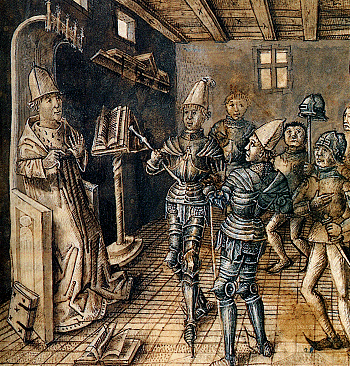 Whether as fighting disciplines or
self-defense skills, the martial arts of Renaissance Europe were not
taught in an ethical vacuum. Whether as fighting disciplines or
self-defense skills, the martial arts of Renaissance Europe were not
taught in an ethical vacuum.
Cliché
as it sounds, the modern practice of historical European arms and the
study of their close-combat teachings can indeed be a pathway to
personal growth: you are exercising, increasing coordination and
balance, learning about history, appreciating your heritage, developing
self-defense skills, improving self-discipline, and socializing with
like-minded fellows. Yet, it is by doing so not just with a mutually
accepted approach and standards, but with shared values that makes all
the difference.
In
the earliest formation of our association it was realized that in the
course of our study we preferred to associate with and have as fellow
members individuals of good character. Each new member we select, in
essence, changes our community to some degree. After encountering in
this subject more than a fair amount of flakes, fakes, deceivers, and
insincere role-players over the years, we sought to express those
values that we ourselves follow as a club. Thus, we came up with a list
of five elements we felt expressed this as a credo. The ARMA's credo
was instituted as a code of conduct; a way of
acknowledging the moral or ethical component of historical European
martial arts study.
Our Credo of Renaissance Martial Arts Studies:
-
Respect for History and Heritage
- Sincerity of Effort
- Integrity of Scholarship
- Appreciation of Martial Spirit
- Cultivation of Self-Discipline
This
credo is something we try to promote in our relations with our
collective members and colleagues, and that we also try to express
whenever educating others about the martial arts of Renaissance Europe.
It is both a way of thinking about and a manner of operating within a
community of like-minded Renaissance martial arts practitioners. These
ideas define who we are and guide our efforts. They serve as principles
and ideas we find uplifting and inspiring for our collaborative
exploration and resurrection of Renaissance martial arts.
Central
here is the ideal that each of us may consider how through our studies
our strength of character as well as our strength in arms is being
forged. What is conduct other than the way we
behave toward one another and the way we behave when they are not
around to see? What is a code other than an
affirmation of a set of values? Although the five points above are
self-explanatory, some clarification and elaboration is certainly
worthwhile.
Respect
for History and Heritage:
History is not a starting point of inspiration or an inconvenience to
work around, but both the source and the subject. It is our past, our
ancestors, our civilization, our origin, our guide. Reconstruction and
revival, recovery and resurrection, is our challenge. The worst thing
we can do is mock it or show it contempt through triviality, frivolity,
and ignorance.
Sincerity
of Effort: Developing martial discipline and real skill comes
first and foremost from being honest with yourself and with your own
capabilities and motives. It doesn't come from role-play, from
escapism, or doing things purely for entertainment or display. Skill
only comes as a result of earnest, committed effort combined with
understanding and appreciation. Self-deceit, pretense, arrogance, and
false pride are ruinous to progress in martial arts. It also means that
petty politicking and selfish cliques have no place in martial arts
study.
Integrity
of Scholarship:
Honesty in research does not just mean looking at data for or against
your thoughts and notions, or not intentionally omitting contrary
evidence, but not plagiarizing others' material or misrepresenting
ideas and teachings that are not your own work. As this craft's revival
requires considerable scholarship, academic credibility also means
avoiding rigidity and obstinacy. To some degree everything should be
kept tentative, open to further interpretation, and continually subject
to amendment.
Appreciation
of Martial Spirit: Recognize that this craft is about
violence, and know that it existed as the domain of warriors, soldiers,
fighters, knights, duelists, and others. Whether in the form of
fighting arts or martial sports, you should respect veterans both past
and present, and all those who share in a warrior code of struggling
justly against adversity. Pay them homage by continually challenging
yourself to improve your strengths and diminish your weaknesses,
whether physical, mental, and personal.
Cultivation
of Self-Discipline: Controlling movement and range and timing
as you execute techniques is only a physical part of the craft. The
rest involves mental and emotional control. Along with the prerequisite
necessity of courage (the ability to act in spite of fear), Medieval
and Renaissance warriors prized wisdom, fortitude, audacity, and
prudence. These elements were often expressed in chivalric virtues.
Wisdom consisted of knowledge and rationality. Fortitude was physical
strength or the strength of mind that allowed one to endure pain or
adversity with courage. Audacity meant boldness and decisiveness, and
Prudence meant caution and discretion. Today we express this in good
conduct and decorum toward our fellows. But the necessary discipline to
achieve this is developed through practice, training, study, exercise,
research, interaction, participation, growth,
and learning continuously.
The
ARMA believes that martial art training does not just build character,
its reveals character, such that, for higher progress a certain ethical
and
spiritual component is inherent to its serious study.
It
has been said that knowledge in itself is not virtue, the knowledge
must be virtuously applied. As with any tool, the knowledge can be
abused. Neither martial arts nor fencing can in itself change a
person's character if they are unethical or despicable to begin with.
But with proper guidance the honest nature of such martial activity can
offer them the grounds and opportunity by which to improve character.
It forces an individual to confront who they are, what they are made
of, and push the limits of what they expect of themselves and what they
can do through sincere effort.
In
the 16th century, Martin Luther said all education is the education of
character. Yet we should not confuse education in self-defense and
tactics as being permissible instructions to freely deceive and always
seek to fight. There is a self-truth revealed through fencing that can
compel the fencer toward wanting to be a person better than they are by
virtue of their own merit and accomplishment. Thus, there is a view
that in any form of fighting, it is not only our strength of arms alone
but our character that is also being tested. There has long been a view
that the art of fencing (or training in martial arts) promotes positive
moral and character-building qualities. Part of this also draws
supposedly from the view that a person who in practice fighting might
delve so low as to lie about a hit in order to "win" a bout was capable
of far greater deception and duplicity in life itself, where actions go
largely unobserved by one's peers. To deny a palpable hit during
bouting, or claiming one in bad faith, or making a strike after a halt
is called, thus called a person's greater integrity into
question.
This
was even more important in the violent world of historical combat
training in the Medieval and Renaissance eras where a man offended by
his partner's attitude during practice fighting might then demand a
real fight with sharp swords. So it is not too much to ask
that as we study this craft we all have consistency of words and deeds.
That can mean examining your preconceptions and being wary of holding
emotional investment in beliefs about weapons and fighting that are not
supportable by reliable evidence you can offer.
We
are all more than just subscribers in the ARMA. Our membership means
more than just paying a fee to access information and advice, it means
we are fellows of a community who follow a certain common Study
Approach and Training Methodology as well as accept mutual motives and
objectives. We also try to promote and uphold certain standards of
skill. So, even if someone is not regularly participating physically or
actively involved in research, and not seeking certification in our
Ranking system's curricula, that's okay. But, if they are going to be a
part of us then their energies and time really cannot go toward another
historical fencing effort or other martial art studies, or
pledge to a different set of standards. Both our subject and craft
deserve and demand a certain minimum effort that can only be made with
integrity and sincerity.
The
ARMA has always advanced the idea that exploration and activities in
this subject is something that should enrich a person's life, not offer
escape from it. We therefore embrace a set of ethical values in our
eforts. This component of historical European martial arts is derived
from the chivalric, Christian, and classical humanist elements featured
within the historical source literature of our subject. We fully
appreciate this may be anathema to a very large portion of the assorted
role-players, stunt fencers, charlatans, and flakes doing various forms
of historical fencing or stunt fighitng today. Individuals who cannot
accept these values in their personal character are therefore asked not
to pursue membership with us. Because our members represent us, they
represent our values, our teachings, and our training efforts. And each
represents our subject on the whole.
So,
while there's a lot of good reasons to become involved, there are
several reasons not to take up study of this craft: don't do it just to
add another belt to your martial arts collection, or to sell products
and make a buck, or to distract you from a bad job or unhappy marriage,
or because you are looking for a hobby to escape an unfocused life, or
merely to lose weight to find a romantic partner, or because the
thought of power over a local study group makes you swoon, or because
you're seeking validation through association with an authoritative
source, or simply to augment your existing martial art. Instead, be a
part of our community because you sincerely want to learn from the
best, because you share our values, and because you share our love for
the subject.
These
forgotten skills are after all not ones that are needed for our
survival anymore. So as we pursue them for different reason than did
those who once depended on them for protection, we must find higher
reasons for doing so. Our warrior ancestors who defended their persons
as well as their honor and valor attempted the same when they strive
toward the ideal of a Noble Science of Defence.
| Given
this, it is common sense that we should all behave with common courtesy,
politeness, decorum, and mutual respect toward one another in our
public discourse or personal interaction. But our club in general
has rules as well, such as not revealing curricula or sharing materials
with non-members or former members, not allowing ex or non-members
to participate in practice sessions, and making full disclosure of
your intention to publish instructional or educational material in
the future. These go hand in hand with not displaying tantrums or
hurling insults but generally behaving online as you would in person,
acting with sincerity and good faith. There is no need to even ask
how doing otherwise could possibly uphold the spirit of camaraderie
and loyalty the old Masters of Defence prized. |
Every
student of the martial arts must live with the real consequences of
how they train, and with whom they train, not the good intentions
of either. |
While
we are just an association, our shared love of the subject and our
commitment to pursuing it with a credo of shared values also makes us a
family of sorts. Which is exactly why certain incidents can strain
relationships among the friends and colleagues that we make
together. It is not just about mastering techniques and
developing martial spirit. There are bonds of camaraderie that
require mutual respect, trust, loyalty, and honor.
These directly influence what
you are ultimately able to uncover in reconstructing this craft as well
as how you can practice or teach it. It all ties together. But it is
the common values our association upholds that should bind us as
brothers and sisters of the sword, not mere local ties to who we might
practice with.
The
ARMA essentially emulates a fighting guild in the style of the
historical Renaissance masters. Being a part of the old fighting guilds
and studying under a teacher in a Fechtschule was
about much more than having the martial spirit and physical
conditioning to skillfully execute techniques. It was also about shared
values --- camaraderie, respect, trust, and loyalty.
These are issues of character. Experiencing these things is as much a
part of exploring and celebrating our Renaissance martial heritage
today as is learning combat moves. It is no less an aspect to
revive and recover than the fighting skills themselves.
Because
we are a club of principles, and approach our studies in just such a
way, we want individuals of principle who uphold principle.
In a
world and an age where it is far too easily to forget values and the
need to do the right thing, hard as it may be it is all the more
important we make the attempt to stand for something.
But note there is nothing overtly religious or
theological
about this code (nor will we permit it to be turned into one, as
that matter is up to each person alone).
Our credo can
in some ways be summed up as essentially: show good manners with
loyalty and don't
be a jackass.
We
hope every ARMA member (and anyone else) considers this credo seriously
and tries to forge these ideals into their own effort within historical
fencing. No member is required to follow the training material we
offer, but everyone has to abide by our credo and the rules of decorum.
It's a simple matter: Our curriculum is optional. Our code of conduct
is not.
"seek to thoroughly understand this
art and learn
to apply a true honorable earnestness"
- Master Joachim Meyer
Kunst des Fechtens, 1570
Terms of Service
The ARMA Membership
& Non-Disclosure Agreement
The ARMA is a private
subscription-service club
functioning as an online virtual school of individuals with shared
values collectively working in the same craft from shared materials
under a mutual study approach with a common motive, method, and
objective. No member is required to follow the training and testing
program offered, but everyone has to abide by our credo and the
standards of appropriate decorum. Our curriculum is optional. Our code
of conduct is not. Everyone is expected to uphold the spirit of
camaraderie and ethics of respect and loyalty the old Masters and
fighting guilds prized.
Acceptance of ARMA Membership
constitutes:
recognition of our code of conduct (Credo), pledge to maintain
confidentiality of club resources, neither reveal nor share ARMA
curricula or materials with ex or non-members, nor permit their
attendance at practices and training sessions without approval from the
Director. Members also acknowledge that the ARMA Director has sole
authority on all administrative matters and policies concerning
membership, and further understand that violation of the membership
agreement or code of conduct is grounds for immediate dismissal.
Members also consent to inform the Director if they are preparing or
developing separate material or curriculum on European martial arts /
historical fencing for either publication or public instruction.
Members acknowledge that compliance with the above Membership Agreement
and Terms of Service is a condition of membership.
|
