Battling at the Bridge
Stick Fights and Boxing Spectacles
in Renaissance Venice
 About
1669 an anonymous Venetian essayist wrote a detailed history recounting
the city’s many guerra di canne or “war with sticks”.
The Chronicler of these great pugni
(or fights) wrote the battles “are not lowly things of little
importance, but of the highest consideration”. Beginning in the
late 1300s and lasting until the early 1700s, these mock battles or
battagliola, consisted of
mobs of working men with shields and in helmets pummeling each other
with wooden sticks in hours of chaotic melees. Men were routinely
injured and maimed in the fighting and inevitably some killed. The
first official note of these Venetian stick battles dates from 1369
but they apparently did not begin to occur on bridges until 1421.
The events were of such pride that the Venetian government arranged
them for honored guests. In 1493 one such event was held before the
Duke and Duchess of Ferrara. A small stick war was displayed in 1582
for Turkish diplomats and another was even held in 1585 for Japanese
ambassadors. In 1574 a bridge battle conducted
by 600 Venetian artisans was arranged for the French King Henry III.
Although, Henry later reportedly complained that the event “was
too small to be a real war and too cruel to be a game.” About
1669 an anonymous Venetian essayist wrote a detailed history recounting
the city’s many guerra di canne or “war with sticks”.
The Chronicler of these great pugni
(or fights) wrote the battles “are not lowly things of little
importance, but of the highest consideration”. Beginning in the
late 1300s and lasting until the early 1700s, these mock battles or
battagliola, consisted of
mobs of working men with shields and in helmets pummeling each other
with wooden sticks in hours of chaotic melees. Men were routinely
injured and maimed in the fighting and inevitably some killed. The
first official note of these Venetian stick battles dates from 1369
but they apparently did not begin to occur on bridges until 1421.
The events were of such pride that the Venetian government arranged
them for honored guests. In 1493 one such event was held before the
Duke and Duchess of Ferrara. A small stick war was displayed in 1582
for Turkish diplomats and another was even held in 1585 for Japanese
ambassadors. In 1574 a bridge battle conducted
by 600 Venetian artisans was arranged for the French King Henry III.
Although, Henry later reportedly complained that the event “was
too small to be a real war and too cruel to be a game.”
During the 1500s and 1600s the spectacles grew in size and
significance. Several times a year Venetian workers and tradesmen would gather on
particular Sundays or holiday afternoons to fight for possession of a bridge. These ritual
encounters were also called battagliole sui ponti
or “little battles on the bridges”. Such pre-arranged battles were known as guerre ordinate. They would take several forms from
individual duels and small-scale brawls for a few hundred or thousand onlookers to
enormous ones prepared days in advance and held for hours in front of tens of thousands of
spectators. They were waged by all types of citizens but for the most part the civili. In Medieval Pisa, we know of the
so-called giucco del mazzeascudo or men fighting
“with wooden weapons sometimes altogether, sometimes two at a time” with wooden
helmets and a padded breastplates of iron. The massive Ponte di Mezzo overlooking the Arno
River in Pisa was often used as a tournament field for similar factional battles. From at
least the tenth century in many Italian communities rival bands of youth were known to
battle in open fields using fists, stones, or wooden swords and shields. One professor of
Renaissance Italian history tells us such pretend wars between fighters wielding sticks
and rocks and protected by shields, helmets, and armour were a regular occurrence in
Italian cities during the era.
In Medieval Venice chivalric tournaments were far less common, were
conducted mostly by professional soldiers rather than Venetians, and commonly were genuine
mock battles. This allowed the Venetians the
opportunity to appraise the prowess of their own troops and reward the skillful fighters. In 1458 the Venetian commander Bartolomeo
Colleoni held a tournament battle between two squadrons of 70 men-at-arms fought with full
weapons. The contest was for possession of a small wooden castle erected outside the
Doge’s palace. This Venetian tradition of large-scale mock fighting and tournaments
ended in 1480 when horses were barred from the streets and was replaced instead by mock
naval encounters.
Originally the Venetian bridge fights were waged with sharpened
sticks or robust cane, known as canne d'India,
from local lagoons. The sticks were customarily hardened at the point
by repeated soaking it in boiling oil. Interestingly
they were employed as much for thrusting as for striking.
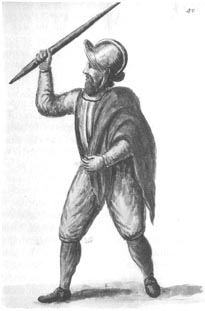
It is no surprise the participants typically wore an iron helmet or celada. Some
also wore iron and leather cuirasses or zacco
(mail under their shirt). A leather or wooden
shield (targa or rodella) was also a necessity. Although
some are known to have used a cloak wrapped around the left arm. Interestingly, though the combatants are nearly
all commoners, these arms closely resemble those customarily associated with gentlemen of
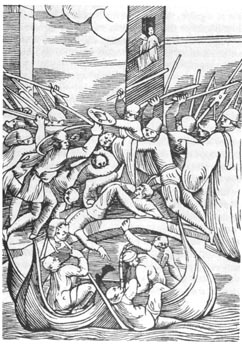
the era. One woodcut from 1550 though depicts the battles with little armor, few
helms, several long staffs, and a even halberd in the background.
The battles themselves were staged and fought without
any formal or written regulations. Though no details survive of the actual
combats we can imagine that jumbled crowds of men with sharp sticks stabbing
and striking even if without intent to injure would be a quite dangerous
activity. As to the injuries,
we are told by another chronicler the participants carried on their persons
“…the scratches, sprains, teeth knocked out, dislocate jaws,
gouged eyes, and finally, smashed ribs and crippled legs”. The tension
of the events ran high and the sight of a single dagger drawn in anger
could instantly cause a hundred others to be pulled amidst the brawling
factions. Historian Robert Davis tells us “Although individual
aggression and vendetta often played a role in these violent encounters,
the real motive force behind the battagliole was the pursuit of group
and personal honor, arising from an intense factional loyalty and rivalry
that was strong enough to challenge even the absolutist powers of the
Republic's central government.”
Renaissance historians trace the Venetian factional rivalries back to
immigrants of the Rialtine Islands. Reports survive of pretend battles from as early as c.
810 between factions armed with sharp sticks or canne
d'India. In Venice the citizens formed
various factions or teams each with its own unique name and sometimes costume. The
fighting squads at the battles were typically composed of forty or fifty men from the same
neighborhood or same occupation or guild. The
two main factions formalized in 1548 where the Castellani
and the Nicolotti. One faction, the Paluani, was known for arriving at the bridges in
military order, with their squads dressed in matching uniforms. Loyalty to one’s
faction was highly prized. Faction members caught changing sides to help throw a fight
could expect violent reprisal or assassination.
Weeks before the event detailed arrangements would
be made to prepare the teams for the contest. The passion for this martial
festival on these common bridges swept up the entire city.
Fascination for the event penetrated every corner of daily life
as people of all classes were caught up. On the appointed day vendors
and food hawkers would also swarm to the bridge sites. The fans of the
events were as obsessive as any modern soccer or football fanatic. The
crowd would watch the spectacles in excitement, cheering, whistling, and
waving handkerchiefs. For one afternoon the bridge became an arrengo
or arena. To make things safer, sawdust was sprinkled on the bridge stones
to prevent slipping, straw padding was placed around the bridge abutments
in case of falls, and the water below was cleared of rubbish or debris.
Once the battle began the water below the bridge would be jam packed with
barges and boats and gondolas until no water was visible.
The crowd was in effect the ultimate arbiter and determined
by applause or condemning hisses which fighters and which side had acted
honorably or cowardly. The battagliole
were also celebrations of personal honor as men fighting in pairs or in
large mobs on a public stage thought to gain name and recognition among
their peers and spectators. Factional
leaders called padrini were chosen from the champions of each
side. They were charged with not only leading and organizing the factions,
but partitioning them safely and equally in the piazza before the fight
as well as planning safe routes for each side to take to the bridge site
beforehand. Each contingent of 50 factionaries from a neighborhood was
itself headed by a capo or “boss”,
responsible for recruitment and discipline.
The crowd too could
become riotous. Pumped up by wine they sometimes might begin throwing
roof tiles off of nearby balconies (stripping them almost entirely bare
in the process!). More than one event was halted because of the trouble
this caused. As well, gentlemen viewing from opposing “box seats”
might loudly exchange words and insults which could lead to swords being
drawn then and there or an arranged duel occurring afterwards. The militia
often had to break up battles that got out of hand. Local
aristocrats would step into the factions and attempt to lower passions.
Often their intervention held more respect than either that of the municipal
authorities or the factional leaders themselves.
The Venetians were always highly sensitive about factional
honor and many were ready to defend against perceived insults from other factions using
the weapons that every artisan routinely carried about the city: the handy stiletto (stillo)
or the broad pistolese (also known as the lengua de vaca, or cow's tongue)
as well as spiked boat poles (spontoni) used in the city canals. Some also stuffed
their work aprons (traverse) with handfuls of iron balls or stones (cogoli),
to be thrown with lethal effect from a safe distance. Davis adds “Arguments between
even two or three enthusiasts over the merits of their respective faction could thus
easily result in bloodshed and massive brawls, the more so since—as one English
observer noted—Venetian commoners were far more likely to join in a fight than to
assist in breaking it up.”
As early as 1505 the Venetian Council of Ten in the
name of public order began to punish those who assembled for the bridge
wars. Supplies of sticks had to be secured and hidden between events.
But like laws against dueling, their efforts largely went ignored and
were often repeated. Gangs of armed youths would get caught up in the
excitement and frequently rumble with their rivals or the police. Many
of those involved in neighborhood contingents were street toughs or raffines. We know for example of one, Tonin,
a Caporione tailor from San Luca who
in the 1630s was described as “an assassin” who “lives
by arms… gathering about him at his expense a large gang of miscreants
[malviventi] with whom he has
assaulted and killed many”.
Due to the state’s opposition to the disorder
caused by these popular pastimes, by 1600 the bridge fights in Venice
ceased to use sticks and became unarmed brawls called guerre
di pugni or “war of the fists”. As with the stick wars,
these bare-handed sporting brawls could attract thousands of fighters
and tens of thousands of spectators. The new mode of combat apparently
caused great curiosity and wonder. A possibly apocryphal explanation for
the transition from sticks to fists supposedly occurred in 1585 when one
faction ran out of sticks but continued to fight on unarmed and the other
faction matched them. Ironically, this was not out of honor, but because
they could no longer “fence” with their opponents and were instead
being punched in the face and chest. Because the injuries from fist blows
were readily seen to be more significant, the other side cast away its
weapons. One historian adds: “At the same time, there are signs
that the nature of the battles themselves began to change under the 'civilizing'
influences of police and patricians. Whereas earlier in the century it
had been customary to stage a few (but rarely more than half a dozen)
individual boxing matches (known as mostre, or "showings")
as a sort of warm up before beginning the actual mob attack on the bridge
(the frotta) that was the main event, by the 1660s, there are indications
of a shift of emphasis from group brawling to single combat.”
The Venetians became well-known for their pugilistic
skills by the late 1600s. The Slavic soldiers, Dalmatia or Schiavoni, were regularly thrashed and thrown into the water by the
jabbing skill of the Venetian boxers. One source says that although the
Slavs were accustomed to “coming to the clinch with sharp steel,”
in the unarmed bouts they swung their arms about ineffectively as if they
still had blades. This is
an interesting anecdote about the application of military cut-and-thrust
skills compared to the calculated jab of boxing–which interestingly
resembles the classic foyning thrust of late Renaissance fencing.
Eventually, one-on-one boxing matches called mostre began to take place before the
general bridge assaults. The term mostra
means a display or exhibition; the actual fighting of the boxing match
was called a cimento or steccado.
These “duels” became more and more popular. The pugni or “boxers” would wear
leather or even “paper” chest armour and prided themselves on
their fine dress. Later they began to go bare-chested, wrapping their
shirts around their waists to protect their kidneys from punches. The
fighters would typically wear only one padded glove or guanti of soft or hardened leather
on their right hand, but by the end of the 1600s wore two gloves. Sometimes
their gloves were even secretly sewn with lute strings so as to rapidly
bloody an opponent’s face. The object of the mostre
was not to score a knock out or to deliver powerful punches, but to bloody
the opponent by a hit to the nose, lip, or face.
The boxing fights or cimenti,
were divided into rounds during which the combatants returned to their
respective corners. The rounds were known as assalti (assaults) or salti (jumps or dances). The fighter or duelista fought for his personal honor and reputation. Display was
important and each fighter was expected to “show himself well”.
As one historian describes it, by their performance and the abuse they
underwent, the fighters in effect laid claim to the public’s adoration
and respect (much like the later 19th century German university
student’s Mensuren ritual duel). In these “boxing”
matches the crowds evidently were most pleased by contestants who stood
their ground and took blows to their face unflinchingly, striking out
cleanly without too much dancing or fencing around (“troppo gioco
nella scherma”). Defensive skills were less admired than displays
of courage.
We are also told how sometimes these events “would
be upset by the fighters themselves, who might well explode in a factional
frenzy under the numbing stimulus of ample draughts of free wine and the
deafening cries and whistles of as many as 30,000 onlookers, ending up
turning on each other with drawn daggers and machetes. Some of the more
aggressive spectators might also decide to join in the action, punching
those nearby, brandishing weapons, or lobbing paving stones into the thick
of the scrum. In either case, the result was predictable and often
deadly, as all boundaries between the factions, the fighters and the onlookers
dissolved into a stone-throwing, knife-wielding melee, sending men and
women from both factions scrambling panic-stricken away from the deadly
battle field.”
The “cult” of the pugni
was about the value of the individual and his prowess, aggressiveness,
and proper conduct. These champions were treated as star athletes, being
welcomed by wealthy patrons and nobles as heroes as important as any victorious
soldier. Surprisingly, foreign mulattos were even occasionally brought
in as ringers by wealthy faction supporters and several became popular
champions (shades of today’s heavyweight prize fighters 300 years
later!). Like star athletes, the best champions would gain fame and fortune
all over the city. Their image would be lionized and depicted in paintings,
cartoons, and effigies.
It is worth noting that in the mostre, “Grappling and wrestling were condemned less as unfair
fighting than as a coward’s way of avoiding his rival’s punches;
when a duelist would not allow himself to be turned into a beast.”
Fighters instead relied on solid exciting blows that factional honor required.
In some cases apparently combatants even agreed before hand to pull punches.
Despite all the ferocity and display, the fights were fairly benign affairs
and ended with an embrace and fraternal kiss. A fighter who had been unfairly
dishonored by a fellow pugni might also seek a vendetta with
his compadre and the support of the sect
of his faction. He might be backed in his quest by wealthy merchants and
nobles so that steel would later settle the matter through blood.
 By the late 1600s
weapons and armour were dropped from the bridge fights entirely. The Chronicler
of the events suggests there was only room for one form of fighting, and
once the stick fighting fell out of popular favor it could not exist alongside
the very different fist fighting.
The story argues boxing “won out” over stick fighting. As historian of the bridge wars Robert
Davis suggests, “That an essentially naked man should triumph over
a heavily armored adversary was itself–in an age dominated by professional
soldiers, hierarchical armies, and not a few remnants of chivalric ideas–a
seeming paradox charged with republican and egalitarian.” He adds,
“The boxer’s victory was one of pragmatism… the results
of an intrinsically plebeian decision as to what worked best at the bridges.”
We can imagine wooden weapons being easy enough in a crowded melee
to use in banging on another’s shield, helmet or stick, but unarmed
fighting, even if just straight jabs, required closing to shorter range
and direct contact flesh on flesh.
The change from sticks to fists may also reflect the changing nature
of war in the period, when individuals' skill in traditional arms was
becoming less and less important than firepower and close order drill
in formation. By the late 1600s
weapons and armour were dropped from the bridge fights entirely. The Chronicler
of the events suggests there was only room for one form of fighting, and
once the stick fighting fell out of popular favor it could not exist alongside
the very different fist fighting.
The story argues boxing “won out” over stick fighting. As historian of the bridge wars Robert
Davis suggests, “That an essentially naked man should triumph over
a heavily armored adversary was itself–in an age dominated by professional
soldiers, hierarchical armies, and not a few remnants of chivalric ideas–a
seeming paradox charged with republican and egalitarian.” He adds,
“The boxer’s victory was one of pragmatism… the results
of an intrinsically plebeian decision as to what worked best at the bridges.”
We can imagine wooden weapons being easy enough in a crowded melee
to use in banging on another’s shield, helmet or stick, but unarmed
fighting, even if just straight jabs, required closing to shorter range
and direct contact flesh on flesh.
The change from sticks to fists may also reflect the changing nature
of war in the period, when individuals' skill in traditional arms was
becoming less and less important than firepower and close order drill
in formation.
While the bridge battles consisted mostly of working
class artisans and laborers, the nobility did participate. Until at least
the 1580s aristocrats were involved heavily in the battagliole
and their chronicler tells us: “In these old-styles the more fiery
and pugnacious nobles were accustomed to go to the bridges… armed
with light helmets, heavy gloves, and cutlasses, to serve as auttorevoli padrini.” The change from armed to unarmed surely
finished off the involvement of aristocrats in the actual combat. The
late 1600s Venetian guidebook of Alexandre Saint Disdier described that
the nobility delighted in seeing “these fights and battles, while
for the common people it is an affair of reputation and of importance.” Primarily, the nobility as spectators
would watch from rented balconies or moored boats, but their role as fans
and supporters did play an essential part in the promotion and success
of the battles.
The crowds of patricians would waive their handkerchiefs
to show approval and enthusiasm of their side. Hundreds
might waive in unison as a signal to the opposing noble spectators to
challenge them to send forth a duelist or even to admit defeat. When
shaken rapidly, handkerchiefs could be a sign of contempt that the opposing
fights were weak or cowardly. By the mid-1600s nobles had almost entirely
ceased participating and only took active roles as leaders before the
clash. As spectators however, gambling on the battles was considerable
(just as with modern day sporting events). To organize these events and pull
them off required considerable negotiation on behalf of the artisans and
workers, the faction leaders, the wealthy merchants who backed them, and
the nobility who supported (and gambled on) them as well as government
officials concerned with public safety and order. Interestingly, as with
modern sport teams, the neighborhood merchants would endorse and support
their factions, including handling their uniforms.
Similar
events to the Ventian battles were held in Florence on special occasions
in the late 1500s and early 1600s, sometimes between guilds of dyers and
weavers. The combat might last 30 minutes or more. Such fights were also very
common in Pisa, where they occurred on the city square and were used
as a form of martial exercise as well as sport (such events continue into
the present day). By the 1500s they began to be played on small bridges.
A wooden weapon called a mazza-scudo and a small shield were originally
used. Typically metal helms with padding of cotton or horsehair were worn,
as was some degree of iron body armor. Other men wore less armor and participated
as light fighters. A special tool called a targone, part shield,
part weapon was also employed. Attacks were allowed with the blow and
the point to the adversary’s head, arms, and chest.
The guerra di
canne represent an interesting part of martial sports in European
history, and shed insight on a rarely considered aspect of Western martial
culture. While there are similar accounts of mock battle sporting events
in Italian history, because of their distinct and almost entire
concentration on bridges, the Venetian events are unique. As a writer at the time expressed:
“The purpose of our combat and contests is not to kill each other
or tear each other apart, but only, in the presence of the city, to win
and to take possession of the bridge, with competition and with the usual
audacity.”
To read more about this, see “The Police and the Pugni: Sport and Social
Control in Early-Modern Venice”.
Robert Davis. Stanford Humanities Review, 6.2, 1998, The War of the Fists–
Popular Culture and Public Violence in Late Renaissance Venice, Oxford University Press 1994, and Mercenaries and
Their Masters - Warfare in Renaissance Italy. Rowman and Littlefield,
1974.
Back to the Essays Page |
