
|
||||||||
|
|
||||||||
|
By Henrik Andersson It is a well-known fact that Salvator Fabris served as a fencing master at the court of Denmark, but perhaps fewer people know that early sources show him to have lived in Sweden. Apparently, though, he came to Sweden, not as a fencing master but as a hired assassin – hired by King Sigismund
[i]
of Poland and Sweden to take the life of the King’s uncle, Duke Karl
[ii]
, subsequently King Karl IX of Sweden, during a theatrical performance at a banquet given by Sigismund. It sounds like a plot from Shakespeare, but it’s perfectly true, or at least …Well, at any rate, the background story is true, and no less interesting. The incident supposedly occurred in the winter of 1594. In 1587 Sigismund, the eldest son of King Johan III
[iii]
of Sweden and Queen Katarina
[iv]
(a Polish princess), had been elected King of Poland. In Sweden Johan III, his father, was King and Karl, his paternal uncle, ruled a small duchy. A struggle for mastery in Sweden was going on between the brothers and between them and the high aristocracy. King Johan III died in November 1592, which made Sigismund King of both Poland and Sweden. In January 1593 Sigismund let it be known, from his residence in Poland, that he was planning to visit Sweden that summer to bury his father and have himself crowned. Duke Karl, whose ambition knew no bounds, tried to obstruct this by introducing, abetted by the Church and the nobility in Sweden, religious and political demands calculated to make Sigismund renounce the throne of Sweden. The Polish Diet also opposed his plans for visiting Sweden, and he did not finally set out until August 1593. The fleet of 60 ships with which he sailed carried, in addition to Sigismund and his young consort Anna, their servants and entourage, priests, counsellors, 40 soldiers, trumpeters and most of Sigismund’s court orchestra, which included several Italian musicians. Sigismund went ashore in Stockholm in September and was received by Duke Karl, his uncle, and representatives of the Estates and the Church. Negotiations opened immediately between the King and the Swedish nobility, concerning the apportionment of power in the land between the Council and the King, and with representatives of the Church, concerning relations between the Swedish Protestant Church and the Catholic monarch. The Polish entourage stayed in Stockholm while preparations were being made for the funeral and coronation in Uppsala. This period of waiting was a strenuous time for Sigismund’s courtiers, resulting in numerous brawls and bloody affrays between Swedes and Poles. Sigismund’s bodyguards walked the streets of Stockholm at night, roaring drunk and brandishing drawn swords. His musicians were rumoured among Stockholmers to be nothing but Catholic priests and Jesuits in disguise. Salvator Fabris as a masked assassin in Uppsala The royal funeral took place in Uppsala on 1st February 1594, and after it the negotiations between Sigismund and his uncle on the governance of the realm continued in Uppsala. On Shrove Tuesday, 12th February, with the talks still in progress, Sigismund invited his uncle, Duke Karl, to dinner at Uppsala Castle. After the meal a number of costumed Italians, of whom Salvator Fabris was one, performed a play with drawn swords. The plan had been to murder Duke Karl during the performance, but he had been warned that an attempt on his life was imminent, and did not come to the banquet. A contemporary source describes what happened during the banquet: " ... Yes, indeed, and no less despicable is the manner in which King Sigismund during the actual coronation festivities in Uppsala hatched an infamous scheme against his beloved uncle, whereby he would send out some troops from his bodyguard in secret against Duke Karl, by whom the Duke was to be murdered in the most terrible manner. And this would have happened as Sigismund planned had not a certain Hieronymus Strozzi
[v]
disclosed this scheme to Duke Karl, as his evidence witnesses. After the failure of this treacherous scheme, Sigismund decided to have a comedy performed by some Italian actors, masked and armed with drawn rapiers - the like of which one has seldom heard - among them one Salvator Fabriz, actor in and author of the above-mentioned tragedy, which was played unceasingly day and night, holding the audience enthralled and full of lively mimicry and expressive gestures. Salvator Fabriz endeavoured, however, in every way to perform this tragedy before Duke Karl, though the play would not have entertained him greatly. But Duke Karl set little story by the actions and gestures of such fools and assassins and did not whish to appear in public in such company. Had Duke Karl attended, as King Sigismund and his Councillors hoped, then the Duke would have been most cruelly murdered. ... "
[vi]
This narrative comes from Exegesis historica …, written by Duke Karl and his Chancellor Nicolaus Chesnecopherus and printed in Stockholm in 1610. The book was a Latin translation of a Swedish version published in 1609. The story of Sigismund’s banquet for his Uncle Karl and of how the Duke, warned by Count Strozzi, evaded the attempt on his life has been reiterated, with little variation, in several early Swedish history books and chronicles.
[vii]
Fencing master in comedy or tragedy
“ ... Furthermore, the Northern Goths and Swedes also employ another game for the exercise of the young, in which they have them practise dancing between bared rapiers and drawn swords. This dance, which conforms to certain rules and with singing, led by a single dancer, is learned by them during their formative years under the tutelage of proficient men. They perform this game in public, above all at Shrovetide, and it is called by an Italian word, masquerade. ... ”
[viii]
Fabris in Sweden – fact or fable? Disregarding the question of what kind of drama or dance was performed at Sigismund’s coronation, we have to examine the interesting statement that Salvator Fabris, one of Europe’s best-known fencing masters, was in Uppsala in February 1594.
But how and why had Salvator Fabris come to Sweden? Most probably he was a member of Sigismund’s entourage and came here solely in order to attend the Uppsala festivities. As has already been mentioned, the musicians accompanying Sigismund on his Swedish journey included several Italians. The cultural life of Poland during Sigismund’s reign was very much under Italian influence. Several Italian artists, architects and musicians were active in Poland. Several of these Italians were favoured by the King and in direct contact with him, and many Polish nobles had studied at Padua and the other Italian universities. Unfortunately it has not been possible, on the strength of Swedish archives, to establish that Salvator Fabris served at the court of Sigismund in Poland, but letters from Fabris show him to have been in touch with fellow-countrymen who did. After his travels on the continent of Europe, Fabris returned to Italy, teaching fencing at the great University of Padua. His renown as swordsman was now at its peak, and young noblemen from all over Europe made their way to Padua to be taught by the great fencing master. Salvator Fabris’s pupils in 1598 included the German Duke Johan Friedrich
[x]
of Schleswig-Holstein-Gottorp, who succeeded in recruiting Fabris for his court in Stade (Lower Saxony, Germany), to give further fencing instruction to the Duke and his brother. End game and a strange dedication
Following Salvator Fabris’s death, his pupils went on giving fencing instruction in his Padua fencing salle, and Fabris’s fencing book went through several editions until 1713. A German translation was brought out in 1691 by the famous printer Isack Elzevier in Leiden. That edition is dedicated to King Gustavus Adolphus
[xii]
of Sweden. Gustavus Adolphus was himself the son of Duke Karl (Karl IX of Sweden). A strange quirk of fate, one might say, Salvator Fabris’s work being published with a dedication to the king whose father, so the latter maintains, he had planned to murder on Shrove Tuesday 1594 in Uppsala.
Notes:
[i]
Sigismund (1566-1632) was elected King of Poland, as Sigismund I, in August 1597 and stayed on the Polish throne until his death in 1632. He was crowned King of Sweden (Sigismund I) on 19th February 1594, but deposed by his Uncle Karl on 24th July 1599.
[ii]
Karl IX [Charles] (1550-1611), Lord Protector 1599-1604, King of Sweden 1604-1611.
[iii]
Johan III (1537-1592), King of Sweden 1568-1592.
[iv]
Katarina (1526-1583) was by birth a Polish princess. Her father was King Sigismund I (“the Old”) and her mother, Queen Bona Sforza, came of the exalted princely house of Milan, where bloody jostlings for power were a part of everyday life. In this way Katarina and her siblings grew up in Italo-Polish Renaissance surroundings.
[v]
Hieronymus (Geronimus) Strozzi, Conte de Belvedere, came from Florence. After unmasking the assassination plot he entered, with Sigismund’s permission, the service of Duke Karl, but Sigismund was back in Poland by the time he found out that Strozzi had betrayed him. Count Strozzi died in Sweden in 1619.
[vi]
Anon. [King Karl IX of Sweden & Nicolaus Chesnecopherus] Exegesis Historica ..., Stockholmiae, 1610 (p. 78 ff.). Here translated from the Latin by Carl Erik Holm.
[vii]
See e.g. Dalin, Olof von Swea Rikes Historia, Stockholm, 1758 (vol.3:2, p. 295): " ... Shrove Tuesday, 12 February, the King held a Lenten Feast that was to be enlivened in the evening with an Italian Comedy by one Salvator Fabriz: the Duke was present at the dinner but was warned away from the play by Count Hieronymus Strozzi, who had learned of a plot against his life ...".
[viii]
Magnus. 1555 (vol. III, part 15, chap. 23). Concerning the fencing exercises of the Northern peoples, Olaus Magnus, in 1555, goes on to write that (vol. III, part 15, chap. 16) : “… from fencing masters and through assiduous practice they learned skill in dealing and avoiding sword strokes. And some of them were so skilled in the noble art of fencing that with unerring accuracy they could strike their opponent’s eyebrow. Anyone cowardly enough to blink at such a blow was instantly banished from court and his wage forfeited.” (A fencing exercise very similar to the German Mensur duel).
[ix]
Didier, Henry de Sainct. Traicte Contenant les Secrets du Premier Livre sur l'Espee seule ..., Paris, 1573 (p. 6 ff.)
[x]
Johan Friedrich (1579-1634), Duke of Schleswig-Holstein-Gottorp also archbishop of Bremen was cousin to the Danish King Christian IV.
[xi]
Particulars of Salvator Fabris’s death year have been traced by Mr. Tom Leoni and are presented, with several other interesting facts about Fabris’s life, on his website: http://www.salvatorfabris.com/SalvatorFabris.html.
[xii]
Gustav II Adolf [Gustavus Adolphus] (1594-1632), King of Sweden 1611-1632.
Bibliography: The following are some of the sources on which this essay is based. A full list is available from the author on request. Andersson, Henrik "Fäktning vid Vasahovet och en mordkomplott i Uppsala" [Fencing at Vasa court and a murder plot at Uppsala] in Fäktning En idrotts historia, Stockholm, 2004 Bogucka, Maria "The Vasa dynasty in Poland" in Kungliga Vitterhets Historie och Antikvitetsakademiens årsbok 1977, Stockholm, 1977 Dahlberg, Gunilla Komediantteatern i 1600-talets Stockholm [The Theatre of the Strolling Players in the 17th Century Stockholm], Stockholm, 1992 Gelli, Jacopo Bibliografia generale della scherma con note critiche, biografiche e storiche, Milano, 1895 Hergsell, Gustav Die Fechtkunst im 15. und 16. Jahrhunderte, Prag, 1896 Magnus, Olaus Historia de gentibvs septentrionalibvs ..., Romae, 1555 Migliorato, Giuseppe "Salvator Fabris Den italienske Faegtemester og hans forbindelser med Christian IVs hof" [Salvator Fabris The Italian fencing master and his connections to the court of King Christian IV] in Fund og Forskning i det kongelige biblioteks samlingar. XXXI, Köbenhavn, 1992 Ulfvarson, Ann-Marie "The Sword Dance" in Piae Cantiones Svärdsdans (Musica Sveciae MSCD 201), Stockholm, 1993 Vigeant, Arsène La bibliographie de l'escrime ancienne et moderne, Paris, 1882 Wikland, Erik Elizabethan Players in Sweden 1591-92, Stockholm, 1977 |
|
|
|||
|
|
|||
|
|||
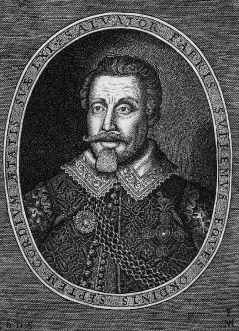 Salvator Fabris as a Hired Assassin in Sweden
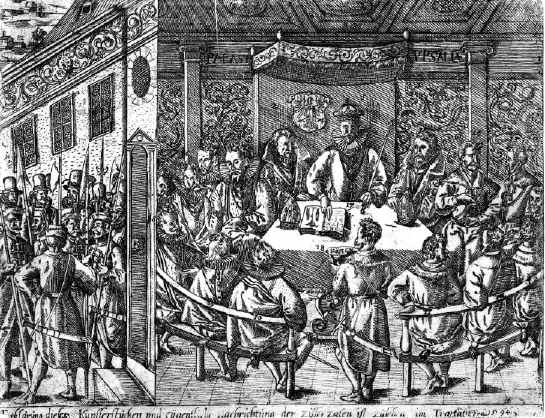 Theatre and music historians have studied and written about the performance which was staged at the banquet. Among other theories, it has been surmised that the performance was a sword dance, and the fact of it taking place on Shrove Tuesday corroborates this. In his magnum opus, Historia de Gentibus Septentrionalibus
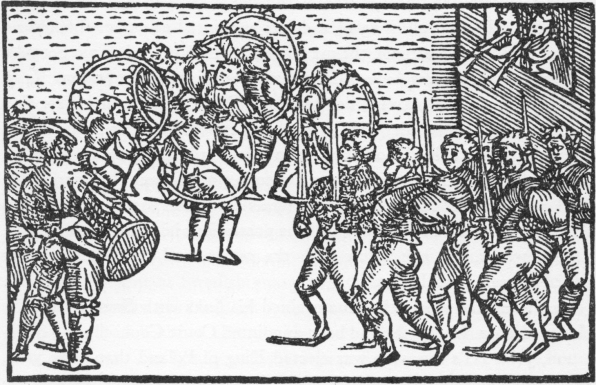 The sword dance is a complicated dance with several turns and movements which can assume many different guises, but with certain features in common. The dance begins with the dancers entering with bells round their legs and their swords sheathed. They perform a species of ring dance with each holding the neighbour’s sword point, describing various figures and patterns. After a few turns the chain is dissolved, the dancers draw their swords, clash them together and form different patterns with their swords in the air. The dance begins slowly, very gradually accelerating and ending in a deafening crescendo. This is followed by a more narrative, dramatic act in which one of the performers plays the part of king and dances alone, followed by the others, who play soldiers fighting, dancing and juggling with their weapons. The dance and singing are accompanied by music on drum and flute and by the performers imitating other musical instruments. In the final scene, which is without music, a trial is performed in which a lansquenet is charged with bringing dishonour upon the regiment. He begs for mercy but is sentenced to death and is executed by the other dancers. Perhaps it was during a suggestive dance of this kind that Duke Karl was meant to have been murdered during Sigismund’s coronation festivities.
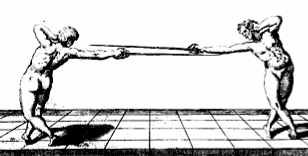 Little is known for sure concerning Salvator Fabris’s early years. He was born in 1544 or 1545 in Padua or Bologna. His youth coincided with the period known as the apogee of the Italian school of fencing. Early Italian masters like Achille Marozzo, Angelo Viggiani and Giacomo di Grassi were still alive and teaching. Fabris studied these masters and their pupils, refined and developed their techniques and on this basis devised a theoretical and practical system which still today is considered the finest of its age. He quickly became a highly esteemed teacher, working in Germany, Spain and France as well as Italy. The French fencing master Henry de Sainct-Didier writes that he met Fabris and discussed fencing theory with him in Paris in about 1570.
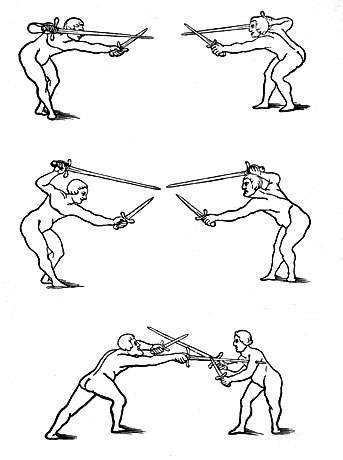 In the autumn of 1601 Salvator Fabris left the Duke’s service and as a farewell gift presented him with a magnificently illustrated manuscript. On 12th October 1601 he took up his appointment as fencing master to King Christian IV of Denmark. In 1606, while still a fencing master in Denmark, he published his great, De lo schermo o vero scienza d’arme