 |
||||||||
|
|
||||||||
by Jeffrey Hull
It is possible that
Talhoffer’s longsword plates (tafeln)
are showing us both kinds of fighting.
Unfortunately he does not tell us one way or the other. His unarmoured longsword fighters are
ostensibly practicing unarmoured fighting – yet demonstrably, they are
practicing both unarmoured fighting and armoured fighting. This is realised if we consider how the
portrayed moves relate to the variety of combat techniques as dependant upon
whether a Medieval combatant fought either unarmoured or armoured. If so, then we find the longsword plates
dealt and grouped ordinally and equally into thirty-six for unarmoured and
thirty-six for armoured. It seems that there are
seventy-two plates (#01-#67 & #74-#78) delineated for longsword (Langes Schwert) from the fight-book of
1467 AD by Hans Talhoffer which consist of half (#01-#36) meant for
unarmoured fighting (bloßfechten) and half (#37-#67 & #74-#78)
meant for armoured fighting (harnischfechten). This sequence of longsword plates is
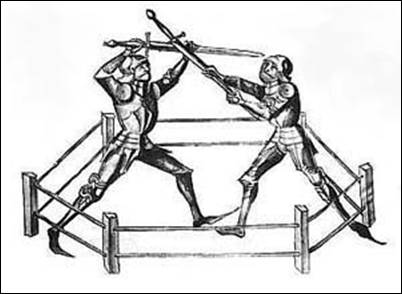
interposed by six plates (#68-#73) dealing with a grudge-match between two
knights in full plate-armour (rüstung) who also wield longswords.
Incidentally, all men portrayed in the range of plates from #01-#78
are fighting afoot. Firstly, we should consider
the weaponry shown in the plates delineated for longsword. The fighters seem to wield Oakeshott-type
XVa, XVIa or XVIIIa longswords. Such
were a basic selection of differing yet coeval types for middle to late 15th
CentAD throughout Germany and Austria, or for that matter, much of the rest
of coeval Europe. Secondly, we should
consider the garments shown in the plates delineated for longsword. The fighters are outfitted in some sort of
close-fitting fight-clothing, tailored for the whole body and paneled,
gusseted or padded. If these were
undergarments for rüstung, then
such would have served to absorb shock beneath the custom-fit tempered steel
plating which covered a knight’s whole body – in other words,
arming-clothes. However it be, this
clothing must have served as sweat-suits, for we can plainly see the fighters
practicing thusly garbed. Such male
costume was common enough throughout much of Europe at that time and consists
of doublet, shirt, trews, cod and shoes.
This fight-clothing could have been made of any variety of textile
and/or tanned materials, such as linen, wool, hemp, silk or leather, with
perhaps a certain part of metal.
Perhaps it has been too generally and readily assumed in modern times
that fighters bedecked in this manner were always portraying primarily
unarmoured fighting. Thirdly, we should consider
the relevant techniques portrayed and described by the master. As shall be explained, some are fit for
doing certain things better than others.
Hence, some tend to be used more for unarmoured and some more for
armoured. These techniques are as
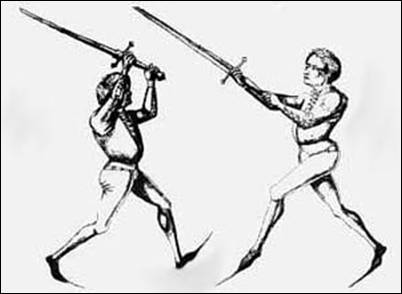
follows: Hewing –
this is cleaving with the edge. Talhoffer calls various techniques done by this method: schlachen; schlag; haw;
how; hout; krump; gayszlen
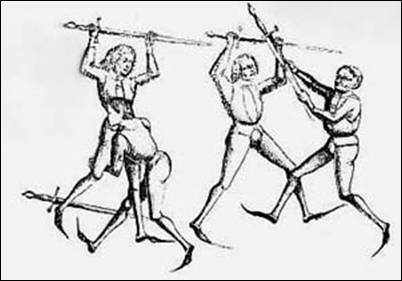
Hewing – from plate #01. Oberhow.
– Vnderhow. Overhew.
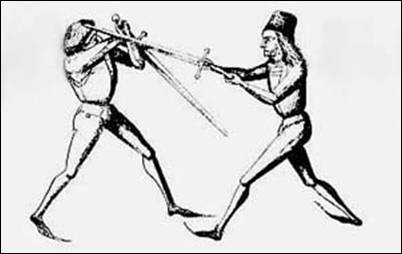
– Underhew. Thrusting – this is piercing
with the point or ramming with the pommel. Talhoffer calls various techniques done by this method: ortt; stich; hefften; stos; stossen [different
from hinweg stossen or shoving]
Thrusting – from plate
#04. Das
lang Zorn ortt. – Darfür ist das geschrenckt ortt. The
long wrath-point. – Therefor is the set-point. Slashing – this is raking with
the edge. Talhoffer calls various techniques done by this method: schnit; fahen [!]
Slashing – from plate #21. Der
gryfft nach der vnderen blosz. – Der schnit von oben daryn. He
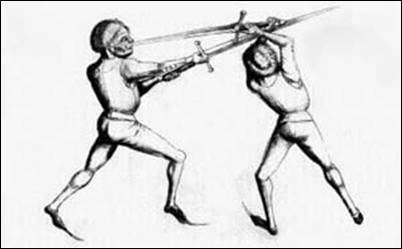
attacks at the lower openings. – He slashes from above therein. Half-swording – This is when one
hand grips the hilt and the other hand grips the blade. Talhoffer calls various techniques done by this method: brentshiren; gewauppet ort Morte-striking – This is when both
hands grip the blade to smite with the pommel or crossguard. Talhoffer calls various techniques done by this method: mortschlag; mordstreich; tunrschlag
Half-swording against
Morte-striking – from plate #37 (2nd pair). Vsz
dem Tunrschlag Ain werffen. – Vsz dem Tunrschlag ain Ryszen. Out
of the thunder-strike throwing. – Out of the thunderstrike wrenching. Lastly, we should consider the
differences between unarmoured and armoured fighting of that time. However, it is acknowledged that much
similarity unavoidably exists as we are talking about the same weapon – the
European longsword of 15th CentAD.
Yet the distinctions are clear and should be of general agreement
among those who practice historically realistic European swordfighting which
is based upon the German fight-books (fechtbücher) or upon the Italian manuals. What follows is substantiated by perusing
such fight-books as Liechtenauer (1389 via Doebringer and 1440 via Ringeck),
Liberi (1410), Gladiatoria
(1430-1444), Lignitzer (1452 via Danzig), Hundfeld (1452 via Danzig &
1491 via Speyer), Talhoffer (1467), Wallerstein
(1470), Vadi (1482), Lew (1491 via Speyer), Goliath (1510), Czynner (1538) and Mair (1550): * Hewing and slashing are most wieldy for unarmoured* The blade of a longsword wielded by hew or
slash is effective against the unarmoured foe, or by hew for breaching the
leather or maille-armoured foe – yet neither does well against the
plate-armoured foe. Against such the
hew may batter yet probably shall not breach.
And the slash is next to worthless.
Against plate-armour such strikes shall most likely simply bounce,
glance or slide. Hewing must have
proven frighteningly destructive against the unarmoured foe, or for that
matter, the maille-armoured foe – as everything from battlefield archaeology
to modern test-cutting on deer carcass shows – yet it just was not the thing
for hurting the plate-armoured foe. * Half-swording and morte-striking are best for armoured* An unarmoured fighter can do both as needed,
either against an unarmoured foe or especially against a plate-armoured
foe. A longsword wielded by
half-swording lets the fighter strongly set aside a foe’s strike and allows
accuracy and power for thrusting, especially for seeking the gaps of
plate-armour. If wielded to
morte-strike, it makes for a fearsome attack against a foe whether unarmoured
or armoured. With the pommel it allows
battering of plate-armour; and with the crossguard, it allows piercing of its
gaps or perhaps the armour itself, and hooking and wrenching of both his
armour and the foe himself. The
equally plate-armoured fighter and foe would surely do both half-swording and
morte-striking against each other. * Thrusting is ubiquitous to
both armoured and unarmoured* The point of a longsword wielded this way has overall efficacy, utilised
to smite the unarmoured foe almost anywhere and to smite the armoured foe by
breaching the gaps of his plate-armour.
Thrusts can be driven with hands upon hilt or by half-swording. * Arms crossed or apart works for unarmoured * yet * Arms apart works for armoured * When warding or attacking with
the longsword, a man in fight-clothing can work easily with techniques that
either make his arms cross or keep them apart – however, the man in
plate-armour really must tend to keep his arms apart when warding or
attacking, for his steely shell hinders or prevents such with arms crossed (geschrenckt). One may note that the knights in rüstung keep their arms apart in their
fight. Now, with all this in mind,
a simple analysis of Talhoffer’s captions and pictures finds marked
difference between what prove to be two distinct halves of Talhoffer’s
longsword plates:
So the distinction seems
rather clear. The first half has lots
of hewing and a bit of slashing, whereas the second half has neither
thereof. The first half has little of
half-swording and morte-strikes, whereas the second half has lots of each
comparatively. Each half has decent if
differing amounts of thrusting. The
first half portrays a noticeable amount of arms-crossed yet mostly
arms-apart, whereas the second half only portrays arms-apart. Hence Talhoffer’s fight-clothing-bedecked
longswordsmen portray a definite unarmoured first half and a definite
armoured second half for their totality of longsword fighting
techniques. None of this should be any
surprise if we simply realise that it would be utilitarian, efficient, and
couth for the students of a fight-school to practice differing sets of
contextually dependant moves for a given weapon just as they would practice
differing weaponry. Furthermore, besides the foregoing technical and statistical evidence,
it seems there is also numerological evidence. Talhoffer’s #73 rüstung plate portrays the exact same
struggle of weaponed-point (gewauppet ort) against morte-strike (Mordtschlag), as found in the second pair within his #37 langes schwert plate of weaponed-point
(unnamed) against thunder-stroke (Tunrschlag)
– but with differing outcomes. In the rüstung, weaponed-point-man forsets (versetzen or versatzung) morte-man’s attack and finishes by shoving him away (hinweg stossen) – whereas in the langes schwert, thunder-man wrenches (Ryszen) weaponed-point-man’s attack
and finishes with thrust of pommel (stos)
to face. Thus the rüstung plates end with similar struggle as the beginning of the harnisch half of the langes schwert plates. If this was done wittingly by the arcanity
of Medieval numerology, then perhaps it is indicated by how switching the
digits of “37” makes “73” and vice-versa.
Such thinking may explain the odd placement of the six rüstung plates within the seventy-two langes schwert plates between #67
& #74 rather than between #36 & #37 – that is, between the end of the
bloß and the beginning of the harnisch. Indeed, the knights struggle within a
battle-yard (schranken) which is
fenced hexagonally, thus reinforcing the idea of the factor of “6”, which if
squared arrives at “36” – a familiar number as already witnessed.
The same Half-swording
versus Morte-striking – from plate #73. Usz
der versatzung hinweg stossen. – Der haut den straich volbracht. Out
of forsetting shoving away. – He has fully brought the strike. Lastly,
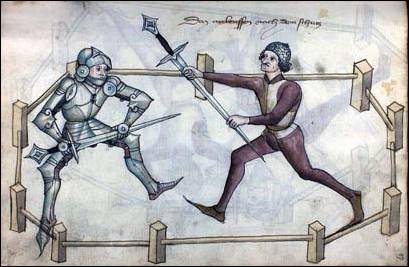
Talhoffer’s 1459 version contains a plate (87 recto) portraying a combatant in full plate-armour versus one
in fight-clothing. This plate is set
in the fight-book such that it bridges its own sections of rüstung and langes schwert – that is, betwixt fighters portraying harnisch and bloß. Indeed, these
combatants are portrayed within a battle-yard doing half-swording versus
morte-strike. The similarity is
interesting to consider vis-à-vis
Talhoffer’s last edition.
Guess what happens here –
from 87 recto of the 1459. Das anlouffen nach dem
schutz. The ready-stance after the
spear-hurling. One final
thought: Since Talhoffer’s readership
were likely the knights and soldiers of his lord, Herr Leutold von Königsegg,
it makes sense that such men would have need to know the variance
distinguishing bloß from harnisch – thus the emphasis of
technique befitting different combat. Conclusion: The longsword plates found in Hans
Talhoffer’s fight-book of 1467 AD are dealt into two equal halves which show
the typical and marked differences between armoured fighting and unarmoured
fighting of 15th CentAD European swordsmanship. ***** Primary Sources: Cod.icon. 394a Handschrift; Hans Talhoffer (auth); Schwaben; 1467; Bayerische
Staatsbibliothek; München Fechtbuch
aus dem Jahre 1467;
Hans Talhoffer (auth); 1467; Michael Rasmusson (transcr & transl); 2004;
Schielhau Web-Site; <http://www.schielhau.org/tal.html> Medieval Combat; Mark Rector
(transl & interp); Hans
Talhoffer (auth); Bayern; 1467; Greenhill Books; London; 2000 Meister Hans Thalhofer: Alte Armatur und Ringkunst; Hans Talhoffer
(auth); Thott 290 2º; Bayern; 1459;
;
<www.kb.dk/kb/dept/nbo/ha/index-en.htm> Talhoffers Fechtbuch aus dem
Jahre 1467; Hans Talhoffer (auth);
Schwaben; 1467; Gustav Hergsell (transcr & transl); Prague; 1887; Forschungs und Landesbibliothek Gotha Buch 4° 113/2 Talhoffers Fechtbuch aus dem
Jahre 1467; Hans Talhoffer
(auth); 1467; Mark Rector (transcr & transl); 1999; ARMA Web-Site;
<http://www.thearma.org/Manuals/talhoffer.htm> Secondary Sources: Altenn Fechter anfengliche Kunst; Christian Egenolph (auth); Alexander
Kiermaier (transcr); Franckfurt am Meyn; 1529; Die Freifechter Webseite; 2001; <www.freifechter.org> Armour from the Battle of Wisby; Bengt Thordeman (auth); Brian Price (intro);
Chivalry Bookshelf; Highland Village; 2001 Blood Red Roses: The Archaeology of a Mass Grave
from the Battle of Towton AD 1461;
Veronica Fiorato (edit), Anthea Boylston (edit), Christopher Knüsel (edit);
Oxbow Books; Oxford & Oakville; 2000 Brief Introduction to Armoured Longsword Combat; Matt Anderson (auth); Shane Smith (auth); ARMA
Web-Site; 2004; <www.thearma.org/essays/armoredlongsword.html> Codex
Wallerstein; Gregorz
Zabinski (transcr & transl); Bartlomiej Walczak (transl & interp);
Paladin Press; Boulder; 2002 (from 1470) Flos
Duellatorum; Fiore dei
Liberi (auth); Hermes
Michelini (transl); Italy; 1410; Knights of the Wild Rose; Calgary; 2001;
<www.varmouries.com/wildrose/fiore/fiore.html> Gotha Buch
4° 113/2 Handschrift; Hans Talhoffer (auth);
1467; Forschungs und Landesbibliothek
Gotha History
of Art; HW Janson;
Prentice-Hall & Abrams; New York; 1981 (2nd edit) Kurzen Schwert; Martin Hundfeld
(auth); from Codex Speyer (Handschrift M
I 29 or Fechtbuch);
Hans von Speyer (edit & comp); Beatrix Koll (transcr); (transcript
thereof & formerly also facsimile); Almania; 1491; Universitätsbibliothek Salzburg;
2002; <www.ubs.sbg.ac.at/sosa/webseite/fechtbuch.htm> Kurzes Schwert; Andre Lignitzer (auth); Kurzes Schwert; Martein Hundtfeltz
(auth); both from Danzig Fechtbuch; Peter von Danzig (auth & edit); Monika Maziarz (transcr); Preuszen; 1452; ARMA-Poland Web-Site; 2004; <www.arma.lh.pl/index.html> Liber
Chronicarum; Schedel; Wolgemut; Pleyenwurff; Alt;
Koberger; Füssel; Nürnberg; 1493; bound uncoluored Latin edition; Wilson
Collection; Multnomah County Library Liber de Arte Gladiatoria
Dimicandi ; Filipo Vadi (auth); Urbino; 1482; Luca
Porzio (transl); ARMA Web-Site; 2002; <http://www.thearma.org/Manuals/Vadi.htm> Medieval Meat Cutters; James Knowles (prod-direct); ARMA-Ogden Web-Site;
Quicktime-video; Utah; 2004;
<http://www.arma-ogden.org/content/view/11/2/> Records of the Medieval Sword; Ewart Oakeshott (auth & illus); Boydell Press;
Woodbridge; 2002 (rev-ed) Ritterlich Kunst; Sigmund Ringeck (auth); Johannes Liechtenauer (auth); Stefan Dieke (transcr); Mscr. Drsd. C 487; Bayern; 1389
& 1440; Sächsische
Landesbibliothek-Dresden; Die
Freifechter Webseite; 2001;
<www.freifechter.org> Sigmund
Ringeck’s Knightly Art of the Longsword; David Lindholm (transl & interp); Peter Svärd (illus); Johnsson & Strid (contr); Sigmund
Ringeck (auth); Johannes Liechtenauer (auth); Paladin Press; Boulder; 2003
(from 1389 & 1440) The
Tailoring of the Grande Assiette; Tasha Kelly McGann (auth); La Cotte Simple Web-Site; 2004;
<www.cottesimple.com/blois_and_sleeves/grande_assiette/grande_assiette_overview.htm> The Wars of the Roses; Terrence Wise (auth); Gerry Embleton (illus); Osprey;
Oxford; 2000 ***** Acknowledgements:
My thanks to Matt Anderson, Casper Bradak, Donald Lepping, Randall
Pleasant, Shane Smith, and Bartholomew Walczak. About the
Author: Jeffrey Hull has been training
in European fighting arts the ARMA way for about five years now. Previously he trained in Asian martial
arts. He holds a BA in Humanities. Copyright 2005 of
Jeffrey Hull |

|
|
|||
|
|
|||
|
|||