
|
||||||||
|
|
||||||||
|
By John Clements Just as with the subject of swords and
swordsmanship, historical swordsmithing is also something currently
filled with considerable myth and misconception. At different times and in different regions
throughout the Medieval and Renaissance eras a variety of swords were
devised for a variety of demands. There was a natural competition at
work between arms and armor, as a man needed one to fight effectively
and the other to stay safe. The result was a diverse family of single
and double hand swords for cutting, thrusting, or cutting and
thrusting. These might be straight or curved, slender or wide, tapered
or not, and single or double-edged.
But just how swords were made is something
rarely presented in an easily understood manner and a good deal of
confusion surrounds this topic today. The technical terminology and
debate involved can often overwhelm the modern student of spathology (the study of historical swords).
As a tool the sword was the premier personal
weapon of the professional warrior and unlike other weapons, such as
bows, spears, axes, daggers, etc., which were also used in hunting and
could be made by any craftsman, a sword was made by a skilled
specialist. This man was a swordsmith or a bladesmith. He would
actually “smith” a blade. Through his talent and experience he worked
by hand to carefully shape and then temper iron into finely crafted
steel. He didn’t simply grind and polish a pre-made piece of cold metal
with a few tools. The Swordsmith's Trade A swordsmith’s goal was to produce a sturdy
fighting blade hard enough to hold a fine edge or point, yet was also
resilient (able to flex under strain but immediately after return
true). He was far more than a “blacksmith,” who would hammer out or
cast common tools from soft iron. A swordsmith typically had to know
how to make steel---the harder form of iron that contained minute
traces of carbon (usually from charcoal). Steel,
or carburized iron, enabled a metal blade to have a far sharper edge
and to withstand much greater stress without breaking or staying bent. But first the swordsmith had to acquire good
steel of the desired trait. The craft of smelting iron into steel was
an exacting skill in itself and quality steel was a trade good. Source
steel could sometimes be obtained in pre-forged ingots produced by
others specialized in the task, saving the bladesmith the trouble and
leaving him free to concentrate on shaping and tempering. Some smiths
though would smelt their own raw ore. This part was also something of a
mystery for their was no way in the past to know, let alone properly
measure, the minute carbon content that under high heat seemed to
magically transform iron into steel. A swordsmith had to base it all on
his experience of what, as best he could tell, had worked well enough
before.
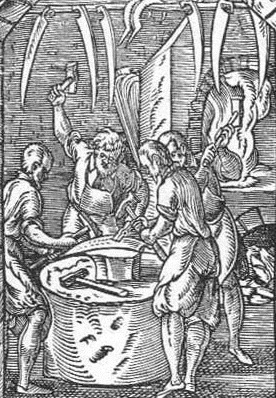
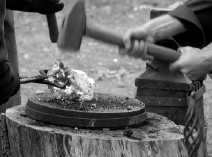
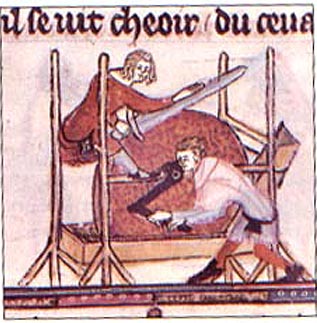
With the hammers and tongs that were his
trade the swordsmith would work the proto-blade, moving the block of
glowing metal back and forth between an anvil and a hot coal furnace
fueled by a bellows. He needed just the right “color” of heat to keep
the metal at just the right pliability. He would shape his metal while
red-hot by slowly and repeatedly hammering
and re-heating until it was the length, width, and thickness he wanted.
He had to work the sides, edges, and tang into shape, none of which was
entirely identical in its characteristics to the others. In order to be both strong and light for
striking powerful cuts or thrusts against either hard or soft targets,
different sword blades would require not just different lengths and
widths but different cross-sections. A
swordsmith had to skillfully create these shapes, perhaps in some small
way improving his design each time by refining his techniques and
incorporating new ideas. This process was all much slower and far more
exacting than so often depicted in movies with the pounding “k’tang!”
of a hammer falling over and over on a glowing bar of metal (nor at any
step would molten metal have been poured into molds in the making of a
blade).
But once a blade was finished a suitable
hilt would need to be attached. No matter how good a blade was it was
only useable with a good hilt. This last step was often performed by
another craftsman called a cutler.
A hilt (pommel, grip, and guard) all had to fit firmly and be
completely secure, usually being custom made for whatever blade it
matched. Sometimes a handle might be made specifically for the hand of
the owner. The handle of hard wood, horn, or bone had to be tight and
securely graspable. Complex hilts of various bars were usually shaped
of single solid pieces that were often worked cold rather than hot, but
would be reheated when permanently attached. They were not spot-welded
for such technology did not yet exist and would have proved too weak
for the abuses of combat. When it at last had its hilt only then could
the completed sword finally be tested and approved. Lastly, the whole
weapon would be polished smooth, perhaps to a bright shine, before
being oiled. Craft and Artistry Within the historical craft of swordmaking
there was always a certain degree of trial and error in the process as
well as constant experiment to produce stronger and more effective
weapons. Sword makers just didn’t know at the time they were adding
certain percentages of trace elements. They didn’t know they were
achieving exactly the right temperature threshold to fuse together
different metals, align molecules, or crystallize steel. They had no
"hardness scales" or measurable standards to go by. They simply judged
by eye and hand the metal’s color and malleability for just the right
moment at each step.
A good maker or shop earned a reputation for reliability and consistency in their product. Continuous
feedback between swordsmiths who constructed the tools and swordsmen
who used them was necessary for the latter to be satisfied and the
former to make a living. As swordsmen used
their tools in combat and returned with suggestions or complaints newer
and better models were tried. Like a modern auto-engineer designing
high-performance racecars who needs expert drivers to test his designs
to their limits, so too did the swordsmith rely on the swordsman. Over
generations this vital circle of interaction between maker and user
resulted in more and more sophisticated swords to meet the challenges
of better armors and newer fighting techniques. All the while adding to
the weapon’s ancient mystique. As with any craft swordsmiths ranged in their talent and expertise. There
were ones to meet all levels of demand and expense. Their trade, their
business, was offering working tools that were a perishable product.
Each sword they made was a custom piece, even as it might often match a
known pattern or style and sometimes be produced quickly in large
quantities. Yet, as a personal weapon a sword would be prized and
cherished for there was always a certain awe to something forged from
fire and earth into an object of deadly beauty. Ancient Art and Modern Science Throughout history, different swordsmiths of
different cultures devised different ways of reliably achieving the
result of a strong sword that was also sharp. The craft required the
highest technology of the day but in the end it was an Art. Whatever
the method and technology and whatever the design, there were always
certain aspects of swordsmithing indispensable to creating tough and
resilient blades.
We might imagine for a moment that if a
sword could somehow be made of rubber it would have the ideal
resilience to withstand impacts and bend as needed without ever
breaking or deforming. Of course it wouldn’t cut or stab well at all.
Similarly, if a sword could be made of glass it could have the sharpest
of razor thin edges, but it would also shatter on impact and be
useless. If the two qualities of rubber and glass could somehow be
combined though, they would produce an ideal bladed weapon. In a sense
then this is what real swords of fine steel have always tried to
accomplish.
Swordsmiths in northern Europe discovered a method of swordmaking (now called pattern-welding) whereby various pieces of iron and or steel rods of different hardness were combined by twisting and folding them together. This was used in Europe until the early Middle Ages. The ability to work metal in this way to create unique visible patterns on a blade’s surface may have been considered a sign of the metal’s quality and the smith’s skill. By the later Middle Ages swordsmiths were already constructing blades of more homogeneous steels by forge-welding together different bars of iron and steel (without the requirement for twisting rods). Others were of more homogeneous but differentially heat-treated steel. Some blades were made of a laminate construction, produced by
“folding” the steel over and over then forge welding at each fold
(resulting in “layers”). In this lamination method to refine and make
the steel more homogenous it was folded and forge welded. The
swordsmith had to “fold” the bar of metal, resulting in a doubling of
the “layers” and in the process blending the qualities of the various
pieces of steel in the billet. The more the steel was folded the more
homogeneous the metal in the blade became. The amount of folds would be
determined by both the material and the final qualities the smith was
looking for. One other way to combine smaller amounts of better steel
into a larger useable billet was to create a piled structure where a
few bars of refined steel were stacked together then welded as one and
forged out into a blade shape without any further folding. But swords
made by whatever means consisted essentially of careful combinations of
softer iron with harder steel.
A good swordsmith would also have surely
understood that just as different portions of a blade had different
roles in guarding, binding, and striking they were not each uniform in
their cross-section. To withstand the unique stress placed upon the
shoulder of the blade (just below the cross) the tang especially had to
have a different consistency than other portions. Whatever fighting
techniques a particular blade might be designed for the swordsmith
would be familiar with the specific qualities required. For a thrusting sword no quality was more
important than stiffness. To effectively stab through various materials
a thrusting blade would not require any of the flexibility so
associated now with modern sporting, theatrical, and recreational
swords. A hard rigid point was what mattered. In
the design of a cutting sword the primary concern was for the stress
forces that would be applied against its edge. Structural strength
perpendicular to the edge (that is, to the sides) though also
important, was a secondary factor. In modern times swords have often been
deemed of supposedly good quality when they can be slowly flexed
repetitively, bent in a big circle, or continually plied back and forth
then straightened again. However, these qualities reflect neither a
good fighting weapon nor the concerns of actual historical swordsmen. A
good sword blade had to be resilient and this was not a factor of
either flexing or bendability. It was a matter of edge and point
hardness combined with the need to repeatedly withstand sudden forceful
impacts without breaking or bending—a factor of the metal’s plasticity
versus its elasticity. Achieving this mix was a major part of the
technical challenge involved. Rediscovering a Lost Craft Without the continued need for quality
edged-weapons, and with fewer and fewer skilled swordsmen around to
test and use them in earnest, the personal craft of swordsmithing by
hand rather quickly faded. Swords are not
the same kind of tools as knives, which do not require the vigorous
warding and parrying of other large blades or striking against assorted
armors and other weapons. This is why modern craftsmen must reconstruct
from our past the historical methods and techniques of swordmaking.
Most swords today are produced as replicas
or reproductions using a stock-removal process whereby a uniform bar of
modern steel is shaped by machine or power-tools and then tempered to a
certain outer hardness. For the most part, this is sufficient for
costume weapons and even for purposes of most martial arts practice.
But with few exceptions such weapons are generally deficient for more
energetic training and serious test cutting. We can well imagine they
would have proved deficient in historical combat.
Modern sword makers either can’t or don’t
usually do this, and consumers suffer as a result. The cost of creating
accurate historical swords by hand, combined with the effort and (now
rare) skill involved, means that modern commercial sword manufacturers
rely on a variety of work-saving measures to produce replica weapons
(which is why they typically lack many of the essential handling
characteristics of originals). Consumer ignorance also makes them prey
to all manner of hype and deception by less reputable sword
manufacturers.
There is actually still a tremendous amount
we just don't know yet about the craft and technology of how historical
swords were really made. But through reconstruction and experimental
archeology we are reaching a new level of knowledge, which previous
generations of scholars, craftsmen, and historical fencing
practitioners did not have. With each year and each new discovery, our
understanding advances. Such effort involves not constructing swords to
the best of modern technology and metallurgical science, but making
them according to the truest historical methods—and then testing them
properly. Though we now have manufacturing methods
that can create all manner of steel with all manner of exact
attributes, the craft of making a fine sword---the art of swordsmithing---is still something of a mystery.
|
|
|
|||
|
|
|||
|
|||
 It
must first be appreciated that a sword is unlike any other object.
There is nothing else to which it can really be analogous. It is a
fighting tool, but it is not simply a giant knife or a huge razorblade
nor is it just a heavy hunk of long flat metal with a handle. A sword
is a unique instrument with its own functional properties dependent
upon its design.
It
must first be appreciated that a sword is unlike any other object.
There is nothing else to which it can really be analogous. It is a
fighting tool, but it is not simply a giant knife or a huge razorblade
nor is it just a heavy hunk of long flat metal with a handle. A sword
is a unique instrument with its own functional properties dependent
upon its design. 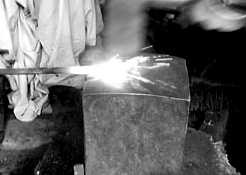 The real sweat came when he set about to work the ready metal into a blade. A swordsmith needed to carefully forge
 When
satisfied with the initial shape the swordsmith was far from finished.
A finely crafted sword had to have just the right mix of good steel as
well as just the right temper. Heat treatment was the final crucial
step that gave the blade its strength and toughness. Heat-treating is
really the whole process of quenching (or hardening) and
tempering (or slightly softening). Tempering is really just the
low-temperature re-heating of hardened yet still somewhat brittle steel
(now called martinsite). In essence it’s the “relaxing” of
the steel at a low temperature (as if baked in a kitchen oven). The
higher the temperature or the longer a temperature is applied the more
the metal’s structure is “relaxed,” thus making the blade tougher while
somewhat softer. But when they were tempering historical swordsmiths
did not know they were rearranging molecules of martinsite into a
softer yet tougher pattern. They just knew they were making a better
blade through careful use of heat over time.
When
satisfied with the initial shape the swordsmith was far from finished.
A finely crafted sword had to have just the right mix of good steel as
well as just the right temper. Heat treatment was the final crucial
step that gave the blade its strength and toughness. Heat-treating is
really the whole process of quenching (or hardening) and
tempering (or slightly softening). Tempering is really just the
low-temperature re-heating of hardened yet still somewhat brittle steel
(now called martinsite). In essence it’s the “relaxing” of
the steel at a low temperature (as if baked in a kitchen oven). The
higher the temperature or the longer a temperature is applied the more
the metal’s structure is “relaxed,” thus making the blade tougher while
somewhat softer. But when they were tempering historical swordsmiths
did not know they were rearranging molecules of martinsite into a
softer yet tougher pattern. They just knew they were making a better
blade through careful use of heat over time. 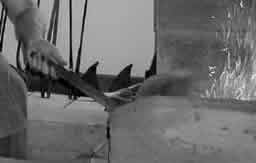
 When
the blade had cooled it was ready to be ground and sharpened (or
“polished”). This is where its edge and point would be properly honed
by hand to a desired degree for the type of fighting work it was
expected to perform. By holding the cold blade against a series of
large slowly turning stone grinding wheels of different grains, the
blade’s final shape would be formed. It could then be given an edge
with smaller stones or hard metal files. Sometimes an apprentice or
specialist accomplished this job. A sword blade might also be inscribed
or decorated, perhaps by the maker or another artisan (although some
decoration might be applied earlier during forging). A swordsmith might
sell his bare blades to others to then turn into ready swords or
complete them himself.
When
the blade had cooled it was ready to be ground and sharpened (or
“polished”). This is where its edge and point would be properly honed
by hand to a desired degree for the type of fighting work it was
expected to perform. By holding the cold blade against a series of
large slowly turning stone grinding wheels of different grains, the
blade’s final shape would be formed. It could then be given an edge
with smaller stones or hard metal files. Sometimes an apprentice or
specialist accomplished this job. A sword blade might also be inscribed
or decorated, perhaps by the maker or another artisan (although some
decoration might be applied earlier during forging). A swordsmith might
sell his bare blades to others to then turn into ready swords or
complete them himself. 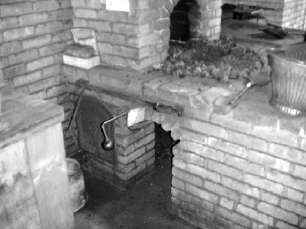 Over
time, as a swordsmith developed his method and acquired feedback on the
performance of his product, he slowly perfected (and guarded) his craft
---even if some of its finer points were a mystery even to himself.
Because the qualities and attributes that made up a good sword were not
yet understood as a metallurgical science, the processes that produced
a good sword blade were an art---and one with a certain mystique.
Over
time, as a swordsmith developed his method and acquired feedback on the
performance of his product, he slowly perfected (and guarded) his craft
---even if some of its finer points were a mystery even to himself.
Because the qualities and attributes that made up a good sword were not
yet understood as a metallurgical science, the processes that produced
a good sword blade were an art---and one with a certain mystique. 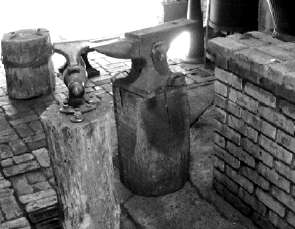 Historically,
it was better for a sword to be too soft than too hard. A softer blade
may certainly become bent, but it will still cut and it won’t snap.
They did not have to be nearly as “springy” as many modern “replica”
swords now give the impression. Steel springs certainly bend before
breaking, but are not the best for the tough and resilient needs of
long fighting blades. Medieval metalsmiths were certainly capable of
making chisels and other tools with very hard edges from very hard
steels. But again, as with springs, these properties alone were not
those ideal for fighting blades.
Historically,
it was better for a sword to be too soft than too hard. A softer blade
may certainly become bent, but it will still cut and it won’t snap.
They did not have to be nearly as “springy” as many modern “replica”
swords now give the impression. Steel springs certainly bend before
breaking, but are not the best for the tough and resilient needs of
long fighting blades. Medieval metalsmiths were certainly capable of
making chisels and other tools with very hard edges from very hard
steels. But again, as with springs, these properties alone were not
those ideal for fighting blades.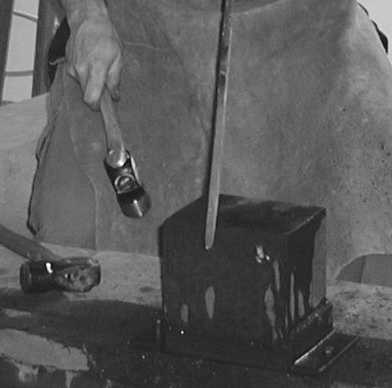 We
can note that during the Medieval and Renaissance periods an enormous
variety of techniques for producing iron and steel as well as for
methods of blade forging and heat-treatment were all in use. In Europe
metal was produced using bloomery furnaces, blast furnaces, and
crucible melting. Differences were understood between various
steels even if the science behind them was not. There was not a direct
linear development of technologies or methods whereby earlier ones were
quickly discarded as obsolete. Several might be in use at any one
time in the same region or even by the same maker. There is also
evidence that many varied methods of differential tempering (i.e.,
softening one portion of the blade slightly more than another) were
practiced and though each could generate different effects on the
structure of a metal blade, they all aimed at similar results.
We
can note that during the Medieval and Renaissance periods an enormous
variety of techniques for producing iron and steel as well as for
methods of blade forging and heat-treatment were all in use. In Europe
metal was produced using bloomery furnaces, blast furnaces, and
crucible melting. Differences were understood between various
steels even if the science behind them was not. There was not a direct
linear development of technologies or methods whereby earlier ones were
quickly discarded as obsolete. Several might be in use at any one
time in the same region or even by the same maker. There is also
evidence that many varied methods of differential tempering (i.e.,
softening one portion of the blade slightly more than another) were
practiced and though each could generate different effects on the
structure of a metal blade, they all aimed at similar results. 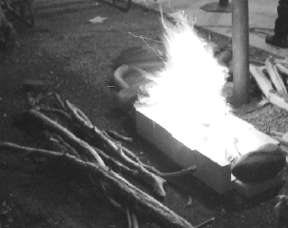 While,
by contrast, knife-making is nowadays alive and well as both art and
science, the making of Medieval and Renaissance swords in an authentic
manner is another story entirely. No traditional art of swordsmithing
in the West survived the tumultuous centuries of changing military
technologies (and fencing styles). Just as with their lost combat
teachings, no surviving school or lineage of European swordsmithing
preserved and passed on the old methods unchanged and unbroken. Because
we came to no longer depend on swords for life and death encounters and
they were not weapons we needed for war or self-defense any longer, the
ancient art of swordsmithing in Europe eventually atrophied and fell
into obscurity.
While,
by contrast, knife-making is nowadays alive and well as both art and
science, the making of Medieval and Renaissance swords in an authentic
manner is another story entirely. No traditional art of swordsmithing
in the West survived the tumultuous centuries of changing military
technologies (and fencing styles). Just as with their lost combat
teachings, no surviving school or lineage of European swordsmithing
preserved and passed on the old methods unchanged and unbroken. Because
we came to no longer depend on swords for life and death encounters and
they were not weapons we needed for war or self-defense any longer, the
ancient art of swordsmithing in Europe eventually atrophied and fell
into obscurity.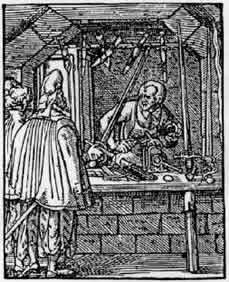 Thus,
to accurately replicate the swords of old, modern swordmakers must
closely examine and measure real historical swords in all the ways they
can. They must note far more than their weight and general shape. They
must understand the subtle changes in their cross-sectional geometry
and in the angles of their edge at different portions that effect the
select distribution of mass along the blade from tang to tip. Besides
just knowing about the distinct metallic qualities that make up their
inner and outer materials, they must also match the weapon’s original
balance points and center of gravity so that it feels right when used
correctly (this is why it is so crucial to accurately reproduce actual
historical models rather than just try to create original new styles).
Thus,
to accurately replicate the swords of old, modern swordmakers must
closely examine and measure real historical swords in all the ways they
can. They must note far more than their weight and general shape. They
must understand the subtle changes in their cross-sectional geometry
and in the angles of their edge at different portions that effect the
select distribution of mass along the blade from tang to tip. Besides
just knowing about the distinct metallic qualities that make up their
inner and outer materials, they must also match the weapon’s original
balance points and center of gravity so that it feels right when used
correctly (this is why it is so crucial to accurately reproduce actual
historical models rather than just try to create original new styles).