
|
||||||||
|
|
||||||||
Using the "F" Word – The Role of Fitness in Historical FencingThe exercise of the body goes hand in hand with the Exercise of Armes. Renaissance martial arts were a highly athletic activity. Yet, to be honest, the role of fitness in historical fencing is a delicate issue for some students. The subject is admittedly a sensitive one for many sincere practitioners burdened by modern sedentary lives or other non-physical careers behind desks. No one likes being reminded that they are out of shape or in poor physical condition either. And to be honest, among the historical-reenactment community this problem is frequently endemic and at present, in America, obesity itself is epidemic. So, any discussion of the necessity for physical fitness in the earnest performance of Renaissance martial arts is sure to cause discomfort among some readers and even resentment among others. For far too many enthusiasts of historical fencing, fitness is a “four letter word” that inconveniences their fantasy view of Medieval and Renaissance close-combat. In the study of what are at heart vigorous physical activities it is perhaps human nature, rather than to feel inspired or motivated, to tend instead to be agitated or irritated by reminders of the import of athleticism. This is especially true today with a subject frequently pursued as casual diversion and mere escapism. That fitness should be at all anathema in a craft that is first and foremost a physical activity is perplexing. But this article will attempt only to address the role, historical and practical, of physical conditioning in the practice of Renaissance fighting skills. The Traditional Position
In the early 1400s the educator Vittorino da Feltre, "required as a correlative to a fine intellectual humanism a standard of physical excellence and personal bearing to match." To Vittorino, "The purport of such training was to develop an easy, graceful bearing, suppleness, and dignity of figure." As such, he stressed for youth the importance attached to diet, clothing, and exercises as well as being inured to cold and prolonged exertion. The educator and expert in arms Leon Battista Alberti in the mid-1400s advocated and practiced martial arts, "for the sake of health rather than sport or pleasure." Also in the mid 1440s, Aneneas Sylvius Piccolomini (who later became Pope Pius II) argued that active training in physical exercises helped to create total fitness as well as a physically pleasing body, both of which helped the individual bear arms in a manly fashion.
Yet, a knight's training clearly emphasized physical conditioning and self-discipline as well as martial skills. During the Age of Chivalry physical education was revived as a complex military education and strenuous training was required of knights and men at arms. Ancient Germanic and Celtic customs of initiation into manhood and military service also played a part in the later rituals of knighthood. Training produced not just physical skill but discipline. The historian of physical education Earle Ziegler noted that the aim of physical education during the feudal and manorial period served a practical objective of producing a man possessing all the necessary physical and psychological attributes for skill in hand-to-hand combat arts.
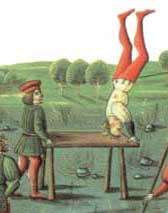
The historian E. Prestage once described how in 14th century France, the armiger, or young squire, whose training in the mesnée was the subject of numerous reflections in the Chansons de Geste, "grew up in the martial traditions of an athletic community, that valued prowess above all things. He was taught the management of horses, the care and use of arms, fencing (which developed the lungs and made one "fitter and more erect and much straighter for it")..." Prestage also noted the squire "had to undergo a strenuous course of exercises calculated to increase his strength and dexterity." The necessity for accurate control over the movements of a horse in battle also led to special exercises known as voltige, consisting of jumping into and out of a saddle or onto a table. Later actual wooden horses were used to practice this. By the 11th century vaulting in this way became an art in itself and continued well into the 18th century where it became the source of today's gymnastic pommel horse. Another example of the physical training a young esquire seeking knighthood would undergo in the late 1300s comes to us from Jean Le Meingre (Boucicaut), the marshal of France during the reign of Charles VI, who founded the order of the Dame blanche a licu vert, a society that defended the wives and daughters of absent knights. Boucicaut described a regimen heavy on exercise fitness: "Now cased in armour, he would practise leaping on to the back of a horse; anon, to accustom himself to become long-winded and enduring, he would walk and run long distances on foot, or he would practise striking numerous and forcible blows with a battle-axe or mallet. In order to accustom himself to the weight of his armour, he would turn somersaults whilst clad in a complete suit of mail, with the exception of his helmet, or would dance vigorously in a shirt of steel; he would place one hand on the saddle-bow of a tall charger, and the other on his neck, and vault over him…He would climb up between two perpendicular walls that stood four or five feet asunder by the mere pressure of his arms and legs, and would thus reach the top, even if it were as high as a tower, without resting either in the ascent or descent…When he was at home, he would practise with the other young esquires at lance-throwing and other warlike exercises, and this continually." (Lacroix, p. 146). This thought is echoed in that of Dom Duarte, king of Portugal, more than a century later when in his 1434 work on fencing, the Regimento, which following from Vegetius's advice for training Roman soldiers, he advised that a wooden horse be kept to practice jumping on and off the saddle as well as being accustomed to sitting mounted in armor. (Anglo, Martial Arts, p. 257). Interestingly, Dom Duarte discerned differences in physical results of sports compared to martial arts when he warned, if a knight wanted a good arm for fencing, he should avoid playing ball games-especially any requiring the throwing of either light or heavy objects as this could weaken military skills. (Anglo, Martial Arts, p. 257). Boucicaut's exercises, which he devised to make himself more effective in battle, included running long distances to build up his stamina and to build up his arm muscles and toughen his hands spent long periods striking with his fists or with a hammer. (H. Nicholson, p. 116-117). Literature of the period, while referring frequently to tournament and joust as military training for knights, makes few references to common fencing masters giving practical instruction in weapon handling to the nobility. It has been therefore suggested that because Boucicaut placed such stress on these martial exercises they were somehow unusual. This might possibly have been so among the majority of nobles and military commanders but surely not men-at-arms of the warrior class. Is it any surprise then that in his 1542 martial arts compendia, Paulus Hector Mair, a collector or Fechtbuchs as well as a practitioner of the craft, referred to the subject by the Latin, artes athleticae? Mair even entitled his work the "Ultimate Book of Athletics."
Aegidius Romanus in the early 14th century wrote that a military leader needed to be attentive to exercitatio, or individual drill, noting that, "having arms unaccustomed to striking and limbs untrained for fighting" was useless for soldiers. He also stressed the importance of practice as toughening to endure hardship as well as "hardness of body". Medieval texts also describe young knights training with weapons of double weight in order to develop strength. Here we might recall the instructions of the Roman military writer Vegetius's (widely read in the age) describing the traditional training of soldiers. Vegetius told how young legionnaire recruits were given double-weight swords and shields to train hard by striking at posts. In this way, when the recruit took up real and lighter weapons, "as if freed from the heavier weight, he will fight in greater safety and speed."
The famed 14th century knight, Geoffrey De Charny, in his treatise on chivalry criticized even entitled some of his chapters, “A Good Man at Arms Should Not Pamper His Body” and “A Good Man at Arms Should Not Fear Discomfort.” At one point Charny specifically criticized overweight knights writing of those who tried to fit themselves into armor but could not perform well: “one has seen many of those thus constricted who have to take off their armor in a great hurry, for they could no longer bear to wear their equipment; and there are others who have been quickly seized, for they could not do what they should have done because they were handicapped by being thus constricted; and many have died inside their armor for the same reason, that they could put up little defense. And even without their armor they are so constricted and strapped up that they cannot undertake anything, for they cannot bend down, nor can they run nor jump nor threw stones nor engage in any other sports requiring strength or agility; indeed they can hardly sit down, and it demands just as great an effort to struggle to their feet again. There might be some who would prefer to give the appearance of being a good man at arms rather than the reality, but no one, however devious or simple, would doubt that when it comes to achieving something, whether in or out of armor, it is those who perform the greatest deeds whose name are on everyone’s lips and who are most honored.” (De Charny, Chapter 42). An example from Jean Le Meingre in the late 1300s of the training a young esquire seeking knighthood would undergo describes a range of physically demanding exercises: "Now cased in armour, he would practise leaping on to the back of a horse; anon, to accustom himself to become long-winded and enduring, he would walk and run long distances on foot…In order to accustom himself to the weight of his armour, he would turn somersaults whilst clad in a complete suit of mail, with the exception of his helmet, or would dance vigorously in a shirt of steel; he would place one hand on the saddle-bow of a tall charger, and the other on his neck, and vault over him…He would climb up between two perpendicular walls that stood four or five feet asunder by the mere pressure of his arms and legs, and would thus reach the top, even if it were as high as a tower, without resting either in the ascent or descent..." 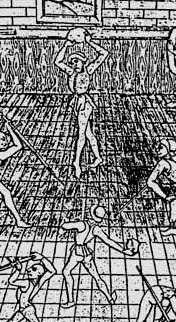 In Havelok the Dane, written
between 1280 and 1290, we read of this in a description of knights
enjoying exercise: "The moste joye that mouhte be—Wrastling
with laddes, putting of ston" (i.e, threw heavy stones). In
a short English play from c.1470, "Robyn Hod and the Shryff off
Notyngham," several activities are described similar to those traditionally
performed in May games, including stone throwing, wrestling, and
vigorous sword fighting. Illustrations of German fencers from
the 15th century depict them engaged in a range of activities
from wrestling and lifting weights (throwing large stones) to performing
calisthenics and gymnastics. In Havelok the Dane, written
between 1280 and 1290, we read of this in a description of knights
enjoying exercise: "The moste joye that mouhte be—Wrastling
with laddes, putting of ston" (i.e, threw heavy stones). In
a short English play from c.1470, "Robyn Hod and the Shryff off
Notyngham," several activities are described similar to those traditionally
performed in May games, including stone throwing, wrestling, and
vigorous sword fighting. Illustrations of German fencers from
the 15th century depict them engaged in a range of activities
from wrestling and lifting weights (throwing large stones) to performing
calisthenics and gymnastics.
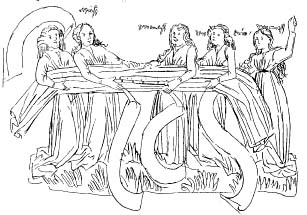
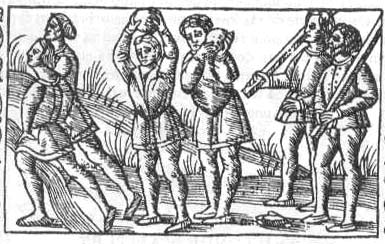
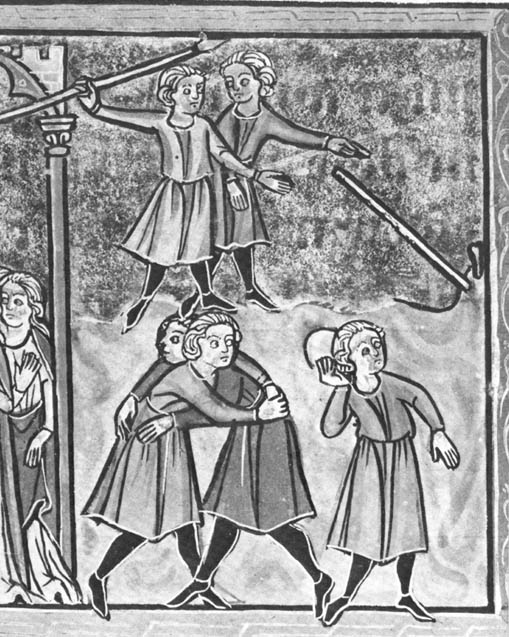
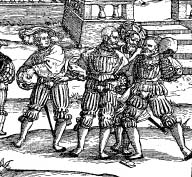
In one such image, the "Master of the Banderoles", a large room is portrayed with figures conducting several exercises including handling long swords, performing acrobatics, and lifting heavy stones. An anonymous illuminated manuscript image from the 14th century depicts four panels of figures exercising, including: men wrestling and lifting stones, fencing with sticks and small triangular bucklers, casting a spear, and finally what appear to be three knitting females sitting about a table indoors. An astrological text from the late 14th century offers a colorful image depicting range of martial exercises practiced in the sun outdoors, including sword and buckler fencing, stone throwing, stick lifting, wrestling, and vaulting. Illustrations of German fencers from the 15th century depict them engaged in a range of activities from wrestling and lifting weights (throwing large stones) to performing calisthenics and gymnastics.
 Another form of strength
training called Strebkatze consisted of various forms of "tug-of-war"
games using rope or cloth. According to Wassmannsdorff this training
was good for fencing with longswords or two-handed weapons because
it strengthened the muscles used in descending cuts. Finally, playful
forms of milder non-combat grappling or wrestling were also conducted.
(Turnen und Fechten, p. 11-18). Another form of strength
training called Strebkatze consisted of various forms of "tug-of-war"
games using rope or cloth. According to Wassmannsdorff this training
was good for fencing with longswords or two-handed weapons because
it strengthened the muscles used in descending cuts. Finally, playful
forms of milder non-combat grappling or wrestling were also conducted.
(Turnen und Fechten, p. 11-18).
 In
eras where physical harm from fellow humans was daily a real possibility,
knowledge of self-defence kept a man free and safe. But in time,
the study of arms became a discipline that could be pursued for
its own end, for its values of health, vigor, and well-being, yet
never conducted without regard to values defined by other liberal
studies. This humanistic ideal of fitness is very much an important
aspect of our Renaissance martial heritage. In
eras where physical harm from fellow humans was daily a real possibility,
knowledge of self-defence kept a man free and safe. But in time,
the study of arms became a discipline that could be pursued for
its own end, for its values of health, vigor, and well-being, yet
never conducted without regard to values defined by other liberal
studies. This humanistic ideal of fitness is very much an important
aspect of our Renaissance martial heritage.
Fitness among the Masters
 There is a simple but obvious dynamic at
work in all this: practice puts you in better shape; being in better
shape puts you in better practice. Jacopo Porcia, the military writer
and humanist educator, in his military treatise from the 1470s
(translated into English by Peter Betham in 1544 as, The Preceptes
of Warre), provided advice on keeping troops fit and prepared for
fighting by training in mock combat (section 33): "For accordyng to
their exercyse, so shall they be in strength and valiant-nesse. And
this is the onely meane to make our army strong and lustye. The
capitayne may somtyme for theyr exercyse, devyde his souldyours and
ordre them in forme and lykenesse of a battayle. But he must beware of
bloodsheddyng, lest some discorde and quarellyng, therof do ryse…"
Commenting on how "Yonge men ought to be chosen for soldyours" (section
185) Porcia also advised to select those which "have a pleasure to
handle weapons, to fyght, takyng it for a sporte and game. Suche
fellowes lustye and stronge, be lyke to become valiaunte and expert
warryours…" Writing "Of exercyse" (in section 99), Jacopo also advised:
"For what science is that whyche can be kepte flouryshyng without
exercyse, when exercyse doeth passe and overcome nature…” For "a
skylfulle capytayne ought to dryve hys men to some kynde of exercise
[i.e., exercitus], lest they be astonyshed, when tyme is that
they must fyght." Later he added (in section 183) how, "this science as
it is gotten and assured by exercise, so is it lost by negligence." There is a simple but obvious dynamic at
work in all this: practice puts you in better shape; being in better
shape puts you in better practice. Jacopo Porcia, the military writer
and humanist educator, in his military treatise from the 1470s
(translated into English by Peter Betham in 1544 as, The Preceptes
of Warre), provided advice on keeping troops fit and prepared for
fighting by training in mock combat (section 33): "For accordyng to
their exercyse, so shall they be in strength and valiant-nesse. And
this is the onely meane to make our army strong and lustye. The
capitayne may somtyme for theyr exercyse, devyde his souldyours and
ordre them in forme and lykenesse of a battayle. But he must beware of
bloodsheddyng, lest some discorde and quarellyng, therof do ryse…"
Commenting on how "Yonge men ought to be chosen for soldyours" (section
185) Porcia also advised to select those which "have a pleasure to
handle weapons, to fyght, takyng it for a sporte and game. Suche
fellowes lustye and stronge, be lyke to become valiaunte and expert
warryours…" Writing "Of exercyse" (in section 99), Jacopo also advised:
"For what science is that whyche can be kepte flouryshyng without
exercyse, when exercyse doeth passe and overcome nature…” For "a
skylfulle capytayne ought to dryve hys men to some kynde of exercise
[i.e., exercitus], lest they be astonyshed, when tyme is that
they must fyght." Later he added (in section 183) how, "this science as
it is gotten and assured by exercise, so is it lost by negligence."
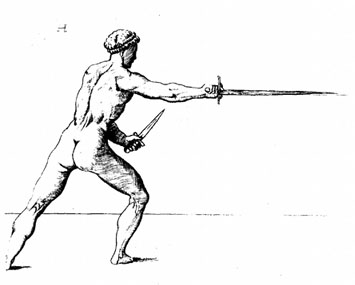
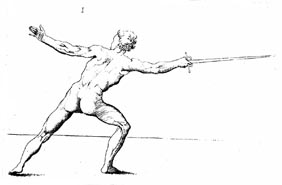
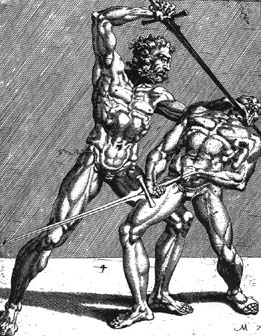
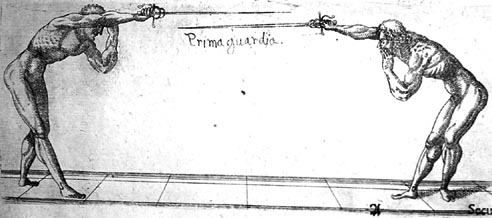
The Hispano-Italian master of arms and knight, Pietro Monte, who wrote voluminously on fighting and military arts at the end of the 15th century, included a concise chapter on body conditioning and diet in his Colecteanea work published in 1509. Monte advocated weight lifting, running sprints, and other callisthenic workouts in order to achieve the ideal martial physique—again, in the classic model. As many Renaissance writers did, Monte stressed the importance of physical conditioning and exercises as key to health, happiness, and martial prowess. The Dutch artist Martin von Heemskerk in 1552 produced a series of detailed fencing and wrestling woodcut engravings consisting of muscular athletes engaged in short sword, two-handed sword, and wrestling. The nude figures reflecting a physical ideal in the classical style are reminiscent of those appearing in Camillo Agrippa's early rapier fencing treatise published two years later. In 1570, the master Giacomo Di Grassi wrote on the importance of fitness, saying, “let every man that is desirous to practice this Art, endeavor himself to get strength and agility of body, assuring himself, that judgment without this activity and force, avails little or nothing.” Di Grassi further declared, "that strength of body is very necessary to attain to the perfection of this Art, it being one of the two principal beginnings first laid down." He then added, "For men being blinded in their own judgments, and presuming on this, because they know how, and what they ought to do, give many times the onset and enterprise, but yet, never perform it in act." In his section on exercise Di Grassi instructed, “how a man by private practice may obtain strength of body” advising, “For tahe obtaining of this strength and activitie, three things ought to be considered, to witte, the armes, the feete and the leggs, in each of which it is requisite that everie one be greatlie exercised…” Yet, he also added later, “For the ende of this arte is not to lifte up or beare great burdens, but to move swiftelie. And there is no doubt but he vanquisheth which is most nimble, and this nimblenesse is not obtained by handling of great heftes or waightes, but by often moving.” Underscoring the need for practice and exercise, Di Grassi also stated that “judgment without…activitie and force, availeth litle or nothinge.” Di Grassi even went to on to state how for the swordsman, “it is principally necessary that (as in other weapons ...they both be active in body and strong in the arms, which are required in the managing of each weapon.” Di Grassi was quite explicit in the need for continual physical conditioning for effective fencing, even commenting on how lack of it would lead to discouragement in the student:
Di Grassi finally added that physical fitness was directly related to fighting skill: "Farther, when he shall perceive, that he hath conveniently qualified and strengthened this instrument of his bodie, it shall remaine, that he onely have recourse in his minde to the fine advertisements, by the which a man obtaineth judgement." Similarly, in Vincentio Saviolo's 1595, His Practice in Two Books, we read from the "First Dayes Discourse" concerning the rapier and dagger: "Therefore hee that wil exercise these rudiments must have a very apt and well framed body…" As did others, English master George Silver, in his famous 1599, Paradoxes of Defense, rightly observed the health benefits of martial arts: "exercising of weapons puts away aches, griefs, and diseases, it increases strength, and sharpens the wits. It gives a perfect judgement, it expels melancholy, choleric and evil conceits, it keeps a man in breath, perfect health, and long life." In addition to striking at a wall target with a heavy sword dozens of times a day and vaulting on the traditional wooden pommel-horse for exercising the body in agility, Francesco Alfieri in his 1640 fencing treatise included a chapter on "The Gentleman's Exercises" (Gli esercizi del cavaliere), wherein he advocated playing with a pike or a two-handed sword as being highly beneficial to body conditioning.In his elaborate tome on fencing with the rapier from 1630, the master Girard Thibault d’Anvers commented that, “the lover of this art, who will render himself capable of it, will borrow courage and assurance of arms, even if he lacks the certitude and dexterity of their usage by the feebleness of his forces.” Yet even this master known for a method emphasizing finesse and grace, also observed, “It is certain that the strength of the body is of very great importance when it comes to striking…We hold our physical strength in great esteem, but we know that we lose its fruit, if we try to use it before the right time.” (John Michael Greer. Academy of the Sword, Chivalry Bookshelf, 2006, p. 71 & 149) The Modern Place No training, no matter how good, can prepare a man for
the reality of battle. The most that can be done is instill
basic responses, physical conditioning, and mental toughness.
But history shows that physical conditioning can make all the
difference. Besides the mental or psychological elements, the physical attributes vital to the martial art of historical fencing are arguably strength in the legs and arms and agility in the body. Strong legs ensure firm and speedy footwork along with balance and leverage. Strong arms permit the quick and powerful wielding of weapons in offensive and defensive movements. A healthy physique naturally allows for balanced and synchronized movement as well as strength, dexterity, and endurance.
Unfortunately, there is still a detectable undercurrent of negativity among many within the historical fencing community toward the very idea of athleticism and fitness, as if acknowledging its substance somehow spoils the fun (or at the least, perhaps suggests the corollary that fitness and athletics are contrary to its pursuit). This is a pity since the two activities should be understood as symbiotic and complementary.
The question then for today's student and scholar of Renaissance martial discipline is, how much will you allow this to influence and inspire your own activities? The role of fitness should not be something that we ignore or that discourages us, but that we place with everything else we learn and include in our study—i.e., sense of timing and range, proficiency in techniques, awareness, mental clarity and focus, etc. This is an important aspect of raising the credibility and legitimacy of Renaissance martial arts as well as improving your own performance. Whether we acknowledge it as true or not, the act of practicing and fighting with swords and weapons, as well as grappling and wrestling, are vigorous physical activities the performance of which (regardless of other intangibles) is enhanced by athleticism and fitness.
*Note: bibliographic references have been removed from this online version prior to print publication. © Copyright 2005 by John Clements & the ARMA. Updated 8-2014. A useful source for gear associated
with self-training for fitness is: |
|
|
|||
|
|
|||
|
|||
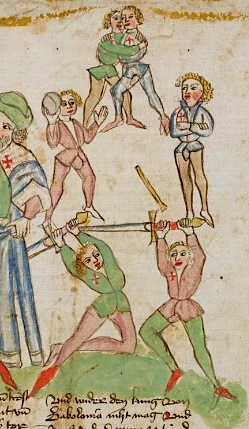 Petrus
Vergerius in the early 1400s similarly wrote how in war skills alone
were useless without the strength and endurance needed to bear the
rigors of campaigning. Equally, Alberti Battista in the mid 1400s
advocated: "In all training no end may be preferred to that of physical
soundness" saying "Games which require dexterity, endurance, strength,
qualities of eye and nerve, such as fencing…" were to be
preferred. A number of other 15th century humanist
writers on physical education also repeatedly stressed the importance
of muscular strength and conditioning. We might recall the
various images of weight-training in Medieval artwork showing heavy
stone lifting or throwing by fencers (similar perhaps to the modern
"medicine ball" exercise tool) as well as the use of heavy sticks
equivalent to later "Indian club" exercise tools.
Petrus
Vergerius in the early 1400s similarly wrote how in war skills alone
were useless without the strength and endurance needed to bear the
rigors of campaigning. Equally, Alberti Battista in the mid 1400s
advocated: "In all training no end may be preferred to that of physical
soundness" saying "Games which require dexterity, endurance, strength,
qualities of eye and nerve, such as fencing…" were to be
preferred. A number of other 15th century humanist
writers on physical education also repeatedly stressed the importance
of muscular strength and conditioning. We might recall the
various images of weight-training in Medieval artwork showing heavy
stone lifting or throwing by fencers (similar perhaps to the modern
"medicine ball" exercise tool) as well as the use of heavy sticks
equivalent to later "Indian club" exercise tools.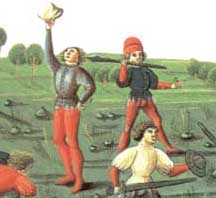
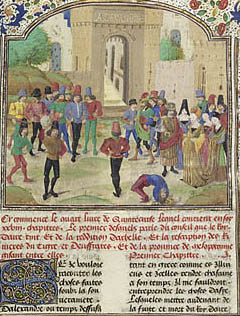
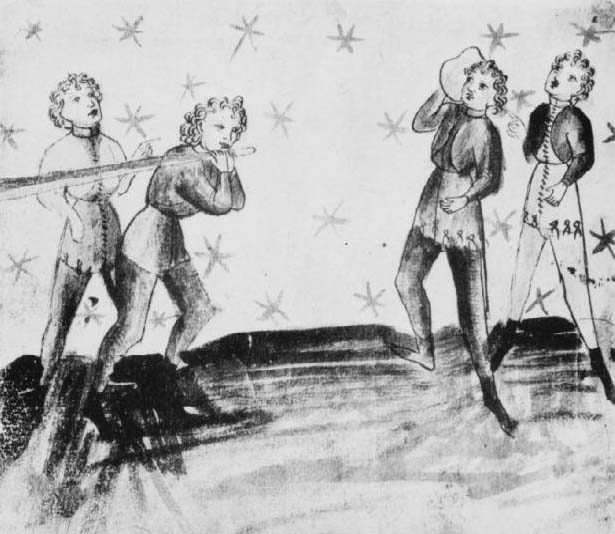
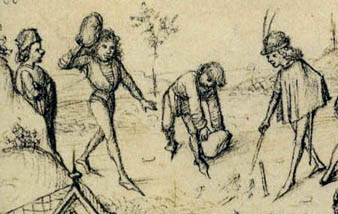 In German regions this stone tossing was later known
as, Schiessen der Stange. Another image from c.1531
of Fechters exercising outside shows them again wrestling,
fencing with two-hand swords and dussack, and preparing to toss
large stones. Castiglione in 1526 even advised "to cast
the stone" as being one of those exercises befitting a courtier
which, though not directly related to the practice of arms, held
"a greate agreemente with them." A late 15th century illuminated
image by Jardin de Vertueuse (J. P. H Getty museum, MS. Ludwig
XV 8, fol. 99) depicting the competition in Sittacene and the
placating of Sisigambis from the life of Alexander illustrates
the same familiar one-handed lifting of large round stones, and
hefting over the head of short wide sticks along with gymnastic
exercises.
In German regions this stone tossing was later known
as, Schiessen der Stange. Another image from c.1531
of Fechters exercising outside shows them again wrestling,
fencing with two-hand swords and dussack, and preparing to toss
large stones. Castiglione in 1526 even advised "to cast
the stone" as being one of those exercises befitting a courtier
which, though not directly related to the practice of arms, held
"a greate agreemente with them." A late 15th century illuminated
image by Jardin de Vertueuse (J. P. H Getty museum, MS. Ludwig
XV 8, fol. 99) depicting the competition in Sittacene and the
placating of Sisigambis from the life of Alexander illustrates
the same familiar one-handed lifting of large round stones, and
hefting over the head of short wide sticks along with gymnastic
exercises. 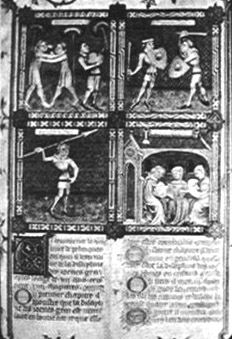
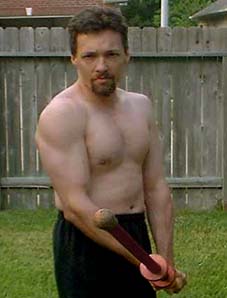 The core muscles that permit balance, coordination,
and agility are the keys for the development of superior
neuromuscular skills—critical for an activity like fencing
or wrestling. Interestingly, balance, coordination, and agility—elements
ideal for the functional capacity necessary for superior
fighting ability—are themselves largely independent of muscularity,
cardio-endurance, and even body-fat ratio. While weapons training
arguably works the arms and legs more than other areas of the
body, when performed correctly and with sufficient effort it also
holistically works the small muscle groups as well—the ones
that build stability and hold everything together. Thus,
many exercise experts today are more and more emphasizing core
conditioning, that is, not big muscularity and definition
or even aerobic endurance, but improved proprioceptive
awareness: neuromuscular conditioning for improved balance,
coordination, reflexes, and agility. These are the very factors
in higher martial arts skill. As our Renaissance forebears
knew, these elements of fitness are achieved through the practice
of arms combined with bodily exercises. There was nothing mystical
or preternatural about the spatial and temporal acuity achieved
from this.
The core muscles that permit balance, coordination,
and agility are the keys for the development of superior
neuromuscular skills—critical for an activity like fencing
or wrestling. Interestingly, balance, coordination, and agility—elements
ideal for the functional capacity necessary for superior
fighting ability—are themselves largely independent of muscularity,
cardio-endurance, and even body-fat ratio. While weapons training
arguably works the arms and legs more than other areas of the
body, when performed correctly and with sufficient effort it also
holistically works the small muscle groups as well—the ones
that build stability and hold everything together. Thus,
many exercise experts today are more and more emphasizing core
conditioning, that is, not big muscularity and definition
or even aerobic endurance, but improved proprioceptive
awareness: neuromuscular conditioning for improved balance,
coordination, reflexes, and agility. These are the very factors
in higher martial arts skill. As our Renaissance forebears
knew, these elements of fitness are achieved through the practice
of arms combined with bodily exercises. There was nothing mystical
or preternatural about the spatial and temporal acuity achieved
from this. 
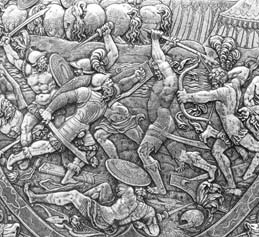 There's no question today that the vast
majority of historical fencing enthusiasts do not live a lifestyle like
that of our Renaissance ancestors. Perhaps compared to us now
they were less comfortable overall, or due to inferior medical science
less healthy in the long run, but mostly they lived more active
lives. Unlike us, they did not sit down for 10 to 12 hours a day
as we typically do and even simple tasks we now take for granted might
involve considerable physical labor. Everyday they walked most
everywhere, rode horses frequently, ate few sweets and plenty of fresh
(not canned or processed) vegetables and grains. It is understandable
then that a practitioner who might feel over weight, out of shape, or
because of lifestyle habits just knows they are not in the best
physical condition they could or should be, may find descriptions of
the importance of fitness in this subject intimidating or depressing.
That's unfortunate, for the purpose of this article is to explore the
historical role of fitness in Renaissance martial arts and place it in
proper context for today's enthusiast.
There's no question today that the vast
majority of historical fencing enthusiasts do not live a lifestyle like
that of our Renaissance ancestors. Perhaps compared to us now
they were less comfortable overall, or due to inferior medical science
less healthy in the long run, but mostly they lived more active
lives. Unlike us, they did not sit down for 10 to 12 hours a day
as we typically do and even simple tasks we now take for granted might
involve considerable physical labor. Everyday they walked most
everywhere, rode horses frequently, ate few sweets and plenty of fresh
(not canned or processed) vegetables and grains. It is understandable
then that a practitioner who might feel over weight, out of shape, or
because of lifestyle habits just knows they are not in the best
physical condition they could or should be, may find descriptions of
the importance of fitness in this subject intimidating or depressing.
That's unfortunate, for the purpose of this article is to explore the
historical role of fitness in Renaissance martial arts and place it in
proper context for today's enthusiast. 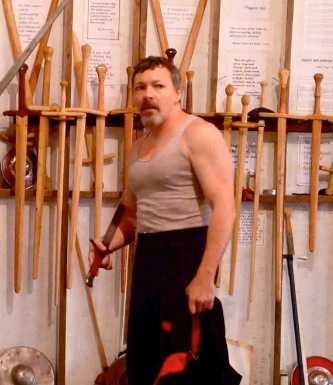 Every
serious practitioner of Renaissance martial arts today should
endeavor to have their own regimen of physical exercise (along
with a sensible diet) to complement their study and training.
Whether it consists of some weight lifting, aerobic exercise,
running, stretching, pilates, yoga, etc., is up to each student.
As the late-16th century Dutch protestant theologian, Francis
Johnson, stated, "I take the true definition of exercise to be,
labor without weariness." There are plenty of resources online
that can assist readers with advice and information for devising
a program (after consulting with a qualified physician). The bottom
line is to do something as an adjunct to your fencing.
Not being in good shape is no excuse for not beginning activities
that will help you get in better shape. In the end, practicing
a martial art is the best way to get in shape for a martial
art. Whether your weapon of choice is the largest two-handed
sword or the thinnest rapier, the exercise of the body goes hand
in hand with the Exercise of Armes.
Every
serious practitioner of Renaissance martial arts today should
endeavor to have their own regimen of physical exercise (along
with a sensible diet) to complement their study and training.
Whether it consists of some weight lifting, aerobic exercise,
running, stretching, pilates, yoga, etc., is up to each student.
As the late-16th century Dutch protestant theologian, Francis
Johnson, stated, "I take the true definition of exercise to be,
labor without weariness." There are plenty of resources online
that can assist readers with advice and information for devising
a program (after consulting with a qualified physician). The bottom
line is to do something as an adjunct to your fencing.
Not being in good shape is no excuse for not beginning activities
that will help you get in better shape. In the end, practicing
a martial art is the best way to get in shape for a martial
art. Whether your weapon of choice is the largest two-handed
sword or the thinnest rapier, the exercise of the body goes hand
in hand with the Exercise of Armes.