|
||||||||
|
|
||||||||
|
Anonymous late 16th Century German Fighting Guide - Codex Guelf 83. (c.1591) ARMA
Exclusive By Prof. Dr. B. Panconcelli-Calzia. Specialized German literature has some valuable manuscripts and books which provide an insight into the past of the German fencing arts since the 14th century. Recently, out of the vast amounts of text, a practical example came to me from the 16th century. It…shows beautiful hand-painted works and the great diversity of the subject. …I was able to wrest this gem from its sanctuary and release some of the enclosed paintings, resplendent in their original colors, for the first time. Let us…put ourselves on a 16th century fencing grounds. The manuscript will be our historical guide.
|
|
 |
|
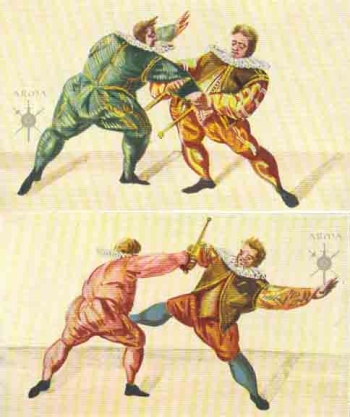 Let
us turn now to that part of the fencing-grounds where it is going notably
quiet and still. Aren't those boys each holding a dagger? Yes, and they
want to fence with them. There is no position taken, no greeting exchanged
- such formalities were completely unheard of until the middle of the
17th century - there are no overly lively or unnecessary movements made.
Each boy stalks and keenly observes his opponent every moment; it depends
on whether the man goes "high or low" at the other … "If
he goes high / you are allowed to get yourself nothing / and want the
parts / so you have in mind / freely take / But if he goes low / so have
yours in good wariness" ... says Master [Fabian von] Auerswald. A
movement from one of the fencers, to hit the opponent from above! Quickly,
he grabs the antagonist's right wrist, twists his arm around, so he loses
his senses, and stabs him in the thigh. Should the one fencer lose his
dagger or is surprised by an enemy while unarmed, he is then exclusively
dependent on the tricks of grappling. The second pair of dagger-fighters
have just shown a magnificent moment of this seemingly unfair fight; the
unarmed fighter grabbed the weapon-arm of his opponent with his right
hand, instantly bent it and through lifting his opponent's right leg to
the side, caused him to fall. Let
us turn now to that part of the fencing-grounds where it is going notably
quiet and still. Aren't those boys each holding a dagger? Yes, and they
want to fence with them. There is no position taken, no greeting exchanged
- such formalities were completely unheard of until the middle of the
17th century - there are no overly lively or unnecessary movements made.
Each boy stalks and keenly observes his opponent every moment; it depends
on whether the man goes "high or low" at the other … "If
he goes high / you are allowed to get yourself nothing / and want the
parts / so you have in mind / freely take / But if he goes low / so have
yours in good wariness" ... says Master [Fabian von] Auerswald. A
movement from one of the fencers, to hit the opponent from above! Quickly,
he grabs the antagonist's right wrist, twists his arm around, so he loses
his senses, and stabs him in the thigh. Should the one fencer lose his
dagger or is surprised by an enemy while unarmed, he is then exclusively
dependent on the tricks of grappling. The second pair of dagger-fighters
have just shown a magnificent moment of this seemingly unfair fight; the
unarmed fighter grabbed the weapon-arm of his opponent with his right
hand, instantly bent it and through lifting his opponent's right leg to
the side, caused him to fall. |
|
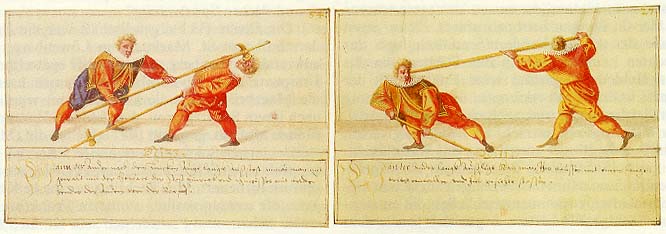
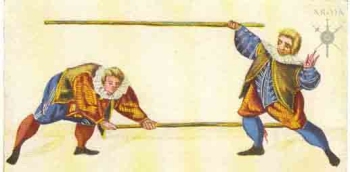 But
what kind of noisy activity is in the neighboring yard next to the fencing
grounds? There is also fencing going on here. These young men can only
practice outside, because their weapons are much too long. The long staves,
with which our lads in the yard fence, are the practice weapons for learning
the use of the long lance. In war, the men-at-arms also used shorter weapons
and they prepared themselves for these through the so-called half-staff.
Next to the boys with the half-staves stand others with halberds, which
because of their axe-blades - with which the enemy can be hooked - and
their points, were to be feared more in close-quarters combat than the
excessively long lance. But
what kind of noisy activity is in the neighboring yard next to the fencing
grounds? There is also fencing going on here. These young men can only
practice outside, because their weapons are much too long. The long staves,
with which our lads in the yard fence, are the practice weapons for learning
the use of the long lance. In war, the men-at-arms also used shorter weapons
and they prepared themselves for these through the so-called half-staff.
Next to the boys with the half-staves stand others with halberds, which
because of their axe-blades - with which the enemy can be hooked - and
their points, were to be feared more in close-quarters combat than the
excessively long lance.
It would be joyously welcomed, when next to the new [sport] weapons also the use of the old would be snatched from the past and again cultivated. Systematic attempts to revive the earlier German fencing arts were already started in 1924 by the author of these lines. The demonstrations, which always supplement the scientific lectures, were acclaimed by the audience, regardless if they were fencers or amateurs. If the fencing of the earlier Germans were to again gain respect and these fencing techniques properly cultivated, then could someone, for whom the modern sport-weapons show no promise, perhaps use two-handers, especially if he is stocky and strong, another, who is lighter and more agile, would probably decide on the dusack, etc. This should stay isolated not only for reasons relating to sports, but also for cultural history, for the cultivation and revival of old practices requires becoming acquainted with past cultural assets and so contributes to a deeper appreciation of the history of a people.
ARMA will feature more on this unique manuscript soon!
From Velhagen und Klasings Monatshefte, Jg. Berlin, 1926. Translation Copyrighted 2003 by Eli Combs. All righst reserved. |
|
|
|||
|
|
|||
|
|||
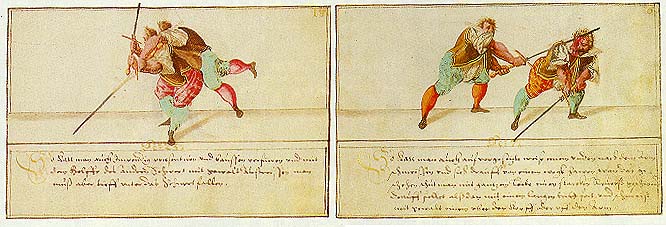
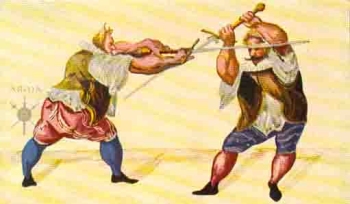 An
old man with a long beard and a martial look about him is the Master.
He leans against a staff and observes the fencers; they are simple, vigorous,
and agile people. Two boys get weapons. We don't believe our eyes…
they have barely laid both hands on the handles of the mighty swords,
and already they attack each other. There is no exchange of greetings,
nor did the one opponent wait until the other had taken his position.
The boys do not even wear masks! That is daring! … Let's settle ourselves!
The weapons are blunt, and the boys withstand a hearty blow. They must
get used to that, if they are not already, for they will have to endure
altogether different blows on the battlefield or during prize- and showfighting,
which will have to be parried with sharp weapons. How the boys dexterously
wield their two-handers! But they fence differently than we do today!
They do not wait until the opponent has executed his "action"
before parrying and only then answering, instead most parry a strike with
a counterstrike, as the boy on the left has just shown us. His opponent
planned a diagonal-strike to the torso, but he countered with his weapon
such that he not only parried the strike, but at the same time would hit
the opponents arm. But they already know about feinting as we use it today!
An
old man with a long beard and a martial look about him is the Master.
He leans against a staff and observes the fencers; they are simple, vigorous,
and agile people. Two boys get weapons. We don't believe our eyes…
they have barely laid both hands on the handles of the mighty swords,
and already they attack each other. There is no exchange of greetings,
nor did the one opponent wait until the other had taken his position.
The boys do not even wear masks! That is daring! … Let's settle ourselves!
The weapons are blunt, and the boys withstand a hearty blow. They must
get used to that, if they are not already, for they will have to endure
altogether different blows on the battlefield or during prize- and showfighting,
which will have to be parried with sharp weapons. How the boys dexterously
wield their two-handers! But they fence differently than we do today!
They do not wait until the opponent has executed his "action"
before parrying and only then answering, instead most parry a strike with
a counterstrike, as the boy on the left has just shown us. His opponent
planned a diagonal-strike to the torso, but he countered with his weapon
such that he not only parried the strike, but at the same time would hit
the opponents arm. But they already know about feinting as we use it today!
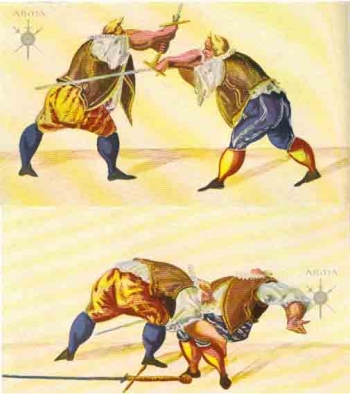 The
boy here on the right makes as if to hit his opponent on the head; he
had barely raised his sword when he received a mighty blow to the side;
it was a strike made with crossed arms. That must hurt, seeing as the
weapon is heavy and the blow was executed with full force by powerful
arms. The one that was hit cries out in rage at the deed, places his left
foot forward and lays his sword over the right shoulder, the blade hanging
down behind him. He wants to execute the so-called "Wrath Strike"
[Zornheib], which owes its' name to the emotional state of the
fencer. Should the blow land, it will cause much pain, for it comes with
a shattering force, but in reality it is not so dangerous, because it
must be held too far back and therefore easily allows for an intermediate
action! The boy, at whom such a strike is aimed, is indeed on his guard:
he escapes the wrath strike through a simple, deep bow and ducking at
the stomach. The heavy two-hander finds no resistance, rushes further
through the air, and pulls the fencer with it in a large arc; quickly
the defender lets a mighty blow fall upon the back of his opponent. Now
a wild chase develops! The boy that was hit jumps sideways here and there,
bends deeply until he almost touches the floor, then like a feather pops
back up, scrapes the opponent, makes an amazing amount of unbelievably
fast feints and attempts strikes, which - if they achieved their goal
- would be no pleasant touches for the opponent. But the young lad has
a sharp eye … and still we suddenly see him fall on his back. What
happened? His furious opponent was finally able to beat the opposing sword
with such force, that it was flung to the side. Quickly he threw down
his weapon, closed on his adversary in one leap and bent in a flash, grabbed
him behind the knees and threw him backwards to the ground.
The
boy here on the right makes as if to hit his opponent on the head; he
had barely raised his sword when he received a mighty blow to the side;
it was a strike made with crossed arms. That must hurt, seeing as the
weapon is heavy and the blow was executed with full force by powerful
arms. The one that was hit cries out in rage at the deed, places his left
foot forward and lays his sword over the right shoulder, the blade hanging
down behind him. He wants to execute the so-called "Wrath Strike"
[Zornheib], which owes its' name to the emotional state of the
fencer. Should the blow land, it will cause much pain, for it comes with
a shattering force, but in reality it is not so dangerous, because it
must be held too far back and therefore easily allows for an intermediate
action! The boy, at whom such a strike is aimed, is indeed on his guard:
he escapes the wrath strike through a simple, deep bow and ducking at
the stomach. The heavy two-hander finds no resistance, rushes further
through the air, and pulls the fencer with it in a large arc; quickly
the defender lets a mighty blow fall upon the back of his opponent. Now
a wild chase develops! The boy that was hit jumps sideways here and there,
bends deeply until he almost touches the floor, then like a feather pops
back up, scrapes the opponent, makes an amazing amount of unbelievably
fast feints and attempts strikes, which - if they achieved their goal
- would be no pleasant touches for the opponent. But the young lad has
a sharp eye … and still we suddenly see him fall on his back. What
happened? His furious opponent was finally able to beat the opposing sword
with such force, that it was flung to the side. Quickly he threw down
his weapon, closed on his adversary in one leap and bent in a flash, grabbed
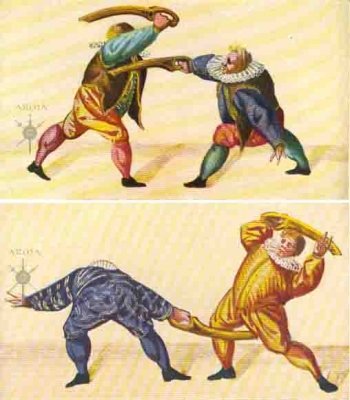
him behind the knees and threw him backwards to the ground. 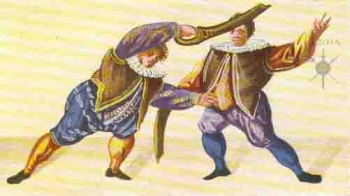 Now
we think, the fallen is lost, because the long weapon, which he is still
holding in his hand, would only hinder him in close-quarters combat [Nahkampf].
We err, for the early German fencers were so proficient at grappling,
that most of the time they show the same good performance as in fencing.
It was, however, not a Greco-Roman fight, but a grappling, in which all
holds were allowed without exception. In time, this style of grappling
fell into oblivion in Germany. Only at the beginning of this century as
it was introduced to Germany under the exotic name of jujitsu, did it
come again, like many other originally local things, to be honored. -
Our attention will now be claimed by another pair of fencers, who are
fighting with short and characteristically curved weapons. These are dusacks
made of wood. But what do we see? The one fencer parries with the left
hand and at the same time hits his opponent on the head! That is completely
consistent with the rules. Until the beginning of the 19th century the
left hand was always used, regardless if one fenced in the German or Latinic
style. In Romantic countries, and especially in Italy, in the 16th century
one even held a dagger or a cloak in the left hand. Approximately 70 centimeters
long and weighing one pound, the wooden dusack allowed for a relatively
fast moving match, also the strikes and parries were extremely varied.
Now
we think, the fallen is lost, because the long weapon, which he is still
holding in his hand, would only hinder him in close-quarters combat [Nahkampf].
We err, for the early German fencers were so proficient at grappling,
that most of the time they show the same good performance as in fencing.
It was, however, not a Greco-Roman fight, but a grappling, in which all
holds were allowed without exception. In time, this style of grappling
fell into oblivion in Germany. Only at the beginning of this century as
it was introduced to Germany under the exotic name of jujitsu, did it
come again, like many other originally local things, to be honored. -
Our attention will now be claimed by another pair of fencers, who are
fighting with short and characteristically curved weapons. These are dusacks
made of wood. But what do we see? The one fencer parries with the left
hand and at the same time hits his opponent on the head! That is completely
consistent with the rules. Until the beginning of the 19th century the
left hand was always used, regardless if one fenced in the German or Latinic
style. In Romantic countries, and especially in Italy, in the 16th century
one even held a dagger or a cloak in the left hand. Approximately 70 centimeters
long and weighing one pound, the wooden dusack allowed for a relatively
fast moving match, also the strikes and parries were extremely varied.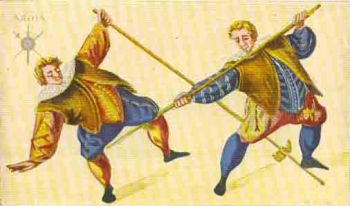 Jumping
forward, backward, and to the side, stalking the opponent, feinting, parrying
with the left hand, disarming the opponent through beating or grabbing
and holding the blade, all this was known to the German fencers of the
16th century. That this is how people fenced in Germany in the past, is
known by only a few today. With time, came changes. The perfection of
firearms on the one side, and the flourishing of the art of fencing in
the romantic countries, especially in Italy, exerted a profound influence
even in Germany. Long, heavy weapons could not prevail against a relatively
light weapon like the rapier. Rapier fencing quickly conquered the field
and maintained it. Already at the time from which [this] manuscript stems,
was Latinic rapier fencing quite common in Germany. German students also
settled their disputes of honor with the rapier from the middle of the
17th century until about the [1830's]. Also, the historical view brings
the proof, that the "old" Germans did not fence exclusively
in open spaces, without stalking and did not only utilize strikes.
Jumping
forward, backward, and to the side, stalking the opponent, feinting, parrying
with the left hand, disarming the opponent through beating or grabbing
and holding the blade, all this was known to the German fencers of the
16th century. That this is how people fenced in Germany in the past, is
known by only a few today. With time, came changes. The perfection of
firearms on the one side, and the flourishing of the art of fencing in
the romantic countries, especially in Italy, exerted a profound influence
even in Germany. Long, heavy weapons could not prevail against a relatively
light weapon like the rapier. Rapier fencing quickly conquered the field
and maintained it. Already at the time from which [this] manuscript stems,
was Latinic rapier fencing quite common in Germany. German students also
settled their disputes of honor with the rapier from the middle of the
17th century until about the [1830's]. Also, the historical view brings
the proof, that the "old" Germans did not fence exclusively
in open spaces, without stalking and did not only utilize strikes.