|
||||||||
|
|
||||||||
|
ARMA
Editorial – March 2009 By John Clements The interrelatedness of indigenous
fighting arts in
Renaissance Europe is a fact. Throughout the period of
the 14th to
17th centuries Masters of Defence traveled throughout
the regions of
Latin Christendom teaching and sharing their craft.
Arms, armor, and
associated
fighting methods were traded, copied, and employed
across lands and
countries.
Mercenaries from many regions fought all over Western
Europe for
different
kingdoms and princes, and traveling knights engaged in
tournament
events held
at courts throughout the continent and the British
Isles. The
source
teachings of Renaissance martial arts were also
preserved written and
illustrated works that at the time were brought all over
Europe and
studied by
different schools and teachers in many cities and
regions. Despite
their many
differences, the lands comprising Western Europe during
the Medieval
and
Renaissance period were linked by many factors. Kingdoms
and regions
were
interconnected by geography, by religion, by commerce
and sea travel,
by a
common Greco-Roman and Germanic heritage, by blood ties
between
nobility, and
by common enemies.
Given the historical interrelatedness
of Renaissance
martial
arts practice, it is therefore very difficult today for
any one
nationality or
ethnic grouping to make claims of ownership or privileged position
over the newly
emerging study of historical
European combat teachings from the Renaissance era.
Except in certain
instances, when referring to the writings of regional
masters and
authors from
the Renaissance it is not possible to any large degree
to consider
modern
people in any modern nation-states the caretakers or
repositories for
any of
these lost teachings. The succeeding generations of
cultural and ethnic
changes
have rendered most of the people very different than
who they were five
or six
centuries ago when these forgotten skills were
actively taught and
practiced.
Some modern nations as we now know them did not even
exist as political
entities at the time. Modern nationalism and nation
states did not
emerge until after the period of the
Renaissance—when
its traditional
fighting methods and military technology had already
drastically
changed. In
almost
all cases, the people or ethnic group that once
resided on a portion of land or in a city where a now
lost fighting
method was
at one time practiced or a historical master of arms
once lived are long
gone. They have changed appreciably during the
intervening centuries.
The
migrations, the interbreeding, the upheavals, wars,
plagues, and
religious
conflicts have heaped massive change on nearly all of
them. Some of the
original source teachings under study today even come
from regions or
kingdoms
or ethnic groupings that no longer exist because the
turmoil of
centuries have
since changed the old borders and original populations
many times over.
For example, the old Holy-Roman Empire, under which most of
these arts
flourished, no longer exists. The
inhabitants who now happen to be living on a spot of
land or speaking a
certain
language today are not necessarily descended from the
same ones as
those who
were there 500 or 700 years earlier. The
martial arts
formerly
associated with their distant ancestors were not
retained or preserved
as part
of any national tradition or local custom. Study of the enormous surviving
instructional material on
the vanished martial arts of Renaissance Europe presents
no real
cultural
barriers to understanding the self-defense ideas and
combative elements
it
contains. Thus, for example, it hardly matters that a
particular
master’s
manuscript or book was produced in Venice in 1580, or
that a fight
instructor
in 1540 was a Lombard commoner, or was a Swiss German
nobleman in a
region of
Bologna ruled by the Spanish monarchy, or was a Milanese
residing in
London. Our ability to
study and
reconstruct this material can neither be credited nor
discredited
because of
who our forebears once were or where we now live. There
is no such
thing as
“genetic knowledge” when it comes to cultural
traditions. Given that these are extinct cultural practices that were not exclusively linked to any one national identity, efforts to study them now must identify with the Art rather the geographic source of the teachings. Therefore, no current nation or country can claim a special connection to reviving and reconstructing a lost tradition by mere right of the literature being in their root language or having once been taught and practiced in the same region. This is even more so if the craft was never preserved intact nor in any meaningful way retained in the locality. To
argue
otherwise is akin to imagine
what if Shakespeare’s plays had only recently been
rediscovered and had
not
been performed in centuries, then claiming that
because a person today
speaks
English and lives in Stratford-upon-Avon they are
somehow inherently
more adept
than anyone else at being a Shakespearean scholar or a
Shakespearean
actor. It
doesn’t work that way. Would someone today be so
idiotic as to suggest
you can't be an Egyptologist without being from modern
Egypt now? Or,
consider
that while ancient geometry
texts are now open source works in the public domain,
understanding of
them is ultimately a matter of each individual's own
capacity for
learning and aptitude for mathematics. Modern Greeks are
not privy to
special insight or access into them by virtue of their
being indirect
descendants and cultural heirs of the
authors. Rather, skill in
knowing geometry is most accessible to those who today
have the better
method of educational training and better means of
learning its
practical application.
The same is
true of the literature on Renaissance combat
skills. While particular historical combat
teachings
can be attributed to
an author of a particular city or region, it ultimately
represents one
example
of the diverse combat arts from an entire historical
epoch. The
surviving
source works are the embodiment of the combat teachings
of an era, not
a single
nationalized ethnically-based tradition (if there even
was such a thing
in the
Renaissance). An ethnocentric or nationalistic
approach to
practicing the
craft today is therefore not really feasible. This also
helps explain
why over
the past 150 years no fencing masters from any modern
European nation
have been
able to recover their lost Renaissance martial arts
heritage as their
own. The
reason they failed was not racial or language
deficiencies, but lack of
understanding about the proper biomechanics of
self-defense in the era
combined
with inexperience in the core principles using the arms
and armor
widespread in
the age. They approached the subject much too narrowly
and from a
contemporary
martial culture too far removed from the original. (One
might even make
the
argument that in particular countries modern peoples
have a far
stronger
connection with the world of 19th century
fencing masters
than they
do to the milieu of Medieval and Renaissance fighting
men. Yet, those very same
Victorian masters
revealed their huge cultural gap with these antique
traditions of close
combat
when they repeatedly expressed a profound ignorance and
naiveté over
the nature
of earlier teachings.)
For example, in what is now modern
Germany
and Italy, just
as for everywhere else, there are no surviving
traditions for teaching
or
practicing this craft as an authentic martial
discipline. Instead, it
is all a
new process of discovery for everyone involved no matter
where they are
located. No single community has the authority or
expertise to make
claim as
the sole representative of extinct teachings that only
in the last ten
years
have started being seriously exploring as a legitimate
martial art.
(And for
many enthusiasts, doing it as something more than just
costumed
reenactment and
theatrical display is itself a recent phenomenon.) So, a line of reasoning cannot
be offered that only
members
of a particular cultural, ethnographic, or geographic
region have a
connection
now to these forgotten traditions—ones which for
centuries were
practiced
by fighting schools and fencing teachers across Europe.
We can also note that both modern
sport
fencing associations
and traditional Asian martial arts styles each have
histories of
rivalry and
bickering over who has authority over lineage and
tradition within
their own
respective circles. So, it should be even easier to
understand the
impossibility of any authority being in sole charge of
studying any
aspect of
the lost historical fighting arts of the Renaissance. And yet, if a particular
European town had a unique
connection to an actual historical Fechtschule or Master
of Defence,
and had
archeological evidence of its physical existence and
actual practices,
it could
be an interesting matter. This would require a group of
organized
practitioners
in the same historical location following original
indigenous sources,
using a
sound approach and methodology of study, and being
officially
recognized by
their own government as pursuing the goal of
resurrecting a local
custom as a
national tradition. Then in time they could make a case
for their
having some
authority in their effort at cultural reconstruction and
revival.
Whether or
not they could achieve any respectable martial skill or
insight is
another
matter entirely. At the very least, such an
endeavor would be a
new and
bold experiment in historical fencing studies.
(Provided, that is, they
could
keep up martial standards and suffer through the state’s
interference
in
turning efforts into just another Klopfechter tourist show. Avoiding
the bureaucratic
temptation toward diminishing
effects of sportification and popularization is no
easy task.) As an emerging field of study, Renaissance martial arts has only recently started being seriously explored by all manner of groups and individuals from a wide spectrum—none of which can make an ethnological or nationalistic claim to some aspect of this study by virtue of geography or custom. There are dozens of efforts now underway in a dozen or more countries all relying on the same materials, but very often viewing them with quite different attitudes and approaches, as well as studying it with disparate motives, goals, and methods. Often this results in wildly divergent opinions on key elements such as basic footwork and postures amid other essential factors. This then begs the question; by what argument could anyone make the assertion that they are a worthy to authoritatively represent a fighting discipline of which we are all students and all collective inheritors? What we work toward recovering and preserving is, in effect, an intangible cultural heritage. Given that this is a craft which has not been in existence for centuries the logical conclusion that must be reached is this that subject is open to nearly anyone who puts in the combination of physical demonstration and academic effort—the pairing of martial skill with scholarly research. And that is solely how credibility should be judged. |
|
|
|||
|
|
|||
|
|||
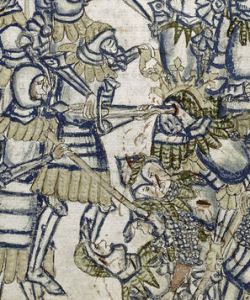

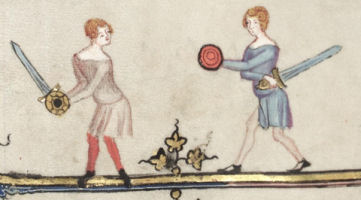
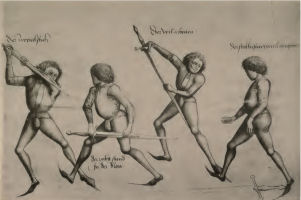
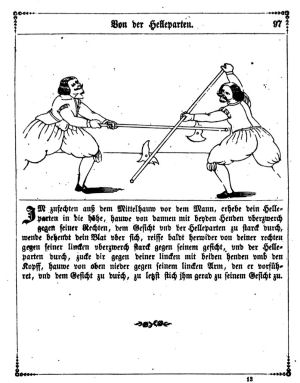
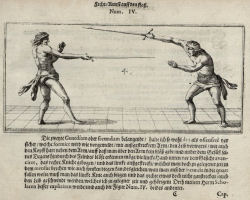 Ultimately,
we have only a few dozen major sources on
Renaissance martial arts that we must all study. These
materials are
almost
entirely 14th and 15th century German, and 15th and 16th
century
Italian and
German, along with some 16th and 17th century English
and Spanish works.
Ultimately,
we have only a few dozen major sources on
Renaissance martial arts that we must all study. These
materials are
almost
entirely 14th and 15th century German, and 15th and 16th
century
Italian and
German, along with some 16th and 17th century English
and Spanish works.