Name that cut?????

For Historical European Fighting Arts, Weaponry, & Armor

Moderators: Webmaster, Stacy Clifford

User avatar
JeffGentry
Posts: 1089
Joined: Tue Apr 20, 2004 8:35 am
Location: Columbus Ohio

Name that cut?????

Postby JeffGentry » Sun May 01, 2005 4:59 pm

Hello Folk's


What is a rising/under cut after you do Zornhau called?

I am starting this thread at J.C.'s request, We had an interesting discussion on this at his class this weekend.

Why are the Oberhau's named, and we only have the name Unterhau for all the Under/rising?

Does it make sense that the master's named only the Over cut's and not the Under/rising cut's?


Or were the Under/rising cut's named and we have not interprated something right?

Any opinion's or thought's on this?

Jeff
Semper Fidelis

Usque ad Finem

Grace, Focus, Fluidity

User avatar
Mike Chidester
Posts: 160
Joined: Mon Oct 28, 2002 1:27 pm
Location: Provo, Utah
Contact:

Re: Name that cut?????

Postby Mike Chidester » Sun May 01, 2005 7:51 pm

What I've always been taught is that each Oberhau has a corresponding Unterhau. So the cut you desribe is simply an Unter-Zornhau. Likewise a cut from Vom Tag to Alber is a Scheitelhau, and a cut from ALber to Vom Tag is an Unter-Scheitelhau.
Michael Chidester
General Free Scholar
ARMA Provo

"I have met a hundred men who would call themselves Masters, and taking all of their skill together they have not the makings of three good Scholars, let alone one Master."

User avatar
JeffGentry
Posts: 1089
Joined: Tue Apr 20, 2004 8:35 am
Location: Columbus Ohio

Re: Name that cut?????

Postby JeffGentry » Sun May 01, 2005 7:59 pm

Hey Mike


If that be the case then why do the manuel's not refer to them as such, we see strike a zornhau why do we not see strke an unterzornhau?

and why do they not list them or describe them as such?

are we not seeing something or are we mis translating something?


Jeff
Semper Fidelis


Usque ad Finem


Grace, Focus, Fluidity

User avatar
Jake_Norwood
Posts: 913
Joined: Thu Sep 19, 2002 11:46 am
Location: Clarksville, TN

Re: Name that cut?????

Postby Jake_Norwood » Sun May 01, 2005 8:54 pm

The masters largely discourage unterhauen except as a movement following a bind. They don't like them, I think. Off the top of my head, here's some named unterhauen:

-Unterhau (duh)
-Das Gayszlen (Talhoffer)
-Zwerch (yes, in Doebringer and Meyer both the zwerch occassionally rises, and is referred to as an unterhau of sorts)
-Veller (Doebringer)
-Wechselhauw (Talhoffer and Meyer; starts as an unterhau)
-Kurtzhauw (Meyer, Ringeck. Starts as an oberhau, becomes an unterhau)
-Windhauw (Meyer)
-Two of the four schnitt are from below--this is the only place that the unterhau is listed as a technique in Liechtenauer, excepting some of the techniques in Ringeck, etc.
-Meyer, in his section on fighting from zornhut, details a zornhau-unterhau combination. And that's what he calls it. Oberhau (or zornhau, I forget which), and unterhau with the long edge. That's it.
-Drey Hewe (Doebringer-contains two unterhauwen, one from each side, and called as such: simply "unterhauwen." I'll add, also, that once the text starts moving in most of these manuals the term "zornhau," "Scheitelhau," and "krumphau," etc. all get replaced by simply "oberhau, unterhau, and zwerchau. The names of techniques are not necessarily the way that they described what actually happened in a fight (interesting, no?)).

I don't think that we're missing anything, as much as we're trying to find something that isn't really there. The unterhau appears to have been used as an action from the bind, and that's just about it from the source materials. It doesn't appear to be as universally useful of a technique as the others in their opinion--they didn't name every aspect of it unless they had found a particular use for a particular variation on it.

We also have to remember that the "8 cut diagram" does not appear in any of the Liechtenauer treatises...CW has something similar, and Meyer actually has one, but even there Meyer only writes "unterhau." So for the first 200 years of recorded German swordsmanship we don't see them recording anything quite like the Italian segno--they didn't see swordsmanship that way, I think. The geometry of the "German Tradition" is much more complex than that--footsteps come on trianges, attacks close lines of attack for defense almost as a higher priority than simply attacking (making a seemingly all-offensive style of fighting possible, acutally). The diagram in CW shows a few useful lines of attack...and along the lines of an unterhau he shows a DAGGER, not even a sword. Interesting, no? Especially since he doesn't show anything like an unterhau but lots of stabs to the belly. Not a coincidence, I think.

Add to this the "complication" that the German unterhau appears to have frequently been pretty high up, along the lines of hangen, and you have a pretty dramatic re-working of what the unterhau was, and what it might not have been.

Also, the reference to "unter-zorn-hau," etc., is (I believe) a modern thing, trying to fill the gaps in this very issue--how to name the variations on the unterhau, which seems to be a less popular attack amongst the masters.

Please understand that I'm not saying "there is no unterhau," but rather, "It is what it is, not what we want it to be for our modernly organized minds."

Jake
Sen. Free Scholar
ARMA Deputy Director

User avatar
Mike Cartier
Posts: 594
Joined: Mon Sep 23, 2002 12:21 pm
Location: USA Florida

Re: Name that cut?????

Postby Mike Cartier » Mon May 02, 2005 7:02 am

Flugelhau is also a unterhauen
Mike Cartier
Meyer Frei Fechter
www.freifechter.com

User avatar
JeffGentry
Posts: 1089
Joined: Tue Apr 20, 2004 8:35 am
Location: Columbus Ohio

Re: Name that cut?????

Postby JeffGentry » Mon May 02, 2005 11:00 am

Hey Jake

I wonder if you see what i am getting at?


-Zwerch (yes, in Doebringer and Meyer both the zwerch occassionally rises, and is referred to as an unterhau of sorts)


Ok there is an odd idea a zwerchau that sort of rise's.

HMM Zwerchau is an Over strike?

Doebringer quote: "Here note that the Krumphaw is an Oberhaw that goes well out to the side with a step, and then goes in a crooked manner to one side"

Could this not indicate a somewhat rising cut?

Not the traditional "windshield wiper".

Jeff
Semper Fidelis


Usque ad Finem


Grace, Focus, Fluidity

User avatar
Jake_Norwood
Posts: 913
Joined: Thu Sep 19, 2002 11:46 am
Location: Clarksville, TN

Re: Name that cut?????

Postby Jake_Norwood » Mon May 02, 2005 12:31 pm

No, Jeff. I know the argument you are referring to. Although John has some unanswered points, the unterhau he's referring to has lots of names--and none of them are krumps.

Also, the zwerch is not an oberhau--at least it isn't called that. It's a zwerch, moving along the line between.

Jake
Sen. Free Scholar

ARMA Deputy Director

User avatar
Jake_Norwood
Posts: 913
Joined: Thu Sep 19, 2002 11:46 am
Location: Clarksville, TN

Re: Name that cut?????

Postby Jake_Norwood » Mon May 02, 2005 7:02 pm

I posted this once and lost it already (the problem with big posts), but here's what I have to say about the Krumphau, based on what the masters say about it, and what they show about it. My conclusions are that the Krump is an oberhau, with a clearly descending trajectory, where the point is projected out in front of the face, not receeded over the head, and where contact with the enemy's weapon or body comes from the side and from above. Also that the "unter" krumphau that I believe you are referencing as the "new krump" is in fact another strike alltogether, called the "kurtzhau" by Ringeck, Meyer, etc. and the "Veller" by Doebringer.

First Talhoffer. Tafel 19, the the "quick crooked strike" (or Krump) is illustrated thusly:

Image
Note that the krumper (the guy on the left) has his blade clearly positioned *over* his opponent's blade, not under it. What's more is that the follow-on strike, found also in Ringeck, etc., requires that the initial krump land on top of the opponent's weapon. Talhoffer illustrates the follow-on strike in Tafel 20 (the guy on the right this time):

Image

Now we move onto Liechtenauer with Goliath's Glosa:

"Text on the Bend Strike with its plays

"Bend out nimbly, throw your point to the hands, Bend to whom would attack, striding allows many strike.

"Glosa
"The bend strike is one of the four displacements against the four guards, in that with it one breaks the guard named the Ox, and it thus also drives onto the Over and Under Strikes. When you come to him in the pre-fencing, if he stands against you holding his sword before his head in the guard of the Ox, on his left side, then put your left foot forward, and hold your sword on your right shoulder, in the guard, and burst with the right foot, well to your right side against him, and strike in with the long edge, from crossed arms, over the hands." (http://www.schielhau.org/goliath.p21-40.html#p35)

Here's the acompanying illustration. It is exceptional in that it shows the krump mid-strike, instead of at the normally illustrated "nearly complete" position. Note the extended arms and fully extended point. Also note that *this* his how you break the ochs--not by coming in underneath it. Instead you hit your opponent from the side in his arms. If he strikes out or thrusts from this position the line of attack is closed off by the sweeping nature of the krumphau. Thus it ensures defense while attacking--the perfect meisterhau. The krumper is on the left, his opponent, in Ochs, on the right:

Image

Now Ringeck,

(Lichetenauer says:)"Use the Krump with agility, aim the point at the hands.

(Ringeck comments:)"This is how you should aim a krumphaw at the hands: when he attacks yo ufrom his right with an ober or unterhau at the opening, leap with your right foot toward his left sdie and simultaneously strike his hands with your arms crossed, using the tip of your sword. You can also use this if he is in ochs.

(Lichetenauer says:)"Use the Krump and deflect with a step, then he will strike last.

(Ringeck comments:) "This is how you can deflect strikes from above using the krumphaw. If he strikes at you with an oberhau from his right at your opening, then leap to his left side with your right foot and move the tip of your sword over his sword to a schrankhut. Practice this on both sides. From the deflection you can strike at his head." [That, BTW, is what Talhoffer shows on Tafel 20]

Then Ringeck goes further to describe exactly what I believe you are doing:

(Lichtenauer says:) "Do not use the Krump, strike short (kurtzhau) and change through; that will work.

(Ringeck comments:) "If he leads with an oberhau from his right shoulder, proceed as if you want to bind his sword with a krumphau, but let your strike fall short and guide your point through under his sword and wind your hilt over your head on your right, then thrust at his face."

(Translation by D. Lindholm, pages 58-61; Tobler's and Bellenhausen's say the same thing)

And then Doebringer (Lindholm's translation)...

"This is on the Crooked strike [Krumphawe]

"Go crooked [Krump] with skill and throw the point at the hands, strike crooked [Krump] at he who sets well, with steps you will hurt many strokes. Strike [Krum] to the flat of the master when you wish to weaken him.

[Now this following paragraph covers the Kurtzhau, which is what I think you're doing, more or less]

"When it flashes above step away that I will applaud. Do not [Krum] short strikes changing through [Durchwechsel] thereby do [Krum] whoever wishes to deceive you the noble war will confuse him, so that he does not know if he is out of danger.

"Glossa. Here note that the crooked strike [Krumphaw] is an upper strike [Oberhaw] that goes out well to the side with a step, and then goes in a crooked manner to one [the other] side. Therefore Liechtenauer means that if you wish to do this strike well, you shall step well out to the right side as you strike. And you shall throw or shoot your point in over the cross guard at the [opponents] hands. And you shall strike with your flat, and when you hit the flat [of the opponent’s sword?] you shall remain on it with strength and push firmly and see were you can easiest and straightest hit him with strikes or thrusts or cuts and you shall not strike too short and not forget the changing through [Durchwechsel ] were it is suitable to do it.

[Continuing, Doebringer has a "veller" which fits the bill of this so-called "new krump" quite well also.]

"26V
"A strike is called the feint/error [Veller] and it comes from the krumphaw and it is described after the cross strike (zwerchhaw) which is described firstly and it shall be before the cross strike. And it goes krumt from below and is shot in over the cross guard at him by shooting the point just as the krumphaw from above and down."

And now Meyer:

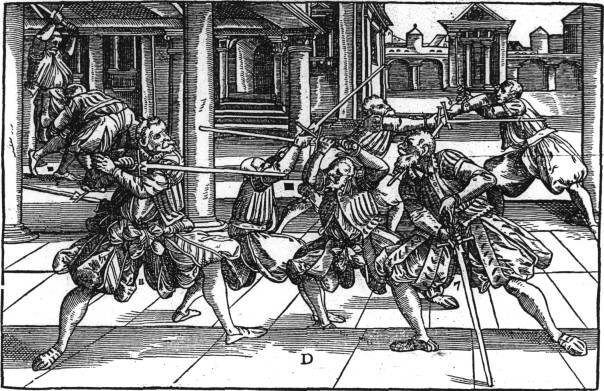
"Krumphauw

"This strike is described thus: stand in the Wrath Guard with your left foot forward, when your opponent strikes, step with your right foot fully away from his strike and against his left side, strike with the long edge and crossed hands against his strike, or between his pommel and blade, diagonally over his hands, and fully overshoot his arms to lay on the blade, as shown in illustration D by the figures on the upper right hand side."
Image
Again, see that the krumper (upper right, right figure) has his blade clearly *above* his opponent's. Not underneath.

I again add what I think that you are doing, from Meyer, which he, Ringeck, and Dobringer all say comes from the krump, but is not a krump: the veller or kurtzhaw (short strike)...

"Short Strike

"This is a secretive attack, and is described thus: when your opponent strikes you from above, stand as if you would respond with a Bend Strike, that is to bind his sword with the half edge, but let it fall and drive through under his sword, strike with the half edge and crossed arms over his right arm to hit his head, thus you have closed off his sword with the long edge, and accomplished the Short Strike, and stand as is shown by the smaller figure (mid background) on the left of illustration B fighting against the right."

(Rassmussen's Translation: http://www.schielhau.org/Meyer.p12.html)

Dobringer, Ringeck, Goliath, Talhoffer, and Meyer all say that the Krump is an oberhau. They all (but Talhoffer) also show a move which is specified as not being a krumphau but which resembles it and begins using it, the kurtzhau (Dobringer calls it a Veller). That, I believe, is the move that you are doing. Thus the question "what do we call that unterhau" can be answered without mistakenly (I believe) labelling it as a krump.

Comments and counter-arguments are appreciated. I can be dissuaded (as the recent Sturzhau agrument proved), but I better see something that somehow nullifies all the above sources along with those that I didn't cite, but which nonetheless present the krump the same as above.

Jake
Sen. Free Scholar

ARMA Deputy Director

User avatar
Matthew_Anderson
Posts: 335
Joined: Wed Sep 24, 2003 5:57 pm
Location: Virginia Beach, VA

Re: Name that cut?????

Postby Matthew_Anderson » Mon May 02, 2005 7:51 pm

Jake,
Your whole analysis of the Krump seems right on to me. I have always thought of the short strike as a sort of feint that starts like a Krump but you end up under his blade instead of on top. Then you can change through and thrust or even cut with a short edge unterhau to the hands or arms, (although I believe Ringeck says to thrust to the face). Anyway, I can see how this variant of the krump could be seen as an unterhau, but really, it still starts from above. Of course, you can certainly perform an unterhau starting in left schrankhut or nebenhut that can end up working something like a krump and looking similar in that the hands are crossed at some point. Ringeck comments on several versions of this technique and really, the effect is very similar to the Krump but he never calls it that.
Matt Anderson
SFS
ARMA Virginia Beach

User avatar
ChrisThies
Posts: 77
Joined: Sat Feb 08, 2003 8:54 pm

Re: Name that cut?????

Postby ChrisThies » Mon May 02, 2005 8:21 pm

What is a 'Flugelhau'?
{Good fencers make good neighbors}
Christopher Thies

User avatar
Randall Pleasant
Posts: 872
Joined: Mon Sep 23, 2002 3:35 pm
Location: Flower Mound, Texas, USA

Re: Name that cut?????

Postby Randall Pleasant » Tue May 03, 2005 2:10 am

Jake

I too agree with your analysis of the Krump and believe that a Krump is always an Oberhau. I can not see any way in an Unterhau could be categorized as a Krump. I would consider any Unterhau made by crossing or uncrossing the hands to be a "Zwerch to the Pflug" (see Lindholm, page 80), which is illustrated in the following image from Goliath. This Zwerch to a lower opening can be almost verticle.

<img width=600 height=800 src="http://www.thearma.org/Manuals/Goliath/62.jpg">
Ran Pleasant


Return to “Research and Training Discussion”

Who is online

Users browsing this forum: No registered users and 7 guests


Note: ARMA - The Association for Renaissance Martial Arts and the ARMA logo are federally registered trademarks, copyright 2001. All rights reserved. No use of the ARMA name or emblem is permitted without authorization. Reproduction of material from this site without written permission of the authors is strictly prohibited. HACA and The Historical Armed Combat Association copyright 1999 by John Clements. All rights reserved. Contents of this site 1999 by ARMA.