At this year’s April, through Lancelot I made contacts with the famous American blade smith Michael ‘Tinker” Pearce. After some e-mail exchange, I ordered through the service of Lancelot. The second sword was finished before the first sword is done, as there was an accident that ruined the first blade, which is featuring hollow grind. So the second sword arrived first, and the first sword is still being made when I am writing this review.
After talking with Michael about some design and ideas that I though on sword, he gave me some very good opinion and answers helpfully. After the final design was confirmed, I waited for my dream sword to arrive.
A few days ago when Michael said that my sword had been shipped I had been anticipating, as I wasn’t at home on that very morning, I went to the express company by myself at night.
I felt strange when I got the box. Why wasn’t the box locked? And oh – it was the scabbard! And when I open it, there’s another big surprise. The sword was in the scabbard, while Michael didn’t ship like that. It must be somebody!
The tip was not bent when I pulled the sword out from the scabbard. The handling sensation is nice, but the guard and pommel was completely different from what I have been expecting. I wanted a 10 inches long arc type guard while it turns out to be a cruciform, and the block like scent stopper didn’t came up as expected… The unexpected design actually fit the sword practically with very nice effect; one can easily use the sword with these fitting. The thing that I was too happy about is that there’s no ricasso, of which I have noted in the design. So some fingering techniques cannot be used safely.
Although there are some surprises to me, at the same time, Michael seems to have knew what I really want. He actually improved the designed a lot, and had fitted my expectation of “A war sword in high medieval field that can be used against armour, or as a civilian self defense weapon, which can be used against all manner of weapon.” The design of purely straight, width diminishing from forte to tip blade guaranteed a good thrusting blade (due to the good supporting power), while it also weakened the cutting power. Michael designed it nicely; he kept the tip portion wide enough while gradually increase the width of the blade down to the forte. This means the blade has considerably power against armour while can also work well in cutting. Or to describe in a much better way, the blade has a concave taper profile. This is much smarter than my original design; again I am much appreciated Michael’s sophisticated skill.
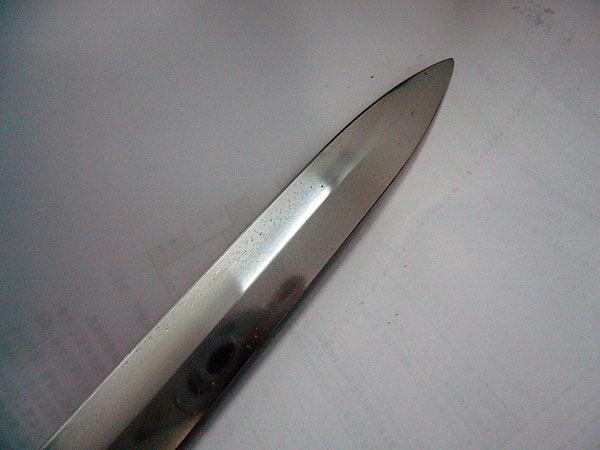
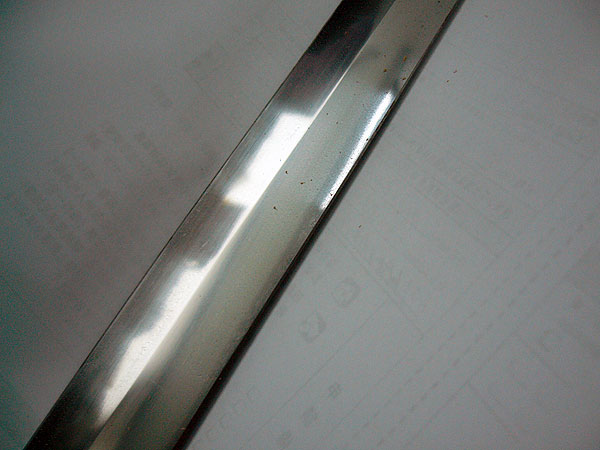
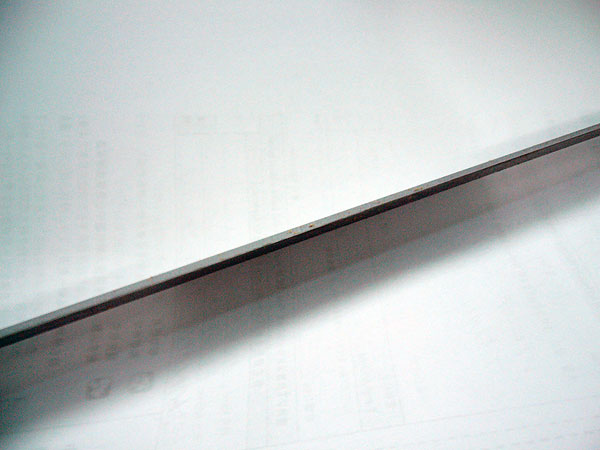
The blade is in diamond cross section with slightly convex curve. The secondary bevel is very sharp, I would know the power of it when I test cut later. The cruciform guard and the pommel are nice, only that there are some scratches and some weird blade spots. Perhaps they are some minor rusting. Comparing to the parts made by casting, the parts made by stock removal, although have flaws, still look better. Perhaps it’s due to the regular scratching effect due to grinding.
The look of the sword is marvelous. Although there are some minor unbalances on the appearances in some very small places, still they are not problem. The most noticeable thing is the fuller, one of the fuller was quite obviously unbalanced, it looked awkward when fitted with the guard. But still it’s not a big problem. The actual error is in between 0.5mm to 2mm.
Handling the sword, aside from that “solid” feeling, I also feel that the sword is reliable. This is a war sword, both the length and weight are close to the upper limit of long sword. It’s sturdy and useful: Like other medieval swords, there is no fancy decoration. But the simple yet elegant construction let us feel that it is “honest” and “reliable”. Or, is the sword actually like it’s owner? I feel that the sword expressed my personal character, big and solid, not caring much about little fuss.
After talking about the design I shall talk about the data. It’s length is about 47 inches, weighted 3.55 pounds, CoB from guard at about 4.5 inches and with a handle at about just a bit more than 10 inches long. Base thickness at 8.5 mm and is 2mm at the tip. For those of you who are familiar with the figure of Tinker’s sword, his swords are usually much lighter than this. The large figures are due to my personal flavour in design.
These figures also indicate that the sword has a very solid construction. Although it’s lighter than my practicing weapon, the balance is much more to the tip and, for having not been practicing for a month and a half, I cannot push the speed limit to maximum. Michael had materialized the idea of “Harmonic balance” and “Dynamic balance”. To say the main reason, the sword is balanced well that the vibration of the sword is greatly reduced to a point that when the blade alignment change in a certain motion, the required energy is greatly reduced as the efficiency of energy transfer is extremely high. Also because of the weight and balance, after casting the sword out it would automatically and gracefully finish off the cutting motion. Unless the action is wrong, or the recover from a strike would be very comfortable. The sword is perfect on maneuverability and controllability. It’s no need to talk about thrusting, the straight, uninterrupted thrusting motion gave me a sensation of freedom…
To conclude, I would describe this sword as “living”. This sword is like that it actually lives. When you handle it you would feel that the sword actually has life in it. With the communion with this sword, one can experience the law of swordsmanship. It just likes a good friend in life. This “lively” feeling may due to the minor flaws of the sword, or the skill and the heart of the craftsman. This wonderful sensation cannot be expressed with words at all.
############################################################################################
This is the report on the test cutting of the sword. In this experiment, two swords were tested. The first sample is from the Albion Swords LTD, the Brescia Spadona from the Museum Line. The second one is the Tinker-Alfred War-sword No. 2.
The set up of the experiment is a target on a non fixed PVC plastic tube, with leather wrapped. This allows some diversion of force after the cutting. Of course, live targets would not diverge the force after being cut. So this set up can be said to be more challenging than a live target.
The target in this experiment is pork. Aside from the usual pork arm, pig heads were also prepared. Pigs’ constitution is tougher than human.
Result of the Brescia Spadona:
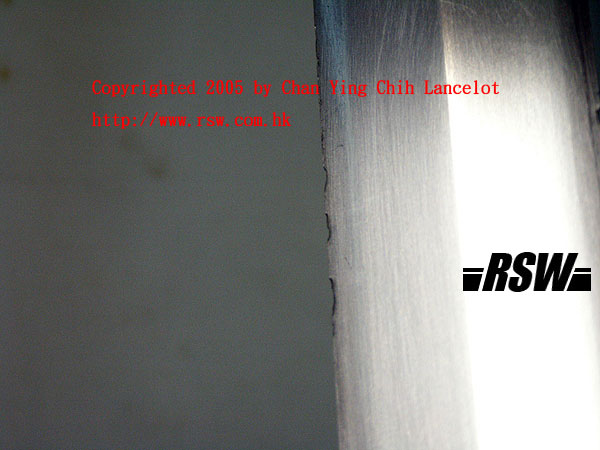
Pig’s head: The cut can cut into the cheekbone. The edge was extensively damaged and became serrated.
Result of Tinker-Alfred War-Sword No.2:
Pork arm: No matter if it is a diagonal cut or a vertical cut, the strike cut into the arm with tissue connecting the remains. The last strike, aside from completely cutting the pork arm into two, also split the leather wrapped PVC tube clearly.
Pig’s head: Every cut can cut deep into the cheekbone, not observable damage on the edge afterwards. The thrust sliced the tissue upon contact. After cutting, the thread of cord-wrap handle was loosed out.
Conclusion:
The Tinker-Alfred War-Sword No.2 performed better than the Brescia Spadona, in both cutting performance and durability.
The damaged edge of the Albion Brescia Spadona sample

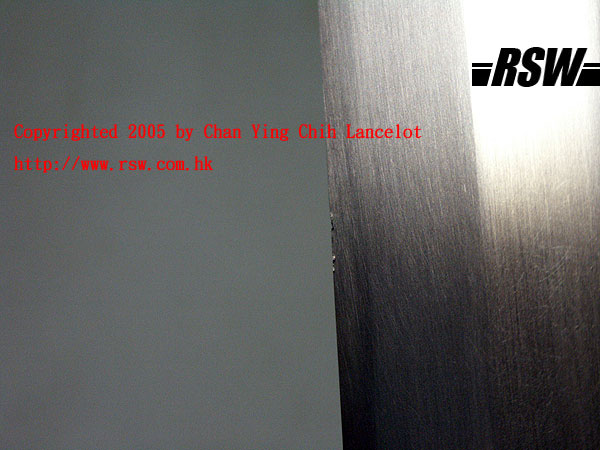


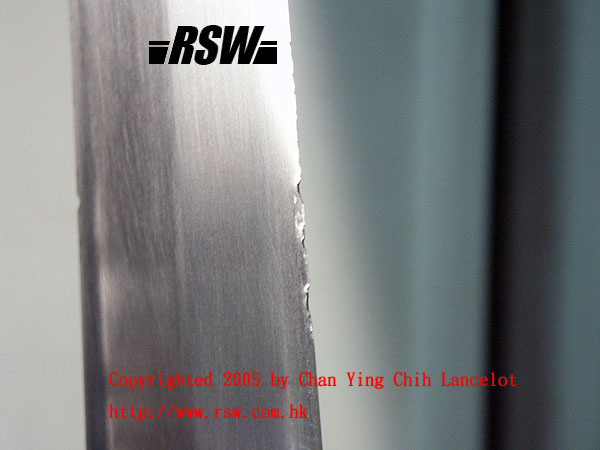
The edge of Tinker-Alfred War-sword No.2 sample: