Sword grip length

For Historical European Fighting Arts, Weaponry, & Armor

Moderators: Webmaster, Stacy Clifford

User avatar
philippewillaume
Posts: 336
Joined: Wed Apr 21, 2004 6:51 am
Location: UK, windsor
Contact:

Re: Sword grip length

Postby philippewillaume » Mon Jan 16, 2006 4:30 am

Hello
We cannot really oppose Dobringer grip and Thalloffer or Gloliath grip; Different time and probably different sword.

The only thing I can add is try it.
I use a AT1515 and a Swedish longsword mad by Mark Vickers.
The Swedish long sword is significantly longer and has a much longer handle so on te hat1515 the hands are touching together and on the swede they are not.
In both case and after a few trials, I was really impressed and surprised by the results.

I find the Dobringer grip is very good at cutting target that are not very well supported (it is better with target on the hard side as well so a loosely held broom handle or tree branch). And it is not that great in tamashigeri (it’ll do fine up to a certain point but it is not performing as well as other grip or type of cut)
I think it really promote tip velocity for small and quick movement on the most direct and shortest trajectory.

All that being said one you have a fell for the strike you pretty much grab the sword as you please, you will be able to repeat it and will adjust the pressure of the grip of the back and hand to get the desired effect.
Phil
One Ringeck to bring them all In the Land of Windsor where phlip phlop live.

david welch
Posts: 453
Joined: Wed Dec 18, 2002 5:04 am
Location: Knoxville TN

Re: Sword grip length

Postby david welch » Mon Jan 16, 2006 7:56 am

I think it's interesting that you should point out the pflug issue, because the primary locations we see the "hands close together" are mostly all pflug in the early Liechtenauer sources.


Oh no.

We can go through later sources and find all the hands close technique we want to. Lets take... Kunst des Fechten . <img src="/forum/images/icons/grin.gif" alt="" />

Plate E
Image

The figure in left front is clearly swinging a wrath strike just like a baseball bat with his hands close. The figure directly behind him looks like he has just made a wrath strike and still has his hands close.

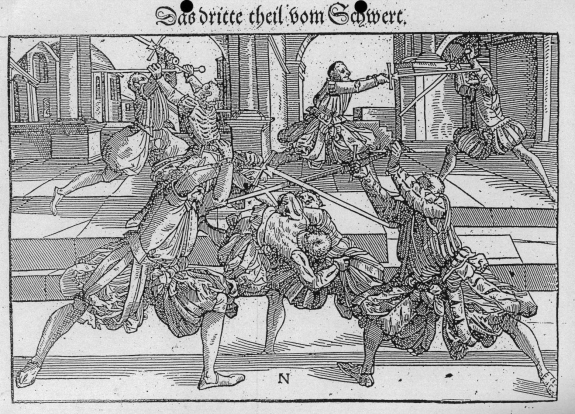
Plate N:
Image

One of each in the rear pairs has his hands close.

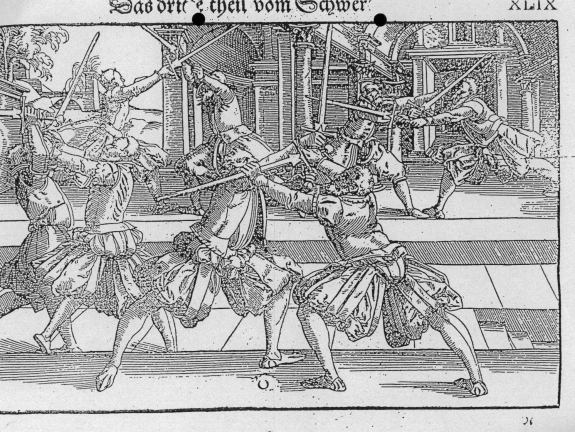
Plate O:
Image

Figure on the far left has his hands close.

Plate B:
Image

Center figure on the right has his hands close....

We can keep finding these examples in later artwork if we keep looking, but these should be enough to point out that it isn't just "some old guy" that used close hands.

From my personal experience playing with it, I am finding I swing faster and hit harder with my hands close, the same as with a bat or a club. But you are correct about not having the leverage like that. So as soon as I try to work in the bind I slide my hands apart to gain leverage. I don't want you to think I am saying that you have to lock your hands together and keep them there anymore than I think the only correct way is to fight with them far apart.
"A sword never kills anybody; it is a tool in the killer's hand." Lucius Annaeus Seneca 4BC-65AD.

david welch
Posts: 453
Joined: Wed Dec 18, 2002 5:04 am
Location: Knoxville TN

Re: Sword grip length

Postby david welch » Mon Jan 16, 2006 9:29 am

I just wanted to throw this in the mix...

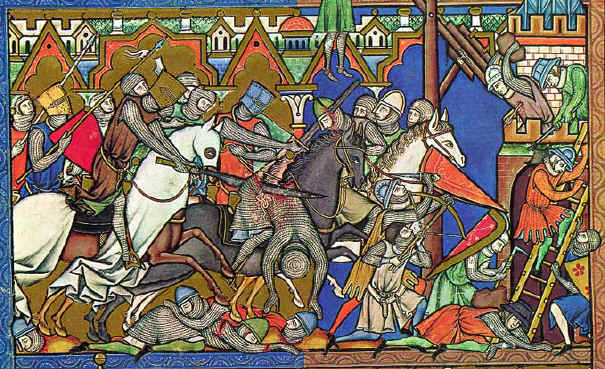
I was looking at the historical artwork to see what I could find, and in the very first picture we have up:

Image

The only two handed sword in the picture, that big chopper, is being used with his hands together, even though there is more than enough hilt to use it with his hands far apart. <img src="/forum/images/icons/grin.gif" alt="" />
"A sword never kills anybody; it is a tool in the killer's hand." Lucius Annaeus Seneca 4BC-65AD.
User avatar
Stacy Clifford
Posts: 1126
Joined: Fri May 14, 2004 11:51 am
Location: Houston, TX
Contact:

Re: Sword grip length

Postby Stacy Clifford » Mon Jan 16, 2006 12:40 pm

remember we also take a passing step when batting


I'm surprised nobody caught this. You take a simple step when swinging a bat (with the back foot remaining planted, however), not a passing step. I seem to remember Ran telling me he screwed up his kid's baseball swing this way.
0==[>>>>>>>>>>>>>>>>>
Stacy Clifford
Free-Scholar
ARMA Houston, TX

User avatar
Jake_Norwood
Posts: 913
Joined: Thu Sep 19, 2002 11:46 am
Location: Clarksville, TN

Re: Sword grip length

Postby Jake_Norwood » Wed Jan 18, 2006 6:55 am

David,

As I suspected we're not really talking about the same thing, but I want to address some of your points anyway.

First, the Zornhau-as-baseball swing. Shame on you. I taught you better. That's not at all what's happening there, but this is the wrong thread to go into it.

Second, the preponderance of those images shows the handle being used fully, though not necessarily with the pommel being gripped--this is the correct interpretation of Dobringer's statement if there is one, IMO. What it is *not*, however, is the hands-close-together grip of film or Christian Tobler's first book. This is the grip that I am fighting primarily. It is, I believe, a "bad" grip for most functions.

Third, that grip is a liquid thing, is a long-standing element of my approach to the field. You know this as well as any! Saying, however, that "hands close together is legit because grip is liquid" is the same as saying "hands far apart (or on the pommel) is legit because grip is liquid." In allowing everything we say nothing.

Fourth, there's still no address of the interference that close-hand grips provide in proper adjustment of technique inndes.

I agree, as previously stated, that hands-close-together gets you a stronger, more brutal single-stroke (as seen in the above artwork). But only a buffalo fights that way as a matter of standard course...

hmmm....

Jake
Sen. Free Scholar
ARMA Deputy Director

david welch
Posts: 453
Joined: Wed Dec 18, 2002 5:04 am
Location: Knoxville TN

Re: Sword grip length

Postby david welch » Wed Jan 18, 2006 1:24 pm

Jake,

While you realize that I will hold on to a point until I am beaten and forced to let go, before I go that far I want to make sure it is the point I am trying to defend. Therefore I want to clarify my position on the baseball bat/wrath strike.

First, the Zornhau-as-baseball swing. Shame on you. I taught you better. That's not at all what's happening there, but this is the wrong thread to go into it.


I fully understand that a wrath strike is not a baseball swing. When I wrote:

The figure in left front is clearly swinging a wrath strike just like a baseball bat with his hands close.


My meaning was that his hand and arm position is just like the ready position just before you swing a ball bat. Hands together, arms up and body torqued. I did not mean that the two were the same swing, though after rereading it I can see how poorly worded my reply was and that I certainly seemed to be saying that.

Also, I originally only brought it up as a (unanswered) question :
"If there is a biomechanical advantage to having your hand far apart for either speed or leverage... why don't we swing a baseball bat like that?"

Realize of course, I am referring to speed or leverage/power in the strike itself, not in what we do after.


Second, the preponderance of those images shows the handle being used fully, though not necessarily with the pommel being gripped--this is the correct interpretation of Dobringer's statement if there is one, IMO. What it is *not*, however, is the hands-close-together grip of film or Christian Tobler's first book. This is the grip that I am fighting primarily. It is, I believe, a "bad" grip for most functions.


I believe the "a "bad" grip for most functions" is the key here. This is clearly a grip to use for the most powerful blow possible, such as you would make with a Vorschlag.

You could also use it for very fast, although very weak, twitching. This could possibly be one of the reasons that the earlier manuals warns of getting caught weak with your arms crossed, while Meyer doesn't seem to have much concern over it that I can tell. I can tell you this, I wouldn't want to make a habit of it.


Third, that grip is a liquid thing, is a long-standing element of my approach to the field. You know this as well as any! Saying, however, that "hands close together is legit because grip is liquid" is the same as saying "hands far apart (or on the pommel) is legit because grip is liquid." In allowing everything we say nothing.


I understand. As a matter of fact what you taught us about that is the reason we feel free enough about the fluidity of our grip to ask "why not" about this and investigate it. Grip it just too fluid to say that any grip does not have a place, at least until proven otherwise.


Fourth, there's still no address of the interference that close-hand grips provide in proper adjustment of technique inndes.

I agree, as previously stated, that hands-close-together gets you a stronger, more brutal single-stroke (as seen in the above artwork). But only a buffalo fights that way as a matter of standard course...


Just as an example for the first part. Place your hands close together in wrath guard. As you make your strike, when you see that you will not be successful, let your bottom hand slide down to the pommel, as you would when you cut with an axe, where you place your hands apart and slide the top hand down as you strike... just reverse it, i.e. your bottom hand slides down into a wide grip. This puts you into longpoint with your hands apart and ready for handwork.

As to the second, I strongly believe you know that it would be foolish to fight in any one way as a matter of standard course.


Lastly, I would like to go back and address this, though it too needs it's own thread:

But some of what we're seeing here, too, is "Dobringer's old, so he must be right! I can feel it." Humbug, I say. Do I believe Doebringer's wrong? No, but I'm not ruling it out, either.


I started with the Liechtenauer specifically to dispel the notion that Meyer was a "school fencer". I am just now starting to get what I think is a good handle on it, but due to this I have come to the conclusion that Meyer was anything but. We have found everything that is in in Doebringer in Meyer, and close to vice-versa. Meyer was not trying to do anything new, he was giving a detailed explanation of Liechtenauer's Art. Everything Doebringer says not to do in fencing, so does Meyer. Meyer's slashing to the four openings are in Doebringer, you just have to be able to see them, and I was able to thanks to Meyer. The grip thing is one where Doebringer says to, Meyer doesn't say one way or the other... but shows pictures of it. I honestly don't think either one should replace the other, but that they should be used to compliment one another. To tell you the truth, I am starting to believe that Meyer, Doebringer, and Talhoffer should be thought of as a set.
"A sword never kills anybody; it is a tool in the killer's hand." Lucius Annaeus Seneca 4BC-65AD.
User avatar
Jake_Norwood
Posts: 913
Joined: Thu Sep 19, 2002 11:46 am
Location: Clarksville, TN

Re: Sword grip length

Postby Jake_Norwood » Thu Jan 19, 2006 1:18 pm

Sounds good. You know that I, too, will fight an idea until the bitter end (but I will let it die if necessary). I think we're much closer to the same page here than before. Good.

And you pulled out the "Meyer's not a sport" card! Dammit! You know I'm a softie for that stuff. LOL.

I'll be playing around with all of this tonight, in my little room, with my messer. (Don't take that the wrong way!).

Jake
Sen. Free Scholar

ARMA Deputy Director


Return to “Research and Training Discussion”

Who is online

Users browsing this forum: No registered users and 16 guests


Note: ARMA - The Association for Renaissance Martial Arts and the ARMA logo are federally registered trademarks, copyright 2001. All rights reserved. No use of the ARMA name or emblem is permitted without authorization. Reproduction of material from this site without written permission of the authors is strictly prohibited. HACA and The Historical Armed Combat Association copyright 1999 by John Clements. All rights reserved. Contents of this site 1999 by ARMA.