How Effective is It?

For Historical European Fighting Arts, Weaponry, & Armor

Moderators: Webmaster, Stacy Clifford

Lance Chan
Posts: 377
Joined: Fri Oct 25, 2002 3:03 pm
Location: Hong Kong
Contact:

Postby Lance Chan » Thu Oct 25, 2007 2:38 am

I think I agree with your comment. All the time I get comments from Asian stylist friends that my stance isn't low and sturdy enough, while I enjoy agility from the less extended stance. But then as an Asian myself, I don't have the upper muscle strength of westerners and some of the moves like successive zwerchau is very difficult for me to execute, while I found that even the newbie swordsman from the west could do it quite fast.

david welch wrote:
LafayetteCCurtis wrote:As for the difference between the Japanese and European systems, I don't think it's possible to summarize it within the limits of a forum post because neither system is a monolithic martial art--rather, each of them is a collection of many different but interrelated styles.


After talks I have had with Jake Norwood, I tend to agree the basic, rough differences as a whole is that the EMA tended to take advantage of their lower COG, and the WMA their greater hight, weight, and upper body mass.

That is very broad though, and you will be able to find instances in both where they don't stick to the "rule".
Realistic Sparring Weapons
http://www.rsw.com.hk

Sripol Asanasavest
Posts: 133
Joined: Fri Oct 05, 2007 9:31 am

Postby Sripol Asanasavest » Fri Oct 26, 2007 8:37 am

I must admit! I was skeptical about how good the Medieval and the Renaissance sword fighting techniques are, but after reading many replies, it could be one of the major styles to be reckon with.

I have a story about my own experience about Muay Thai, or Thai boxing, the art of my native land. At first I was skeptical, too, about Muay Thai prowess and effectiveness as a martial as with many people from my country. I once believe it was nothing more than just a hype in my own country. But now after watching every modern top fighters alive today fight, they all adopted Muay Thai striking techniques as their striking techniques. I was quite surprised to see them thinking of Muay Thai with such a high regard. So, now, I'm certain that it wasn't just a hype in my country, but it is a truely effective art to be reckon with. This is somewhat identical to my experience with Muay Thai, that someday people will dispell myths about WMA.

Sripol Asanasavest
Posts: 133
Joined: Fri Oct 05, 2007 9:31 am

Postby Sripol Asanasavest » Fri Oct 26, 2007 9:07 am

Lance Chan wrote:I think I agree with your comment. All the time I get comments from Asian stylist friends that my stance isn't low and sturdy enough, while I enjoy agility from the less extended stance. But then as an Asian myself, I don't have the upper muscle strength of westerners and some of the moves like successive zwerchau is very difficult for me to execute, while I found that even the newbie swordsman from the west could do it quite fast.


[/quote]

That is so true. Sometimes I wonder why they make the swords so big and long while in Thailand they use much smaller blades which are intended to be use with single hand. Thai daab (sword) is even shorter than Samurai swords. It's strange because Thai people are known to be a little taller and bigger than the Japanese, but they like using two swords, which is quite popular in ancient Siam, and boy are they fast compared to the bigger weapons they use in WMA. Still... Even a Thai sword is difficult to use if you don't train and build up the muscles in the arms necessary. It's actually heavier than I thought and when I swing it, I can't get the fast movements, like the light saber you see in Star War, the way I see they use the Thai daab in the demonstrations. I think in every fighting style you have to build up endurance and the muscle necessary inorder to fight more effectively. I would suggest weight training and running. I know in Muay Thai and Krabi Krabong they run a lot because their movement is very fast and they need to have stemana with all the light saber moves! LOL!

carlo arellano
Posts: 26
Joined: Sun Oct 21, 2007 1:43 am
Location: Lake Forest, CA

Postby carlo arellano » Fri Oct 26, 2007 10:34 am

That is so true. Sometimes I wonder why they make the swords so big and long while in Thailand they use much smaller blades which are intended to be use with single hand.


Longer reach, better cutting power and because they physically could and of course they also used one handed swords.

I have studied Krabi Krabong and Muay Thai and have used the techniques in full contact stick fighting and I could ask you the same question, why are Thai weapons so big compared to the typical Filipino weapon?

Empty your cup and try it yourself, get physical. You will get better answers that way.

I am an Asian and I have no trouble wielding the weapons. On the other hand I have had the benefits of a western diet growing up and Crossfit.

:twisted:

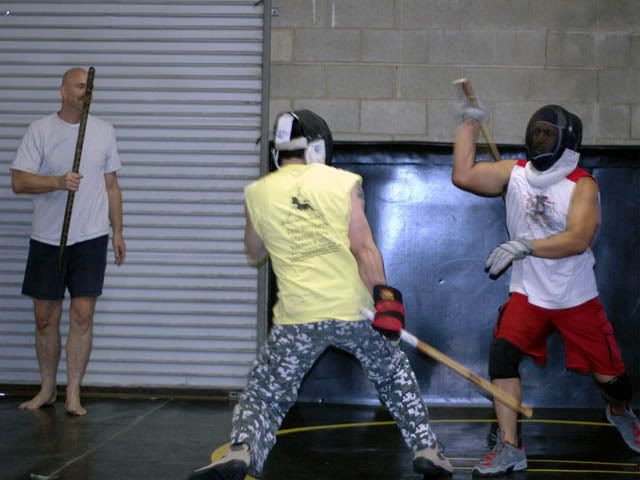
I'm 6' and 205 lbs which is large by Asian standards, that's me on the right.

Image

Westerners come to eastern arts respectfully and with an open mind, more easterners should do so with western arts as Lance has.

Sripol Asanasavest
Posts: 133
Joined: Fri Oct 05, 2007 9:31 am

Postby Sripol Asanasavest » Fri Oct 26, 2007 10:55 am

Acually, in Thailand there are a lot of 6' foot persons, now, but you don't get that massive upper body like you would see in a lot of Westerners.

And, yeah, I know what you mean about opening your mind to other cultures. Thai people love Westeners or Farang (that's what they call Westerner in Thailand) for some reason. Thai people think Westerners are much nicer than Thai people themselves. LOL!!

Sripol Asanasavest
Posts: 133
Joined: Fri Oct 05, 2007 9:31 am

Postby Sripol Asanasavest » Mon Oct 29, 2007 7:35 am

I don't get though. Still with the better reach and more cutting power the longer swords have, you still sacrafice a few things. It's still difficult to use in a crowded situation like in a formation or confined space like fighting inside the castles. Would it be better to make something heavy but not so long to help fight at closed range. This is where I think an axe and a shield has the advantage over a very long swords. If I'm not mistaken the axe is much shorter, but has heavy small head which allow more force to concentrate on narrower cutting edge which gives it a tramendous cutting power and allow the user to fight better at closer range. Use it with a shield and it is highly effective. This is probably why the Franks perfer to fight with their axe, and I hear they have a very good axe design which allows them to easily split their enemies' shields, and the axe double as a great throwing weapon against charging enemies much like the Roman Pilum.

Alan Abu Bakr
Posts: 76
Joined: Sat Jul 07, 2007 9:33 am
Location: Sweden

Postby Alan Abu Bakr » Mon Oct 29, 2007 7:48 am

I just thought of this:
david welch wrote:After talks I have had with Jake Norwood, I tend to agree the basic, rough differences as a whole is that the EMA tended to take advantage of their lower COG, and the WMA their greater hight, weight, and upper body mass.


Well during the middle ages, europeans weren't as tall as they are now...
Those who live by the sword will be shot by those who don't.
(I neither like the real name rule, nor do I find it to be good)

Sripol Asanasavest
Posts: 133
Joined: Fri Oct 05, 2007 9:31 am

Postby Sripol Asanasavest » Mon Oct 29, 2007 8:06 am

Yes, you made a great point. I just remember: when the Portuguese made contact with the Siamese they were the same height as the Thai. Apparently, Thai people back in those days enjoy a much better diet than the Thai later in history. The area around Siam back in those days were full of wildlife and fish, and it's lush fertile soil allows for easy cultivation of rice and other crops. I hear back when America was still young, the tallest people weren't actually European Americans or Australians, it was the Cheyane (sp), the native Americans. The average of the Cheyene back in those days were 5' 8". The average height of European Americans is 5' 6" I blieve and Australians were 5' 7". Apparently the native enjoy the diet rich in protein from buffalo and few vegetalbles that grows wild, and the drinking water cleaner because living space wasn't crowded so no raw sewage in the water supply like you would get in a old crowded American cities back in those days.

carlo arellano
Posts: 26
Joined: Sun Oct 21, 2007 1:43 am
Location: Lake Forest, CA

Postby carlo arellano » Mon Oct 29, 2007 10:40 am

Correct me if I'm wrong but I believe the longsword became ascendant when better armor was developed so that soldiers could forgo the shield. Another thing about long blades, especially the massive two handers, they're great for clearing real-estate, one swing has the ability to hit multiple people in a killing arc making it a devastating battlefield weapon but not a naval one or an urban one. The medieval warrior also had a variety of tools at their disposal, not just the longsword. Battlefield combat is a proving ground, combat in wide open fields where one can get surrounded develops such long weapons, rain forests with myriad branches and roots where long blades can get stuck develops shorter weapons.

User avatar
RayMcCullough
Posts: 160
Joined: Tue Sep 26, 2006 9:05 am
Location: Robertsdale, AL

Postby RayMcCullough » Tue Oct 30, 2007 9:04 pm

What seems funny to me about the difference in the Europeans and the Asian world is that in the 1500's , the average heights were relatively the same, but the European weapons were much longer. From swords to daggers and every weapon in between.

Things that make you go hmmmm.
"The Lord is my strenght and my shield, my heart trusteth in Him and I am helped..." Psalms 28:7

"All fencing is done with the aid of God." Doebringer 1389 A.D.

carlo arellano
Posts: 26
Joined: Sun Oct 21, 2007 1:43 am
Location: Lake Forest, CA

Postby carlo arellano » Wed Oct 31, 2007 12:01 am

Japanese, and Korean swords seemed to have been at comparable lengths to their european cousins but southeast asian weapons tended to be shorter. This could have been possibly due to the thickness of the rainforests and having branches and such that could entangle longer swords.

Sripol Asanasavest
Posts: 133
Joined: Fri Oct 05, 2007 9:31 am

Postby Sripol Asanasavest » Wed Oct 31, 2007 9:07 am

I think the reason is for closed range combat. Since there was a lot of thick vegetations and undergrowth, most like you are going to fight at closer range than anything. I believe the Romans and the Greeks use shorter swords as well for closed combat since they are fighting in a very tight formation. However, even Thai use longer reach weapon like long kao and spear with a shield or no shield.

User avatar
Grant Hall
Posts: 144
Joined: Wed Sep 28, 2005 7:11 am
Location: Australia, Victoria

Re: Kunst des Fechtens

Postby Grant Hall » Wed Feb 13, 2008 6:27 am

Jay Vail wrote:Pre-Marqui boxing = pankration = MMA = sanshou = muay thai.

There are differences between all these arts (some quite substantial), but there are also massive similarities. That should be no surprise.

Both kungfu and muay thai have incorporated western boxing hands because of its proven effectiveness both in the ring and on the street. This is not to say that boxing hands replaces other techniques in either system, but rather those methods are brought in and often heavily relied upon. This development is well documented in the literature describing recent trends in both arts.

For the effectiveness of basic boxing hands in the street see:
http://youtube.com/watch?v=6iDlzL7zrNU


Hey I just got around to reading this thread, and so just watched this video.

I'd like to comment by say that this video shows something that most Martial Artists neglect to realise. As an experienced fighter (both in self defense situations/streetfights and in competetion Tae Kwon Do), I can say with full assurance that if that guy was a TKD fighter or almost any other type of "Kick-fighter" he would have been taken down, and most likely stomped.

The reason I say this, is because it is plain to see that it was mobility that kept this guy on his feet, he choose who to engage and when (atleast for the most part), and thus he dictated the rythm and flow of the fight.

So why couldn't he do this with TKD? Because in TKD and most other kick, or even knee, reliant martial arts, when you kick, you (mostly) become immobile. Giving you opponent(s) time to close on you. Because this guy was a boxer, and one of the fundamental principals of Boxing is to move around, he was able to move back as fast as his attackers moved forward, whilst delivering devestating jabs and punches.

This is one reason I believe kicks in an serious martial arts should be kept to a minimum, and only used when appropriate.

Remember a punch from a boxer can generate more force than almost all kicks and punches in a large variety of other martial arts (including Kung fu), and speaking from experience it is ALOT easier to punch someone in the head than to kick them.

Hmm, now that that little rant is over, I'm wondering wether or not to even post it ;) I suppose I will, since someone somewhere might find it useful, though I'm sure it's off topic.

Cheers!

<<<<<<<<<<]==0
Grant Hall - Scholar
--ARMA Australia--
0==[>>>>>>>>>>

“The Nation that makes a great distinction
between its scholars and its warriors
will have its thinking done by cowards
and its fighting done by fools"
– Thucydides 5th c. BC

david welch
Posts: 453
Joined: Wed Dec 18, 2002 5:04 am
Location: Knoxville TN

Postby david welch » Wed Feb 13, 2008 8:12 pm

RayMcCullough wrote:What seems funny to me about the difference in the Europeans and the Asian world is that in the 1500's , the average heights were relatively the same, but the European weapons were much longer. From swords to daggers and every weapon in between.

Things that make you go hmmmm.


I believe that on average, if you took a Westerner and Easterner of equal height, you will find the westerner has longer legs, and a shorter torso. The Easterner will have shorter legs and a longer torso.

Both will have about the same "mass" in the torso, but because for the Westerner it is compacted in a shorter body it gives better mechanical advantage and more strength, in addition to him being a little more "muscled" around the chest and shoulders.

The Easterner will have more of his weight lower because of his legs are shorter in proportion as compared to the westerner, and will be able to use his longer abdomen to a leverage advantage.

You can still see this today, also. This isn't just something in the past. There is a fad in China right now where women are having their legs broken and stretched, to appear western in proportion for "fashion".

But again, remember I'm just casting a very wide net. You will be able to find people on both sides that don't fall into this generality.
"A sword never kills anybody; it is a tool in the killer's hand." Lucius Annaeus Seneca 4BC-65AD.

LafayetteCCurtis
Posts: 421
Joined: Sat Nov 04, 2006 7:00 pm

Postby LafayetteCCurtis » Thu Feb 14, 2008 8:21 pm

carlo arellano wrote:Another thing about long blades, especially the massive two handers, they're great for clearing real-estate, one swing has the ability to hit multiple people in a killing arc making it a devastating battlefield weapon but not a naval one or an urban one.


Mmm...not exactly. You mentioned yourself that the longsword was developed when better armor became available; this implies the society has grown rich enough to develop such armor, and by extension to equip many soldiers outside the elite group of men-at-arms with a decent amount and quality of armor. I guess we're all familiar with the odds of cutting cleanly through an armored body, even one protected by nothing more than a thick padded/quilted garment. Another fact that gives the lie to this reasoning is that if longswords had been developed for cleaving through multiple opponents, then they would have had broad, flat cutting blades, but on the contrary they had narrower, thicker blades obviously more suited to thrusting than other blade types before them.

Let's not mention Type XIIa and XIIIa greatswords, which were developed when the principal mode of protection in Europe was still a hauberk and a large shield--or the use of the zweihander in significant numbers by Spanish and Austrian naval troops during the Battle of Lepanto!


Return to “Research and Training Discussion”

Who is online

Users browsing this forum: No registered users and 27 guests


Note: ARMA - The Association for Renaissance Martial Arts and the ARMA logo are federally registered trademarks, copyright 2001. All rights reserved. No use of the ARMA name or emblem is permitted without authorization. Reproduction of material from this site without written permission of the authors is strictly prohibited. HACA and The Historical Armed Combat Association copyright 1999 by John Clements. All rights reserved. Contents of this site 1999 by ARMA.