Silver question

For Historical European Fighting Arts, Weaponry, & Armor

Moderators: Webmaster, Stacy Clifford

User avatar
Jaron Bernstein
Posts: 1108
Joined: Sun Dec 07, 2003 12:58 am

Silver question

Postby Jaron Bernstein » Sat Apr 11, 2009 8:51 am

Hi folks,

I am reading through Silver and wonder if anyone can give a good description of what he calls a "Morris pike", a "Black bill" and a "Forrest bill".

Jaron :D

User avatar
Sal Bertucci
Posts: 591
Joined: Fri May 02, 2008 8:04 pm
Location: Denver area, CO

Postby Sal Bertucci » Sat Apr 11, 2009 10:58 am

Ha HA!! I had this question a few months ago, and now can answer it. I'll start with this link.

http://en.wikipedia.org/wiki/Bill_(weapon)


As is mentioned in Silver the main difference between the two is length, and why it is not stated I feel like the forest bill has a lighter blade than the black bill. For giggles, if you wanted a trainer for a black bill I would highly recommend a brush hook or Kaiser blade.

http://en.wikipedia.org/wiki/Kaiser_blade

As you can see good ideas don't change. :D And the destructive power of these things is terrifying! :twisted:

User avatar
Stacy Clifford
Posts: 1126
Joined: Fri May 14, 2004 11:51 am
Location: Houston, TX
Contact:

Postby Stacy Clifford » Sat Apr 11, 2009 11:01 am

This seems to come up now and again. Here are two old threads that have about as good answers as any I know of yet:

http://www.thearma.org/forum/viewtopic.php?t=21102

http://www.thearma.org/forum/viewtopic.php?t=23347
0==[>>>>>>>>>>>>>>>>>
Stacy Clifford
Free-Scholar
ARMA Houston, TX

User avatar
Jon Pellett
Posts: 125
Joined: Mon Apr 04, 2005 12:15 pm
Location: Calgary, AB

Postby Jon Pellett » Sat Apr 11, 2009 11:02 am

A morris pike is just a regular pike.

No one is entirely sure what distinguishes the various kinds of bills (brown, black, forest, etc), but as Sal says the forest bill is longer and presumably lighter. The black bill was likely your standard English bill.

User avatar
Stacy Clifford
Posts: 1126
Joined: Fri May 14, 2004 11:51 am
Location: Houston, TX
Contact:

Postby Stacy Clifford » Sat Apr 11, 2009 11:09 am

Arms & Armor sells this as an "English Bill" and equates it with the brown or forest bill, though I'm not sure what their source is:

http://www.armor.com/pole030.html

Whatever you call it, I want one. :)
0==[>>>>>>>>>>>>>>>>>

Stacy Clifford
Free-Scholar
ARMA Houston, TX

User avatar
Matt Bryant
Posts: 133
Joined: Sun Jul 17, 2005 9:34 pm
Location: Tulsa, Oklahoma
Contact:

Postby Matt Bryant » Mon Apr 13, 2009 5:14 pm

[quote="Sal Bertucci"For giggles, if you wanted a trainer for a black bill I would highly recommend a brush hook or Kaiser blade.

http://en.wikipedia.org/wiki/Kaiser_blade

As you can see good ideas don't change. :D And the destructive power of these things is terrifying! :twisted:[/quote]


"Some people call it a Kaiser blade, I call it a Sling blade. MmmmHmmm."
Matt Bryant
Scholar Adept
ARMA Associate Member - Tulsa, Oklahoma

"Keepe the point of your Staffe right in your enemies face..." -Joseph Swetnam

Ryan Woo
Posts: 10
Joined: Fri Apr 11, 2008 8:57 pm
Location: Columbus, OH, USA

Postby Ryan Woo » Thu Apr 16, 2009 11:45 pm

I rememeber Dr. Anglo's book has some info on the bills (chapter 5 on polearms I believe).

User avatar
Jaron Bernstein
Posts: 1108
Joined: Sun Dec 07, 2003 12:58 am

Postby Jaron Bernstein » Sat Apr 18, 2009 1:08 pm

Ryan Woo wrote:I rememeber Dr. Anglo's book has some info on the bills (chapter 5 on polearms I believe).


Thanks guys. Now I have another question about what he calls the Gardant fight.

This is from the published Wagner version, pg 271:

"Gardent fight in genrall is of two sorts, the first is true gardant fight, which is either perfect of imperfect.

the perfect is to carry your hand and hilt above your head with your point down towards you left knee, with your sword blade somewhat near your body, no bearing out your point, but rather declining in a little towards your said knee, that your enemy cross not your point and so hurt you, stand bolt upright in this fight, and if he offer to press in then bear your head and body a little backward."

There is a modern interpretive drawing shown, but I am not convinced by it.

Any ideas?

User avatar
Benjamin Smith
Posts: 184
Joined: Thu Jun 09, 2005 12:44 pm

Postby Benjamin Smith » Sat Apr 18, 2009 3:07 pm

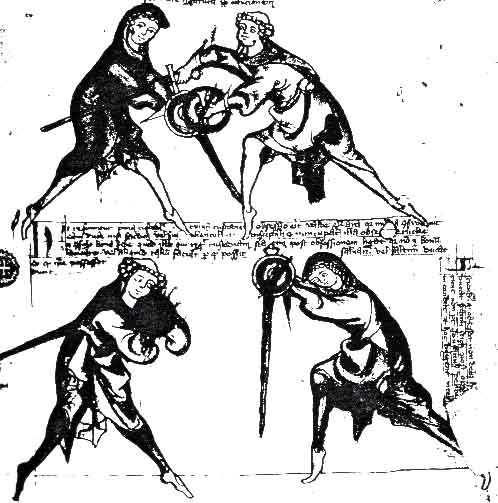
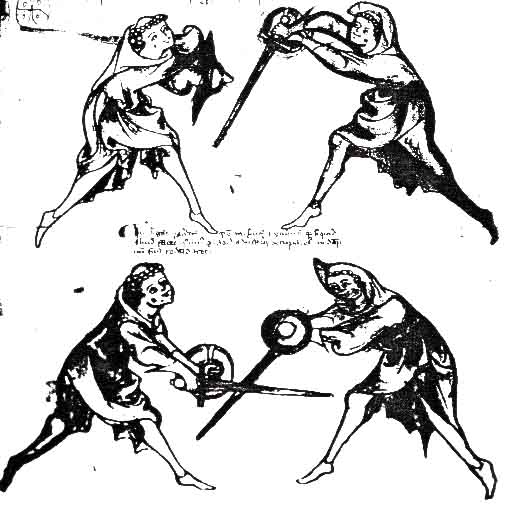
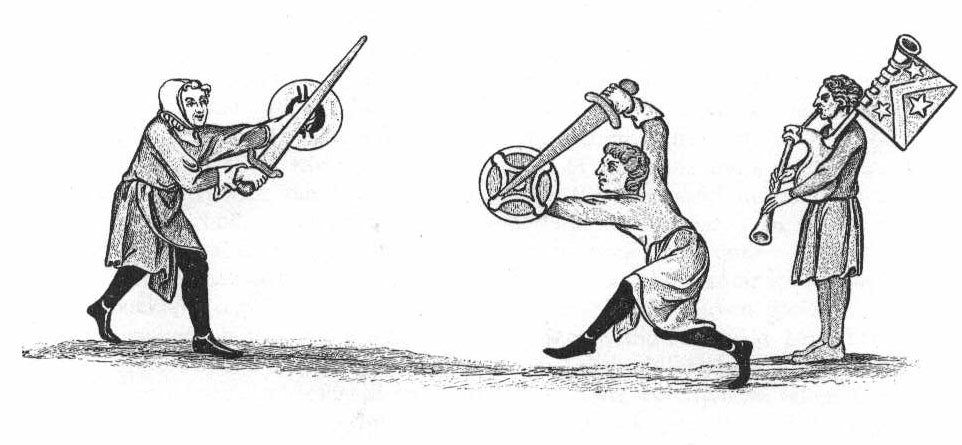
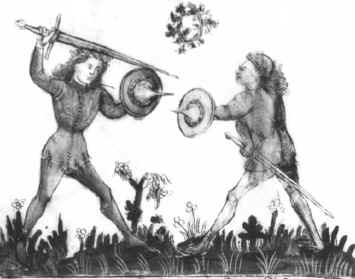
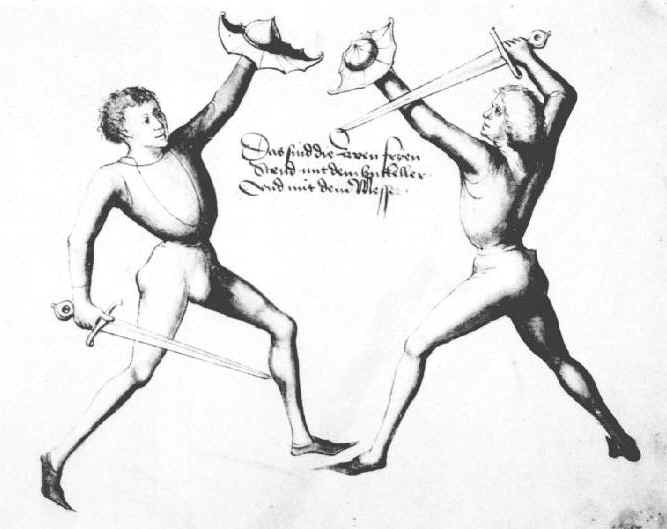
This is pretty straightforward. With a sword and buckler your weapon is in a modified ochs that doesn't "bear your point out" which probably means doesn't point directly at your enemy. The blade could be either above or below your buckler arm which ought to be extended. Silver recommends that you stand bolt upright, which I take to mean that you have a very vertical posture, this does not mean that your feet should be together, though the stance may not have as much distance between the feet as normal, it might be similar to figure bottom right in this plate from I.33 : http://www.thearma.org/Manuals/i33/07.jpg,
or this: http://www.thearma.org/Manuals/i33/23.jpg,
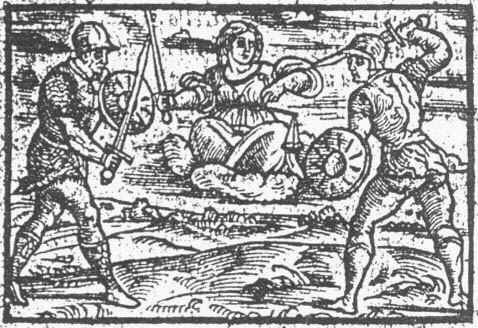
or this: http://www.thearma.org/arttalk/at9.htm from a depiction of sword and shield fighting,
or this: http://www.thearma.org/essays/SandB/cavacalbo1.jpg
or this: http://www.thearma.org/essays/SandB/lookclose.jpg,
or this: http://www.thearma.org/images/fall02/blsbomages13thc.jpg,
or this:http://www.thearma.org/essays/SandB/Gladiatoria112.jpg,
or this: http://www.thearma.org/essays/SandB/0256.jpg

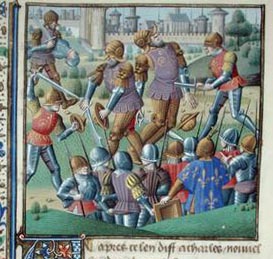
As you can see any of these variations may be the guard that Silver is speaking of.
Respectfully,

Ben Smith

User avatar
Martin Austwick
Posts: 20
Joined: Sun Jun 01, 2008 3:25 am
Location: Surrey, UK
Contact:

Postby Martin Austwick » Sun Apr 19, 2009 1:19 am

I teach True Guardant as roughly this position, what you can't see is that the sword is held to the left of the face thereby giving you a clear field of vision. The important things imho are to keep the hilt higher than the head, and to keep the point towards the left knee (not forwards or upwards).

Image

I don't know how similar this is to what Paul teaches.

Oz
"the more skillful he is in this noble science, the more humble, modest and virtuous he should show himself both in speech and action" - George Silver

User avatar
Benjamin Smith
Posts: 184
Joined: Thu Jun 09, 2005 12:44 pm

Postby Benjamin Smith » Sun Apr 19, 2009 9:11 am

One of the things that I think is important about this is that many similar positions exist, which may be what Silver meant by perfect and imperfect. I feel it means that one may need to adjust the guardant fight depending on the situation, but there is a position that tends to deliver maximum efficiency and this is what Silver means by a perfect guardant fight.
Respectfully,


Ben Smith

User avatar
Jaron Bernstein
Posts: 1108
Joined: Sun Dec 07, 2003 12:58 am

Postby Jaron Bernstein » Tue Apr 21, 2009 7:05 pm

Thanks for all the replies to this. I have one more question. This is from the published version (pg. 304):

"The short staff hath four wards, that is two with the point up, and two with the pointe downe."

Any suggestions?

User avatar
Sal Bertucci
Posts: 591
Joined: Fri May 02, 2008 8:04 pm
Location: Denver area, CO

Postby Sal Bertucci » Wed Apr 22, 2009 8:11 am

Silver seems to prefer the Middle aka High (It depends on who you're reading) Ward and then the Hanging Ward. As Such there is one on the left and one on the right. While there are other wards these best fit within the true times and Silver's personal preferences.

User avatar
Stacy Clifford
Posts: 1126
Joined: Fri May 14, 2004 11:51 am
Location: Houston, TX
Contact:

Postby Stacy Clifford » Wed Apr 22, 2009 9:59 am

Jaron Bernstein wrote:Thanks for all the replies to this. I have one more question. This is from the published version (pg. 304):

"The short staff hath four wards, that is two with the point up, and two with the pointe downe."

Any suggestions?


That is a good question since Silver never actually defines them. It stands to reason that two of the guards are the same as Swetnam's low and high guards (equivalent to pflug and hanging with the longsword) since those two guards also show up in just about every staff work there is. That covers one each point up and point down. If you use Swetnam as the closest English comparison, he talks about a pikeman's guard that sounds like a version of alber, though he's describing it as a guard other people use that you shouldn't. The Germans also have a staff guard like this. David Lindholm interprets Silver's fourth guard as a vom tag over the shoulder, based on his descriptions of "lying aloft." I'm not sure I agree with that, not exactly the way he does it at least, since even Meyer doesn't hold his high guard that far up and back and Silver is using longer staffs than what Meyer shows in his illustrations. Swetnam is adamantly against pulling the point offline to attack, though Silver isn't, but Lindholm's "aloft" positions seems awfully dangerous using an 8-foot staff and facing a potential thrust, the defense from that position would be way too slow with a staff that length. With a shorter staff it's more reasonable, but I'm inclined to think Silver's "aloft" position would probably be further forward where it can come into play faster like Meyer's, which stands up like a flagpole in front of the chest. It's all guesswork though when you only get one sentence to play with.
0==[>>>>>>>>>>>>>>>>>

Stacy Clifford
Free-Scholar
ARMA Houston, TX

User avatar
Martin Austwick
Posts: 20
Joined: Sun Jun 01, 2008 3:25 am
Location: Surrey, UK
Contact:

Postby Martin Austwick » Wed Apr 22, 2009 10:01 am

Jaron Bernstein wrote:Thanks for all the replies to this. I have one more question. This is from the published version (pg. 304):

"The short staff hath four wards, that is two with the point up, and two with the pointe downe."

Any suggestions?


I have always assumed that these wards are possible on either side of the body thereby giving eight possible positions. If we assume that the difference between the two that their point up is the position of the hands and the same with the point down we have four possible combinations.

Hands high, point high.
Hands high, point low
Hands low, point high
Hands low point low

If we also take into account the fact that Silver says the short staff is the same as the two handed sword we are left with four wards that look very reminscent of the German wards Plfug, Alber, Ochs and Vom Tag.
"the more skillful he is in this noble science, the more humble, modest and virtuous he should show himself both in speech and action" - George Silver


Return to “Research and Training Discussion”

Who is online

Users browsing this forum: No registered users and 4 guests


Note: ARMA - The Association for Renaissance Martial Arts and the ARMA logo are federally registered trademarks, copyright 2001. All rights reserved. No use of the ARMA name or emblem is permitted without authorization. Reproduction of material from this site without written permission of the authors is strictly prohibited. HACA and The Historical Armed Combat Association copyright 1999 by John Clements. All rights reserved. Contents of this site 1999 by ARMA.