Postby James Brazas » Mon Nov 12, 2012 11:28 am
Another idea is to try studying those materials surviving for Sword-and-Buckler as well as Sidesword-and-Rotella.
Even if you aren't interested in shields, learning how to use them is often the best way to learn how to fight against them. It's the same reason why George Silver, who hated rapiers, learned to use one and even taught its use. To defeat the enemy, you must know him.
Sword-and-Buckler is different from Crusader-era Sword and Kite shield in that the Buckler is small, much faster in use, held in a fist grip, and made of steel. Bucklers range in size, with most being approx. 1 foot in diameter. British Royal Manuscript I.33 is a good introduction.
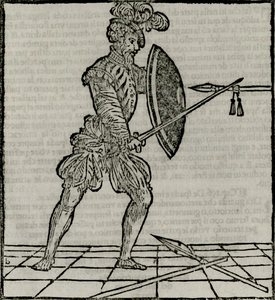
Sidesword-and-Rotella is different from Crusader-era Sword and Kite Shield in many ways. The Sidesword is a longer sword, has better hand protection, and favors the thrust over the cut. The Rotella is a round steel shield about 2 feet in diameter. The shield is somewhat closer to the Kite Shield, but it is still smaller, made of steel, and more mobile. It is also held in a stance that does not block the swordsman's view as much. Manciolino, Marozzo, and Di Grassi all teach Sidesword and Rotella (aka Sword and Target or Sword and Shield).
4 tactics that might be useful to you:
1. If you are using a longsword, you usually have a reach advantage over an opponent using sword-and-buckler, sword-and-shield, etc. Try to stay out of his range and thrust and cut from afar. So long as you keep the opponent at a distance, you will eventually win. This tactic works any time you have a longer weapon than your opponent.
2. Try to move to his shield-side (as before mentioned) since he can't see you as well there. You have a free hand, so you can grab his shield or buckler, wrench it to the side (or even out of his hand) and stab or cut him.
3. A good sword-and-buckler or sword-and-shield user knows that he has the advantage if he can trap your sword between his sword and shield. That would allow him to disarm you or perform various advanced counterattacks. Sword-and-buckler/sword-and-shield often has the advantage in the bind. Don't let him trap your sword. Keep it moving.
4. If your opponent has a shield or buckler, another useful tactic is feinting. If you convince your opponent that you are attacking in one direction, he will usually raise his shield/buckler to defend there. This will create an opening in another area. Immediately strike that area. Larger shields have the ability to protect a larger area at a time, but they are also slower to move. You can use that to your advantage. It can be especially difficult for him to defend against a cut to the legs when he has moved his shield to protect his head.
Hopefully this helps.