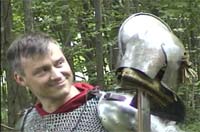
Charron test cutting

For Historical European Fighting Arts, Weaponry, & Armor

Moderators: Webmaster, Stacy Clifford

Guest

Sparring power, force, and strength.

Postby Guest » Tue May 27, 2003 3:23 pm

To make up for my lack of content in my last post, I'll ask a question.

With the type of sparring (padded) swords we advocate and use, how much force should be used / do you use?

The instructions on our site, IIRC, advise that full-speed-full-force sparring when unarmored may not be good idea. (some of you out there could probably make a crater out of someone with a full-force blow.) Then again, sparring with padded swords allows one to see if they are able to perform what they have been practicing with speed and power yet, and how much speed and power they can use without being out of control. Thoughts?

This brings up a thought about the deference between free-play and sparring, which I'm going make a topic about called "Terminology: Free-playing vs Sparring"

User avatar
John_Clements
Posts: 1167
Joined: Wed Sep 18, 2002 10:43 pm
Location: Atlanta area

Re: Sparring power, force, and strength.

Postby John_Clements » Tue May 27, 2003 4:01 pm

The answer would be "control".
See the other current thread on Soft & slow vs. Hard & fast.
This would be better asked there.
Do NOT send me private messages via Forum messenger. I NEVER read them. To contact me please use direct email instead.

User avatar
Randall Pleasant
Posts: 872
Joined: Mon Sep 23, 2002 3:35 pm
Location: Flower Mound, Texas, USA

Re: Sparring power, force, and strength.

Postby Randall Pleasant » Tue May 27, 2003 4:17 pm

Mike

Sorry for my comments, the content of your first post was fine. It was I who was off topic, I was making a joke - your first post could have many meanings to someone from Louisiana. <img src="/forum/images/icons/laugh.gif" alt="" /> <img src="/forum/images/icons/tongue.gif" alt="" />
Ran Pleasant

Guest

Re: Those Vidios

Postby Guest » Fri May 30, 2003 7:45 am

Hi Folks,

I took those videosof Bob and his wife Kristi doing the test cutting. Those swords of Peter Johnson are amazing things to hold. I cut successfully one and from Frontal posta to Boars tooth with very little power and it went clean through. I did do some poorcuts and these were not successful but I did not coordinate very well and hence the problem.

The tatami matting was intresting to cut. The thikest we tried was three mats rolled together. They cut very easily.

All the best

Col
HEMAC member
ARMA member (I think I may still be)

Guest

Re: Those Vidios

Postby Guest » Fri May 30, 2003 9:20 am

Ciao Colin, nice to hear from you here <img src="/forum/images/icons/grin.gif" alt="" />
However we all know you have Jedi powers so stories of you cutting without strenght are no surprise for us <img src="/forum/images/icons/wink.gif" alt="" />

User avatar
Odin Lindgaard
Posts: 6
Joined: Thu Jan 23, 2003 12:53 am
Location: Lofoten, Norway

Re: speed and force

Postby Odin Lindgaard » Sat May 31, 2003 5:31 am

Hi Stewart,

"What it seems to me you are describing would result in both the hands and tip moving more or less in a straight line (you said that the hands were thrown to the right a little, which would also include minimal downward motion) and then a quick, snapping quarter arc downward for the tip, with a possible follow through arc with the hands."

Re-reading my posts I see that I have been too vague, so I`ll give it another try:

There is not necessarily a snap or a follow through. You shoot the point at your opponent by stretching out your arms, the right farther that the left, hitting him with the foremost part of your sword. The hands may arc, but the point certainly does not have to.


The easiest way to see this is to do the following:
Assume vom Tag at the shoulder next to a wall, make a mark on the wall where your point (or the part of the blade with wich you want to hit) is and a mark at where the opening you want to hit would be, and then draw a line between these to marks.

Now as you move forwards (Döbringer says you should step to the side, but now you have a wall there) move your point along the line by first pushing out with your right hand, then with your left. The sword does not hit with a downward or in any other direction circular motion, it follows the straight line into the target.

Guds fred!
Odin

User avatar
TimSheetz
Posts: 412
Joined: Fri Sep 20, 2002 4:55 pm
Location: Madrid, Spain

Re: speed and force

Postby TimSheetz » Sat May 31, 2003 6:51 am

HI Odin,

I understand the idea behind the linear movement you are talking about.. but if we videoed it and traced the tip I am pretty sure it would be moving in a slight arc.. as it is a long fairly rigid object that is pivoting.. But for me this is all semantics.

The important piece is that the blow is fast, down with great speed and force - mostly by putting force on the grip in the pivoting of it, and NOT by "dragging the grip and blade through an arc."

That sound right?

Thanks,

Tim
Tim Sheetz
ARMA SFS

User avatar
Odin Lindgaard
Posts: 6
Joined: Thu Jan 23, 2003 12:53 am
Location: Lofoten, Norway

Re: speed and force

Postby Odin Lindgaard » Sat May 31, 2003 10:07 am

Hi Tim,

"I understand the idea behind the linear movement you are talking about.. but if we videoed it and traced the tip I am pretty sure it would be moving in a slight arc.. as it is a long fairly rigid object that is pivoting.. But for me this is all semantics."

Yes, the linear movement is the ideal. Personally I am not capable of drawing a straight line even with a pencil.

"The important piece is that the blow is fast, down with great speed and force - mostly by putting force on the grip in the pivoting of it, and NOT by "dragging the grip and blade through an arc."

That sound right?"

Yes, it does.

Guds fred!
Odin

User avatar
Bob Charron
Posts: 65
Joined: Fri May 23, 2003 6:13 am
Location: Madison, WI
Contact:

Re: speed and force

Postby Bob Charron » Fri Jun 13, 2003 11:13 am

I just thought I would let you know that I did some more test cutting in Benicia this last weekend at the Schola St. George event.

Jim Alvarez, who is quite a fine gentleman and excellent cutter with a katana brought several boxes of single and double soaked tatami mats for the attendees to cut.

I had been working with Gus Trim on the development of a sword that reproduced the handling characteristics I've observed in the museum pieces, and which is affirmed by working with the mechanics in Fiore's system. We particularly worked on moving the center of rotation closer to the hilt (about 8" out) and on making the blade stiffer. It's a marvelous piece, and I bought it a few minutes after I first held it in my hand.

I had no problem cutting fendente or sottani in a relaxed fashion. In one pass I stood in dente di cenghiaro and without moving my feet cut sottani and then fendente to return to the same guard. 4" sections of the target were cut cleanly from the whole with no effort.

Jim Alvarez asked me what cutting training I had taken, since I seemed to be able to cut easily. I told him that the master I was studying instructed to move from one position to the other, and to take the blade through a particular path, and that's all I was doing. I didn't have to consciously do anything else but remain relaxed.

Witnesses all agreed it looked effortless.

So it seems that Fiore does tell us exactly how to cut, and that you can learn to cut from a book :-)

The purpose of this post is to praise Fiore's system and confirm during this second-ever cutting experience what I discovered that night at Albion Armouries with Peter Johnson's sword the first time I ever cut a target. Gus Trim's sword performed excellently, experienced cutters made positive comments, and onlookers remarked it looked effortless. All this credit goes to Fiore, who told me exactly what to do.

Bob Charron
St. Martins Academy of Medieval Arms

User avatar
Webmaster
Posts: 289
Joined: Wed Sep 18, 2002 9:19 pm
Location: Houston, Texas

Re: speed and force

Postby Webmaster » Fri Jun 13, 2003 12:28 pm

Thanks for the post, Bob. Will there be any pictures or video for people to view?

Also, the next time you get to test cut, I think you should see what difference it makes to move your feet with your cuts. We recommend moving your feet with all cuts and transitions between stances, as we find this adds stability, speed, and additional power. If your upper body moves through a cutting motion and your lower body doesn't, it is dangerously easy to become unbalanced in most of our experience. I imagine you are probably aware of this, but since you specifically mentioned not moving your feet, I thought we should address the subject.
0==[>>>>>>>>>>>>>>>>>>>>>>>>>>>>
Stacy Clifford
ARMA Webmaster

User avatar
John_Clements
Posts: 1167
Joined: Wed Sep 18, 2002 10:43 pm
Location: Atlanta area

Re: speed and force

Postby John_Clements » Fri Jun 13, 2003 1:15 pm

Stacy is of course correct, as John Waller and Hank Reinhardt stressed at the Atlanta Renaissance Martial Arts Expo in 2002 which we hosted, you must move your feet in coordination.

Another reason for the necessity of moving the feet is that your target (opponent) will also be moving --either away from or toward your action. And should they displace your cut with their own counter blow, unless yours has sufficient power to recover correctly you are in big trouble.

To quote Hans Leckuechner’s rule number 4 for the beginner fencer from his manual from the 1470s: “He who moves after the blows, has no right to be proud of his art.”

JC
Do NOT send me private messages via Forum messenger. I NEVER read them. To contact me please use direct email instead.

Guest

Re: speed and force

Postby Guest » Fri Jun 13, 2003 2:39 pm

Bob,

Well, if you are going to be "assisting" Gus Trim in a sword design, I suggest reading this importnat article: http://www.thearma.org/spotlight/heymr.htm

From what I understand, according to Peter Johnson and the good folks at Albion, Trim violates nearly every concern raised in it.

Btw, when and where exactly did you handle real pieces? Which types? Are you sure they were originals and not modern fakes or 19th century replicas that exist in many museums like David Edge currently writes about in his new article in the Oakeshott Institute journal?

Folks sometimes get confused. Just because a sword is in a museum doesn't very well mean it is a good sword. It may well be and a used piece at that... but it may well be a sword no one really wanted and it hung on a wall for years/centuries and eventually made it to a museum. Master Bladesmith Dan Maragni discusses this is the interview I conducted with him. http://66.246.43.48/~armano/Interview1.htm

I almost bought a 19th century repro piece thinking it was a real sword and Lee Jones and Dan Maragni were kind enough to show me an actual fake, which I would have never guessed it to be.

Cheers,


Return to “Research and Training Discussion”

Who is online

Users browsing this forum: No registered users and 14 guests


Note: ARMA - The Association for Renaissance Martial Arts and the ARMA logo are federally registered trademarks, copyright 2001. All rights reserved. No use of the ARMA name or emblem is permitted without authorization. Reproduction of material from this site without written permission of the authors is strictly prohibited. HACA and The Historical Armed Combat Association copyright 1999 by John Clements. All rights reserved. Contents of this site 1999 by ARMA.