Armored combat and sword-pistols

For Historical European Fighting Arts, Weaponry, & Armor

Moderators: Webmaster, Stacy Clifford

User avatar
Stacy Clifford
Posts: 1126
Joined: Fri May 14, 2004 11:51 am
Location: Houston, TX
Contact:

Postby Stacy Clifford » Tue Aug 07, 2012 4:06 pm

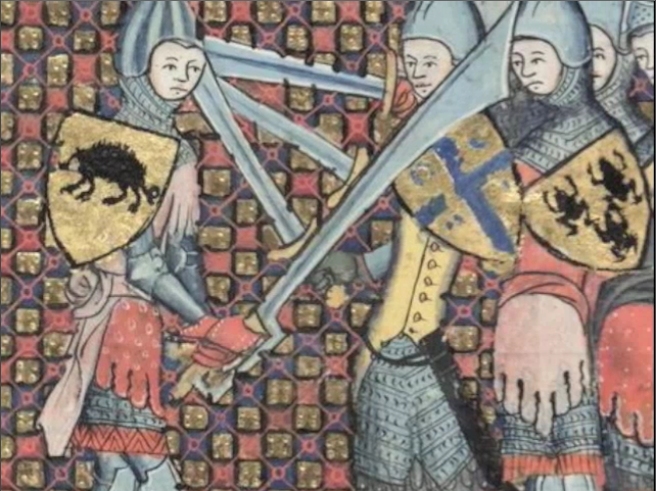
Swords would have to be A LOT better than guns at dealing trauma to make them primary. However, the setting being the 1860s, handguns still run out of bullets, and handguns that shoot really large bullets probably don't shoot as many of them. (I imagine an .80 caliber six-shooter would make the Walker Colt .44 look like a Derringer.) So your shots do more damage, but you get fewer of them per gun, and you either need more guns or two hands on a bigger weapon. Bowmen, pikemen, and earlier arquebusiers usually carried swords as backup, and they got to use them plenty often enough. As for swords that do more damage to armor, that idea has been around a long time...

http://www.thearma.org/arttalk/at44.htm
(Look in the background of the top panel.)

Image
0==[>>>>>>>>>>>>>>>>>
Stacy Clifford
Free-Scholar
ARMA Houston, TX

Jonathan Hill
Posts: 111
Joined: Fri Sep 25, 2009 3:01 pm

Postby Jonathan Hill » Tue Aug 07, 2012 4:27 pm

I was going ask which is more important to you, the armor or the sword? Swords actually became more useful in war when guns became more predominate/armor was dropped. By the early 1800’s the line cavalry was issued a sword as a primary weapon rather than a secondary weapon. When we drop armor and guns are more popular like in the early 19th C the sword is your go to weapon for when the bullets have flown and you need to keep fighting. So a simple answer to your problem is drop the armor; that is what we did. You can also make the armor less common and thus only available to the officers or upper class but also make it more suited to faster combat. While armor is not the hindrance people think it is for fighting, a man in armor moves slower than a man without armor. They are still no match in the fight but when you need to run to different parts of a battlefield because the artillery is pounding you, the guy that is not in armor will get there faster and be less fatigued by the effort. The lack of armor will allow faster footmen than armored men, thus why armored liked horses.

At the point of the civil war you still did not have a metal cartridge bullet and thus most pistols would need to have a significant time to re-load them rather than the quick re-loading you are used to with a modern revolver. For early revolvers you had to load each cylinder individually and once the gun was fully discharged you did not have time to re-load in the fight, you pulled another one, a sword or you fell back.

David Zietlow
Posts: 8
Joined: Sat Aug 04, 2012 3:21 pm

Postby David Zietlow » Wed Aug 08, 2012 1:45 am

Stacy Clifford wrote:Swords would have to be A LOT better than guns at dealing trauma to make them primary.


Image

I'm just kidding.

I love the damage-ammo tradeoff. Very interesting battlefield dynamics.

Jonathan Hill wrote:I was going ask which is more important to you, the armor or the sword?


Good question, I'm starting to wonder myself.

What I like about swords is that its art is complex, intricate, subtle--a deep game, far more than gun warfare. The samurais must have been devastated when any peasant could pick up a gun and render worthless their lifetime of training. (It's a shame Hollywood wastes its intricacies though--there's so much untapped potential in it. One of my all-time favorite movie fights is the climactic duel in Troy--you can feel the strategy behind it, the depth of the game. Too often I'll be caught in the illusion of a movie until the fight scenes, but that Troy scene's believability did wonders for the drama, the intensity of the scene for me. That's so much more than "cool factor.")

What I like about armor is 1) some degree of protection from stray arrows/bullets, 2) how it lengthens duels, as opposed to "short and sharp," 3) giving characters more room to make mistakes. Even the best fighters make split-second strategic errors, and without armor that can be fatal. My story revolves around a female lieutenant who's heavily restricted in her personal and professional life. In an era of sexist pseudoscience, I was hoping to show the depth and complexity of the intellectual game she's playing.

You guys are awesome. I don't have any more questions right now, but I'm really enjoying this conversation. Thanks :D
Last edited by David Zietlow on Tue Apr 23, 2013 5:13 pm, edited 2 times in total.

User avatar
Stacy Clifford
Posts: 1126
Joined: Fri May 14, 2004 11:51 am
Location: Houston, TX
Contact:

Postby Stacy Clifford » Wed Aug 08, 2012 11:50 am

Yeah, I think this scenario is starting to work itself out. One of the reasons plate armor went by the wayside is that steel plate strong enough to resist bullets simply became too heavy for combat use. If a magic light-weight metal comes along that can do the job, you extend the life of plate armor by a few hundred years. As long as loading bullets remains on the slow side, plate armor and close combat can have a place on the battlefield. Once fast-loading cartridges, magazines, and smokeless gunpowder are invented, that's probably the end of full plate and swords as a useful combo because guns are now too efficient not to be primary. The 1860s would likely be the armored knights' last big hurrah on the battlefield, with the Gatling gun being the harbinger of their impending doom.
0==[>>>>>>>>>>>>>>>>>

Stacy Clifford
Free-Scholar
ARMA Houston, TX

LafayetteCCurtis
Posts: 421
Joined: Sat Nov 04, 2006 7:00 pm

Postby LafayetteCCurtis » Tue Aug 14, 2012 4:54 am

The thing about armour and mobility is a complicated issue. In the Middle Ages, the people most likely to wear full armour (i.e. men-at-arms) were a physically stronger, faster, tougher lot than the average soldier when out of armour; their armour did slow them down but all that did was bring them to roughly the same speed (or only slightly lower) than a significantly less well-armoured foot soldier.

When the Renaissance kicked in, armour grew heavier overall in order to resist the impact of firearms. This meant that even battlefield harnesses slowed the wearer down more than comparable full suits of armour from the 15th or late 14th centuries, and additionally the wearing of armour had spread to non-chivalric classes of foot soldiers who didn't have the superior physical conditioning of men-at-arms. This is what Francois de la Noue complained about when he said that men were once able to wear their armour around the clock but by his time (the late 16th century) they were clothing themselves in heavy, ungainly suits that could only be worn for a few hours at a time before they began to inflict serious discomfort.

Now, if the "mythril" armour had the lightness of medieval pieces and much better protection, their greatest weakness would be a matter of fatigue and heat exhaustion. Even in the Middle Ages, armour always impeded the body's natural "heat sink" capability, and this became more serious with late-medieval and Renaissance plate armour designed to minimise vulnerable gaps and joints. Fewer joints where weapons could break in also meant fewer joints for heat to leak out. Any soldier wearing much armour would not have been much slower than unarmoured counterparts but he probably would have tired much more quickly, so heavily-armoured units would have had to be held in reserve and unleashed only once they had a clear target that they could approach in a straight line. I'd expect them to spend most of their time being rested and husbanded for the decisive moments--and often just lying unused for the entire duration of a battle because the general couldn't make up his mind about when that decisive moment was going to come.

LafayetteCCurtis
Posts: 421
Joined: Sat Nov 04, 2006 7:00 pm

Postby LafayetteCCurtis » Tue Aug 14, 2012 5:30 am

David Zietlow wrote:Speculation: a firearm of mythril-bashing caliber would probably have to be a two-hander. Give it a bayonet, and maybe even a hook--you could fashion a polearm out of it, adding close-range options to armored combat. Using it for melee may damage the firing mechanics (that's part of the game). Mythril's strong enough that bashing would do little good, but maybe you can thrust between what little gaps the Maximilian-esque armor has, or fire point-blank for increased lethality...I'm just rambling off the top of my head, but this might work.


There's a great deal that you could extrapolate from similar situations that realistically happened in history. One of the things that comes to mind is the introduction of the tank in World War I. Early tank armour was necessarily quite thin since the engines available could not propel a much heavier vehicle to a reasonable turn of speed. As a result, the Germans experimented with special kinds of rifle rounds (among them ones where the projective was reversed so that it struck with the blunt end first) that proved capable of penetrating tank armour at long range. Pretty much all sides also began to develop anti-tank rifles of a size and power comparable to modern anti-materiel rifles; I suspect that similar weapons would have been an important development priority in a Civil War milieu with armour that could resist ordinary musket balls. Perhaps they would have taken a form similar to early wall guns (search for the German term "Doppelhaken" or Eastern jingals, probably crewed by two soldiers rather than one. The impact of the large bullets from such a weapon would have been equivalent to (at least) a strong blow from a stout warhammer and they would have allowed properly-equipped teams to engage armoured troops from a much longer range, than, say, an extra-heavy revolver firing the equivalent of shotgun slugs (Le Mat, anyone?)

And of course there's still rifled gunpowder artillery. No matter how strong an armour is, a single solid bolt from even a small gun would probably have been able to put a hole through several knights in a row--or crush them to their deaths even if the armour managed to stay in one piece.


Another path of development that would be of some interest is naval history. In the 1860s, improved steel production methods scaled up better for armour than for guns. While bulletproof armour for the individual soldier or horse was still too heavy to be practical, large thick slabs of steel armour for ships proved much easier to manufacture than large guns that could penetrate such armour. The reason is quite simple: steel slabs for armour were just that--slabs--and even contoured pieces didn't need anything like the detailed shaping that would have been essential for personal body armour. On the other hand, extremely large muzzle-loading guns were very impractical to operate; some nations did experiment with such guns (especially the Italians with their 16-inch guns), but their reloading procedure was so difficult and complicated that there was little prospect of realistically loading and firing a second shot once battle was joined. Breech-loading guns didn't even count since the obturating mechanisms that would make them practical (de Bange interrupted screw breeches, Krupp sliding wedge breeches, brass or steel quick-firing shell casing large enough for artillery) had not yet been developed. As a result, the two major ironclad battles of the era (Hampton Roads/Monitor vs. Virginia and Vis/Lissa) featured a large amount of ramming, and this led naval tacticians throughout the late 19th century to put too much emphasis on ramming even when gun technology had caught up and allowed battleships to engage each other at longer ranges than ever before--a misconception finally broken at the Battle of Tsushima. So yeah. If you want a 100% historically correct predominance of heavy armour, think of ships within this narrow window of time (1850s/1860s to 1870s or at most early 1880s).

If none of those things are like what you're looking for, I'll just bring the discussion back to the issue I mentioned early on: you don't need armour to have lots and lots of swordplay in the mid-19th century. Champions challenging each other to single combat between the lines wasn't unheard of either; cavalrymen (especially dashing light cavalrymen like hussars and chevaulegers) did this all the time during the Napoleonic wars and the romanticism of that time still had a strong grasp upon the mind of the Civil War officer.


What I like about swords is that its art is complex, intricate, subtle--a deep game, far more than gun warfare. The samurais must have been devastated when any peasant could pick up a gun and render worthless their lifetime of training. (It's a shame Hollywood wastes its intricacies though--there's so much untapped potential in it. One of my all-time favorite movie fights is the climactic duel in Troy--you can feel the strategy behind it, the depth of the game. Too often I'll be caught in the illusion of a movie until the fight scenes, but that Troy scene's believability did wonders for the drama, the intensity of the scene for me. That's so much more than "cool factor.")


Maybe you should consider a different dimension to the complexity and intricacy of war. Firearms didn't really make war simpler and more brutal as such; while gunpowder warfare may have required less skill in individual handling of arms, gunpowder armies actually required more training than earlier ones since the characteristics of their weapons as well as the larger numbers of soldiers involved meant that teamwork had become more important than ever. If your character was a low-ranking officer, why not show her skill in leadership and tactics? Go read Bernard Cornwell's Sharpe series if you need to convince yourself that such things could work. Sharpe does get into a large number of swordfights throughout his fictional career, mind you.
David Zietlow
Posts: 8
Joined: Sat Aug 04, 2012 3:21 pm

Postby David Zietlow » Fri Aug 17, 2012 7:02 pm

More data, thanks. I'm still experimenting with armor, but I picked up the Sharpe series.

Maciej Talaga
Posts: 4
Joined: Sun Apr 26, 2009 4:26 am
Location: Warsaw, Poland

Postby Maciej Talaga » Thu Aug 30, 2012 4:38 am

Hi,
scimming through what you've written I thought that you should take a look on this piece: http://collections.royalarmouries.org/i ... wO30=&pg=3
Notice that it is an estoc and it has got pointy quillions.
Best regards
'Dum pugnas victor es'
ARMA-PL Warsaw Study Group


Return to “Research and Training Discussion”

Who is online

Users browsing this forum: No registered users and 18 guests


Note: ARMA - The Association for Renaissance Martial Arts and the ARMA logo are federally registered trademarks, copyright 2001. All rights reserved. No use of the ARMA name or emblem is permitted without authorization. Reproduction of material from this site without written permission of the authors is strictly prohibited. HACA and The Historical Armed Combat Association copyright 1999 by John Clements. All rights reserved. Contents of this site 1999 by ARMA.
