Jake,
While you realize that I will hold on to a point until I am beaten and forced to let go, before I go that far I want to make sure it is the point I am trying to defend. Therefore I want to clarify my position on the baseball bat/wrath strike.
First, the Zornhau-as-baseball swing. Shame on you. I taught you better. That's not at all what's happening there, but this is the wrong thread to go into it.
I fully understand that a wrath strike is not a baseball swing. When I wrote:
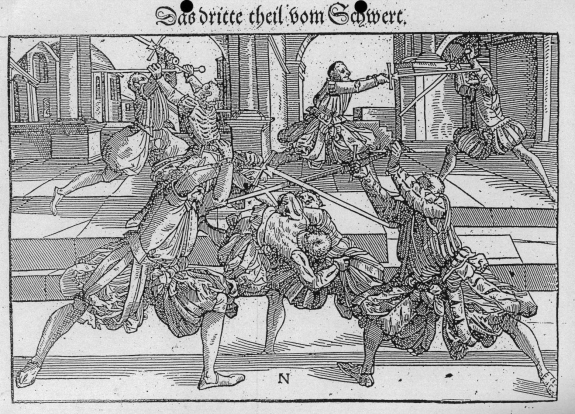
The figure in left front is clearly swinging a wrath strike just like a baseball bat with his hands close.
My meaning was that his hand and arm position is just like the ready position just before you swing a ball bat. Hands together, arms up and body torqued. I did
not mean that the two were the same swing, though after rereading it I can see how poorly worded my reply was and that I certainly seemed to be saying that.
Also, I originally only brought it up as a (unanswered) question :
"If there is a biomechanical advantage to having your hand far apart for either speed or leverage... why don't we swing a baseball bat like that?"
Realize of course, I am referring to speed or leverage/power in the strike itself, not in what we do after.
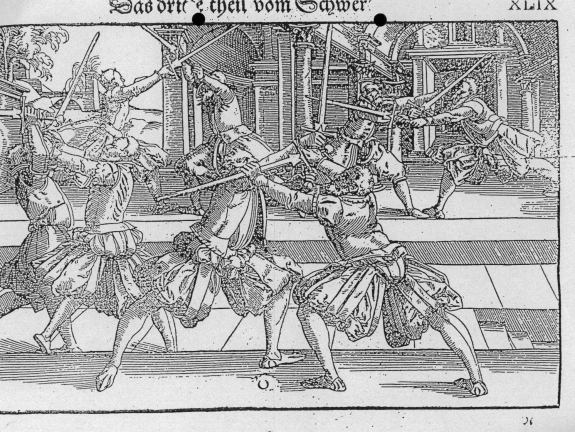
Second, the preponderance of those images shows the handle being used fully, though not necessarily with the pommel being gripped--this is the correct interpretation of Dobringer's statement if there is one, IMO. What it is *not*, however, is the hands-close-together grip of film or Christian Tobler's first book. This is the grip that I am fighting primarily. It is, I believe, a "bad" grip for most functions.
I believe the "
a "bad" grip for most functions" is the key here. This is clearly a grip to use for the most powerful blow possible, such as you would make with a Vorschlag.
You could also use it for
very fast, although very weak, twitching. This could possibly be one of the reasons that the earlier manuals warns of getting caught weak with your arms crossed, while Meyer doesn't seem to have much concern over it that I can tell. I can tell you this, I wouldn't want to make a habit of it.
Third, that grip is a liquid thing, is a long-standing element of my approach to the field. You know this as well as any! Saying, however, that "hands close together is legit because grip is liquid" is the same as saying "hands far apart (or on the pommel) is legit because grip is liquid." In allowing everything we say nothing.
I understand. As a matter of fact what you taught us about that is the reason we feel free enough about the fluidity of our grip to ask "why not" about this and investigate it. Grip it just too fluid to say that any grip does not have a place, at least until proven otherwise.
Fourth, there's still no address of the interference that close-hand grips provide in proper adjustment of technique inndes.
I agree, as previously stated, that hands-close-together gets you a stronger, more brutal single-stroke (as seen in the above artwork). But only a buffalo fights that way as a matter of standard course...
Just as an example for the first part. Place your hands close together in wrath guard. As you make your strike, when you see that you will not be successful, let your bottom hand slide down to the pommel, as you would when you cut with an axe, where you place your hands apart and slide the top hand down as you strike... just reverse it, i.e. your bottom hand slides down into a wide grip. This puts you into longpoint with your hands apart and ready for handwork.
As to the second, I strongly believe you know that it would be foolish to fight in
any one way as a matter of standard course.
Lastly, I would like to go back and address this, though it too needs it's own thread:
But some of what we're seeing here, too, is "Dobringer's old, so he must be right! I can feel it." Humbug, I say. Do I believe Doebringer's wrong? No, but I'm not ruling it out, either.
I started with the Liechtenauer specifically to dispel the notion that Meyer was a "school fencer". I am just now starting to get what I think is a good handle on it, but due to this I have come to the conclusion that Meyer was anything but. We have found everything that is in in Doebringer in Meyer, and close to vice-versa. Meyer was not trying to do anything new, he was giving a detailed explanation of Liechtenauer's Art. Everything Doebringer says not to do in fencing, so does Meyer. Meyer's slashing to the four openings are in Doebringer, you just have to be able to see them, and I was able to thanks to Meyer. The grip thing is one where Doebringer says to, Meyer doesn't
say one way or the other... but shows pictures of it. I honestly don't think
either one should replace the other, but that they should be used to compliment one another. To tell you the truth, I am starting to believe that Meyer, Doebringer, and Talhoffer should be thought of as a set.
"A sword never kills anybody; it is a tool in the killer's hand." Lucius Annaeus Seneca 4BC-65AD.