Based on test cuts, is "edge smearing" effective?

For Historical European Fighting Arts, Weaponry, & Armor

Moderators: Webmaster, Stacy Clifford

User avatar
Vincent Le Chevalier
Posts: 166
Joined: Mon Dec 31, 2007 5:18 am
Location: Paris, France

Postby Vincent Le Chevalier » Fri Feb 20, 2009 4:57 pm

Actually binding vs. not-binding arguments can also be seen in european fencing. An example in the later period can be found in the manuals of Fabris and Thibault. Fabris explicitely recommends not to bind, to avoid the adversary's blade, because it restricts your freedom and gives information to the opponent. Thibault on the contrary, says that binding the sword and working from there is the basic technique that must be mastered absolutely, because the eye is more easily deceived than the hand. Yet the basics of distance and timing are equally present in both methods...

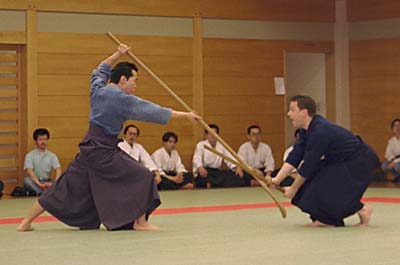
To provide another data point, in Katori Shinto Ryu the more you advance in the kata and skill, the more you bind and work from the bind.

I think there is some issue of personal preference here; some will be more visual and do not need to rely on the feel, some will like the feel better. Also, training for the bind is difficult to do alone or with an inexperienced partner. It's less immediately applicable in free-play as well, but maybe with greater benefits as the level improves.

User avatar
CalebChow
Posts: 237
Joined: Sun Oct 14, 2007 1:31 pm
Location: Philadelphia, Pennsylvania

Postby CalebChow » Fri Feb 20, 2009 9:41 pm

Hmm, thread is getting more heated.
Great exchange of info here, but let's avoid any potential personal judgments/accusations about respective arts or integrity etc., please.

I, personally, am perfectly fine with this thread's discussion on binding, though.

Vincent, could you quote/link a translation of Fabris' statement about avoiding the bind, and maybe a link to a good video that shows the Katori Shinto Ryu binding as well? I think that might be pretty helpful for this discussion.

Thanks
"...But beware the Juggler, to whom the unseemliest losses are and who is found everywhere in the world, until all are put away." - Joachim Meyer

User avatar
Brandon Paul Heslop
Posts: 134
Joined: Sun Mar 04, 2007 12:56 am
Location: West Valley City, Utah
Contact:

Postby Brandon Paul Heslop » Sat Feb 21, 2009 2:26 am

Vincent Le Chevalier wrote:Actually binding vs. not-binding arguments can also be seen in european fencing. An example in the later period can be found in the manuals of Fabris and Thibault. Fabris explicitely recommends not to bind, to avoid the adversary's blade, because it restricts your freedom and gives information to the opponent. Thibault on the contrary, says that binding the sword and working from there is the basic technique that must be mastered absolutely, because the eye is more easily deceived than the hand. Yet the basics of distance and timing are equally present in both methods...

To provide another data point, in Katori Shinto Ryu the more you advance in the kata and skill, the more you bind and work from the bind.

I think there is some issue of personal preference here; some will be more visual and do not need to rely on the feel, some will like the feel better. Also, training for the bind is difficult to do alone or with an inexperienced partner. It's less immediately applicable in free-play as well, but maybe with greater benefits as the level improves.


Vincent,

As your primary example refers to the rapier (and I think we all know how I feel about rapier, ;) ), I contend that it is not applicable to the argument at hand. The rapier is used in a completely different fashion than that of the medieval longsword, (and roughly comparable Asaian sword forms). In short, rapier has no place in this argument.

Asd to your second point regarding the Katori Shinto Ryu form of Japanese swordplay, well...I've gotta give it to you, there...I was unaware of that.

As for your third point about preference, I disagree. Take a look at how many terms Fiore has for incrossada, and the different kinds (high and low). Look at his manuals...most of the techniques are performed from the bind. In the German tradition we have "feeling," "twitching," and "winding." So MUCH EMPHASIS is placed upon the bind, and attacks and counter attacks from the bind. It is central to the longsword. There really isn't any room for an educated argument against the centrality of fighting from the bind. Other elements are present and practiced, of course, but a truly good longsword fencer must have an intimate understanding of fighting from the bind. It is the keystone of advanced knowledge of the art of the longsword.

Caleb: heated? How so? I do believe we're all being more or less civil. Disagreements are bound to crop up.
Thys beeth ye lettr yt stondÿ in hys sygte \
To teche . or to play . or ellys for to fygte...

"This [is] the letter (way,) [for] standing in his (the opponent's) sight \
[either] to teach, or to play, or else for fight..."

-Man yt Wol.

User avatar
Vincent Le Chevalier
Posts: 166
Joined: Mon Dec 31, 2007 5:18 am
Location: Paris, France

Postby Vincent Le Chevalier » Sat Feb 21, 2009 3:42 am

Honestly Brandon I agree with you, the best fencers have to be good at the bind :) I just acknowledge that there were other schools that sought to avoid blade contact as much as possible. I think you're making too big a difference between rapier and the rest of European swordsmanship but I'm obviously not going to convince you, and that's off-topic.

Caleb,
Vincent, could you quote/link a translation of Fabris' statement about avoiding the bind,

I'm sorry, I'm away from home currently so I don't have my translation at hand... I'll try to find the quote again when I get back. Unless someone else is quicker than me...

and maybe a link to a good video that shows the Katori Shinto Ryu binding as well?

Maybe this will be hard to see, but it's something you feel when you practice. Anyway here are the first 4 paired forms performed by two different branches of the school:
http://www.youtube.com/watch?v=KUVzT9tvquY
If you pay attention to blade contact, you'll see more of it in the last forms, and it also becomes less violent, with the blades gliding along seeking for an opening. In other words the use of tactile perception is a lot more subtle in the last forms.

Keep in mind that these forms are not actual combat applications. I think of them as a sort of perfect fight à la Silver, where each fencer is so good and fights so safely that no one is hurt... I'll refrain from commenting in more depth because it's not really allowed by the ryu and I cannot say I have a perfect understanding of it anyway, far from it.

User avatar
CalebChow
Posts: 237
Joined: Sun Oct 14, 2007 1:31 pm
Location: Philadelphia, Pennsylvania

Postby CalebChow » Sat Feb 21, 2009 1:12 pm

Brandon Paul Heslop wrote:
Caleb: heated? How so? I do believe we're all being more or less civil. Disagreements are bound to crop up.


Nothing wrong with disagreements, maybe I was just misreading the tones to be potentially personal. I was just being paranoid as I wrote the post before dinner (hungry = no happy). As long as everyone here is fine then please carry on :wink:

But thanks, Vincnet! Interesting video. Certainly a fair amount of blade contact.
"...But beware the Juggler, to whom the unseemliest losses are and who is found everywhere in the world, until all are put away." - Joachim Meyer

User avatar
Vincent Le Chevalier
Posts: 166
Joined: Mon Dec 31, 2007 5:18 am
Location: Paris, France

Postby Vincent Le Chevalier » Fri Feb 27, 2009 1:32 pm

CalebChow wrote:Vincent, could you quote/link a translation of Fabris' statement about avoiding the bind?

Here is the part I was thinking about:
It is important to remember that, as you find your opponent's sword, you should never touch his blade with yours. [...] Most of the time, if the opponent's sword is not molested, he will not realize that you have found it. Whereas if you touch it, he will very likely realize what you are trying to do, and will have occasion to perform a cavazione, withdraw or change his guard in order to free his sword, and you will have lost your advantage.

Besides, if you touch the opponent's sword, you somewhat disrupt your own form: if you wanted to take advantage of a sudden tempo, you could not do so because your sword is bound by the pressure of the opponent's blade. [...]

Instead, if you keep your sword suspended in the air, you are always more ready in every occasion, your attacks are more in tempo, and you are not forced to control the opponent's blade, which is something that often causes coming to grips and makes fencing degenerate into wrestling.
(in the translation by Tom Leoni, p.16)

If you are not familiar with the concept of "finding the sword", you can read this article about it, also by Tom Leoni: http://www.salvatorfabris.com/UnderstandingGainingTheSword.shtml

Of course Fabris does not shy away from blade contact if the adversary attacks, it's still the only way to set the strike aside, but he is not seeking it as a preparation for further actions. The idea seems to be that you situate yourself in a position where, if blade contact happen, you have an automatic advantage that allows you to strike through. I find the reasons he gives for avoiding blade contact interesting to consider; basically he states that the tactile feeling does not help.

I can probably dig out some Thibault quotes that make opposite points if it is of interest :)

Regards,

Maxime Chouinard
Posts: 72
Joined: Wed Sep 24, 2008 11:46 am

Postby Maxime Chouinard » Sat Feb 28, 2009 10:48 am

There are plenty of binding in many ryuha. The most binding oriented one I can think of is Maniwa nen ryu, the oldest surviving bujutsu school there is (1368). There are no substantial video I'm aware of but here are some pictures:

http://www.shintaido.com/pic/maniwa.jpg
http://www.koryu.com/images/r96mnw.jpg
http://www7.wind.ne.jp/yoshii/rekisi/bunka/img/003.jpg
http://www.geocities.jp/gl_kanko/Gyoji/ ... iraki.html

You can see that they use the guard to trap. They also do some sort of free sparring and dynamic tension exercices to learn how to work in the bind. But like Vincent said, it boils down to personnal preference, some will go for it, others won't. And while I personally like binding techniques, I haven't seen anything that would prove it's superiority under all conditions. I think the empi kata from Yagyu Shinkage ryu actually shows how to work against someone who goes for a binding (at least someone from the shinto school).

Just like in Irish stick, we have two surviving traditions, one goes for the bind (Doyle family style) the other don't (An Maide Bata, which I practice). But both have ways to make it work and make the other fail.

Chris Ouellet
Posts: 83
Joined: Wed Aug 02, 2006 3:38 am

Postby Chris Ouellet » Tue Mar 03, 2009 6:25 pm

Sorry for the late reply, I've recently started a new job and that took all of my attention.

Caleb, I have a thick skin, no worries. Brandon may think and say whatever he wants, it won't offend me.

I can't remember how many times I wrote "vigorously"


Once, and only once, I've checked using the search function on every page. I'm not typically a nit-pick but don't tell me I've missed something obvious when I haven't. Furthermore your only instance of "vigorously" deals with the slice, vigorous slice does not imply a push, they're completely different actions. Pressure in a sliding action is completely different than direct forward pressure to throw the arms back. If you think it's the same, we must agree to disagree.

I don't know why you all of a sudden jumped back onto the issue of your description being inadequate.
"it begins as a "block", followed with a fluid slice" are your exact words on p.1. That's what I initially took objection to. That doesn't include a push to negate counter-attack, sorry, no dice.
It was an inadequate description but we've since come to an accord.

I have furnished you with a qoute from a master (Vadi), which explains the importance of the bind in HEMA, and yet you apparently think you know better? It's at this point that I shrug and go "Okay...that was a collossal waste of my time."

Please don't put words in my mouth - I specifically said HEMA puts a lot of importance on the bind - those are my words.
I also said fighting a good opponent is a game of inches, where timing distance control with slashes and stabs are the primary means of conflict resolution, do you dispute this point?

In my experience binding happens, but much like the slice, it's situational, not to be overly emphasized. This happens to be another one of my pet-peeves, people who over-emphasize the bind.
This is an example of poor sword fighting that emphasizes the bind.
http://www.youtube.com/watch?v=mPkX_oF3 ... re=related
And another:
http://www.youtube.com/watch?v=UUwT7pBF ... re=channel

There's no question there's a time and place to bind. The fact that there are a lot of techniques from the bind means there are a lot of techniques from the bind, nothing more. It certainly doesn't mean you forgo basic distance control, basic cuts and stabs to use binding as central.
I could be wrong but looking at the ARMA videos I'm pretty confident basics remain priority #1. Anyone actually from ARMA disagree?
Binding, slicing, these are all secondary aspects that form the whole of good sword play, each style/tradition puts greater or less emphasis where it will.

And Brandon, if you really disagree, I invite you to come to Columbus Ohio this Saturday. There's the open weapons tournament for the Arnold Sports Festival that day. Even if you don't want to compete, bring your simulator, we can have a safe and fun sparring match.


User avatar
Vincent Le Chevalier
Posts: 166
Joined: Mon Dec 31, 2007 5:18 am
Location: Paris, France

Postby Vincent Le Chevalier » Wed Mar 04, 2009 4:50 am

In my experience binding happens, but much like the slice, it's situational, not to be overly emphasized. This happens to be another one of my pet-peeves, people who over-emphasize the bind. This is an example of poor sword fighting that emphasizes the bind.
http://www.youtube.com/watch?v=mPkX_oF3 ... re=related
And another:
http://www.youtube.com/watch?v=UUwT7pBF ... re=channel


Problem is, there are actual fencing traditions that over-emphasize the bind. I think the guys in your videos are part of a group that studies la Destreza, the Spanish school, and applies it to longsword. Thibault is a master related to that school as well. The idea outlined in Thibault's treatise is that entering with a bind is a safer technique than relying on your speed to enter and strike. It does not forgo the idea of timing and distance at all, on the contrary, distance and angle management are really paramount to success in Thibault's case. I outlined the basic ideas in this older post.

Of course if the adversary refuses the bind Thibault has other solutions. But the bottom line is that if you have two fighters following this tradition, they'll seek the bind as they do in the videos, because the master explicitely says that it's safer to do so.

User avatar
Brandon Paul Heslop
Posts: 134
Joined: Sun Mar 04, 2007 12:56 am
Location: West Valley City, Utah
Contact:

Postby Brandon Paul Heslop » Wed Mar 04, 2009 5:30 am

In my experience binding happens, but much like the slice, it's situational, not to be overly emphasized.

Yes, in the sword form you have primarily studied, I'm sure that's true. I've done my best. QAs I've said before, good luck.

And Brandon, if you really disagree, I invite you to come to Columbus Ohio this Saturday. There's the open weapons tournament for the Arnold Sports Festival that day. Even if you don't want to compete, bring your simulator, we can have a safe and fun sparring match.

If I had the time and the money I'd jump at the offer, Chris. Unfortunately Ohio isn't quite in driving range at the moment, and I'm putting the finishing touches on my forthcoming book, which is sucking up all my free time. I very much doubt I could get the time off of work, anyway. Drop me a line if you're ever in Utah.

returnofthefallen@hotmail.com

All the best,

-B.
Thys beeth ye lettr yt stondÿ in hys sygte \

To teche . or to play . or ellys for to fygte...


"This [is] the letter (way,) [for] standing in his (the opponent's) sight \

[either] to teach, or to play, or else for fight..."


-Man yt Wol.

Chris Ouellet
Posts: 83
Joined: Wed Aug 02, 2006 3:38 am

Postby Chris Ouellet » Wed Mar 04, 2009 6:40 pm

Vincent Le Chevalier wrote:Problem is, there are actual fencing traditions that over-emphasize the bind. I think the guys in your videos are part of a group that studies la Destreza, the Spanish school, and applies it to longsword.


Are there seriously examples of longsword traditions that over-emphasize the bind?
I understand that school to be rapier oriented. I'd like to learn rapier technique actually, but not to apply it to a longsword.

I have great difficulty wrapping my mind around over-emphasizing the bind, in this case Brandon may be correct my many years of training give me a strong bias. I'd need to feel the effectiveness of it in person because frankly I can't believe it right now. This looks like ridiculous play, not war.
Last edited by Chris Ouellet on Wed Mar 04, 2009 6:43 pm, edited 1 time in total.

Chris Ouellet
Posts: 83
Joined: Wed Aug 02, 2006 3:38 am

Postby Chris Ouellet » Wed Mar 04, 2009 6:43 pm

Brandon Paul Heslop wrote:Drop me a line if you're ever in Utah.


Will do. If you're ever in the New York Long Island area then by all means contact me.

User avatar
Vincent Le Chevalier
Posts: 166
Joined: Mon Dec 31, 2007 5:18 am
Location: Paris, France

Postby Vincent Le Chevalier » Thu Mar 05, 2009 6:12 am

Chris Ouellet wrote:Are there seriously examples of longsword traditions that over-emphasize the bind?
I understand that school to be rapier oriented. I'd like to learn rapier technique actually, but not to apply it to a longsword.

If I remember correctly the first Destreza treatises show a weapon that is more cut-oriented than what the ARMA calls true rapier, and they use plenty of cuts, right up to Thibault, so it's not an issue of the weapon being more or less efficient in cuts. Also, as I said not all rapier schools were inclined to bind. I don't know if Spanish Destreza texts state explicitely that the approach and principles should work with any weapon, but their interest in principles rather than techniques makes it more likely...

After all longsword in the context of unarmoured duelling (which is what most people study as far as I can see) is faced with the exact same problem as the rapier, so it wouldn't surprise me much if the tactical solutions chosen could be similar.

As to the centrality of the bind in what remains of the longsword traditions I'll let Brandon and others more familiar with the texts than me speak.

User avatar
Sal Bertucci
Posts: 591
Joined: Fri May 02, 2008 8:04 pm
Location: Denver area, CO

Postby Sal Bertucci » Thu Mar 05, 2009 8:23 am

[quote There's no question there's a time and place to bind. The fact that there are a lot of techniques from the bind means there are a lot of techniques from the bind, nothing more. It certainly doesn't mean you forgo basic distance control, basic cuts and stabs to use binding as central.
I could be wrong but looking at the ARMA videos I'm pretty confident basics remain priority #1. Anyone actually from ARMA disagree?
Binding, slicing, these are all secondary aspects that form the whole of good sword play, each style/tradition puts greater or less emphasis where it will.
[/quote]

I'm fairly new here, but I still think it's fighter's prefrence. It is often maintained that you should keep the Vor, but many of the masters say that the heart of the art is in the bind.

Now even if you use the bind it will still be a game of inches. There are techniques and counter techniques in both situations, and the winner will still be he who performes the correct technique in the correct time.

About the video: It shows correct use of Vor and Nach, but not as much Indes. It is also an older video. ARMA is/has been having changes so we might have newer videos coming up soon that demonstrate it well.

(Correct me if I'm mistaken people)

Sal

User avatar
CalebChow
Posts: 237
Joined: Sun Oct 14, 2007 1:31 pm
Location: Philadelphia, Pennsylvania

Postby CalebChow » Mon Mar 30, 2009 11:32 pm

Hm...

Would everyone here think emphasis binding/winding is a good idea against different weapons/styles, though?
Looking at some of the manuals, it seems that the detailed treatises on the bind/wind are fairly specialized for longsword vs longsword encounters.

That being the case, I personally would not go into bind and wind fights against other arts--especially for, say, weapons more specialized at closer range(back to the original question), slicing, or simply have very different structures like extremely curved blades.

Any thoughts?
"...But beware the Juggler, to whom the unseemliest losses are and who is found everywhere in the world, until all are put away." - Joachim Meyer


Return to “Research and Training Discussion”

Who is online

Users browsing this forum: No registered users and 15 guests


Note: ARMA - The Association for Renaissance Martial Arts and the ARMA logo are federally registered trademarks, copyright 2001. All rights reserved. No use of the ARMA name or emblem is permitted without authorization. Reproduction of material from this site without written permission of the authors is strictly prohibited. HACA and The Historical Armed Combat Association copyright 1999 by John Clements. All rights reserved. Contents of this site 1999 by ARMA.