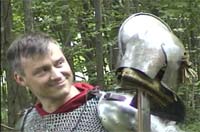
Charron test cutting

For Historical European Fighting Arts, Weaponry, & Armor

Moderators: Webmaster, Stacy Clifford

User avatar
John_Clements
Posts: 1167
Joined: Wed Sep 18, 2002 10:43 pm
Location: Atlanta area

Re: strength, cuts, reach

Postby John_Clements » Sat May 24, 2003 6:25 pm

I must agree with you Tim. Our experiments on cutting fresh raw meat with both replicas and antique baldes, as shown in some of the videos online here, evidence to that. Soft tissue is easily and gruesomely sheared by sharp metal things.

But as with other cuttting tests we did, you can see soft cloth armors were very effective against slices and draws and even short chopping blows from very sharp quality blades.


Recall also the comment by the Nizam in the 19th century to Capt. Nolan when he asked how they dismembered bodies and cut into torsos with single hand blows: “How do you strike with your swords to cut off men’s limbs?’ – ‘Strike hard, sir!’ said the old trooper. ‘Yes, of course; but how do you teach them to use their swords in that particular way?’ – ‘We never teach them any way, sir; a sharp sword will cut in any one’s hands.”

That same year English military officer and writer John Jacob, writing on good cutting swords, declared, “The things cut of themselves, however unskillfully handled.” Then later adds, “Straight swords will not cut, save in skillful hands; curved blades cut fearfully, with very little or no skill on the part of the soldier.”

There are many, many other such comments on the effects of cuts going back to the 16th century. (see my next book for these).
A repeated theme is swords cut terribly, but you must still strike with the necessary skill that produces force.


JC

Do NOT send me private messages via Forum messenger. I NEVER read them. To contact me please use direct email instead.

User avatar
John_Clements
Posts: 1167
Joined: Wed Sep 18, 2002 10:43 pm
Location: Atlanta area

Re: strength, cuts, reach

Postby John_Clements » Sat May 24, 2003 6:41 pm

Not necessary to cut hard...?
Do you mean when facing bare flesh or in general?
Do you mean offensively or even when displacing cuts with counter cuts?
Are you saying, by contrary, that it is necessary only to cut softly?

Again, I defer to the many quotes from the German masters regarding the need for "fencing strongly" as well as to the experiments by Hank Reinhardt and others where powerful blows did tremendous damage against targets (including armors) that shorter softer blows did not.
Do NOT send me private messages via Forum messenger. I NEVER read them. To contact me please use direct email instead.

Lance Chan
Posts: 377
Joined: Fri Oct 25, 2002 3:03 pm
Location: Hong Kong
Contact:

Re: strength, cuts, reach

Postby Lance Chan » Sun May 25, 2003 12:20 am

I agree with John here.

First, not all tatami omote is the same. I've been cutting a lot of them since I got the tinker sword in April 2002. There are softer ones and harder ones. The softer ones represent flesh and the harder ones are really harder than my thigh muscles a lot, which can be a limb to itself.

I've been cutting bamboo too and I agree again that with proper technique, both mat and bamboo feel the same. But if I screw up, usually the tatami ended up with a bent sword but the bamboo would not. The difference is, when my edge placement is slightly off, I still cut into the tatami but the track got turned and trapped my sword inside at a bent angle. Thus bending my blade. On the bamboo, a slightly off edge placement would get your blade skidded off the hard surface, so no bent blade god bless. <img src="/forum/images/icons/smile.gif" alt="" />

Again, I agree with the clothes issue that absorb a lot of shocking power. I've been picking up clothes that are dump by my neighbourhood in the recent month and test cut, test slice and test thrust on them. Even modern summer clothes put up a significant effect on preventing cut through. Of course such clothes cannot absorb impact power. But the winter clothes really do both in preventing cut through and absorbing impact power. Slice didn't do much at all unless I have my sword edges polished to a lower grit, so that it features microserrations. Thrusts work very good.

I've heard from my dojo friends that in Japan there was an experiment to cover a tatami omote with a Judo Gi and no one was able to cut through the target since then.

That's why I also agree to strike with quick short cut and also powerful long reaching cut for different targetting areas.

This is a very good discussion!
Realistic Sparring Weapons
http://www.rsw.com.hk

User avatar
Odin Lindgaard
Posts: 6
Joined: Thu Jan 23, 2003 12:53 am
Location: Lofoten, Norway

Re: speed and force

Postby Odin Lindgaard » Sun May 25, 2003 3:08 am

">to sum up what you are saying (if I may be so bold), is that the power of the cut comes from a well executed circular motion combined with footwork, timing, speed and strength. Not just from physical power executed by brute force.

Essentially. It’s about coordinating these elements as well as edge placement, grip, focus, and follow through. Cutting is not identical to hitting with say a stick or club (which is one reason we have always emphasized test cutting on substantial materials). The element of timing though is a tactical matter more so than a physical one.

JC"

Döbringer is quite specific about NOT cutting with a circular motion:

13v:
und dy selbe kunst ist crust gancz und rechtvertik/ und get of das aller neheste und korf korczste svecht und gerade czu recht zam wen eyner eynen hawen ader stechen wolde und das man im deme eynen vadem ader snure an seinen ort ader sneyde des swertes bu[e]nde und leytet aber czoege den selben ort ader sneide off eines blossen
14r
den her hawen ader stechen selde
(Grzegorz &amp;#379;abi&amp;#324;ski`s transcription)

Now, Hanko is close to impossible to translate into English, but this means something like: when you want to thrust or cut someone your technique should move as straight, close and short as if a cord is tied to your point, and that this cord guides or pulls your point or edge into your opponents opening, i.e. the blade moves in a straight line.

Even though he stresses the importance of cutting hard, using the whole body, it seems like the ability to be the first one that hits was valued more than dealing harder blows than your opponent.

Guds fred!
Odin

Jay Vail
Posts: 558
Joined: Thu Sep 26, 2002 2:35 am

Re: strength, cuts, reach

Postby Jay Vail » Sun May 25, 2003 5:03 am

I am reminded how at several public test-cutting demos and class sessions we've held, attendees and students were invited to try their hand at cutting thick cardboard tubes, and the larger guys –usually with rattan fighting backgrounds --invariably halled off and just bashed the target, sending it flying but barely scratching it –then Hank Reinhardt walks up with the same blade and with a swipe shears through the tube effortlessly (sometimes even twice in a row). Several of you know what I am talking about as you have seen this sort of thing from him or even from me.]


I was one of those bashers . . . I only *dented* the tube. Then HR stepped up and sliced it like a cheese. :-(

User avatar
TimSheetz
Posts: 412
Joined: Fri Sep 20, 2002 4:55 pm
Location: Madrid, Spain

Re: speed and force

Postby TimSheetz » Sun May 25, 2003 6:06 am

Hi Odin,

Could moving in a straight line also mean attacking the fastest MOST DIRECT way? I mean, the weapon is attached to your arms and the movement of the blade will be circular to some degree or another. Physics is physics, then and now.

I have always read that moving "straight, close, and short" as being a description of efficiency of motion.

Yep, sometimes cutting 'firstest' is better than merely cutting the 'hardest'... of course, the best is cutting the 'firstest' AND the 'hardest'! ;-)

Peace,

Tim
Tim Sheetz
ARMA SFS

User avatar
Matt Easton
Posts: 218
Joined: Sun Nov 10, 2002 2:23 pm
Location: London, England
Contact:

Re: strength, cuts, reach

Postby Matt Easton » Sun May 25, 2003 7:10 am

For the record, I completely agree with Bob's comments regarding cutting bone and the sottani cuts - well evidenced and expressed Bob.

Matt

User avatar
Matt Easton
Posts: 218
Joined: Sun Nov 10, 2002 2:23 pm
Location: London, England
Contact:

Re: speed and force

Postby Matt Easton » Sun May 25, 2003 7:21 am

Odin's reading and interpretation of Doebringer's lines is the same as I have read by the Liechtenauer fanatics on the HEMAC mailing list. They could comment more about it than me though.

One must wonder, if we should always strike as hard as we possibly can, then what is a Villano? What is a Buffel?... Someone who strikes harder than is humanly possible? <img src="/forum/images/icons/wink.gif" alt="" />

Matt

User avatar
Shane Smith
Posts: 1159
Joined: Thu Sep 19, 2002 2:15 pm
Location: Virginia Beach

Re: speed and force

Postby Shane Smith » Sun May 25, 2003 7:31 am

Hello Matt.Excellent point.I think perhaps it could be better said thus...

"Hit as hard as you can,but no harder." What I mean is this;strike with as much force as you are able within the parameters of proper technique and without getting sloppy in your effort to cleave another asunder. I"m sure you've seen the stereotypical guy that tries so hard to impress you with his cutting strength that he inevitably over-extends and ends up with his feet crossed and his centre in the next area code.Thats a buffel (And I think we've all seen at least one of these rare creatures! <img src="/forum/images/icons/grin.gif" alt="" /> ).
Shane Smith~ARMA Forum Moderator
ARMA~VAB
Free Scholar

User avatar
Odin Lindgaard
Posts: 6
Joined: Thu Jan 23, 2003 12:53 am
Location: Lofoten, Norway

Re: speed and force

Postby Odin Lindgaard » Sun May 25, 2003 7:35 am

Hi, Tim!

"Could moving in a straight line also mean attacking the fastest MOST DIRECT way? I mean, the weapon is attached to your arms and the movement of the blade will be circular to some degree or another. Physics is physics, then and now."

Döbringer himself says : Auch merke das / und wisse das man nicht gar eygentlich und bedewtlich von dem fechten mag sagen und schreiben ader aus legen / als man is wol mag / is wol mag czeigen und weisen mit der hant / (15r)

”Also notice and know that one can not properly and understandably from the fencing make statements and writings or explanations, as well as one can draw and show with the hand” (My own, dubious translation).

Still I will try to give a description of how I percieved Marlon Höss-Bötger`s demonstration of the principle of a cord tied to your blade at the HEMAC event in Dijon a few weeks ago:

From a vom Tag at the shoulder he basically punches outwards and a bit downwards with his right hand, at the same time as he uses the left to snap the pommel backwards.
This cut (or at least the tip of the sword) does move in a straight line, and having sparred with him with wasters I know that the force is at least sufficient enough to rattle you brain through a fencing mask.
Being hit that way with a sharp would certainly stop your fight.

Your opponent may be able to cut a whale in half, but as long as you win the Vorschlag through initiative and speed, the power of a blow that never was delivered does not matter.

Guds fred!
Odin

User avatar
Bob Charron
Posts: 65
Joined: Fri May 23, 2003 6:13 am
Location: Madison, WI
Contact:

Re: speed and force

Postby Bob Charron » Sun May 25, 2003 7:49 am

Tim,

I will take your advice into consideration for the future. I will need to design a way to do full-speed or near full-speed demonstrations without any risk to my partner.


">to sum up what you are saying (if I may be so bold), is that the power of the cut comes from a well executed circular motion combined with footwork, timing, speed and strength. Not just from physical power executed by brute force."

This quote is Brian's? Sorry, having trouble keeping track now :-) This sums up exactly what I am trying to say as well.

Shane also did a nice job. I very often admonish students to "do it as slowly as is necessary to get it right". We can add speed later. And I believe at the highest levels the art would look effortless. Proper body mechanics and alignment and moving the sword through the proper arc would create all the power one would need while allowing them to remain entirely balanced and collected. The examples of using a saber from horseback need to be examined in context. It is not a longsword on foot.

Stacy, you raise a point worth discussing. At what point do we consider the opponent armoured and alter our technique to meet the challenge? Certainly if his hands, wrists, neck face and head are unarmoured then cutting to these remains the focus. Thrusting in the way that Fiore seems to dictate would penetrate clothing quite easily. Fiore uses a great deal of thrusting, most of which involves advancing the entire body to drive the point home.

And as to discussing differences in order to get at a better understanding - absolutely. However, in our discussions we must keep an open mind and not at any time put forward one method emotionally as superior to another or use ad hominems as part of the discussion. As any good negotiator will tell you, start with the common ground, venture onto ground likely to expose more commonalities, then tackle the small differences, saving the largest for the end :-)
Bob Charron
St. Martins Academy of Medieval Arms

User avatar
TimSheetz
Posts: 412
Joined: Fri Sep 20, 2002 4:55 pm
Location: Madrid, Spain

Re: speed and force

Postby TimSheetz » Sun May 25, 2003 7:55 am

Hi Matt,

I don't think anyone said "you should always strike as hard as you can" as that summons the image of someone off balance and attempting to use force too much...

But someone fencing with all their strength, that is a different image, no? ;-)

There are plenty of thing in Rugby that require skill, finesse, and a sensitivity to the situation.. but you still would play the game as hard as you could, right? ;-)

Peace,

Tim

PS: Have fun a SARUM! Don't forget our coordinated cross ocean toasts!
Tim Sheetz

ARMA SFS

User avatar
Bob Charron
Posts: 65
Joined: Fri May 23, 2003 6:13 am
Location: Madison, WI
Contact:

Re: speed and force

Postby Bob Charron » Sun May 25, 2003 7:56 am

Odin,

The quote below is a jewel! May I use it (full credit to you of course)?

"Your opponent may be able to cut a whale in half, but as long as you win the Vorschlag through initiative and speed, the power of a blow that never was delivered does not matter.

Guds fred!
Odin "
Bob Charron

St. Martins Academy of Medieval Arms

User avatar
TimSheetz
Posts: 412
Joined: Fri Sep 20, 2002 4:55 pm
Location: Madrid, Spain

Re: speed and force

Postby TimSheetz » Sun May 25, 2003 8:07 am

HI Odin,

OK, I am glad you described it that way.

Well, if that is how you are describing a straight line, then I think we have been describing the same sort of things using different terms...

The sword may "move in a straight line" if you are measuring that line as the GRIP moving. The GRIP moves basically straight while the sword is pivoting around the grip (thanks to that left hand pulling back on the grip). The tip of the sword is moving in a circular arc.

I can see now that when the term: circular cuts" is used it summons the image that the grip is being moved in an arc - which it can and often is. But I wouldn't think of the term as solely those type of cuts.

Well, it is clearer to me, if no one else what you meant.
The cut you described was a sort of scalp cut at the top of the head, no?

Thanks!

Tim Sheetz
Tim Sheetz

ARMA SFS

User avatar
TimSheetz
Posts: 412
Joined: Fri Sep 20, 2002 4:55 pm
Location: Madrid, Spain

Re: speed and force

Postby TimSheetz » Sun May 25, 2003 8:16 am

Hi Bob,

Thanks.

"I will take your advice into consideration for the future. I will need to design a way to do full-speed or near full-speed demonstrations without any risk to my partner."

Speaking of partners, I wanted to add this... I think some things are a bit too risky to go full speed with wasters and blunts with a partner without taking all the time to gear appropriately.

So even doing something in "thin air" at full speed can let new folks or people unfamiliar with the technique know what to work towards.

I have done that a lot with new folks trying to work hengen techniques... if they slow motion it only they never can work the slow motion blade play in an accurate manner.

I agree that to accelerate without learning the control to execute the technique correctly is to be avoided.

Thanks,

Tim Sheetz
Tim Sheetz

ARMA SFS


Return to “Research and Training Discussion”

Who is online

Users browsing this forum: No registered users and 18 guests


Note: ARMA - The Association for Renaissance Martial Arts and the ARMA logo are federally registered trademarks, copyright 2001. All rights reserved. No use of the ARMA name or emblem is permitted without authorization. Reproduction of material from this site without written permission of the authors is strictly prohibited. HACA and The Historical Armed Combat Association copyright 1999 by John Clements. All rights reserved. Contents of this site 1999 by ARMA.