Charron test cutting

For Historical European Fighting Arts, Weaponry, & Armor

Moderators: Webmaster, Stacy Clifford

User avatar
Brian Hunt
Posts: 969
Joined: Thu Jan 23, 2003 2:03 am
Location: Price, Utah
Contact:

Re: speed and force

Postby Brian Hunt » Sun May 25, 2003 9:17 am

Bob,


<"to sum up what you are saying (if I may be so bold), is that the power of the cut comes from a well executed circular motion combined with footwork, timing, speed and strength. Not just from physical power executed by brute force."

This quote is Brian's? Sorry, having trouble keeping track now :-) This sums up exactly what I am trying to say as well.>


yeah that quote was mine in Response to John's post on cutting. I was trying to make sure I understood him correctly on the correct mechanics of a properly executed cut or attack. His Post was very long so I tried to "sum" everything up with a few words. <img src="/forum/images/icons/smile.gif" alt="" />
Tuus matar hamsterius est, et tuus pater buca sabucorum fundor!

http://www.paulushectormair.com
http://www.emerytelcom.net/users/blhunt/sales.htm

User avatar
John_Clements
Posts: 1167
Joined: Wed Sep 18, 2002 10:43 pm
Location: Atlanta area

Re: speed and force

Postby John_Clements » Sun May 25, 2003 10:10 am

Döbringer is quite specific about NOT cutting with a circular motion:

13v:
und dy selbe kunst ist crust gancz und rechtvertik/ und get of das aller neheste und korf korczste svecht und gerade czu recht zam wen eyner eynen hawen ader stechen wolde und das man im deme eynen vadem ader snure an seinen ort ader sneyde des swertes bu[e]nde und leytet aber czoege den selben ort ader sneide off eines blossen
14r
den her hawen ader stechen selde
(Grzegorz &amp;#379;abi&amp;#324;ski`s transcription)

Now, Hanko is close to impossible to translate into English, but this means something like: when you want to thrust or cut someone your technique should move as straight, close and short as if a cord is tied to your point, and that this cord guides or pulls your point or edge into your opponents opening, i.e. the blade moves in a straight line.

Even though he stresses the importance of cutting hard, using the whole body, it seems like the ability to be the first one that hits was valued more than dealing harder blows than your opponent.

Guds fred!
Odin

...fascinating... Thanks, Odin !
This is very intriguing and explains a lot...there has been much discussion about how straight blades impact in a different manner than curved ones and require a somewhat different torquing method from the hands when cutting effectively. With the 16th century Italians we begin to see much more emphasis on slicing with slender blades and less talk of powerful full arm cuts...your Doebringer comment makes me think we are on to something.
While Di Grassi is essentially correct about the geometry of the body and blade in cutting, the impact dynamics of a straight blade have always seemed to me to be more directly angled perpendicularly. Hmmmm....please try to get more on this. I will also ask around.

JC
Do NOT send me private messages via Forum messenger. I NEVER read them. To contact me please use direct email instead.

User avatar
John_Clements
Posts: 1167
Joined: Wed Sep 18, 2002 10:43 pm
Location: Atlanta area

Re: speed and force

Postby John_Clements » Sun May 25, 2003 10:42 am

Matt asks:
One must wonder, if we should always strike as hard as we possibly can, then what is a Villano? What is a Buffel?... Someone who strikes harder than is humanly possible?

I would offer this answer from the sources:
Liechtenauer alluded to buffel or “buffalos” as a demeaning term for farmers and fencers who relied on their strength and raw force alone rather than skilful technique. So it wasn’t that he was against “Strength” but its substitute for lack of skill. You can certainly be skilful and strong. Doebringer, writing on how to face multiple opponents, similarly instructed the best technique (taught by older masters) was the Eysern Pforte (a position with the blade in front, pointed toward the ground). He stated, “With this you could even fight against four or six farmers” (i.e., untrained men who rely on strength). So again, its strength without skill, not strength alone. A number of 15th century humanist writers on physical education stressed repeatedly the importance of muscular strength and conditioning.

As mentioned earlier, the 13th century tale, "Iwein" describes the knightly warrior’s martial craft where, “With practice the weak man can too learn to fight far better, otherwise the state of swordsmanship, as an art, may not have achieved this level of skill. Here was the union of skill and strength.” So, again, not relying on strength alone.

Also, the master of arms Vergerius in the early 1400s wrote how in war skills alone were useless without the strength and endurance needed to bear the rigors of campaigning.
Alberti in the 1430s declared, “In all training no end may be preferred to that of physical soundness” and advised as exercises for youth “Games which require dexterity, endurance, strength, qualities of eye and nerve, such as fencing.”
We see this same thing in the 16th century. For example, Castiglione much later wrote the ideal courtier had to possess “strength, lightnesse, and quicknesse,” as well as “an understanding in all exercises of the bodie that belong to a man of warre.”

So, there's a lot on this topic.
Let me also add that, again, given my size and build, I encounter a lot of fighters and students who are big guys with a lot of body weight able to hit very hard. I always end up telling them, they are relying too much on trying to “whack” and “smack” and not wielding their weapon skillfully with proper form –which would permit them to more efficiently use their strength effectively.

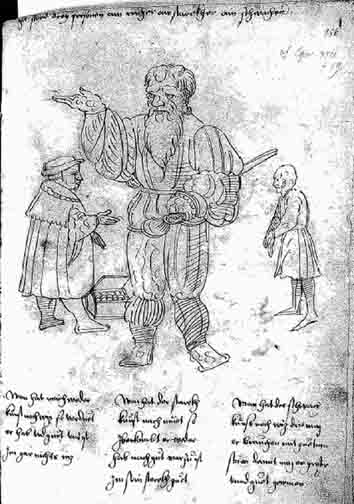
[One last interesting item is toward the end of Jörg Wilhalm’s c1520s fighting manual, it includes an interesting image of something like three men: a rich man, a poor man, and a fencer. It essentially reads along the lines of the wealthy man has money but no real wealth because he does not have skill or strength. The poor working man has strength of body but no skill or money, while the man who has skill has true strength and wealth. {though…I’ve always pointed out couldn’t the rich guy just hire the strong guy to kill the skilled guy? - jk}]

JC
Image
Do NOT send me private messages via Forum messenger. I NEVER read them. To contact me please use direct email instead.

User avatar
John_Clements
Posts: 1167
Joined: Wed Sep 18, 2002 10:43 pm
Location: Atlanta area

Re: speed and force

Postby John_Clements » Sun May 25, 2003 10:45 am

Odin wrote:
Still I will try to give a description of how I percieved Marlon Höss-Bötger`s demonstration of the principle of a cord tied to your blade at the HEMAC event in Dijon a few weeks ago:

From a vom Tag at the shoulder he basically punches outwards and a bit downwards with his right hand, at the same time as he uses the left to snap the pommel backwards.

Yes, yes...very good. I agree.
It is not the same as say, pulling down the sword to make a slicing action. By doing it as above with a long passing step and stretchingout with the arms..."Wham!" Powerful blow. Powerful.

JC
Do NOT send me private messages via Forum messenger. I NEVER read them. To contact me please use direct email instead.

User avatar
Odin Lindgaard
Posts: 6
Joined: Thu Jan 23, 2003 12:53 am
Location: Lofoten, Norway

Re: speed and force

Postby Odin Lindgaard » Sun May 25, 2003 10:53 am

Hi Bob,

"Odin,

The quote below is a jewel! May I use it (full credit to you of course)?"

You certainly may!

Guds fred!
Odin

User avatar
Odin Lindgaard
Posts: 6
Joined: Thu Jan 23, 2003 12:53 am
Location: Lofoten, Norway

Re: speed and force

Postby Odin Lindgaard » Sun May 25, 2003 11:09 am

Hi Tim,

"HI Odin,

OK, I am glad you described it that way.

Well, if that is how you are describing a straight line, then I think we have been describing the same sort of things using different terms...

The sword may "move in a straight line" if you are measuring that line as the GRIP moving. The GRIP moves basically straight while the sword is pivoting around the grip (thanks to that left hand pulling back on the grip). The tip of the sword is moving in a circular arc."

- I would say that the tip moves in a straight line, while the grip performs a small arc.

"I can see now that when the term: circular cuts" is used it summons the image that the grip is being moved in an arc - which it can and often is. But I wouldn't think of the term as solely those type of cuts.

Well, it is clearer to me, if no one else what you meant.
The cut you described was a sort of scalp cut at the top of the head, no?"

- The cut came in at an angle of between 45 and 90 degrees, hitting the side of the head.


Guds fred!
Odin

Guest

Re: speed and force

Postby Guest » Sun May 25, 2003 1:14 pm

Matt, a villano is a farmer in the original meaning of the world, it became rough individual only for metafor, in dialet we still say "vò pruè dal vilàan" to say : "I go to buy something from the farmer". It is likely that peasants demonstrated a poor capacity to keep and regain a guard after a forceful blow for lack of training and this image was associated to anyone who lost his defensive capability for overstriking.

User avatar
Matt Easton
Posts: 218
Joined: Sun Nov 10, 2002 2:23 pm
Location: London, England
Contact:

Re: speed and force

Postby Matt Easton » Sun May 25, 2003 4:08 pm

JC said:
"{though&amp;#8230;I&amp;#8217;ve always pointed out couldn&amp;#8217;t the rich guy just hire the strong guy to kill the skilled guy? - jk}] "

Hehehe - ah yes, the Machiavellian approach - I like it <img src="/forum/images/icons/smile.gif" alt="" />

Matt

User avatar
Matt Easton
Posts: 218
Joined: Sun Nov 10, 2002 2:23 pm
Location: London, England
Contact:

Re: speed and force

Postby Matt Easton » Sun May 25, 2003 4:16 pm

Hi Carlo,

"Matt, a villano is a farmer in the original meaning"

Yeah I know - in English and French it is villain or villein, but it's the same word, I imagine from Latin.

As for the type of strike of the Colpi di Villano - yes I agree - I think it is just an untrained and violent downwards strike, and not the type of projecting strike described in other posts above, which fencers often seek to do, which has the control to finish in an incrossada (crossed blades) or to thrust or volta from that incrossada.

Matt

User avatar
John_Clements
Posts: 1167
Joined: Wed Sep 18, 2002 10:43 pm
Location: Atlanta area

Re: speed and force

Postby John_Clements » Sun May 25, 2003 9:02 pm

I wonder if the Colpi di Villano might equate to a cut from Zornhut??? Thoughts?

JC
Do NOT send me private messages via Forum messenger. I NEVER read them. To contact me please use direct email instead.

Guest

Re: speed and force

Postby Guest » Mon May 26, 2003 4:54 am

This is a mere deduction from probable premises, not a supported historical theory: what a villano does in is work when handling certain tools is to load the blow below his back and hit the ground in a vertical trajectory, bending his back at the end of the blow.
If you apply to swords it is a vertical cut that reaches the ground and exposes the forehead of the swordsman (to the fate).

Guest

Re: speed and force

Postby Guest » Mon May 26, 2003 5:36 am

That makes sense as it is a very natural, instictive way to chamber up a big, powerful cut. A cut like that takes time to develop full speed and power and reach it's target. If done by an untrained "villano" it could easily be countered by a trained swordsman by stepping off line and thrusting, for instance.

User avatar
Matt Easton
Posts: 218
Joined: Sun Nov 10, 2002 2:23 pm
Location: London, England
Contact:

Re: speed and force

Postby Matt Easton » Mon May 26, 2003 7:18 am

JC asked:
"I wonder if the Colpi di Villano might equate to a cut from Zornhut??? "

I interpret the strike of the villain as a powerful downwards strike (fendente) - so the strike of the opponent (who ends up in Denti di Cinghiaro or something that looks like it) rather than the student, who offers a collapsing soft cover (crossing initially in Posta Frontale incrossada), passing effectively under the cover, and then thrusts or cuts on the other side of the opponent's blade.

Zornhut looks quite like Posta di Donna Destraza or Soprana and Fiore says of this guard that it 'covers and injures', which I take to mean it can counter-cut directly or if it gets stopped in the incrossada it goes into Fiore's illustrated plays from the incrossada.

Matt

Guest

Re: strength, cuts, reach

Postby Guest » Tue May 27, 2003 1:02 pm

"JC

p.s.
why are we all online so much this fine memorial weekend?
(I have an excuse, I&amp;#8217;m busy working on writing projects)
"

I don't know about you guys, but I was out helping my girlfriend test cut for the first time. :P

User avatar
Randall Pleasant
Posts: 872
Joined: Mon Sep 23, 2002 3:35 pm
Location: Flower Mound, Texas, USA

Re: strength, cuts, reach

Postby Randall Pleasant » Tue May 27, 2003 2:32 pm

Mike

Maybe it is just me, but your disucssion sounds like it might be off topic - but hey, there is nothing better to do on a long weekend! <img src="/forum/images/icons/blush.gif" alt="" /> <img src="/forum/images/icons/smirk.gif" alt="" /> <img src="/forum/images/icons/smile.gif" alt="" /> <img src="/forum/images/icons/cool.gif" alt="" /> <img src="/forum/images/icons/cool.gif" alt="" /> <img src="/forum/images/icons/cool.gif" alt="" />
Ran Pleasant


Return to “Research and Training Discussion”

Who is online

Users browsing this forum: No registered users and 11 guests


Note: ARMA - The Association for Renaissance Martial Arts and the ARMA logo are federally registered trademarks, copyright 2001. All rights reserved. No use of the ARMA name or emblem is permitted without authorization. Reproduction of material from this site without written permission of the authors is strictly prohibited. HACA and The Historical Armed Combat Association copyright 1999 by John Clements. All rights reserved. Contents of this site 1999 by ARMA.