I posted this once and lost it already (the problem with big posts), but here's what I have to say about the Krumphau, based on what the masters say about it, and what they show about it. My conclusions are that the Krump is an oberhau, with a clearly descending trajectory, where the point is projected out in front of the face, not receeded over the head, and where contact with the enemy's weapon or body comes from the side and from above. Also that the "unter" krumphau that I believe you are referencing as the "new krump" is in fact another strike alltogether, called the "kurtzhau" by Ringeck, Meyer, etc. and the "Veller" by Doebringer.
First Talhoffer. Tafel 19, the the "quick crooked strike" (or Krump) is illustrated thusly:

Note that the krumper (the guy on the left) has his blade clearly positioned *over* his opponent's blade, not under it. What's more is that the follow-on strike, found also in Ringeck, etc., requires that the initial krump land on top of the opponent's weapon. Talhoffer illustrates the follow-on strike in Tafel 20 (the guy on the right this time):

Now we move onto Liechtenauer with Goliath's Glosa:
"Text on the Bend Strike with its plays
"Bend out nimbly, throw your point to the hands, Bend to whom would attack, striding allows many strike.
"Glosa
"The bend strike is one of the four displacements against the four guards, in that with it one breaks the guard named the Ox, and it thus also drives onto the Over and Under Strikes. When you come to him in the pre-fencing, if he stands against you holding his sword before his head in the guard of the Ox, on his left side, then put your left foot forward, and hold your sword on your right shoulder, in the guard, and burst with the right foot, well to your right side against him, and strike in with the long edge, from crossed arms, over the hands." (
http://www.schielhau.org/goliath.p21-40.html#p35)
Here's the acompanying illustration. It is exceptional in that it shows the krump mid-strike, instead of at the normally illustrated "nearly complete" position. Note the extended arms and fully extended point. Also note that *this* his how you break the ochs--not by coming in underneath it. Instead you hit your opponent from the side in his arms. If he strikes out or thrusts from this position the line of attack is closed off by the sweeping nature of the krumphau. Thus it ensures defense while attacking--the perfect meisterhau. The krumper is on the left, his opponent, in Ochs, on the right:

Now Ringeck,
(Lichetenauer says:)"Use the Krump with agility, aim the point at the hands.
(Ringeck comments:)"This is how you should aim a krumphaw at the hands: when he attacks yo ufrom his right with an ober or unterhau at the opening, leap with your right foot toward his left sdie and simultaneously strike his hands with your arms crossed, using the tip of your sword. You can also use this if he is in ochs.
(Lichetenauer says:)"Use the Krump and deflect with a step, then he will strike last.
(Ringeck comments:) "This is how you can deflect strikes from above using the krumphaw. If he strikes at you with an oberhau from his right at your opening, then leap to his left side with your right foot and move the tip of your sword over his sword to a schrankhut. Practice this on both sides. From the deflection you can strike at his head." [That, BTW, is what Talhoffer shows on Tafel 20]
Then Ringeck goes further to describe exactly what I believe you are doing:
(Lichtenauer says:) "Do not use the Krump, strike short (kurtzhau) and change through; that will work.
(Ringeck comments:) "If he leads with an oberhau from his right shoulder, proceed as if you want to bind his sword with a krumphau, but let your strike fall short and guide your point through under his sword and wind your hilt over your head on your right, then thrust at his face."
(Translation by D. Lindholm, pages 58-61; Tobler's and Bellenhausen's say the same thing)
And then Doebringer (Lindholm's translation)...
"This is on the Crooked strike [Krumphawe]
"Go crooked [Krump] with skill and throw the point at the hands, strike crooked [Krump] at he who sets well, with steps you will hurt many strokes. Strike [Krum] to the flat of the master when you wish to weaken him.
[Now this following paragraph covers the Kurtzhau, which is what I think you're doing, more or less]
"When it flashes above step away that I will applaud. Do not [Krum] short strikes changing through [Durchwechsel] thereby do [Krum] whoever wishes to deceive you the noble war will confuse him, so that he does not know if he is out of danger.
"Glossa. Here note that the crooked strike [Krumphaw] is an upper strike [Oberhaw] that goes out well to the side with a step, and then goes in a crooked manner to one [the other] side. Therefore Liechtenauer means that if you wish to do this strike well, you shall step well out to the right side as you strike. And you shall throw or shoot your point in over the cross guard at the [opponents] hands. And you shall strike with your flat, and when you hit the flat [of the opponent’s sword?] you shall remain on it with strength and push firmly and see were you can easiest and straightest hit him with strikes or thrusts or cuts and you shall not strike too short and not forget the changing through [Durchwechsel ] were it is suitable to do it.
[Continuing, Doebringer has a "veller" which fits the bill of this so-called "new krump" quite well also.]
"26V
"A strike is called the feint/error [Veller] and it comes from the krumphaw and it is described after the cross strike (zwerchhaw) which is described firstly and it shall be before the cross strike.
And it goes krumt from below and is shot in over the cross guard at him by shooting the point just as the krumphaw from above and down." And now Meyer:
"Krumphauw
"This strike is described thus: stand in the Wrath Guard with your left foot forward, when your opponent strikes, step with your right foot fully away from his strike and against his left side, strike with the long edge and crossed hands against his strike, or between his pommel and blade, diagonally over his hands, and fully overshoot his arms to lay on the blade, as shown in illustration D by the figures on the upper right hand side."
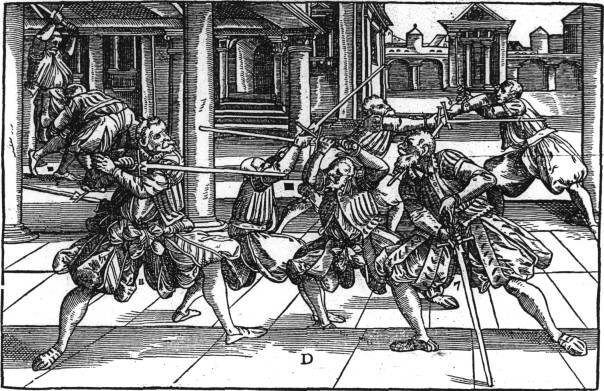
Again, see that the krumper (upper right, right figure) has his blade clearly *above* his opponent's. Not underneath.
I again add what I think that you are doing, from Meyer, which he, Ringeck, and Dobringer all say comes from the krump, but is not a krump: the veller or kurtzhaw (short strike)...
"Short Strike
"This is a secretive attack, and is described thus: when your opponent strikes you from above, stand as if you would respond with a Bend Strike, that is to bind his sword with the half edge, but let it fall and drive through under his sword, strike with the half edge and crossed arms over his right arm to hit his head, thus you have closed off his sword with the long edge, and accomplished the Short Strike, and stand as is shown by the smaller figure (mid background) on the left of illustration B fighting against the right."
(Rassmussen's Translation:
http://www.schielhau.org/Meyer.p12.html) Dobringer, Ringeck, Goliath, Talhoffer, and Meyer all say that the Krump is an oberhau. They all (but Talhoffer) also show a move which is specified as not being a krumphau but which resembles it and begins using it, the kurtzhau (Dobringer calls it a Veller). That, I believe, is the move that you are doing. Thus the question "what do we call that unterhau" can be answered without mistakenly (I believe) labelling it as a krump.
Comments and counter-arguments are appreciated. I can be dissuaded (as the recent Sturzhau agrument proved), but I better see something that somehow nullifies all the above sources along with those that I didn't cite, but which nonetheless present the krump the same as above.
Jake
Sen. Free Scholar
ARMA Deputy Director



