Edge failure of a bastard sword

For Historical European Fighting Arts, Weaponry, & Armor

Moderators: Webmaster, Stacy Clifford

User avatar
John_Clements
Posts: 1167
Joined: Wed Sep 18, 2002 10:43 pm
Location: Atlanta area

Edge failure of a bastard sword

Postby John_Clements » Mon Jan 23, 2006 9:31 pm

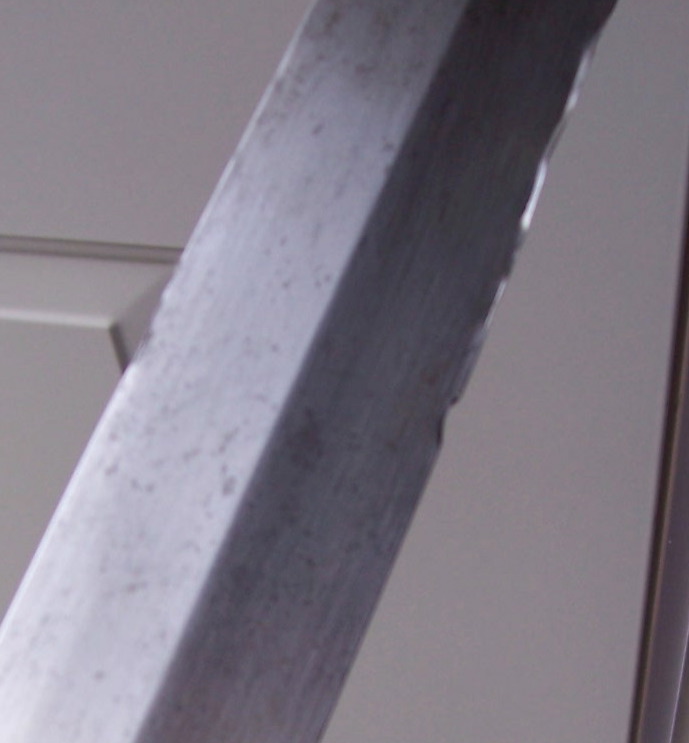
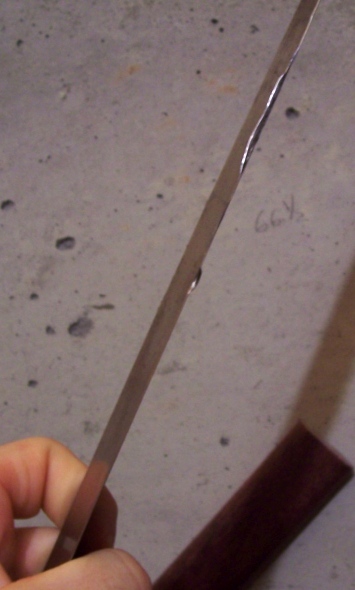
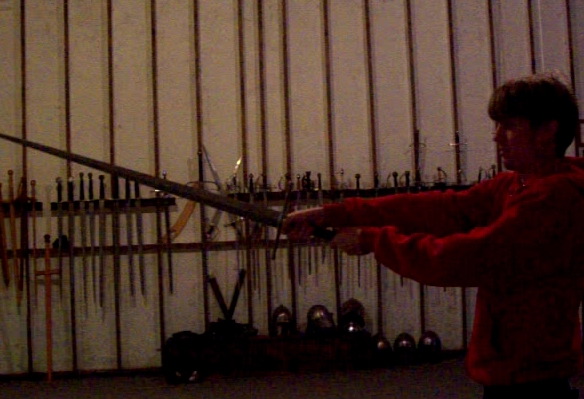
I experienced a dramatic edge failure on one of my favorite Raven bastard swords this week. We were testing out a fine Albion Talhoffer sword, a tapered blade of diamond cross-section. We struck it four times on the flat, as in a displacing action, at about 3/4 power using the Raven sword, a wider blade with a thicker diamond cross-section. This Raven sword had a very fine well-honed yet entirely blunt edge. Previously, this Raven had proved a ferocious cutter cleaving through 3-inch hardwood saplings, cutting 2.5 inches into 2x4 wooden board, hacking through 4 inches of raw beef and bone, and shearing clean through 6 inches of an 8-inch raw pork shoulder. It had also cut cleanly through a 5-inch wet straw mat with a 3/4 inch dowel rod inside.

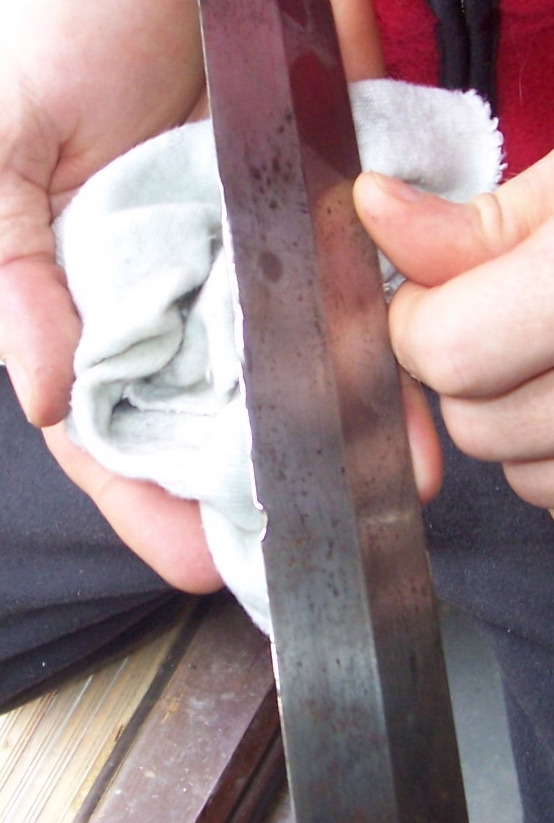
However, the last blow against the narrower Albion blade caused a 2-inch long span on the Raven to literally crack and fold at 90-degrees. Although I have seen sword edges bend, deform, and even shatter, I have never seen one crack and fold before (it’s hard to make out in the photos, but it resembles the non-linear cracks you’d find on bread crust).

This was particularly odd since another portion of this very same weapon (seen in the photos as the slight crescent distortion near the new fold) had previously struck a piece of iron rebar at full-force and only suffered a small depression.

This Raven sword is about 4 years old and I still consider it a fine weapon, so it was quite dismaying to see how poorly it responded to what should be a common action for any sword of this kind: striking away another lighter blade edge to flat. We have the instance on video but it shows nothing unusual. I cannot speculate on the cause at this point, except to note that the Albion blade, as would be expected, had only a minor scratch on the subtle riser of its flat. It may be a case of a weak point on a hard edge striking a much harder flat.

Either way, real swords did historically engage and strike other swords and if they can’t reasonably hold up, I think modern makers are still missing something.

JC
Image
Image
Image
Image
Do NOT send me private messages via Forum messenger. I NEVER read them. To contact me please use direct email instead.

User avatar
Derek Gulas
Posts: 66
Joined: Wed Sep 25, 2002 3:04 pm
Location: Washington USA

Re: Edge failure of a bastard sword

Postby Derek Gulas » Tue Jan 24, 2006 2:09 am

Aiii....

You have my condolences. It sounds like a fine blade.... How do you plan on having it repaired?
Close combat - bringing us together.

Derek
ARMA, Seattle

User avatar
Matthew_Anderson
Posts: 335
Joined: Wed Sep 24, 2003 5:57 pm
Location: Virginia Beach, VA

Re: Edge failure of a bastard sword

Postby Matthew_Anderson » Tue Jan 24, 2006 8:13 am

Wow, that's surprising. I've seen that blade take a real beating against all different kinds of targets with no problems. I wonder if there has been some sort of stress or corrosion weakening inside the blade that has occured over time but wasn't noticeable from the outside? Really weird.
Matt Anderson
SFS
ARMA Virginia Beach

User avatar
David Kite
Posts: 192
Joined: Fri Sep 20, 2002 10:34 am
Location: Terre Haute, IN USA

Re: Edge failure of a bastard sword

Postby David Kite » Tue Jan 24, 2006 10:02 am

Interesting.

So how is it, do you think, that the sword could withstand a full-force blow against steel rebar with minor damages, and sustain much more severe damage from essentially the same material with less force? Was it maybe the shape of the target struck that concentrated more force on a smaller area? Just speculating.

David Kite
GFS, ARMA in IN

User avatar
John_Clements
Posts: 1167
Joined: Wed Sep 18, 2002 10:43 pm
Location: Atlanta area

Re: Edge failure of a bastard sword

Postby John_Clements » Tue Jan 24, 2006 10:21 am

I asked swordsmith Paul Champaign and he is flummuxed over it himself, and said based on my description and photos (without actually seeing it in person yet) that perhaps it was a grain fault in the steel cuased by a minute layer of some impurity. This would not be a surprise since another Raven I had that snapped at the tang during a cut on a soft bag was deemed by experts I know to have metallurgical and tempering flaws.

All I plan on doing is filing away the damage and using it for more practice.

Here's a clip of the actual test against the Albion.

JC


edge on flat test blows
Image
Do NOT send me private messages via Forum messenger. I NEVER read them. To contact me please use direct email instead.

Bill Tsafa
Posts: 118
Joined: Sun Nov 13, 2005 9:11 pm
Location: NYC
Contact:

Re: Edge failure of a bastard sword

Postby Bill Tsafa » Wed Jan 25, 2006 8:24 am


Either way, real swords did historically engage and strike other swords and if they can't reasonably hold up, I think modern makers are still missing something.


I very much agree. I have had some very heated debates with custum sword fabricators at SFI (sword forum international). I have conducted tests and published my results there. These sword makers insisted without end that swords should not be used against anything other then plastic water bottles and straw mats. I have argued with them, what happens if you meet a knight in armor. Their answer is only use axes and maces. I said rediculas, what if I loose my axe or mace... They say only only strike unarmored areas of the body.... I say, one can expect to miss a few times... They say practice more... Its just goes back and forth with no end.

The problem I see with highend sword makers is that they only see the art side of swords. They do not see them as a "tool of war". It seems to me that they are only interested in making jewlery with sharp edge.

User avatar
TimSheetz
Posts: 412
Joined: Fri Sep 20, 2002 4:55 pm
Location: Madrid, Spain

Re: Edge failure of a bastard sword

Postby TimSheetz » Wed Jan 25, 2006 9:59 am

John,

Remember talking to Dan Maragni on 2003 about the tests he was doing on his swords... how hitting them against a solid bar barely did anything... unitl he hit it with a "wrong" angle. Then he said it really did a lot more damage and bent the blade.

Could it be that your weapon took a bad hit from catching the diamond crossection just so?

Tim
Tim Sheetz
ARMA SFS

User avatar
John_Clements
Posts: 1167
Joined: Wed Sep 18, 2002 10:43 pm
Location: Atlanta area

Re: Edge failure of a bastard sword

Postby John_Clements » Wed Jan 25, 2006 10:30 am

Yes, my sympathies, Bill, and my salute for your effort.
Swords must be tested on raw meat and bone as well as soft and hard cloth/leather and certainly against other blades in a reasonable manner. Those designed for facing armors should be tested against armors. It's the biggest joke for manufacturers today to tell consumers their swords are "accurate" or "real" and then not to be used in a historically accurate and realistic manner. It's pathetic that they make such shallow arguments---especially when far more knowledgeable and highly skilled swordsmiths are out there asking people like myself to hard-test their blades for comparison to surviving specimens in order to get them correct.

JC
Do NOT send me private messages via Forum messenger. I NEVER read them. To contact me please use direct email instead.

User avatar
John_Clements
Posts: 1167
Joined: Wed Sep 18, 2002 10:43 pm
Location: Atlanta area

Re: Edge failure of a bastard sword

Postby John_Clements » Wed Jan 25, 2006 10:36 am

No, Tim. Dan''s test showed how tough his steel and edge were on a solid bar of softer steel. In this case, the target was not solid or rigid but flexible and just being held in someone's arms. My strikes were clean edge on flat hits, and not epsecially strong, I think it wouldn't matter what angle it was on in a such a case. The nature of the damage in this test reveals a flaw in the edge there. We've done this same test dozens of times with all manner of other swords without anything similiar ever resulting (other then the struck blade sometimes bending).

JC
Do NOT send me private messages via Forum messenger. I NEVER read them. To contact me please use direct email instead.

User avatar
TimSheetz
Posts: 412
Joined: Fri Sep 20, 2002 4:55 pm
Location: Madrid, Spain

Re: Edge failure of a bastard sword

Postby TimSheetz » Wed Jan 25, 2006 1:07 pm

Hi John,

Hmmm. I wonder what will happen after the damage is filed and polished out? Do you think it will do it again or is this just a freak happenstance?

TIm
Tim Sheetz

ARMA SFS

User avatar
John_Clements
Posts: 1167
Joined: Wed Sep 18, 2002 10:43 pm
Location: Atlanta area

Re: Edge failure of a bastard sword

Postby John_Clements » Wed Jan 25, 2006 3:52 pm

The damage is sinificant to leave a sizeable portion of edge entirely gone after grinding it down, and the remaining portion so thick that it will not matter if it's struck again, since there will be no more edge left there.
Do NOT send me private messages via Forum messenger. I NEVER read them. To contact me please use direct email instead.

User avatar
Matt Easton
Posts: 218
Joined: Sun Nov 10, 2002 2:23 pm
Location: London, England
Contact:

Re: Edge failure of a bastard sword

Postby Matt Easton » Thu Jan 26, 2006 10:16 am

Of course, you've got to remember that historically swords got damaged, bent and broken. Period art shows this and there are plenty of damaged blades in museums and found in rivers etc archaeologically.
Dr Alan Williams has published extensive metallurgical test results of medievals weapons and armour - we know that the average hardness of medieval swords is about 50 Rockwell at the edge, just like modern repros, and that their steel contained slag, which ours does not.
Swords were not relatively expensive in the 14th and 15thC's - most people could afford or own one, from a farm labourer upwards. It is likely that damaged blades were disgarded (or sold for recycling) and a new blade bought. There were expensive and cheap swords then, just as now.

Matt

User avatar
John_Clements
Posts: 1167
Joined: Wed Sep 18, 2002 10:43 pm
Location: Atlanta area

Re: Edge failure of a bastard sword

Postby John_Clements » Thu Jan 26, 2006 11:29 am

Another reputable source I consulted suggested malleable failure like this is the result of inconsistent heat treatment. This makes sense since other portions of the blade have held up very well. Of course, as tools, all swords are perishable and have a limited service life.
Do NOT send me private messages via Forum messenger. I NEVER read them. To contact me please use direct email instead.

Nigel Plum
Posts: 27
Joined: Thu Jan 26, 2006 10:52 am
Location: London

Re: Edge failure of a bastard sword

Postby Nigel Plum » Thu Jan 26, 2006 11:39 am

"I very much agree. I have had some very heated debates with custum sword fabricators at SFI (sword forum international). I have conducted tests and published my results there. These sword makers insisted without end that swords should not be used against anything other then plastic water bottles and straw mats. I have argued with them, what happens if you meet a knight in armor. Their answer is only use axes and maces. I said rediculas, what if I loose my axe or mace... They say only only strike unarmored areas of the body.... I say, one can expect to miss a few times... They say practice more... Its just goes back and forth with no end.

The problem I see with highend sword makers is that they only see the art side of swords. They do not see them as a "tool of war". It seems to me that they are only interested in making jewlery with sharp edge. "

Hi Bill, I see Matt has beaten me to point out that medieval swords did fail. So I think you're being a little unfair on modern sword makers. If I were one (& I'm not) I'd say something along the lines of "if you just cut bottles & fruit you'll do fine. If you bash it on anything harder, just like a real one, it might fail. The more you do that, the more likely it will become."

Given that modern smiths have access to higher quality steel I suspect that their swords actually fail less than the originals. But to quote the ultimate authority on all things engineering "ye canna change the laws of physics" <img src="/forum/images/icons/grin.gif" alt="" />

Cheers, Nigel Plum, Schola Gladiatoria
Schola Gladiatoria

Bill Tsafa
Posts: 118
Joined: Sun Nov 13, 2005 9:11 pm
Location: NYC
Contact:

Re: Edge failure of a bastard sword

Postby Bill Tsafa » Thu Jan 26, 2006 4:21 pm

Hi Bill, I see Matt has beaten me to point out that medieval swords did fail. So I think you're being a little unfair on modern sword makers. If I were one (&amp; I'm not) I'd say something along the lines of "if you just cut bottles &amp; fruit you'll do fine. If you bash it on anything harder, just like a real one, it might fail. The more you do that, the more likely it will become."

Given that modern smiths have access to higher quality steel I suspect that their swords actually fail less than the originals. But to quote the ultimate authority on all things engineering "ye canna change the laws of physics"


Hi Nigil,
What you said is fine and very reasonable. But all the guys I talkied to did not want to give an inch. They where trying to straddel the idea that If I somehow traveled back in time and used their swords they would perform flawlessly, however given that I can not travel back in time, any damage that occurs is a result of the sword being used out of contex. It seems that they refused to entertain the idea that perhaps their is some room for improvement and further testing would be a good idea.


Return to “Research and Training Discussion”

Who is online

Users browsing this forum: No registered users and 20 guests

cron


Note: ARMA - The Association for Renaissance Martial Arts and the ARMA logo are federally registered trademarks, copyright 2001. All rights reserved. No use of the ARMA name or emblem is permitted without authorization. Reproduction of material from this site without written permission of the authors is strictly prohibited. HACA and The Historical Armed Combat Association copyright 1999 by John Clements. All rights reserved. Contents of this site 1999 by ARMA.