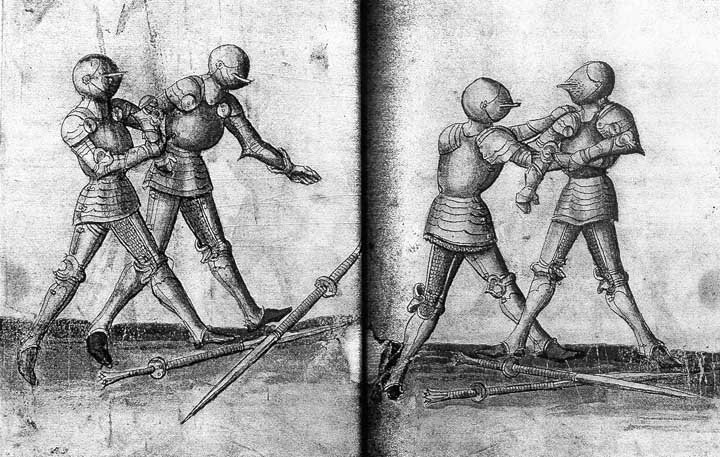
Okay, an
estoc or "tuck" was actually a sword / weapon for armoured warfare and dueling. It was certainly not the same as the single-handed
rapiers of later (16th Century+) foyning fence. A lot of the confusion about the word
estoc and many other terms may be squarely blamed upon Victorian notions and specious modern "curator-speak" bandied about unthinkingly by curators, collectors, antiquarians, academics, etc. It would be nice if more of those "experts" would like read some of the source-literature to try to understand source-terms.
This helpful Moyen Francais (Middle French) dictionary decisively cites multiple 15th Century examples of its use to mean not just "long straight sword" but also specifically "sword-point"
 http://atilf.atilf.fr/gsouvay/scripts/g ... 1186529790
(Just enter "estoc" and read entry ESTOC 1 for the definitions.)
I maintain that
estoc could have been the same thing that the German fight-books & other sources meant by the special term
kampfschwert. Thus it was anything from a dramatically tapering longsword / bastard-sword; to basically a giant spike with rondels girding the handle. Thus a weapon utilised for the half-swording methods of 15th Century European armoured fighting.
Here is a picture from
Solothurner Fechtbuch (circa 1525 IMHO) of what one could call an
estoc / kampfschwert
http://www.thehaca.com/pdf/sf12.JPG
Enjoy,