Sharpness of longswords used for half swording ??

For Historical European Fighting Arts, Weaponry, & Armor

Moderators: Webmaster, Stacy Clifford

User avatar
Roy Robinson Stewart
Posts: 105
Joined: Sat Sep 22, 2007 11:48 pm
Contact:

Sharpness of longswords used for half swording ??

Postby Roy Robinson Stewart » Wed Nov 07, 2007 9:19 pm

I'm struggling to accept that half swording and sharp swords go together, and am wondering what the experts have to say, especially having noticed John Clements cutting with a 'blunt'

I have heard various explanations about gripping the blade 'just so' in order to keep the hands safe, but it seems to me that in a fight it is likely that the hand could slip up or down the blade and slice the fingers.

I really want to know whether or not to assume that half swording is an occasional carefully executed technique performed with a sharp sword (unlikely ?), or if it is a regular technique which can be performed with confidence and strength while grasping a blunter blade firmly.

It makes the world of difference to where my training goes from here, help will be much appreciated.

Regards to all

Roy

PS I have read some of the discussion here on the subject but it seemed inconclusive, and a lot of the illustrations I have seen show the blade grasped firmly quite close to the tip, which seems to refute the idea of differential sharpening. . . what I don't like is a sort of compromise notion where half swording is done in training with blunts but isn't really possible with the 'real deal' sharps. .. . I want to train to use the real weapon.

Also, I'm not buying the hand callous/gauntlet argument, a really sharp blade will surely slice callouses and gauntlets just as well as regular skin

.


.

User avatar
Casper Bradak
Posts: 641
Joined: Fri Sep 20, 2002 4:32 am
Location: Utah, U.S.

Postby Casper Bradak » Wed Nov 07, 2007 10:22 pm

I, like many of us here, have extensive practice at using the halfswording techniques from our source material with a variety of sharp blade forms, and I can attest, as can they, that it works just fine (that is not to say that you shouldn't be careful when trying it for the first time).

As for grabbing the blade towards the point, that is particularly easy to do with a bastard or very tapered sword, as it allows a firm grip all around the narrow blade.

I also don't believe in differential sharpening. That's something for blades of uniform thickness. The blades of medieval and renaissance europe had different cross sections at different portions of the blade, and each portion of the blade was as sharp as that cross section would reasonably allow.
Master Vadi, for one, mentions differential sharpening, i.e. he says that a certain blade form should be sharp a hands length from the point, but then goes on to show the weapon of which he speaks is only capable of an edge there due to it's blade geometry.

But our source material even shows halfswording techniques with wide bladed messers or falchions; weapons with the sole intent of the blade form to lend maximum sharpness and cutting ability vs. unarmoured opponents; and it's being done safely and effectively by expert fighters.

I wouldn't say "trust me" in martial arts often, but from all of our testing and practical application, and the unquestionable ubiquitousness of such techniques in our tremendous amount of source material which was unquestionably written by experts in the arts of killing who trained with such veracity and pragmatism, and our hands on experience with a variety of antique and accurate replica weapons, it's probably one of those things I'd say you can have some blind faith in and work towards until you "get it."

...or if it is a regular technique which can be performed with confidence and strength while grasping a blunter blade firmly.


It is a specialised but common technique which can be performed with confidence and strength while grasping a sharp blade firmly. There are no "just so" grips in life or death combat, and firm grip is what keeps your hand in one place and one piece. You have to halfsword like you mean it.
ARMA SFS
Leader, Wasatch area SG, Ut. U.S.

http://www.arma-ogden.org/

User avatar
Roy Robinson Stewart
Posts: 105
Joined: Sat Sep 22, 2007 11:48 pm
Contact:

Postby Roy Robinson Stewart » Wed Nov 07, 2007 11:48 pm

Thanks Casper, I'll follow your advice, and if feeling hestsant will wear some and protection rather than blunting the sword.


:D

User avatar
s_taillebois
Posts: 426
Joined: Fri Jul 01, 2005 11:29 pm
Location: Colorado

Postby s_taillebois » Wed Nov 07, 2007 11:58 pm

M. Bradek explained it all. The bastard sword because of its tapering blade is very suited to half swording. In practice with one (my favored type) have stuck the point substantially into the pell (wood) without much problem. At worst ended up a few times with what would be similar to a deeper paper cut. And that was without gloves, or guantlets. The biggest problem was some slight bending or chipping on the point.
Have to consider that half swording (as some use it) is premised on a two point support. The hand on the hilt is the one some use to project the force. The hand on the weak of the blade is more for direction. As such the hand on the weak doesn't necessarily have to grip the blade with any excessive or undue force.
And actually given the tendancy of some modern blades to be a little too flexible...in some cases a serious thrust from a half sword could actually be safer. It reduces the likelyhood of the blade springing or even breaking.
Obviously I'm not an expert in the terms of the original masters (or even of their poorer students) but from experimentation what works seems to work.
As far as differential sharpening some do, some chose not to. And bastard swords make better thrusting implements than cutters anyway. They'll do some nasty test cuttings, but nothing like the some of the types with a deeper breadth to the blade. So perhaps it's not that important to have these all that sharp.
Steven Taillebois

Alan Abu Bakr
Posts: 76
Joined: Sat Jul 07, 2007 9:33 am
Location: Sweden

Postby Alan Abu Bakr » Thu Nov 08, 2007 2:33 am

Actually, during Swordfish, I participated in a Talhoffer halfswording workshop.
One of the instructors assured us that he had done a mordhau against a sack (I have forgotten what it contained), without hand protection and without harming his hands. With a sharp blade.
Those who live by the sword will be shot by those who don't.
(I neither like the real name rule, nor do I find it to be good)

User avatar
Jeffrey Hull
Posts: 678
Joined: Wed Sep 25, 2002 3:40 pm
Location: USA

Thrust the Ground

Postby Jeffrey Hull » Thu Nov 08, 2007 12:24 pm

I have taken a Type XIII longsword, gripped strongly bare-handed in half-swording, and thrust the point hard & repeatedly into grassy ground, with no damage to either my hands or, for that matter, my sword. :)

That showed me first-hand how one can do harnischfechten thrusts without worry of self-injury. But I would recommend some sort of leather gloves normally for such feats. But such can be done ungauntleted.

Incidentally, I had differentially sharpened the blade. Where I was grabbing the blade was not razor sharp or anything, but it was sharp enough certainly to cleave flesh & bone.

However: Kids -- I do not recommend doing that, do not try that at home. Seriously.
JLH

*Wehrlos ist ehrlos*

User avatar
Roy Robinson Stewart
Posts: 105
Joined: Sat Sep 22, 2007 11:48 pm
Contact:

Postby Roy Robinson Stewart » Mon Nov 12, 2007 1:01 am

Can anyone show any historical evidence regarding sharpness, particularly for the kind of blades most often used for half swording ? I can't find any, perhaps I am missing something.

Also, I am still not convinced that in an actual fight, with adrenaline involved, that grasping a very sharp sword is possible without a high risk of hand injury. . . all it takes is one slight slip or unexpected knock and that's it, sliced hand. . . . and in spite of the ideal of a firm grip there is the moment when the sword is being grasped and let go of, high risk moments as the hand pressure does no come on instantly.

If I am going to half sword as a technique then I need to be able to do it frequently and with gusto, while at times under pressure from an enemy who is closing in.. . and I need evidence on the historical sharpness factor before committing my live weapon to a high level of sharpness.

The video of John cutting with a relatively blunt sword suggests to me that having a blunter sword which can be confidently grasped might be a good trade off overall.. . . but I'm still 'on the fence'

By the way Jeffrey, you say that you are using differential sharpening, but the illustrations I have seen show the swords being grasped very close to the tip, so differential sharpening doesn't seem to address the issue. Also, you state that the level of sharpness you use is sharp enough to cleave flesh and bone, but not razor sharp. . . however it is apparent that a 'blunt' sword is quite capable of cleaving flesh and bone.

.


:?:

User avatar
Rod-Thornton
Posts: 163
Joined: Fri Jul 22, 2005 10:41 am
Location: The Outer Banks of NC but currently freezing in Rhode Island

Postby Rod-Thornton » Mon Nov 12, 2007 7:19 am

Roy Robinson Stewart wrote:...perhaps I am missing something....Also, you state that the level of sharpness you use is sharp enough to cleave flesh and bone, but not razor sharp. . . :?:


Hello Roy:

One should remember though, that a razor, as in "razor sharp" is a VERY fragile angle of blade....usually something less than 17 degrees or thereabouts...so having something that IS indeed razor sharp is to have a non-durable, easily damaged edge. Sharp, as for a sword, is a practical sharpness. Think of an axe. Granted, that is extreme, but it illustrates the concept well and one can see that you can grasp an axe-head with relatively no fear of a mis-slice, yet it will cleave through wood, wire, rope, flesh and bone, etc. with ease and a lil speed. Typically, with an edge angle of 25 degrees or more (up to like 30 or so) you can get a robust, relatively durable edge that is sharp, but not fragile. With such sharpness, all one need do is ensure not to SLIDE one's hand across the edge and you will not be cut during motions. And like the "axe-analogy" remember longsword cuts are huen, or hewn hack motions, not drawn slicing ones. So I think a razor sharp item is wholly unecessary for a good sharp sword to be well, a good sharp sword.
Rod W. Thornton, Scholar Adept (Longsword)
ARMA-Virginia Beach Study Group

User avatar
Jeremiah Backhaus
Posts: 162
Joined: Wed Dec 20, 2006 6:50 am
Location: West Bend, WI

Postby Jeremiah Backhaus » Mon Nov 12, 2007 9:45 am

I find when I half-sword that I simply use my two middle fingers (ring and middle) and place them in the fuller. The spreading of the fingertip (I am missing one) creates more surface area and grip in the fuller allowing a firmer grip. Also this pushes the flat of the blade into the fleshy part of my palm, again filling the fuller with grip and keeping my hand away from getting cut in almost any way.

I find that to be an effective way to safely half-sword.

-Jeremiah (GFS)

User avatar
Roy Robinson Stewart
Posts: 105
Joined: Sat Sep 22, 2007 11:48 pm
Contact:

Postby Roy Robinson Stewart » Mon Nov 12, 2007 1:37 pm

Thanks Rod and Jeremiah, possibly I'm just 'splitting hairs' and worrying too much prior to receiving my first pair of sharps ( from Angus Trim ). . . .I'll report back after I have had some practice.

.

User avatar
Jeffrey Hull
Posts: 678
Joined: Wed Sep 25, 2002 3:40 pm
Location: USA

Substantiation & Replication

Postby Jeffrey Hull » Mon Nov 12, 2007 2:02 pm

Roy Robinson Stewart wrote:By the way Jeffrey, you say that you are using differential sharpening, but the illustrations I have seen show the swords being grasped very close to the tip, so differential sharpening doesn't seem to address the issue. Also, you state that the level of sharpness you use is sharp enough to cleave flesh and bone, but not razor sharp. . . however it is apparent that a 'blunt' sword is quite capable of cleaving flesh and bone. :?:


How does your question somehow invalidate the example of physical testing which I described to you? It does not.

Plus, I really do not see any of this "swords being grasped very close to the tip" that you claim is so prevalent in the sources that you have perused. That just is not the case with the fight-books.

Anyway, consider that these substantiate what I said:

The following are from Talhoffer (1467).

Here a fencer voids, maybe parries with his feeble, and half-sword thrusts at foe doing and oberhau, all while not grasping "very close to the tip" of the sword :arrow:
http://www.thearma.org/talhoffer/t36.htm

Here is a motschlag, grabbed near the point (as physics of the strike and personal safety actually dictate), but not grabbing the point area itself where, due to differential sharpening, the blade would indeed be at its sharpest. (Although I never stated that someone must differentially sharpen his sword as I so choose to do.) The other high half-sword ward has grabbing well away from point :arrow:
http://www.thearma.org/talhoffer/t37.htm

Here is half-swording done without grabbing near the point :arrow:
http://www.thearma.org/talhoffer/t39.htm

Here these fencers, although not armoured, are actually practicing the targetting of a move where a knight would basically ram and push back his foe with the point of his longsword into foe's axilla. Notice that they are not grabbing their blades near the points :arrow:
http://www.thearma.org/talhoffer/t43.htm

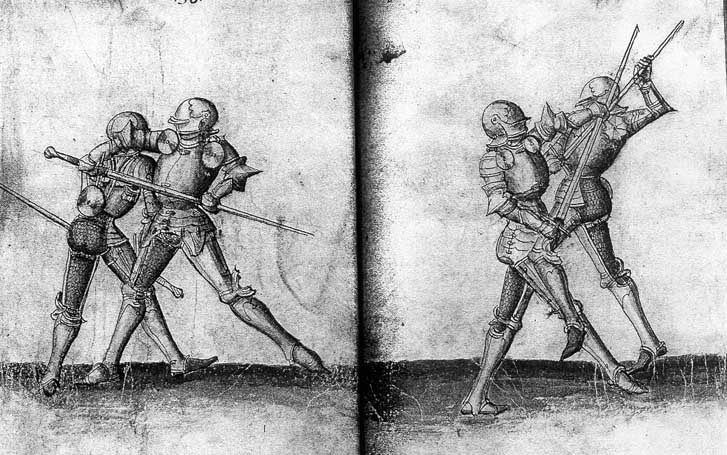
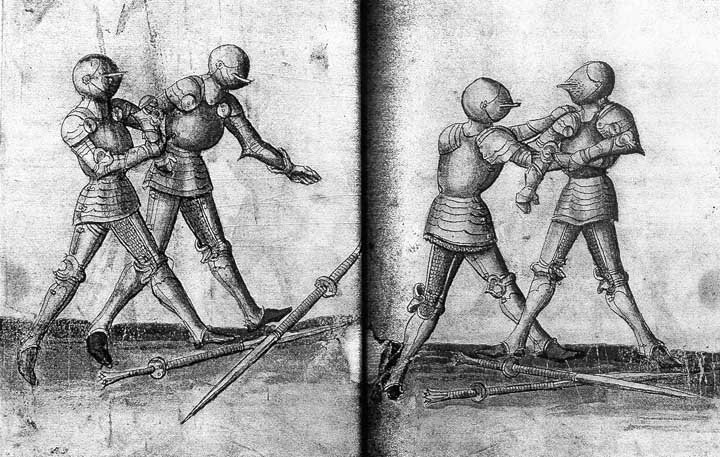
Notice all those techniques were done bare-handed, and indeed can be replicated bare-handed by modern fencers. However, various sources that illustrate kurzes schwert methods of fencing make it apparent that gauntlets were often worn, especially in armoured duels, as per Das Solothurner Fechtbuch :arrow:
Longswords
http://www.thehaca.com/pdf/sf11.JPG
Bizarre Estocs
http://www.thehaca.com/pdf/sf12.JPG

So everything I claimed is substantiated by fight-books and may be replicated by others (but always at their own risk). :wink:
JLH


*Wehrlos ist ehrlos*

User avatar
Roy Robinson Stewart
Posts: 105
Joined: Sat Sep 22, 2007 11:48 pm
Contact:

Postby Roy Robinson Stewart » Mon Nov 12, 2007 2:32 pm

Jeffrey I didn't suggest that your physical testing was invalidated.

I made two points:

1) That there are some illustrations showing swords being grasped near the tip, and given that differential sharpening would leave the tip area sharp, it is thus is no 'cure' for the problem (if such a problem exists) of grasping sharp swords during half swording.

2) That your description of a sword which is not sharp but is sharp enough to cleave flesh and bone is in agreement with the fact that blunter swords can cleave flesh and bone . . . . which is what I was originally postulating. .. that perhaps the historical swords used for half swording were not as sharp as some modern reproductions used for test cutting, but still capable of cleaving flesh and bone


I still don't see any historical evidence for the actual sharpness of swords, are there any historical sharpness tests that you are aware of ?

.

User avatar
Jeffrey Hull
Posts: 678
Joined: Wed Sep 25, 2002 3:40 pm
Location: USA

Something

Postby Jeffrey Hull » Mon Nov 12, 2007 2:46 pm

I have never hurt my hand, with a differentially sharpened blade, doing mortschlag. The real danger is in possibly stabbing oneself in the hip or flank with the point if the swing is done wrongly. The "secret" to gripping the blade properly for half-swording & morte-striking is not much different than the "secret" known to stage-magicians who lay upon beds of nails : distributing & stabilising of mass accros sharp surface(s).

Plus, grasping the blade in the middle for kurzes schwert does indicate something about the sharpness.

Here, Mertein Huendsfelder even explicitly tells us it is alright to do so :arrow:
http://www.thearma.org/Manuals/hundsfelder.html

(137r) Hie heb sich an das kűrtz swert in dem kanpff als es meinster mertein hündsfelder gesait hatt

Item Nim das swertt bÿ der rechten hant bÿ dem beÿn und mit der lincken griff mitten in die clingen und ge vast zu dem man, So müß er schlagen oder stechen, do küm vor und biß rechs pleyb sollichenn und pleib nohenn.

(137r) Here begins the shortened sword fighting [with longswords] as Master Mertein Hündsfelder has taught.

Note: Take the sword with your right hand by your leg and with your left hand in the middle of the blade and go fast to the man, so he must cut or thrust, you just step in and remain on the right side and stay close [to him].


All those points ought to make it clear.
JLH


*Wehrlos ist ehrlos*

User avatar
Roy Robinson Stewart
Posts: 105
Joined: Sat Sep 22, 2007 11:48 pm
Contact:

Postby Roy Robinson Stewart » Mon Nov 12, 2007 3:02 pm

Yes I am gaining some understanding of the principles involved in half swording, thanks for all the valuable study information, and for your patience

Nevertheless I can find no historical evidence of the actual sharpness used.

.

User avatar
Jeremiah Backhaus
Posts: 162
Joined: Wed Dec 20, 2006 6:50 am
Location: West Bend, WI

Postby Jeremiah Backhaus » Mon Nov 12, 2007 3:04 pm

Roy Robinson Stewart wrote:I still don't see any historical evidence for the actual sharpness of swords, are there any historical sharpness tests that you are aware of ?

.


I don't know of any tests, but I have held an actual historical sword from the Oakeshott collection that I almost cut myself on (a lot nervous with a little grip). I would guess that sitting for about 500 years would dull the blade considerably, and since it was still sharp enough for me to even think that I could cut myself, well, it must have been pretty sharp in its prime.

-Jeremiah (GFS)


Return to “Research and Training Discussion”

Who is online

Users browsing this forum: No registered users and 19 guests


Note: ARMA - The Association for Renaissance Martial Arts and the ARMA logo are federally registered trademarks, copyright 2001. All rights reserved. No use of the ARMA name or emblem is permitted without authorization. Reproduction of material from this site without written permission of the authors is strictly prohibited. HACA and The Historical Armed Combat Association copyright 1999 by John Clements. All rights reserved. Contents of this site 1999 by ARMA.