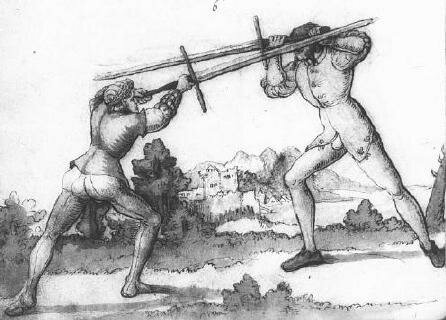
Albion Squire Line 15th century Bastard Sword

For Historical European Fighting Arts, Weaponry, & Armor

Moderators: Webmaster, Stacy Clifford

User avatar
CalebChow
Posts: 237
Joined: Sun Oct 14, 2007 1:31 pm
Location: Philadelphia, Pennsylvania

Albion Squire Line 15th century Bastard Sword

Postby CalebChow » Sun Jan 25, 2009 10:57 pm

http://www.albion-swords.com/swords/albion/squire/sword-squire-bastard.htm

Has anyone here handled one of these before? Based on the review linked below, it seems like the sword suffices as a sparring weapon even though it is technically not a "blunt" but simply "unsharpened." The other squire line swords are said to be too dangerous as the unsharpened edges are still too thin, so that's why I'm asking if this one is an exception or not.

http://www.myarmoury.com/review_alb_15th.html

On top of that, has anyone tried sharpening a Squire line sword before? The Maestro line swords don't seem like they're meant to be sharpened, but the Squire lines have the option, which I think means the steel edges are not designed the same way as the sparring blunts?

What I'm looking for is a sword that I can safely practice with but still have the option to sharpen on my own.
"...But beware the Juggler, to whom the unseemliest losses are and who is found everywhere in the world, until all are put away." - Joachim Meyer

User avatar
Brandon Paul Heslop
Posts: 134
Joined: Sun Mar 04, 2007 12:56 am
Location: West Valley City, Utah
Contact:

Re: Albion Squire Line 15th century Bastard Sword

Postby Brandon Paul Heslop » Mon Jan 26, 2009 12:27 am

CalebChow wrote:http://www.albion-swords.com/swords/albion/squire/sword-squire-bastard.htm

Has anyone here handled one of these before? Based on the review linked below, it seems like the sword suffices as a sparring weapon even though it is technically not a "blunt" but simply "unsharpened." The other squire line swords are said to be too dangerous as the unsharpened edges are still too thin, so that's why I'm asking if this one is an exception or not.

http://www.myarmoury.com/review_alb_15th.html

On top of that, has anyone tried sharpening a Squire line sword before? The Maestro line swords don't seem like they're meant to be sharpened, but the Squire lines have the option, which I think means the steel edges are not designed the same way as the sparring blunts?

What I'm looking for is a sword that I can safely practice with but still have the option to sharpen on my own.


The Maestro line swords are federscherter - http://en.wikipedia.org/wiki/Federschwert - or, "feather swords." They are blunt, edgeless weapons for training, with rounded-off points. They were used historically, with a few examples surviving in museums and private collections. You are absolutely right that they are not meant to be ssharpened.

For what you want, I would go with the Squirew Line. I have handled one - the arming sword, I think - and I can personally attest that it was a fine weapon. I would suggest getting a Maestro line federschert for sparring and a Squire line for cutting. That's just me, though.

-B.
Thys beeth ye lettr yt stondÿ in hys sygte \
To teche . or to play . or ellys for to fygte...

"This [is] the letter (way,) [for] standing in his (the opponent's) sight \
[either] to teach, or to play, or else for fight..."

-Man yt Wol.

User avatar
Jeremiah Backhaus
Posts: 162
Joined: Wed Dec 20, 2006 6:50 am
Location: West Bend, WI

Postby Jeremiah Backhaus » Mon Jan 26, 2009 7:57 am

Actually, the Meyer is a Federschwert, notice the flanges both in the pic on Wikipedia and on the sword. The Liechtenauer is a training blunt, as far as I know there is no name for the "type" of sword that is.

As for the Bastard sword, I have handled it. A good friend has one that is sharpened. The thrusting is amazing. It stands to the usual quality of Albion. That being said, it is not the sword for me, just not my choice. Also, unless you have skill at working with metal and putting edges on swords then don't order it blunt and then try to put an edge later. You will succeed only in ruining the weapon. No offense intended to you, but tempering and edge geometry is no something that is easily understood. You would do better getting a blunt for training and a comparable sharp. Albion does a favor of letting you know which ones are similar.

Hope that helps.

-Jeremiah (SA)
Repetitio mater studorum est.

User avatar
Derek Wassom
Posts: 151
Joined: Tue Oct 01, 2002 3:39 am
Location: Fribourg, Switzerland
Contact:

Postby Derek Wassom » Mon Jan 26, 2009 9:12 am

I have one and I've done some sparring with it. The edges are too thin imo. They could be dangerous and they chip easily.
Derek Wassom
ARMA GFS
Fribourg, CH

User avatar
Randall Pleasant
Posts: 872
Joined: Mon Sep 23, 2002 3:35 pm
Location: Flower Mound, Texas, USA

Postby Randall Pleasant » Mon Jan 26, 2009 10:15 am

Derek Wassom wrote:I have one and I've done some sparring with it. The edges are too thin imo. They could be dangerous and they chip easily.


I'll second Derek's comments. Ernie Perez of the DFW study group has the Squire Line great sword but due to its edges none of us cared to spar aginst it. My personal opinion is that at the very least people should wear a gambeson when sparring the swords of the Squire Line.
Last edited by Randall Pleasant on Mon Jan 26, 2009 2:35 pm, edited 1 time in total.
Ran Pleasant

Jonathan Newhall
Posts: 234
Joined: Mon Dec 01, 2008 2:41 pm

Postby Jonathan Newhall » Mon Jan 26, 2009 1:43 pm

I'll tell you right now that edging a sword is tricky work, and when done after the fact of the forging, is extra so. It usually involves reforging the whole piece, which can result in brittleness et c.

Really it's messy if you want an edge that'll hold up to a couple of good strikes, you're better off just buying one with the edge already on it and one without an edge at all. The reason is because if you can put an edge on an unedged sword then you don't need to be ordering premade swords, you can go make your own! :p

User avatar
CalebChow
Posts: 237
Joined: Sun Oct 14, 2007 1:31 pm
Location: Philadelphia, Pennsylvania

Postby CalebChow » Mon Jan 26, 2009 3:08 pm

Darn. Can't get everything in one sword, huh?

Quoted from the Maestro Line webpage of Albion:
" To have a sword that both looks exactly like a sharp historical sword, and have it be safe in practice combat, is frankly not possible -- a sparring sword needs to be designed along completely different lines from the ground up."

I really want to do test cutting as well as steel-steel sparring, but I can't afford to spend $1000 dollars on this stuff...

Oh well. Thanks for the feedback everyone!
"...But beware the Juggler, to whom the unseemliest losses are and who is found everywhere in the world, until all are put away." - Joachim Meyer

User avatar
Brandon Paul Heslop
Posts: 134
Joined: Sun Mar 04, 2007 12:56 am
Location: West Valley City, Utah
Contact:

Postby Brandon Paul Heslop » Mon Jan 26, 2009 5:53 pm

J. Blackhaus:

Actually, the Meyer is a Federschwert, notice the flanges both in the pic on Wikipedia and on the sword. The Liechtenauer is a training blunt, as far as I know there is no name for the "type" of sword that is.

Splitting hairs, arent we? :) I have seen pictoral evidence for historical federschwerter more or less similiar in form to the Lichtenauer. In Goliath, for example.

http://www.schielhau.org/images/goliath ... atch43.jpg

Some have the flanges in Goliath. Others, like those the link shows, don't. IMO, both are federschwerter. In England, they just called 'em foils...which somewhat unfortunately are only associated with collegiate \ Olympic, or "classical" fencing today.

-B.
Thys beeth ye lettr yt stondÿ in hys sygte \

To teche . or to play . or ellys for to fygte...


"This [is] the letter (way,) [for] standing in his (the opponent's) sight \

[either] to teach, or to play, or else for fight..."


-Man yt Wol.

User avatar
Jeremiah Backhaus
Posts: 162
Joined: Wed Dec 20, 2006 6:50 am
Location: West Bend, WI

Postby Jeremiah Backhaus » Wed Jan 28, 2009 10:13 am

Brandon,

No "l" in the last name. Means "bakery."

Isn't Goliath dealing with Zweihanders?

Otherwise, I don't care what you call them. From the times that I have visited Albion and talked with the guys (and girls) they seem to find a rather large difference between the two.

And I believe that the Federschwert translation is "Feathersword" and since the Meyer is lighter (I don't remember by how much) I think that it fits the definition better.

Whatever, not worth arguing about, definitely worth owning both.

-Jeremiah SA
Repetitio mater studorum est.

User avatar
Brandon Paul Heslop
Posts: 134
Joined: Sun Mar 04, 2007 12:56 am
Location: West Valley City, Utah
Contact:

Postby Brandon Paul Heslop » Wed Jan 28, 2009 7:06 pm

J,

Sorry about butchering your name. Mine's Anglo-Saxon, or "Old English." It means "from the hazel valley." Just thought I'd mention it, since we're sharing. :wink: As I mistakenly thought your name was "blackhouse," I thought it might have been a Middle English (which sometimes spells "house" as "haus" like the German) throwback name, meaning "from the blacksmith's," or something. Oh, well.

Anyway, to the point, I never have thought of federschwert as connoting "light." I had always thought of it as implying "harmless as a feather," as it has no edges or point. After all, one wouldn't want one's training sword to be lighter than one's actual sword, now would one? That wouldn't be very good in the event of real combat. Two-handers or no. Am I wrong? Not that it really matters, of course, as I've seen other examples of federschwerter without the flanges, (which was your main point, was it not?). Goliath was simply the first to spring to mind. However, I have a hard time believing that the fencers of the past would have had a separate name for each type of "practice" sword, don't you?

Anyway, I suppose it doesn't matter...but as you were seemingly interested in getting into the minutea...I thought I'd go along for the ride.

It's been fun.

-B.


Jeremiah Backhaus wrote:Brandon,

No "l" in the last name. Means "bakery."

Isn't Goliath dealing with Zweihanders?

Otherwise, I don't care what you call them. From the times that I have visited Albion and talked with the guys (and girls) they seem to find a rather large difference between the two.

And I believe that the Federschwert translation is "Feathersword" and since the Meyer is lighter (I don't remember by how much) I think that it fits the definition better.

Whatever, not worth arguing about, definitely worth owning both.

-Jeremiah SA
Thys beeth ye lettr yt stondÿ in hys sygte \

To teche . or to play . or ellys for to fygte...


"This [is] the letter (way,) [for] standing in his (the opponent's) sight \

[either] to teach, or to play, or else for fight..."


-Man yt Wol.

User avatar
Jeremiah Backhaus
Posts: 162
Joined: Wed Dec 20, 2006 6:50 am
Location: West Bend, WI

Postby Jeremiah Backhaus » Thu Jan 29, 2009 9:22 am

Brandon,

No worries on the name thing, I get it all the time. I am a blacksmith, so I am ok my name being associated with them, though I am sure an ancestor is pissed that I am not a good baker. :lol:

I checked the weights, 3.3 pounds on the Meyer. 3.75 pounds on the Liechtenauer.

I stand corrected. I know that in my training I like to change the weights a little bit, but in comparing the other swords, they were all within .5 ounces.

Just to respond, I don't think that they had different names for each of their training swords, which is why I didn't know a name for the Liechtenauer.

I didn't think it was minutes when I saw it, but I have learned. Thanks for that opportunity.

-Jeremiah SA
Repetitio mater studorum est.


Return to “Research and Training Discussion”

Who is online

Users browsing this forum: No registered users and 19 guests


Note: ARMA - The Association for Renaissance Martial Arts and the ARMA logo are federally registered trademarks, copyright 2001. All rights reserved. No use of the ARMA name or emblem is permitted without authorization. Reproduction of material from this site without written permission of the authors is strictly prohibited. HACA and The Historical Armed Combat Association copyright 1999 by John Clements. All rights reserved. Contents of this site 1999 by ARMA.