NSA Cut & Thrust Waster review

For Historical European Fighting Arts, Weaponry, & Armor

Moderators: Webmaster, Stacy Clifford

User avatar
Greg Coffman
Posts: 156
Joined: Sat Dec 09, 2006 5:33 pm
Location: Abilene

NSA Cut & Thrust Waster review

Postby Greg Coffman » Fri Mar 20, 2009 8:59 am

I got my new NSA Cut&Thrust yesterday and I thought I'd do a little myarmoury.com-esque extended review for it.

To start, it is very much not what I expected. It handles with much more blade presence than I expected from a 16th century cut & thrust. Now, I do believe that it falls within the range of 16th century swords. I have never handled a real cut & thrust and I trust the expertise of JC and the other ARMA members involved in making sure that it is historically accurate.

The blade is very long for a one handed sword, 37 i/2 inches, and the point of balance on mine is about 6 inches beyond the cross. The blade comes to a point just as narrow as on the NSA longswords but starts at a width of 1 3/4 inches whereas the longsword has a base width of 2 inches. This means that though it is thinner than the longsword blade, it is less tapered and therefore has the heavier feel. Basically, it handles like a long cutter reminiscent of knightly swords (long one-handed cavalry swords) of the medieval period. As a cutter, when in motion it is easy to keep it moving and keep it in motion; it likes to swing. The ergonomics of the handle and pommel are great. The handle is 3 1/2 inches. Compare this to the 4 1/2 inch handle of the NSA one-hander. My hand fits snugly between the pommel and cross which gives advantage in swinging and cutting. I prefer the round (fig) pommel to wheel pommels, and it works well when letting the hand drift to a lower grip. To me, the shorter tighter handle contributes to the cut orientation of the sword. The double side-ring cross guard is probably bigger than it needs to be, but it doesn't get in the way and I'm not complaining about the extra hand protection.

Again, the sword is not what I expected as a middle-of-the-road 16th century cut and thrust. For cut and thrusts of that period, I would expect either for the sword to be more thrust oriented for its length or shorter for its cutting orientation. I should say that my expectations are based from seeing the museum swords at Les Invalides in Paris and from Albion's Next Generation line up. Next will be a comparison between those swords and this waster.

I'm sure the sword will fight well. The long blade pretty much takes away a main disadvantage or reach difference when fighting against a longsword. The heft allows it to be firm in the bind and not beaten aside as easily as a lighter sword. The point of balance so far from the cross gives a lot of authority and presence in the cut. So overall, while it is not what I expected and still not what I would consider typical for a 16th century cut & thrust (with room to be convinced otherwise), I am happy with it and am sure it will grow on me.

As always, New Stirling Arms' work is outstanding. This is a gorgeous waster and a beautiful example of wood craftsmanship. The sword certainly feels robust enough to handle several years of good use. NSA was also a pleasure to do business with even when a part of the shipping didn't go as planned. They are a good company, with good products and good people, and I am glad ARMA has such a congenial relationship with them.

Thanks to everybody involved in the process of producing this fine waster.

p.s.: your next chance to get one of these is at the International Gathering.

Greg Coffman
Scholar-Adept
ARMA Lubbock, TX

User avatar
Greg Coffman
Posts: 156
Joined: Sat Dec 09, 2006 5:33 pm
Location: Abilene

Postby Greg Coffman » Fri Mar 20, 2009 9:57 pm

Here is the link to the thread with pictures of the wasters:
http://www.thearma.org/forum/viewtopic.php?t=23803

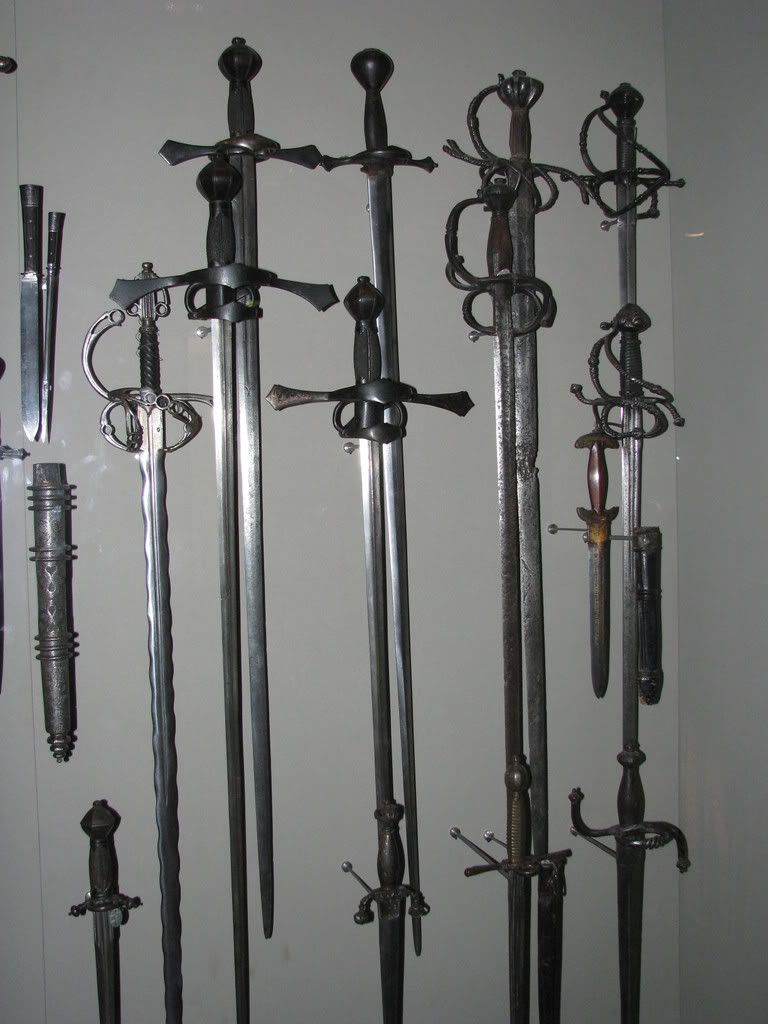
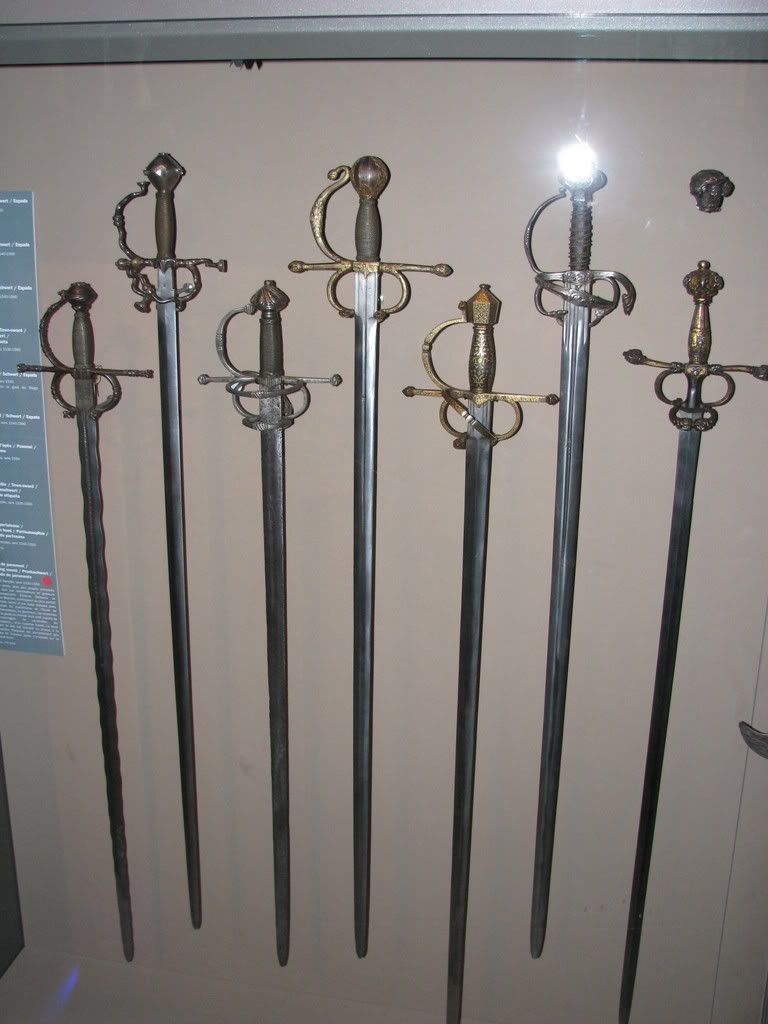
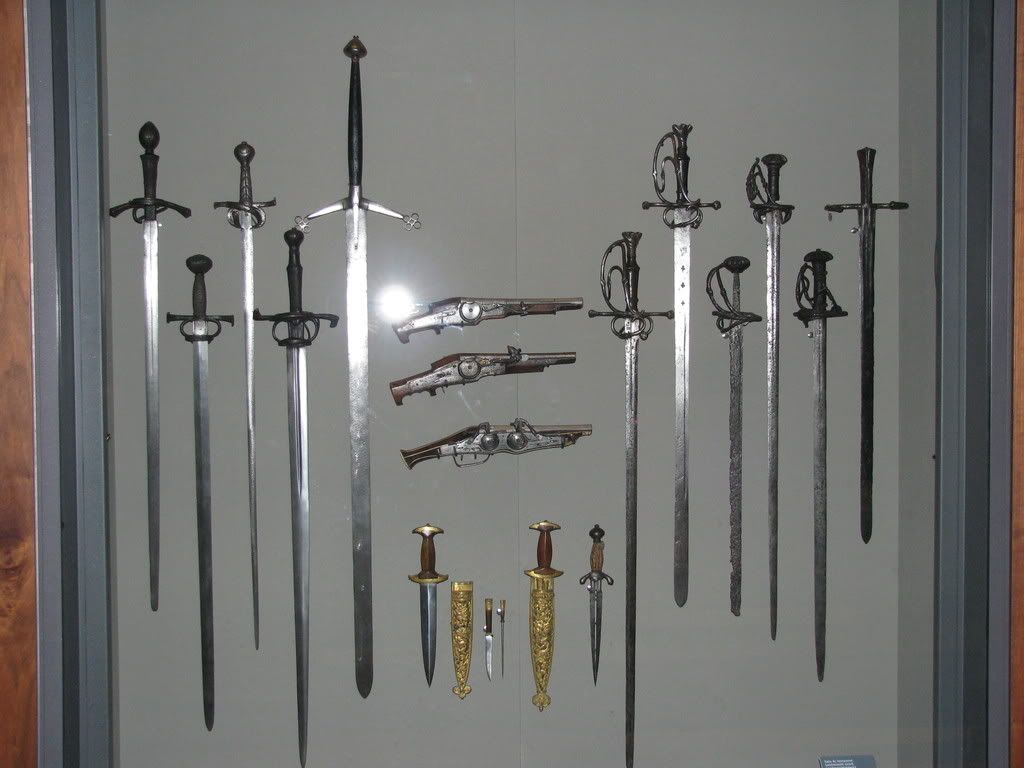
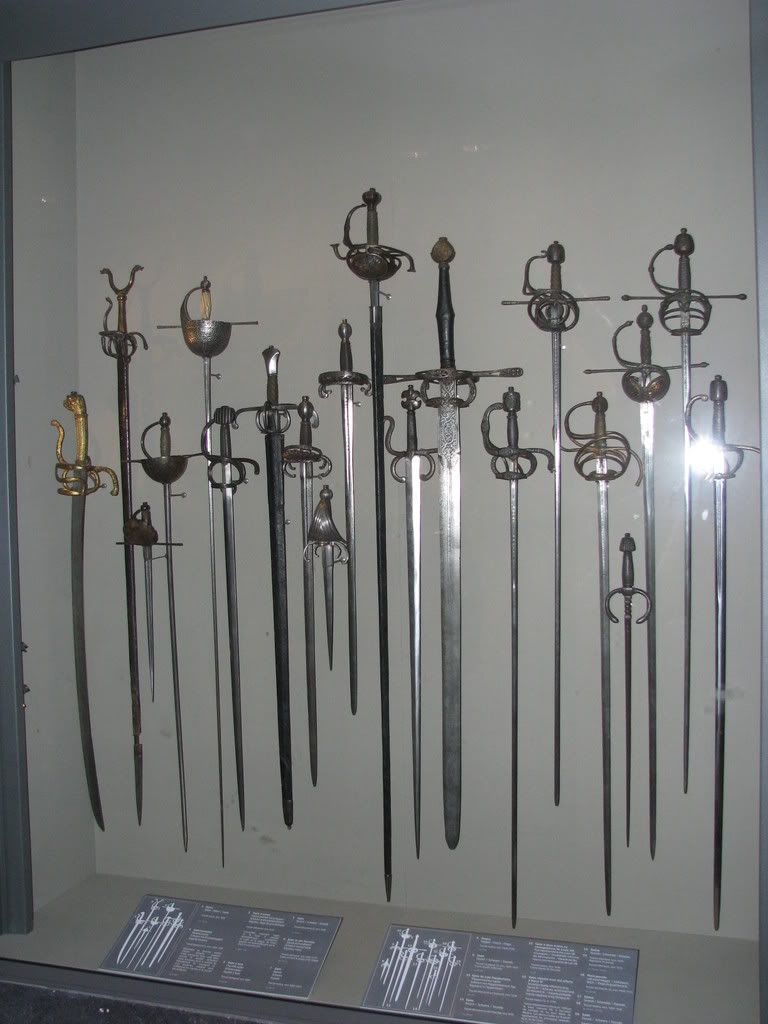
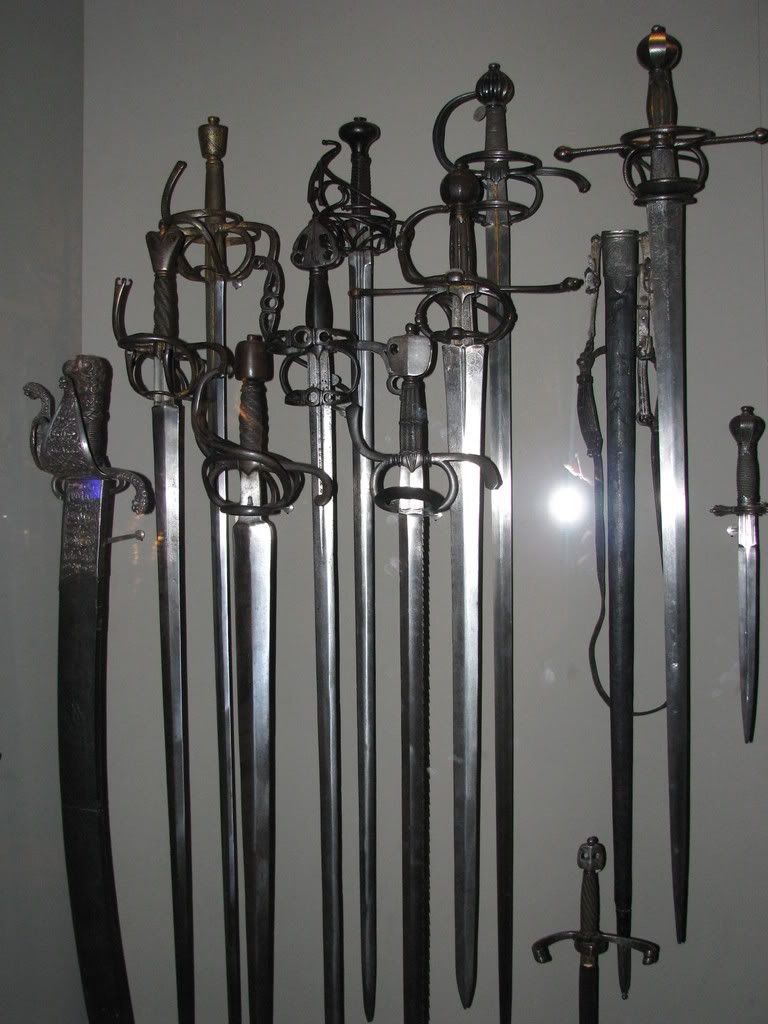
Here are some photos of cut & thrust swords from Les Invalides, Paris.
1
Image
2
Image
3
Image
4
Image
5
Image

Some of these swords are more thrusting oriented and some are more cutting oriented. Some have knuckle guards, some have side rings, some have finger rings. I can pretty much see any hilt configuration on any blade. Especially in that last photo you can see heavier broad blades and more tapered ones, some are even true rapiers. So there is a broad spectrum of one-handed swords during the 16th century. One of the swords in the first photo has an Oakeshott type XIX which looks very much like the blades Albion puts in their Condottiere, Kern, Doge, and Machiavelli (http://www.albion-swords.com/swords/albion/swords-albion-mark-nextgen.htm#Hand-and-a-half). I wouldn't really consider Albion's type XIX to be "cut & thrust" swords, though some of them would certainly fit in the 16th century. They seem to be cutting swords, hold-overs from the previous medieval period. The Oakeshott XII and XIII remain common blade types throughout the Renaissance period as well. In the 16th century, medieval style cutting blades, in-between cut & thrusts, and rapiers all seem to be used.

I wish I had measurements for the swords in these photos. I would guess that most of the one-handers are within a 30-35 inch blade range. There might me one or two that stretch that. Rapiers of course could be longer. Since 16th century comprise a full range from rapier to earlier style cutting swords, I imagine that a 37 1/2 inch blade (the NSA waster) would still be ordinary though not typical. You wouldn't be surprised if you saw one, but it wouldn't be what most people carry. The balance points of the Albion XIXs are 5", 5 1/2", 5 1/8", and 7". The NSA is approximately 6 inches, but the blade is 3 1/2 inches longer. So you get a longer blade with about the same balance point. Another point to consider is George Silver's recommendations for blade length. A 37 1/2 inch blade is just right for me based upon his way to find your proper length. While 37 1/2 strikes me as long for a one-hander, he says that this is your proper length for a two-handed sword as well. 37 1/2 certainly falls within the normal length for longswords. I wouldn't be surprised if Silver's recommendation played an important role in the design of this waster. But is this the norm for the swords of his day? Is this the length the Italians or Germans favored? Was Silver's opinion widely accepted or was he trying to change the status quo like he was with English use of the rapier?

I suppose this gets into how we define a cut & thrust. Not that we need to set firm boundaries between cutting swords and cut & thrusts. The NSA certainly falls within the range of 16th century swords. And it is a great waster. I highly recommend it. And I could be wrong in how I understand 16th century cut & thrust swords.
Last edited by Greg Coffman on Mon Mar 23, 2009 7:07 am, edited 1 time in total.
Greg Coffman

Scholar-Adept

ARMA Lubbock, TX

User avatar
Vincent Le Chevalier
Posts: 166
Joined: Mon Dec 31, 2007 5:18 am
Location: Paris, France

Postby Vincent Le Chevalier » Sun Mar 22, 2009 6:18 am

Hi Greg!

First off thanks for the great pictures, makes me want to go to this Museum again :)

I can't say I have handled original swords either, however I own a Milanese rapier from Arms&Armor that I think would be considered a cut&thrust sword by ARMA members. The blade length is about the same as what you have measured on your waster, so it's not exceptional I think to see that.

Reproducing an accurate balance on a wooden sword while keeping it solid enough to withstand the rigors of training is a challenging task. Compromises have to be made... Quantifying the dynamic balance of weapons is also something that needs more than CoG. If you can measure pivot points as I described here, it should be possible to say more. In fact I'd be very curious to compare this wooden sword to the other trainers I have numbers about.

About the Albion swords you mentioned, it should be noted that the Kern has been described as having a different balance than most swords. It has the same blade as the Condottiere and Machiavelli, but the ring pommel is much lighter, giving a forward balance to the whole sword (more about the Kern here). I don't think its CoG of 7in should be considered typical of cut&thrust swords in general...

Thanks for the review!

User avatar
Benjamin Smith
Posts: 184
Joined: Thu Jun 09, 2005 12:44 pm

Postby Benjamin Smith » Mon Mar 23, 2009 5:39 am

Just a note the swords you mentioned from Albion are type XIX not XIV.
Respectfully,

Ben Smith

User avatar
Greg Coffman
Posts: 156
Joined: Sat Dec 09, 2006 5:33 pm
Location: Abilene

Postby Greg Coffman » Mon Mar 23, 2009 6:10 am

Yep, you're right. I got my roman numerals wrong. I'll go back and change it.
Greg Coffman

Scholar-Adept

ARMA Lubbock, TX


Return to “Research and Training Discussion”

Who is online

Users browsing this forum: Google [Bot] and 7 guests


Note: ARMA - The Association for Renaissance Martial Arts and the ARMA logo are federally registered trademarks, copyright 2001. All rights reserved. No use of the ARMA name or emblem is permitted without authorization. Reproduction of material from this site without written permission of the authors is strictly prohibited. HACA and The Historical Armed Combat Association copyright 1999 by John Clements. All rights reserved. Contents of this site 1999 by ARMA.