Critical of Sport Fencing

For Historical European Fighting Arts, Weaponry, & Armor

Moderators: Webmaster, Stacy Clifford

Guest

Critical of Sport Fencing

Postby Guest » Sat May 15, 2004 1:21 am

I've been viewing ARMA for a couple of years now, but only recently sat down to thoroughly reading the essays. I can't help but notice what appear to be major misconceptions by some of the writers against sport fencing. I've been a competitive fencer for 8 years (C-Rated Epeeist,) and received my instruction from two nationally ranked fencers (one retired,) and have never seen any of what many of the essays claim are bad hallmarks of sport fencing.

If the essays commented that "some" sport fencers teach some of what ARMA considers to be falsehoods, then I wouldn't have an issue. But, most of the essays are written such that it would appear all sport fencers are guilty of commiting the same errors, without citing sources. I will point out what I feel are misconceptions on the part of ARMA, and hopefully we can have a healthy debate on what I've been reading.

1. "It is truly mind boggling that sport and classical fencing instructors teaching ... should regularly block with their edges."
My Response: Huh? Who are these fencers and from what schools do they hail? Anytime I've heard fencers discuss this subject at a tournament, they're usually mocking how Hollywood shows people blocking edge-to-edge. I've competed all over the nation and the opinion of ARMA is shared by fencers around the US. Please, tell me who are the bad fencers teaching incorrect parry techniques so they can be executed.

2. "In modern sport fencing it is also standard to restrict students from any form of bouting for a considerable length of time until they have acquired the necessary foundational form."
My Response: The reason for this is simple. Most people that are new to sport fencing treat the weapon as a club, and/or attack without consideration for the person they are fencing. There is a real risk for injury. What most instructors (that I've met) teach is control, how to attack without seriously injuring someone. However, there are some coaches that teach techniques they know might injure someone. A couple of people I've known who fenced (epee) abroad (World Cup) would return with broken broken bones. There are no complaints, that's just how it is. Also, what is a "considerable" amount of time? Two months? A year? Most American schools I've seen have students bouting on their own after a month or two.

3. "This bouting is always conducted within a tightly controlled framework of permissible actions that directs the play far from its original martial purpose and thus exclusively into the realm of sport."
My Response: It sounds like this is a comment against foil and sabre, which I do not like for the same reasons as the author. There is a thing called "Right of Way" in foil and sabre. It's annoying, and the source of many debates. Also, the body is not a complete target in foil and sabre, the way it is in epee. In epee, there are few restricting rules. The big ones are: 1. To not turn your back to your opponent because it exposes the back of you head to injury as there is little protecting that area. 2. Don't meet guard-to-guard. When you get this close, there is a chance that an over-aggressive fencer may do something stupid. Why is this a rule? A long time ago an over-aggressive fencer did something stupid like put his guard into his opponent's mask. 3. Don't do something obviously illegal, like punching your opponent. It's a sword fight, not UFC. Anyway, the writer needs to explain his comment, because it's debatable and not really applicable to epee.

3. "The value of a technique in fencing is not its lethality but its ability to score, and the mindset of modern fencing is competitive rather than martial."
My Response: Ha! Compete at a World Cup event, and then try repeating the above comment with a straight face. There's a reason the World Cup requires two layers of kevlar, with a hard chest protector as an option. American fencing may have forgotten its roots, but World Cup fencing has improved upon the past and can teach ARMA a thing or two about lethality. Also, I take issue with "the value of a technique is not it's lethality..." This isn't an issue of fencing technique, but intent. It doesn't matter if it's sport fencing, or ARMA - if I'm stabbing at your head with an epee, I know that it can hurt, so I pull back at the moment before impact (unless I don't like the person, then I let them have it,) just as many other fencers are taught. If an experienced competitive fencer wanted to hurt someone, that person could. It's simply a matter of choice and controlling the technique.

For the most part I like a lot of what ARMA teaches, and many of the tenants of ARMA are often brought up in discussion at fencing events: Why can't we have a circular fencing area? Why should corps-a-corps have to stop a fight? Etc...

Anyway, I saw a reference to people speaking outside the sphere of expertise, and I think that's good advice. A few of the ARMA writers need to apply this liberally to what they write of sport fencing because many of their claims are either false, or unsubstantiated. Please, ARMA writers, give statements with cited sources. The fencing community is small and swift to react, and we don't like bad fencing instructors anymore than you do. Don't apply general comments to sport fencing.

User avatar
Allen Johnson
Posts: 638
Joined: Fri Feb 20, 2004 1:43 am
Location: Columbia, SC

Re: Critical of Sport Fencing

Postby Allen Johnson » Sat May 15, 2004 4:09 am

Hello Sean,
I am pretty new to ARMA, and like alot of ARMAteers got my intro to swords through sport fencing. I was teachers assitant for the fencing classes at a junior college (I really taught the class- she used the time to plan). Only after study did I realize that historical fencing resembled little of what I was experiencing, and thus had a desire to learn more. I still enjoy sport fencing for what it is. I agree with some of your points and slightly disagree with others.
1. edge parrying- given the nature of the sport fencing "blades" the whole edge parry debate is really moot there. When the cross section of the blade is a square then why argue the edge? That and in the case of foil and epee you are really only concerned about the point- and given the nature of that style of fighting, the 'edge' wouldnt really sustain much damage. You arent going to have great sweeping, heavy cuts with a smallsword. Can we cay disengage? <img src="/forum/images/icons/wink.gif" alt="" />

2. Time spent in training till you can bout- Im not sure where the writer went to get his info, but I also found this curious on a few levels. First its the semantics of the phrase "considerable legnth of time". How long is that? It's hard to guess (that and I'm reading it out of context). That being said - I think it is important to spend the time to teach the very basics like footwork and how to hold the blade. When I taught we always had a big problem with keeping people from doing what they thought looked cool from the movies (ie - swinging the blade). Nothing looks quite as funny as a D&amp;D fan trying to do some twirl kata thingy with a foil! <img src="/forum/images/icons/grin.gif" alt="" /> In ARMA I also think its vital to spend a "legnth of time" learning these things. How long? Till you get it and prove that you wont be a danger to yourself and others. Bad building blocks (ie basics) will result in huge problems later on. So here I agree with you - but am unclear on what the author had in mind- so it could be just a semantics issue.
3. The strict rules- Here it sounds like basically what you are used to. To someone who spends alot of time doing ARMA style/ historical fencing, the rules of sport fencing (though perfectly fine and understandable in their own context) do seem restrictive. After doing ARMA for a while, I participated in a charity/fund rasing open epee cometition. I hadnt touched my epee in at least 10 months. I had 2 warnings and 2 points awarded to my opponent for parrying with my off hand! <img src="/forum/images/icons/grin.gif" alt="" /> They might have kicked me out if it wasnt a charity event and if I wasnt laughing so hard and appologizing for it so profusley. I just wanted to grapple! So yeah, it can seem restrictive if you are used to practically anything goes as in historical play. That and in ARMA we usually train with people we know and somewhat trust- so we have some assurance that our partner isnt going to level us if we accidentally put ourselves in a vulnerable position. You kind of laugh, pat him on the back and say "yeah - you'da been pretty screwed!"
4. (or your other #3 <img src="/forum/images/icons/wink.gif" alt="" /> ) Lethality issue- Im a little on both sides here. Before I looked at historical fencing I felt that the fencing I knew was a lethal art. I mean- I had the welts and brusises and cracked fingers to prove it right? Whereas sport fencing is made to imitate a lethal art (and does have some similarites- and certainly the same ammount of intent!) The historical study of fencing is the source for the sports imitation. Since you have been with ARMA for a while I can assume that you've spent some time reading and training from historical manuals. Im pretty convinced its more lethal that the sport techniques. You mentioned the World Cup a few times- Unfortunatley I have never been able to attend a competetion on that level- and I think I might be safe to say that the writer of the article you are quoting, probably hasnt either (dont really know- just a guess). So maybe with the observations this individual made were accurate as far as his experiences went. I wont argue that the intent and strength of those world class fencers is anything to balk at. However there are many techniques that result in points in sport fencing that would be impossible or less effective in a historical setting and with period wepons, with an intent to kill as oppose to land the first touch. (Try a flick with a rapier! <img src="/forum/images/icons/wink.gif" alt="" /> )
So overall I can see where you are coming from, but I can also see what the writer was adressing. The othe part of it is that obviously we are all passionate about this stuff. So we tend to get a bit more excited and excitable when talking about it. The writer may have used some strong words to describe his views on what he observed. But thats just it, 'his' views. As unfair as it is for the writer to make sweeping generalizations about sport fencing, it is also equally unfair to group this individuals views under the umbrella of "ARMA writers". You are right, we all can learn something from everywhere and can always have a lesson in acceptance of others opinions and views. Besides...'ARMA' is certainly a lot more leneiant on sport fencing as opposed to other 'stick weilding' groups <img src="/forum/images/icons/wink.gif" alt="" /> It could be worse <img src="/forum/images/icons/grin.gif" alt="" />
"Why is there a picture of a man with a sword in his head on your desk?" -friends inquiry

User avatar
Shane Smith
Posts: 1159
Joined: Thu Sep 19, 2002 2:15 pm
Location: Virginia Beach

Re: Critical of Sport Fencing

Postby Shane Smith » Sat May 15, 2004 6:59 am

I am not a sport fencer so I cannot comment from that point of view,however,I have spent a day at a regional tournament watching the bouts...I have likewise seen skilled historically-accurate fencers engage in rapier play in accordance with the Masters.My honest observations follow.

1.The sport fencing I witnessed was fought by many fencers who were standing very high on the balls of their feet while bouncing up and down(and even off the ground seemingly on many an occasion).Their fighting looked very sport "Taekwondoish" (Is that a word??!!).

In contrast,the historically-accurate rapier work I have seen employed a footwork that while no less dynamic, was much more sure-footed and with no "bouncing about".Indeed the only springing maneuvers I recall were lateral such as penetrating thrusts and the like.

2.The fighting stance of the sport fencers I witnessed was almost completely sideways.While that does obviously reduce target area to your opponent,it also seemingly would hamper your abilty to bring your off-hand into play to trap,grapple,strike,parry etc which leads to a very false fight in my opinion. (Not unlike sport TKD's "no punches to the head" rule).

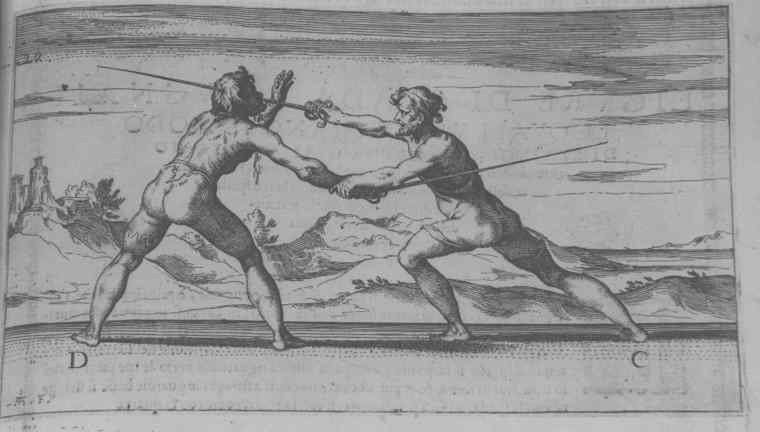
The historically-accurate rapier work I have seen involves a position that is not so full-on sideways and still allows the off-hand to go to work in the manner decribed above. There is alot more close-in work when you are indeed allowed to close and come to grips. In historically-accurate work,the guys I have seen would have no qualms about putting their hilt right through their opponents nose.I think the Masters themselves would have perhaps done no less. Image

The mindset did seem a bit divergent as well.The sport guys seemed content to make a scoring hit with the tip at the edge of range while the historically-minded fencers seem to prefer to be in control at any and all appropriate ranges from the approach to fighting at grips.I saw no close work in the sport fencing I witnessed yet it plays an important role in the source-texts I believe.

I just saw much that day at the tournament that seems false when compared and contrasted with the limited knowledge I have based on my own studies of the historical Masters of the rapier(keep in mind,I am more of a medievalist personally and am probably the least among us when it comes to rapier). In my mind,I see a direct and valid comparison between historically-accurate fencing and sport fencing that is mirrored in the Asian world by "Traditonal" Taekwondo and "Olympic" Taekwondo (Forgive the comparison,I am an old Taekwondo guy so that is my point of reference when it comes to "sportiness" <img src="/forum/images/icons/wink.gif" alt="" /> ). Both are similar in the general sense and both use similar techniques.The difference is that one is so limited by it's rules and "pointing" system that it could justly be said that it is become a shadow of the true martial roots. All that said,I would absolutely NOT discount all sport fighters or say that they can't get the job done on the street.Some people can be good,competent martial artists and then make a gear shift to compete in heavily restricted environments with no loss of efficiency,but even then,you can tell that there is something different about their personal fighting styles.They seem much more "vital" than their opposition...Heck, I spent years fighting Olympic style and fought in tournaments myself...until I came to the conclusion that the false-fight as I deemed it was not for me in spite of my reasonable successes in doing so. I went traditonal after that and have never been happier about such a decision.

My fellow ARMA Scholar Milan Petricevic whom has a fairly extensive sport background I believe gave a very eye-opening commentary on the differences between modern sport fencing and historically-accurate fencing at the last ARMA International Event in NY. To see him demonstrate those differences in action and words was quite shocking. These are NOT two wings of the same bird in my opinion. They seem rather to be birds of a different and distinct kind to me.
Shane Smith~ARMA Forum Moderator
ARMA~VAB
Free Scholar

User avatar
JeffGentry
Posts: 1089
Joined: Tue Apr 20, 2004 8:35 am
Location: Columbus Ohio

Re: Critical of Sport Fencing

Postby JeffGentry » Sat May 15, 2004 11:30 am

Well this will probably go over like a lead ballon but oh well, if you sit and watch a full contact martial art's match be it kickboxing, karate, Taekwondo, what ever , then sit and watch the Ultimate fighting challenge there are two totaly diffrent intent's the intent just like in sport fencing the intenet is to win by scoring point's in ARMA the intent is to learn how european warrior's fought and killed each other our intent(or at least it is in my mind) is to learn to kill with control, I have nothing against sport fencing don't participate it just isn't my thing but most people who fight in a sport would not hold there own against some one who was intent on doing them serious bodily harm because the rule's of the sport are ingrained in there technique ask some martial artist who is good and received a good but kicking from a street fighter it happen's all the time.
Semper Fidelis

Usque ad Finem

Grace, Focus, Fluidity

User avatar
John_Clements
Posts: 1167
Joined: Wed Sep 18, 2002 10:43 pm
Location: Atlanta area

Re: Critical of Sport Fencing

Postby John_Clements » Sat May 15, 2004 11:40 am

Sean,

1. The use of edge blocks in saber fencing is standard. It’s so ubiquitous it’s never even considered given that the sport saber being so incredibly thin, in effect has no real edge and so the matter is considered irrelevant (the same can be said about hitting with the actual “edge” of the blade as compared to the flat when scoring). But, transfer those techniques over to real Medieval and Renaissance cutting blades and there is a serious problem. Consult virtually any book on the subject of sport saber fencing or most any 18th and 19th century saber/broadsword/cutlass text and you find instruction to parry with the edge.

2. Your comment here seems to be not a disputation of facts, but of methods. Historical Renaissance fighting arts were taught differently than today’s fencing sport. We approach our subject differently because ours is not a sport or game, it’s a combative system being interpreted and reconstructed. Just because modern fencing delays bouting until an orthodox form is acquired does not mean it is a universal rule for all similar activities.

3. This comment is also not a disputation of facts. Modern fencing developed from what was once a self-defence method and a duelling skill. It no longer is. As this change occurred, certain limitations and restrictions had to be enforced for various reasons. While understandable, it is also undeniably altered nature of the activity. Our subject is different. We don’t hold competitions for points and we strenuously practice a lot of those “stupid” things precisely because they were the lethal techniques that worked-–and hence are too dangerous now for a sporting game.

4. To argue that modern fencing, which removes the martial aspects of self-defense and battlefield combat effectiveness in favor of doing whatever works to score a point in a game, has somehow “improved upon the past” is a ludicrous statement. That kind of claim is exactly why ARMA exists. To believe that now, today, when men are playing with toy weapons in a game are somehow superior to men who fought with sharp blades under all-out anything goes conditions is a remarkably ignorant claim.

I’ve always found it frustratingly amusing that anyone could hold the view that fencing somehow reached its zenith only after it stopped using real weapons in real fighting. I welcome the opportunity at any time to engage any sport fencer of any caliber under open conditions of ARMA sparring using reproduction blades. I’ve had the most amusing times enjoyable revealing to sport fencers just what a highly skilled Renaissance stylists is capable of with a historical weapon. When you ignore the use of the left hand for parrying and striking, of body contact, of grappling, exclude blade and hilt seizures, disarms, hilt-strikes, kicks, half-swording, and essentially everything that the sport form removed as “dastardly” and “impolite” among gentlemen, you will then find the difference between a martial art of sword fighting and an athletic sport of fencing.

We will continue here to make all the “general comments about sport fencing” and any critical comments that we find substantiated and documented by the volumes of books on the subject as well as the multitude of websites out there and our own experiences (I started sport fencing in 1980 under two leading instructors and competed in teams in college). Given the vast ignorance of our subject of study and the legacy of inane statements made about Medieval and Renaissance fencing and arms and armor by leading sport fencers over the last 150 years, our community has a long way to go to educate sport fencers, not the other way around.

The gulf between edged-weapon theory and practical reality is never wider than when historical fighting skills of life and death are transformed into rule-enshrined competitive sports surrounded by formal protocols and contrived etiquettes.

Regards,

In the mean time, please see this article:

http://www.thearma.org/essays/MartialArtorCombatSport.htm

JC
Do NOT send me private messages via Forum messenger. I NEVER read them. To contact me please use direct email instead.

User avatar
JeffGentry
Posts: 1089
Joined: Tue Apr 20, 2004 8:35 am
Location: Columbus Ohio

Re: Critical of Sport Fencing

Postby JeffGentry » Sat May 15, 2004 11:47 am

Hoped you would get in ther John didn't want to mention you r experience in sabre in my little dissertation on intent, but well said.
Semper Fidelis


Usque ad Finem


Grace, Focus, Fluidity

Guest

Re: Critical of Sport Fencing

Postby Guest » Sat May 15, 2004 10:56 pm

"1. The use of edge blocks in saber fencing is standard."

That's not true. I don't know who your sabre instructor was, but I've known sabre instructors that teach edge-to-edge, and flat-to-edge. You're applying a general statement to the whole of sport fencing.


"But, transfer those techniques over to real Medieval and Renaissance cutting blades and there is a serious problem."

Any sport fencer worth his salt would know better than to do that. Maybe, I'm speaking with some bias on my part. There are less than 600 C-Rated epeeist in the whole of the U.S. and there are over 16,000 fencers. I'm used to running with a pretty tough crowd of fencers, but I have met many fencers who claim to know something about combat because they think they know how to fence. The same people you complain about, I don't like either, but you're doing sport fencers (and yourself) a great disservice by making broad accussations against sport fencing.


"Consult virtually any book on the subject of sport saber fencing"

There are a lot of "teachers" who write saber books. In my opinion, there are only three teachers who should be allowed to write books on saber: Vladimir Nazlymov, Aladar Kogler and Peter Westbrook. I can't speak for the authors you mention.


"2. Your comment here seems to be not a disputation of facts, but of methods. Historical Renaissance fighting arts were taught differently than today’s fencing sport."

That is not true. Many of the "combat" moves were taken out of sport fencing, but some instructors still teach their students how to lunge with the intent to drive a rapier through an opponent. All they've done is replaced the rapier with an epee. With all due respect, I think you had a very poor experience with sport fencing. I mean that out of sympathy, not to insult. There are probably only 2,000+ serious fencers in the U.S., the other 14,000 or so seem to be the ones contributing to your understanding of sport fencing. Perhaps, if you could attend a NAC, or a WC, you would see that what you exerienced is not true of sport fencing. Frankly, if you haven't attended a NAC or a WC, you shouldn't be speaking of sport fencing with any authority because you don't know what true sport fencing if you haven't competed for a World or National Title. Local fencers don't use the same techniques as World Title competitors. There are too many techniques that are reserved for a select few and so most fencing members of the USFA have no idea what they're missing. Many members are required to sign up with the USFA because of club rules concerning insurance and support from the USFA, and they don't compete. At the NAC's, you'll see what can be considered sport fencers. Many techniques at a NAC or WC, you won't see at a local event. No one wants to show their stuff unless absolutely necessary.


"We approach our subject differently because ours is not a sport or game, it’s a combative system being interpreted and reconstructed."

Understood.


"Just because modern fencing delays bouting until an orthodox form is acquired does not mean it is a universal rule for all similar activities."

Actually, there is no "orthodox" form. There are as many forms as there are nations, and even more derivitives still. Sport fencing delays bouting until there is control, not form. Again, you're making serious errors about sport fencing.


"3. This comment is also not a disputation of facts. Modern fencing developed from what was once a self-defence method and a duelling skill. It no longer is."

You've never been to a World Cup, so you shouldn't say that as fact. I don't doubt you could break someone's bones with a Schlager Blade, but try doing that with an FIE BF blade.


"We don’t hold competitions for points and we strenuously practice a lot of those “stupid” things precisely because they were the lethal techniques that worked-–and hence are too dangerous now for a sporting game."

What "stupid" things? Who said anything about stupid? Would you mind telling me at which salle you practiced, because it sounds like someone there is teaching some very bad habits. All the top-seeded fencers I've known are very touchy about picking up bad habits, and can get down right angry if someone tells them otherwise. If I could, I'd introduce you to the people with whom I fence. I guarantee we would dispell many of your beliefs about fencing.


"4. To argue that modern fencing, which removes the martial aspects of self-defense and battlefield combat effectiveness in favor of doing whatever works to score a point in a game, has somehow “improved upon the past” is a ludicrous statement."

I said they improved upon the technique, not the rules of combat. Talking strictly about lunging, advancing, extending - in the 1940's, the lunge, advance, etc... were the same as those described in the books you use as a guide for combat fencing. However, over time, sport fencing applied a much faster advance, a much more powerful lunge and have adapted methods of creating a more powerful and faster extension of the weapon arm. Back in the day, it was unheard of to actually injure someone with a sport weapon. But, a number of people have died, one famously in 1984, and so sport fencers started wearing kevlar and much better steels that can withstand the shock of the modern techniques. It was mentioned that someone was using their off-hand to block attacks; you wouldn't be able to do that against the people I fence.


"To believe that now, today, when men are playing with toy weapons in a game are somehow superior to men who fought with sharp blades under all-out anything goes conditions is a remarkably ignorant claim."

That insult wasn't necessary as I had been addressing you respectfully. But, so be it... You needed to understand my statement. Frankly, it's remarkably ignorant of you to claim to know fencing when you haven't competed at a NAC or World Cup. Were you ever good enough to be rated? Was your sabre instructor rated? Have you ever held a state or national ranking?


"I welcome the opportunity at any time to engage any sport fencer of any caliber under open conditions of ARMA sparring using reproduction blades."

You're in Houston. The current national epee champion is in San Marcos. Challenge John Moreau. Or, if you're as good as you think you are, you'll get a membership with the USFA, and get a state ranking. It's $40 for the year, and usually $15 per event. I'm sure someone of your mighty caliber should be able to adjust and defeat any fencer using their archaic rules.


"We will continue here to make all the “general comments about sport fencing” and any critical comments that we find substantiated and documented by the volumes of books on the subject"

Um, okay. I think it's obvious you know alot about combat fencing, but it's pretty clear you don't know anything about true sport fencing. But, if you don't want to admit it, that's fine with me. You've never held a state title, but you're an expert on sport fencing... okaaaay.


"I started sport fencing in 1980 under two leading instructors and competed in teams in college)."

Okay, that's a start. Which college, if you don't mind my asking, did you compete with, and who were your instructors? I will speak with the USFA to see if they have any national records of their events/stadings, and yours for that matter.


"our community has a long way to go to educate sport fencers, not the other way around."

What are you talking about? You still think edge-to-edge is standard sabre practice. Yeesh.


You've had some bad experiences with sport fencing, and I can appreciate your situation. But, now you're attacking all of sport fencing with the logic of someone wronged. You may feel justified, but then look at who you think is representative of our sport. You got into a debate with Dr. Gaugler over his views on fencing. Well, guess what: Top seeded fencers HATE Dr. Gaugler, and they hate him with a passion. I've read his books, and I believe he is clinically insane. He has this unwavering committment to a style of fencing that no reputable instructor would ever use. Go to www.fencing.net and do a search for him. You'll find mile-long flame wars about him. It looks like you've been reading the wrong books. In fact, you shouldn't even be using books to discuss fencing as many modern fencing books are outdated and used only to instruct beginners at colleges because some teachers/clubs are too lazy to make their own lesson plan. Your "citations" are invalid.

Guest

Re: Critical of Sport Fencing

Postby Guest » Sat May 15, 2004 11:06 pm

"Im pretty convinced its more lethal that the sport techniques."

Teachers don't share the good techniques with just anyone, particularly Americans, for some reason. I learned what I know about the more dangerous techniques the hard way. I pissed off the wrong guy and he hurt me.


"So maybe with the observations this individual made were accurate as far as his experiences went."

Okay, fair enough. But, the same can't be said of high caliber events, and I don't think it's right that the author is applying said experiences to those sport fencers he's never seen or fenced.


"However there are many techniques that result in points in sport fencing that would be impossible or less effective in a historical setting and with period wepons, with an intent to kill as oppose to land the first touch. (Try a flick with a rapier!)"

The flick? Check out fencing.net to see how many flame wars were started over the flick. I don't flick, I hate flicks, and hate any one that does flick. Foilist flick. I hate foilists. Epeeists don't flick as much, but some are guilty. I hate the guilty ones too.


"So we tend to get a bit more excited and excitable when talking about it."

I'm trying not to; believe me, fencers get in trouble with that too.

Guest

Re: Critical of Sport Fencing

Postby Guest » Sat May 15, 2004 11:16 pm

"In contrast,the historically-accurate rapier work I have seen employed a footwork that while no less dynamic, was much more sure-footed and with no "bouncing about".Indeed the only springing maneuvers I recall were lateral such as penetrating thrusts and the like."

The fencers I compete with at NACs fence as you describe, without bouncing. The more inexperienced do bounce around- it's a throw-back to Classic Italian Fencing. Though, there are those who use the technique that are very good with it.


"2.The fighting stance of the sport fencers I witnessed was almost completely sideways."

That's also a throw-back. A lot of top-ranked fencers have taken a more forward stance, with the shoulders shifted forward slightly so you can get more power in your lunge, almost like you were going to punch the opponent. Look up a guy named Cliff Bayer, and you'll see what I mean. Anything circa 2000 will show him in his prime.

Guest

Re: Critical of Sport Fencing

Postby Guest » Sun May 16, 2004 3:38 am

Shane, for some reason your photo wasn't showing up on my screen, but now it is. It's a neat photo, but not one that would be used in sport fencing, though I'm sure it would be a powerful hit. I notice the more forward stance; that is more inline with what I see now at the NAC's. A lot of fencers choosing to stand more forward because you get speed and power.

Also, you mention attacking at the edge of range, that's really a matter of choice. There are numerous sport fencing techniques that are used for in-fighting. Prime (preem) is a parry that usually, conveniently lands on the opponent's groin, but only if you're practically right on your opponent. There is also a parry "quarte" that when used with a ducking action, will allow you fight inside your oppoent's range. It's usually a last resort action. Then, there are people who attack from behind the back, essentially wrapping their arm around themselves to attack from the opposite side, and at extremely close range. You probably won't see much good in-fighting at a local event, but if you don't mind listing your state, I'll see if I can find some NAC's or a WC for you to check out.

User avatar
Brian Hunt
Posts: 969
Joined: Thu Jan 23, 2003 2:03 am
Location: Price, Utah
Contact:

Re: Critical of Sport Fencing

Postby Brian Hunt » Sun May 16, 2004 12:26 pm

Hi Sean,

When I still do any strip fencing, epee is the only weapon of choice for me. I hate foil, and saber isn't much better, and I find still find the rules of epee to be over confining. Heck, when I still do some SCA style rapier fencing, I find their rules to be overly restrictive. I have never been ranked, let alone at the C level that you compete at. I have crossed blades with a ranked French master when I was still in college and his level of skill was amazing to behold. I enjoyed the times I was able to learn from him. I have taught basic strip fencing at my local college, and to friends who have been interested in the sport end rather than historical fencing. When I do fence strip, the nearest school with electric equipment is an hour and a half away. But I still like to get up there once and a while to keep my hand in. So please take my opinions for what they are, someone who still dabbles in sport fencing, but prefers things with less rules and a lot more "realism." Does this mean that if you gave a good sport fencer a sharpened weapon that he would not be a dangerous opponenent? No, it does not, especially if it was a small sword, something that would feel similar in weight and balance to an epee in his hand. A couple of things that could place him at a disadvantage would be how much he is used to the rules structure of sport fencing. You mentioned infighting, so I wish to address the differences. In a sport where you are not allowed to grapple, the techniques of preem, behind the back, and 'quarte' (disclaimer here, I believe this action is one that I know as a pick from your discription, and would be similar to what people here would call a hanging guard) work well, and can be done very quickly by a skilled opponent. In a situation where grappling is allowed they will not work as well against someone who will grab your arm/head/body/leg/sword and hurl you to the ground, or place a joint lock on you, or even in a real life and death situation maybe break your bones/joints. The range of infighting in sport fencing is the range that I would refer to as "wrestling at the sword" in historical fencing because you are withing range of coming to grips with one another.

In sport fencing the rules protect you from things like this and allow certain actions to develop that would not be advisable otherwise. This is an example of one of the things that we mean when we say that sport fencing is not 'true' sword fighting, it is a sport. In any type of sport where you have a series of rules, for safety or other reasons such as making it easier to keep track of scored points, you create an artificial environment where realistic actions may go out the window in defference to winning the game. A good example can be found in Sport Epee. When one person gets ahead in points he may then choose to always attack his opponent without worrying about defense because he wishes to maintain his lead by creating a double touch where both people gain a point. So long as he keeps this up he will win because he is already ahead on points and will continue to gain them ahead of his opponent. In a real life and death sword fight this action would result in two wounded or dead people. Am I saying that all sport fencers will take this obvious advantage during their match? No, but I have seen this tactic used often enough to know it is common.

I can see the passion you have for the type of fencing that you do. Due to your posted rank I am sure you are very good in your art of choice. You also need to understand that what we do and what you do are two different animals, with different approaches and attitudes. If we keep this in mind, and keep egos out of it, we can have a very good discusion of the differences as well as the similarities between our approaches. <img src="/forum/images/icons/smile.gif" alt="" />

with regards.

Brian Hunt
GFS
Tuus matar hamsterius est, et tuus pater buca sabucorum fundor!

http://www.paulushectormair.com
http://www.emerytelcom.net/users/blhunt/sales.htm

User avatar
John_Clements
Posts: 1167
Joined: Wed Sep 18, 2002 10:43 pm
Location: Atlanta area

Re: Critical of Sport Fencing

Postby John_Clements » Sun May 16, 2004 1:28 pm

Sean,
Did you even bother reading the article on the differences between a martial art and a martial a sport that I linked above?

Edge blocks are indeed entirely standard in saber.
I’m glad that you found some enlightened sabre instructors now that apparently feel differnetly. Perhaps ARMA’s influence is finally having an impact. In the mean time, consult the vast literature on sport fencing, and indeed on military saber of the 19th century, as well as that for broadswords, cutlasses, and spadroons of the same period. You will find edge on edge as gospel. Unless, you want to argue that all prior literature on the subject is now obsolete?

I challenge you to find any work–sport or military -- that does not teach the use of edge parrying with those weapons. I know of only two out of dozens upon dozens of major works that disagree. Go ahead, do the research. I have. I possess one of the largest private libraries on the subject in the country. If you have teachers who disagree, let's see it in writing please along with their explantions why.

For that mater, I’m wondering just how is it that your fencing teachers expect you to parry with the flat of a modern sport saber that is no more than a few millimeters in width? I’d certainly like to know how they go about explaining the physical mechanics of that, and in a manner that contradicts the traditional teachings for the weapon. Please explain it for us, for I’ve had countless arguments on the matter with fencing teachers across the US over the last twenty years trying to explain why Medieval and Renaissance styles do not use edge on edge for direct parrying of cuts. It's been a tremendous difficulty to convince them otherwise.

As to my making “broad accusations against sport fencing”, you are quite inaccurate. It’s the other way around, in fact. If you have not delved deeply or read thoroughly on the matter, you are arguing over your head. The material critical of modern fencing is considerable from 19th century alone.

Our research has proven these points. I’ve collected no less than 14 pages of quotes by 20th century fencing authorities (and arms museum curators) making outlandish and unsupportable statements about Medieval and Renaissance fencing and weaponry. The material will appear in a future article and in one of my forthcoming books. Their ignorance it is one of the very reasons ARMA exists in the first place, because one of our messages is that experience and knowledge in modern sport weapons is typically not transferable or applicable to historical martial arts methods.

That you are disagreeing with the very premise that game of modern fencing, being a sport and not a self-defence or battlefield skill, is now no longer taught differently than the historical fighting methods, we really can’t have a discussion.
Even to make such an assertion you'd have to be extremely well versed in the historical teachings, and you clealry aren't.
To counter my posts by mereley saying if we haven't been to a recent high level commpetition or comepted we can't say these things, is no valid argument. We might use the same twisted logic against you, since you are neither a student of nor practitioner of our subject.

Apparently, you just don’t grasp what the difference is between playing for points within a set of artificial rules, and training to fight with swords for real life. If what we present on our site and what references we point to aren't enough to convince you, so be it.

Perhaps someday you will get to spar with a senior ARMA member using replica weapons and all-out techniques, and you will understand how a real martial art compares to your respected fencing game today. We don’t play your sport. But anytime a sport fencer wants to pick up a historical weapon and come play with us --using our system of open rules permitting both hands, blade and arm seizures, grappling, kicking, hilt strikes, half-swording, etc. the invitation is open. And I travel around the country frequently, check our events listing.

In all sincerity, and without meaning any condescension or insult, I strongly suggest you take the time to go and study some of the primary texts of our subject to educate yourself. Before you make further statements try reading Egerton Castle’s classic “Schools and Master’s of Defence,” and Sydney Anglo’s recent “The Martial Arts of Renaissance Europe” for starts.

My first saber instructor was the famed Hungarian, Louis Bankuti, head fencing coach at Columbia University for 20 years. I fenced at USF in Tampa, fenced with the respected Campoli family briefly, and first studied at FIT in Florida with the venerable Polish teacher Sophie Trett. My experienced were amusing and rewarding, but like many others, I grew bored with the game very quickly and now do the real thing.

So please don’t come hear and make accusations s about me or others and our experiences with a sport we found boring and restrictive. The teachings of the game sport fencing are fine for winning under the rules, but they would leave one highly vulnerable and be suicidal if attempted against a skilled martial swordsman who has trained to fight and kill, not “score”.

Modern fencing sport is an athletic game and tactical, it has rules; it has limitations and restrictions that make it a competitive challenge. But it’s not a simulation of what happened in historical combat or even of what’s probable in real fighting. It’s not intended to be about learning how to use Medieval and Renaissance weapons and teachings. That is our message about it.

I understand though that acknowledging this often makes modern fencers feel bad their sport. But instead of feeling bad about it, why not consider that your heritage is being recovered and preserved by what we do, that your sport, while not the pinnacle of some earlier tradition, is still an importnat part of larger and greater legacy of Western martial culture.

Regards,

JC

p.s.
W. Gaugler claims to represent “classical fencing”, we don’t really care what he or you call it or pay attention to the fractional divisions and rivalries within your sport. To us, all of you are still doing the same thing: playing for points within a set of similar rules using the very same tools. It’s not what we do and it’s not what we study.
Do NOT send me private messages via Forum messenger. I NEVER read them. To contact me please use direct email instead.

User avatar
John_Clements
Posts: 1167
Joined: Wed Sep 18, 2002 10:43 pm
Location: Atlanta area

Re: Critical of Sport Fencing

Postby John_Clements » Sun May 16, 2004 3:08 pm

Guys, I think the issue here for our “non-historical fencing” readers is simply that: yes, we’re not very impressed by sport fencing…It’s not the athleticism or the intensity of it that we are ignorant of, nor its technical precision and subtle elegance, or the level of commitment and aggressiveness that its serious participants pursue their competitions with that we have any criticism of. Rather, we just recognize it for what it is.

We understand its technical limitations and martial restrictions, its artificialities and confined rules, its etiquette and its sometimes convoluted origins. Most importantly, we understand its vulnerabilities, and how the method would produce bad habits and weaknesses if used in real combat with real weapons or in free play practice fight against skilled Renaissance stylists.

I think smart sport fencers understand theirs is just a game and that there are many things done just to score that would be impracticable or foolish if the weapons were sharp. That doesn’t diminish their love for the sport. This has been my experience (though I’ve certainly encountered several fencing coaches who were completely ignorant).

I think what the underlying dynamic here is one we encounter occasionally: a modern sport fencer may take it as a personal insult when made to realize the collegiate/Olympic game is not a superior evolution over the historical fighting art. (Think about it, when you have some one arguing that sport fencing skill “is” combat viable because there have been 7 or 8 accidental deaths since 1900, it’s like saying that downhill skiing is combat effective because people can sometimes die there too. What’s ironic is that the deaths in sport fencing have all come from broken blades stabbing close-in…which is something that in Renaissance martial arts we practice techniques all the time—using short stiff blades to get close in and stab at vulnerable spots. Funny that.)

As a former sport fencer, I know full well that a very well-trained sport stylist can do quiet well with an epee or sabre against a mediocre historical stylist who neglects his footwork, his lunging, his point control, or his general physical fitness (we hear all the time about traditional fencers wiping the floor with SCA or Renn fair types). But, to go against a skilled martial artist who has long studied genuine rapier and dagger or cut-and-thrust sword with buckler, not to mention longsword (!)…well, we know that’s another matter entirely. <img src="/forum/images/icons/wink.gif" alt="" />

So, when a passionate modern fencer comes to be made to understand that his sport is not the ultimate pinnacle of all Western martial traditions or the end evolutionary result of centuries of cruder swordplay, but is instead an artificial and somewhat contrived game that over time moved farther and farther away from the combat effectiveness of earlier systems, we must be sympathetic and understanding. After all, we’ve all been there to some degree ourselves when we made the same realization and discovered we could pursue the old lost arts with real weapons. Our goal must be to try to educate and inform.

JC
Do NOT send me private messages via Forum messenger. I NEVER read them. To contact me please use direct email instead.

Dave Housteau
Posts: 9
Joined: Mon Sep 23, 2002 10:52 pm

Re: Critical of Sport Fencing

Postby Dave Housteau » Sun May 16, 2004 4:11 pm

Hello Sean.

You asked: "What "stupid" things? Who said anything about stupid?"

I believe John was referring to your statements here:

"Don't meet guard-to-guard. When you get this close, there is a chance that an over-aggressive fencer may do something stupid. Why is this a rule? A long time ago an over-aggressive fencer did something stupid like put his guard into his opponent's mask. 3. Don't do something obviously illegal, like punching your opponent. It's a sword fight, not UFC."

ARMA recognizes that the gentlemanly duel did take place and undoubtedly there were rules for such engagements. However, ARMA does not restrict it's historic reconstructions around this very limited aspect of post 1670 smallsword public duels.

We study all aspects of European swordsmanship. The later period smallsword, from which sport fencing came about (not the rapier), is only one of many. Even with smallsword, the use of the off-hand was common away from those public spectacles.

If you try and use modern sport fencing as a guide to how things were actually done back in period, this is where we begin to have problems. This is especially true if you go back beyond the smallsword and start discussing the rapier. That is a completely different animal and no Schlager blade can begin to replicate, or can be considered as a reproduction of that weapon.

Dave

Guest

Re: Critical of Sport Fencing

Postby Guest » Sun May 16, 2004 5:43 pm

"So please take my opinions for what they are, someone who still dabbles in sport fencing, but prefers things with less rules and a lot more "realism."


Sounds good to me. If there was an ARMA in my area, I'd take it for the same reason you are. I'm not knocking ARMA, what I don't like is for someone who was never an elite fencer to write about sport fencing as though they are/were. I know a lot about sport fencing, but I wouldn't consider myself an expert. The only true experts are those that have held a world, national or state title, and/or have trained someone who held a title. If someone is going to criticize sport fencing, they should critique the best the sport has to offer, not the people who compete at low level events.

You also need to understand that what we do and what you do are two different animals.


Absolutely. In retrospect, I think part of the confusion lies in my choice of words. Having seen the videos, it's obvious there are fencing techniques (not tactics) that are superior to the ones used by ARMA. However, and I think this is where some confusion lies, ARMA's tactics are more "realistic" and have a great deal over sport fencing. I'm not trying to compare tactics all, I'm only focusing on the techniques. When I look at ARMA's lunging technique, I can see that there isn't enough power in your lunges to be able to break bones with a sport weapon. Again, with the tactics (grappling, reversing, etc..,) however, sport fencing can't really be compared.

When one person gets ahead in points he may then choose to always attack his opponent without worrying about defense because he wishes to maintain his lead by creating a double touch where both people gain a point.


That is true. The reason for that is, on average, a fencer has five bouts in pool events, and then at least one more bout in direct elimination. A good fencer will have 2 or more direct elimination bouts, so they need to conserve their energy by doing only what they need to stay ahead in points for the next bout. Whoever wins the tournament can do so only after having not lost any bouts in DE's.


Return to “Research and Training Discussion”

Who is online

Users browsing this forum: No registered users and 19 guests


Note: ARMA - The Association for Renaissance Martial Arts and the ARMA logo are federally registered trademarks, copyright 2001. All rights reserved. No use of the ARMA name or emblem is permitted without authorization. Reproduction of material from this site without written permission of the authors is strictly prohibited. HACA and The Historical Armed Combat Association copyright 1999 by John Clements. All rights reserved. Contents of this site 1999 by ARMA.