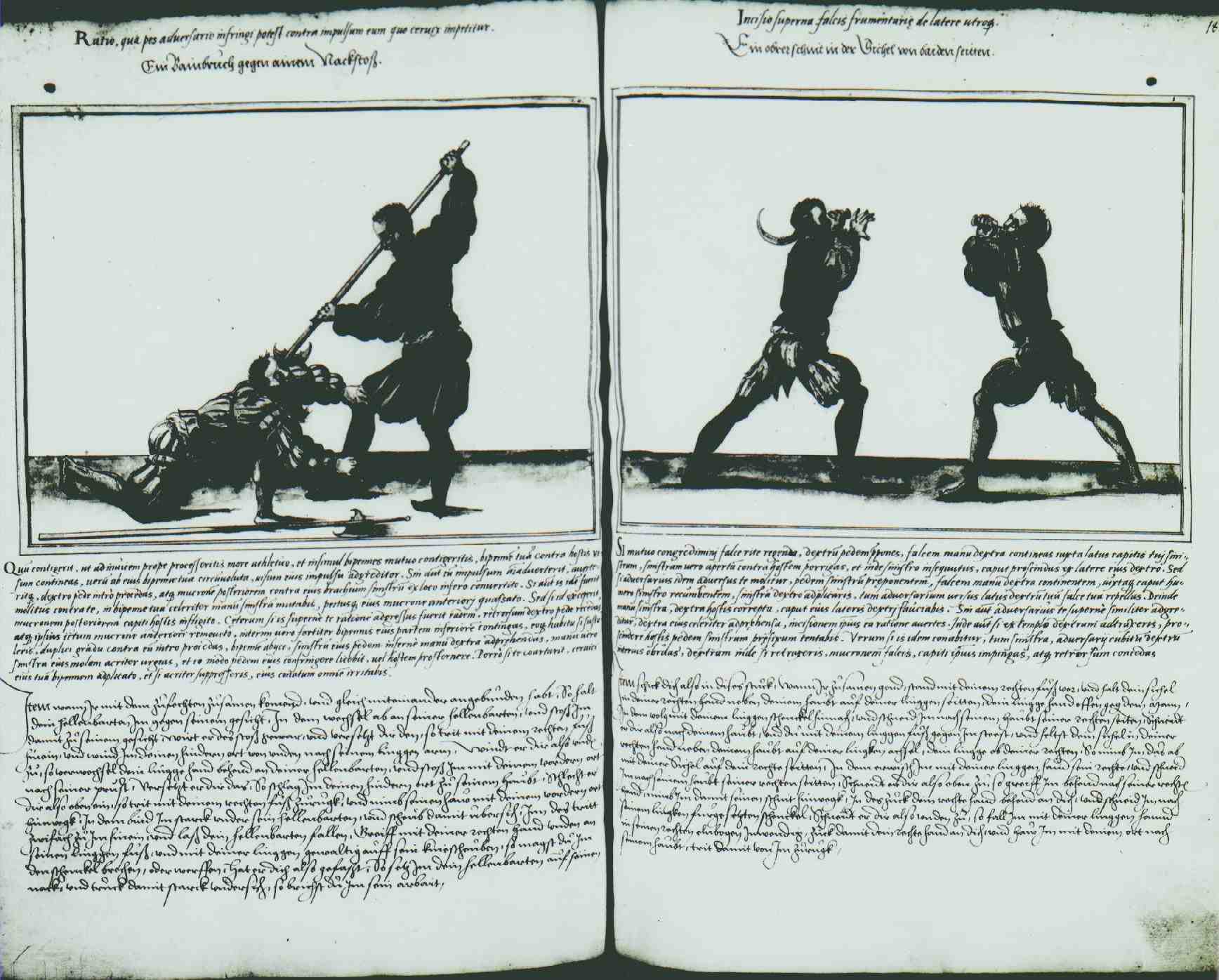
as Mair sometimes says "throw him away from you so that he cannot hurt you and withdraw". This suggests that the throw is not so much a finishing blow as a way to recover from, for example, a disarm, pick up your weapon, and continue the fight armed. Or run like hell.
David, with all due respect, the point of throwing down is to put the thrower in a dominant position to end the fight. The idea of throwing someone down only to let him retrieve his weapon is salon nonsense. Darren Lauer, a Vancouver police officer, not long ago posted a story on e-budo.com about just such a thing happening. A man on a Vancouver sidewalk was attacked by a pimp. The man was a collegiate wrestler and threw the pimp down and walked away. The pimp pursued him and stabbed him in the back. Lauer said the victim died in his arms.
Here is another example of a true fight.
This story is about a fight that occurred between a British officer and a Japanese officer during the invasion of Hong Kong in WW2. The Brit was engaged in a bayonet fight with one Japanese soldier, whom he killed with a thrust. At that moment, the Japanese officer approached from the British officer’s right with sword raised (I interpret the account as meaning the sword was in the kenjutsu equivalent of von tach, aka jodan-no-kamae). Before, or just as the Japanese officer began his downward cut, the British officer dropped his rifle because he could not withdraw the blade in time to defend himself, and leaped toward the Japanese officer, under the cut, grasping the sword BLADE with his right hand at what we would call the ricasso. Simultaneously, the British officer pivoted and grasped the Japanese officer in a head lock, still grasping the sword blade. Whether the British officer then threw the Japanese officer to the ground is unclear to me. Such a throw would be a possible result of his action (aka koshi garuma, or hip wheel, a move, by the way, which is illustrated in several fechbuch). But whether the British officer executed a throw or not, the account was clear that he and the Japanese officer fell to the ground and rolled down a small hill, locked together. (Falling down with the opponent is a common consequence of executing koshi garuma) The British officer did not relinquish his headlock but released the sword and fumbled for his pistol. He was able to draw the sidearm, but had trouble firing it because his fingers were cut from grasping the sword. However, during the struggle on the ground, he managed to press the pistol to the Japanese officer’s head and killed him with a single shot despite his injury.
So the reality is, if one of the fighters is armed with a small weapon (a knife or pistol) his first resort will be to deploy the weapon. Any ground wrestling skills he uses will be dedicated to that objective, not to subduing the enemy with holds and chokes. This is simply the reality of the matter.
If the thrower fails to achieve dominance by the throw in order to finish the enemy, then it was not a good throw under the circumstances. It is not wise to throw someone merely to enter another environment in which to continue the fight on more or less equal footing, especially a footing where strength and endurance have the advantage, which they do on the ground. That Mair discusses groundfighting does not invalidate my premise, which is: the fightbooks do not discuss ground wrestling because it is assumed that the combatants would be armed with knives. There is little wrestling on the ground with knives. The guy with the knife usually prevails.
This is not to say that ground fighting did not occur. I am sure it frequently did, especially in sportive encounters or when the fighters lacked knives. If the pankration is any indication, ground fighting has a long and hallowed history.
Mair’s work addresses the issue of what happens when there are no knives. When you have no knives, the fight is much like MMA, although with bites and eye gouges (which will change your fight considerably, BTW).
We really are talking past each other on this matter.
warm regards, JV