I'll admit that I was doomed when I lost my footing in that clip, Jay, but I still disagree with your conclusions about groundfighting.
The staff bouts between Mike and me illustrate how a good throw or takedown does not necessarily end the fight, and how dominant positions are difficult to maintain against a skilled wrestler. I cannot speak for Fiore or the other 15th century masters, but the groundfighting that Mike and I engaged in is also entirely in keeping with the teachings of Paulus Hector Mair, who devoted an entire chapter in his manual to unarmed ringen in addition to finishing throws with weapons.
For example, there are several plates in the shortstaff section that specifically say to discard your weapon "backwards over your head", throw the opponent, fall on top of him, and subdue him using various chokes, pins, strikes, eye gouges, groin shots, and leg hooks, such as this one:
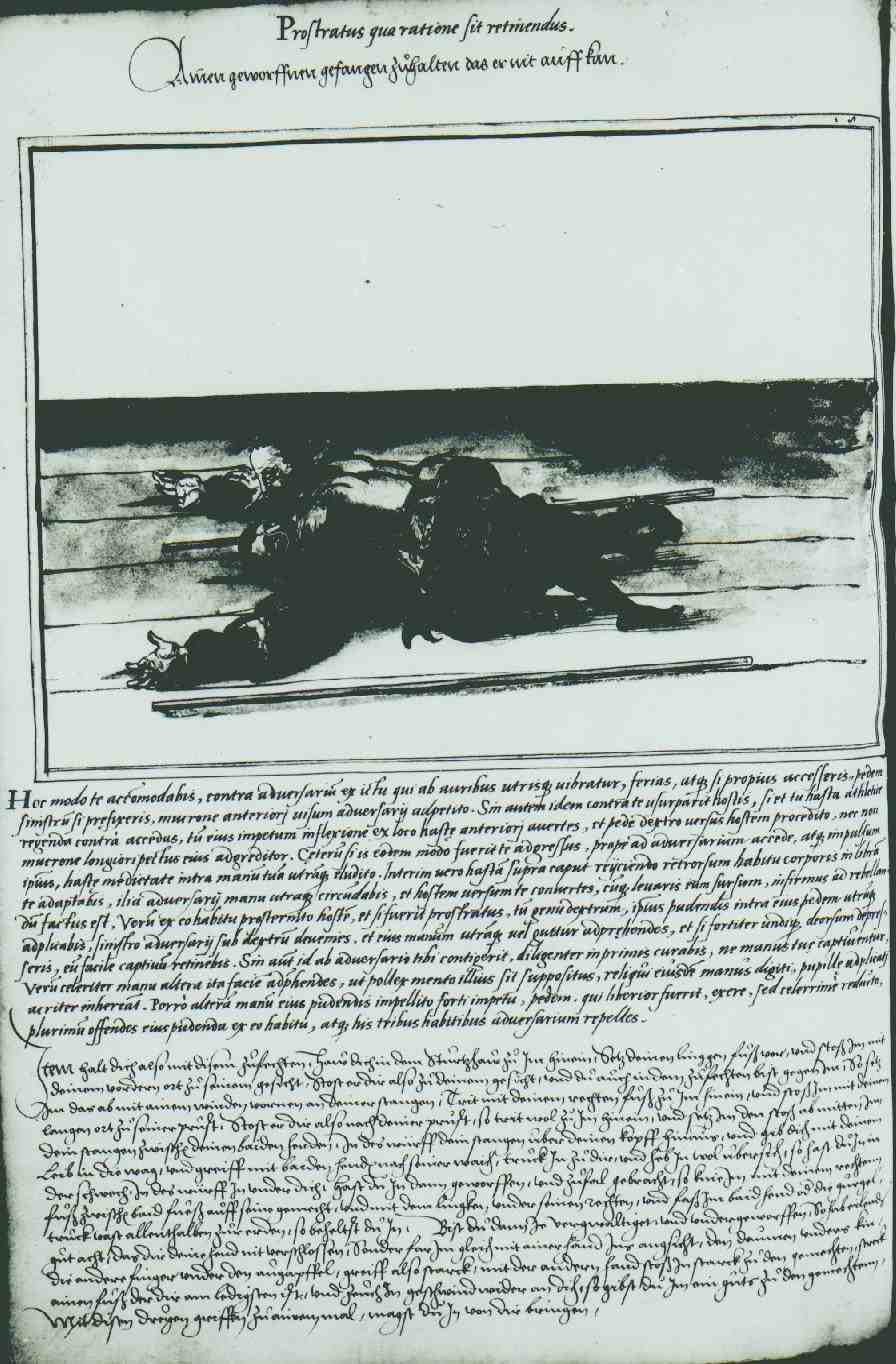
This particular plate emphasizes the need to restrain your opponent's arms and stay out of his guard by hooking one of his legs so that he cannot gouge out your eyes and sweep into a dominant position. Eye gouges and sudden reversals would be a valid concern with or without daggers.
Note also how the supine figure is lying on top of his staff, and the other staff is too far away for the dominant figure to grab; moreover, it wouldn't do him much good on the ground anyway.
The wording in some of the other plates is interesting, too, as Mair sometimes says "throw him away from you so that he cannot hurt you and withdraw". This suggests that the throw is not so much a finishing blow as a way to recover from, for example, a disarm, pick up your weapon, and continue the fight armed. Or run like hell.
The "no groundwork" argument also rides on the assumption that daggers were always present in combat. I am not so sure that this was always the case, esp. into the 16th century. JC published an interesting article in
Spada: Anthology of Swordsmanship on wrestling and grappling in Renaissance combat in which he provides several documented instances of judicial duels in which daggers were not allowed (both parties could negotiate on the terms of the fight), and in which both combatants ended up on the ground after losing their swords (one particularly interesting duel ended with the victor stuffing dirt into his opponent's mouth <img src="/forum/images/icons/laugh.gif" alt="" />).



