
Knee Strikes and Elbow Strikes

European historical unarmed fighting techniques & methods

Moderators: Webmaster, Stacy Clifford

User avatar
Grant Hall
Posts: 144
Joined: Wed Sep 28, 2005 7:11 am
Location: Australia, Victoria

Knee Strikes and Elbow Strikes

Postby Grant Hall » Sat Jun 21, 2008 4:14 pm

Hey guys, I've been looking for any mention of Knee Strikes and Elbow strikes in Kampfringen, to me these techniques seem basic almost second nature, driven by instinct if you will, however proponents of EMA continue to cite these strikes as reasons why EMA is, (superior?) to WMA.

Now even tho I am certain that knee and elbow strikes would have been used not only in Europe but across the whole globe as such basic techniques, I thought I'd look into the manuals to see if I could find any, in an attempt to educate some of the EMA fanatics I know here where I live.

So far I have found a Knee Strike to the balls (the manual's words not mine) of an opponent that is trying to choke you, this is found in Nicolaes Petter's "Clear Education in the Magnificent Art of Wrestling", 1674.

The fourth throat grip.
Again, K grabs L at the throat. Noticing this, L then grabs this arm of K with both hands. With his right hand he grabs K’s wrist and with his left hand he grabs the arm just above the elbow, while he bends his arm inwards. In this way, it is almost impossible for K to free his hand. Should this happen though, by twisting it for long time, L can then press K’s hand against his chest, while he kicks K’s foot. Alternatively, he can kick K’s balls with his knee, which can provoke quite an unpleasant feeling.


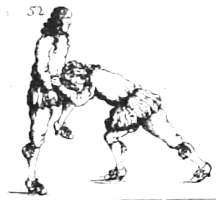
The only other Knee strike I've found so far is delivered to the face of an opponent, used when the opponent is shootinging in on you for a take down, this is found in Johann Georg Passchen's "Vollstandiges
Ring-Buch", 1659.

Or strike his face with your knee as in N° 52.

Image

I've also found Elbow strieks in Passchen to both break an opponent's hold and also to break his ribs and/or face.

So basically I'm satified that not only did the Arts of Europe include knee strikes and Elbow strikes, but that they are recorded in the manuals, however I was hoping to find more strikes in more manuals, and especially in earlier manuals, this is where I was hoping you could hepl me out.

I've heard Meyer has a good unarmed section, but I've never seen it so I don't know if it includes elbow and knee strikes.

Any and all help would be great, thanks in advance!

Cheers!
<<<<<<<<<<]==0
Grant Hall - Scholar
--ARMA Australia--
0==[>>>>>>>>>>

“The Nation that makes a great distinction
between its scholars and its warriors
will have its thinking done by cowards
and its fighting done by fools"
– Thucydides 5th c. BC

Stewart Sackett
Posts: 116
Joined: Mon Dec 11, 2006 5:46 am
Location: Portland, OR

Postby Stewart Sackett » Sat Jun 21, 2008 8:07 pm

Plate 122 of the Codex shows knees to the groin as a counter to a bear hug.

I honestly don't think there'll be a lot in the manuals. Ringen is not Muay Thai. The focus is on grappling rather than striking because grappling is ultimately the more reliable way to incapacitiate an opponent & the more universal form of combat; as it functions in armour as well as out.

Mostly the manuals deal with strikes as entries into grappling, or as pain moves to create space so you can grapple. The codex is also full of phrases like "go around for a while with him", which I take to mean that you should shake your opponent, pummel for position & hit the man until he's off balance. Striking is an implied means to an end, not an end unto itself. Whatever the level of sophistication in medieval striking, the masters chose not to emphasize it in their books.

Also: the arguement that an art is superior because of a greater striking repertoire is deeply stupid. Ringen is primarily a grappling art, so criticizing it for it's limited striking is like western martial artists criticizing Judo because it lacks the boxer's jab. Such comments miss the point entirely.

Edit: I just found Plate 133. It seems like a sucker punch, you put both your hands in the other guy's face & when he reaches up to knock your hands away he's open for a knee to the groin. What can I say, those Germans just like kneeing the groin.
All fighting comes from wrestling.

User avatar
Grant Hall
Posts: 144
Joined: Wed Sep 28, 2005 7:11 am
Location: Australia, Victoria

Postby Grant Hall » Tue Jun 24, 2008 11:42 pm

Stewart Sackett wrote:Also: the arguement that an art is superior because of a greater striking repertoire is deeply stupid. Ringen is primarily a grappling art, so criticizing it for it's limited striking is like western martial artists criticizing Judo because it lacks the boxer's jab. Such comments miss the point entirely.


The argument isn't against Ringen its against ALL WMA, in days past all EMA was cited as superior becuase little was known of WMA, now as more and more WMA is becoming known and people are starting to see that the Europeans had systems of fighting not only as good as EMA but that had very similar moves, the emphasis has started to shift to looking for EMA moves not replicated in WMA and using that as "proof" of EMA superiority. It is my belief however that Humans are Humans and that anywhere you go you'll find that we fight the same, fists, knees, elbows, feet, headbutts, biting anything and everything.

Unfortunately I feel that the Mythos that has grown up around EMA will continue to haunt WMA as far as public opinion of our Arts go, for many years to come.

[quoteEdit: I just found Plate 133. It seems like a sucker punch, you put both your hands in the other guy's face & when he reaches up to knock your hands away he's open for a knee to the groin. What can I say, those Germans just like kneeing the groin.[/quote] Hey, what works works right ;)
<<<<<<<<<<]==0

Grant Hall - Scholar

--ARMA Australia--

0==[>>>>>>>>>>


“The Nation that makes a great distinction

between its scholars and its warriors

will have its thinking done by cowards

and its fighting done by fools"

– Thucydides 5th c. BC

User avatar
David_Knight
Posts: 171
Joined: Sat Sep 27, 2003 4:56 am
Location: Brooklyn, NY

Postby David_Knight » Wed Jun 25, 2008 6:35 am

Mair often employs knee strikes to the groin. An excerpt from the spear and shortstaff chapter in Polearms of Paulus Hector Mair:

"Once you have thrown [your opponent], put your right foot between his legs, knee him in the groin, hook your left leg under his right leg, seize either his hands or his throat, and hold him down by putting pressure on every part of his body.

"If [your opponent] throws you down and tries to pin you, then make sure from the start that your hands are not captured, quickly seize his face with one hand (hook your thumb under his chin and press the other fingers into his eyes, gripping firmly), forcefully strike his groin with the other, kick out whichever leg is freer, and quickly draw it back, thus kneeing him in the groin." – Cod. Vinob. 10825, 162v; C93, 191v

LafayetteCCurtis
Posts: 421
Joined: Sat Nov 04, 2006 7:00 pm

Postby LafayetteCCurtis » Sat Jul 05, 2008 6:19 am

Not exactly German Ringen, but Silver says this in his Paradoxes of Defence:

George Silver wrote:There is no manner of teaching comparable to the old ancient teaching, that is, first their quarters, then their wards, blows, thrusts, and breaking of thrusts, then their closes and grips, striking with the hilts, daggers, bucklers, wrestlings, striking with the foot or knee in the cods, and all these are safely defended in learning perfectly of the grips.


Return to “Unarmed Skills Discussion”

Who is online

Users browsing this forum: No registered users and 5 guests


Note: ARMA - The Association for Renaissance Martial Arts and the ARMA logo are federally registered trademarks, copyright 2001. All rights reserved. No use of the ARMA name or emblem is permitted without authorization. Reproduction of material from this site without written permission of the authors is strictly prohibited. HACA and The Historical Armed Combat Association copyright 1999 by John Clements. All rights reserved. Contents of this site 1999 by ARMA.