Meyer -

Old Archived Discussions on Specific Passages from Medieval & Renaissance Fencing Texts


Moderators: Webmaster, Stacy Clifford

User avatar
Richard Strey
Posts: 122
Joined: Tue Dec 03, 2002 8:59 am
Location: Cologne, Germany

Re: Meyer - Guards

Postby Richard Strey » Sun Dec 08, 2002 5:41 am

Hi John,
what are you referring to exactly? The source for "the sword can bend back" or the fact that it's called a "feather"?

The first I "know" from two people who were able to handle one of the few surviving originals at a museum here in Germany. I can ask for more details, if you're interested.
The second I was told by the smith who made the "replicas". I'll write to him and ask for the exact source, he did say that this name was mentioned in writing.

User avatar
Mike Cartier
Posts: 594
Joined: Mon Sep 23, 2002 12:21 pm
Location: USA Florida

Re: Meyer - Guards Questions

Postby Mike Cartier » Mon Dec 09, 2002 9:43 am

I have a few more questions if someone would be so kind as to indulge me a bit further.

My first question is about the Iron Door
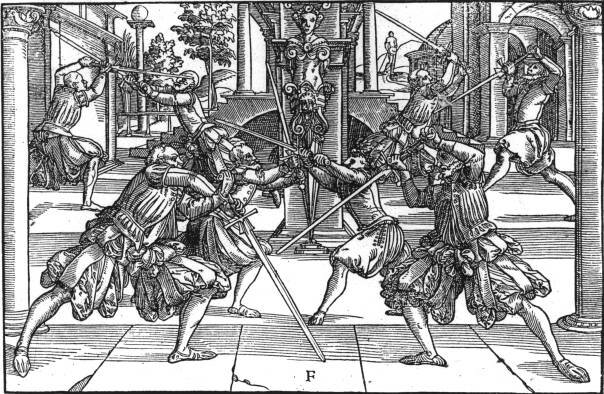
From the F plate (guy on left)
Image
We see what looks like a more solid looking Alber(Olber)

her is the text in Quote:
What the right Iron Door is, which you will find out should you go farther onto Rapier Fencing, that while it is used in stabbing with the Sword as by us Germans, this guard is also easily deflected and sent to the ground. Although at this time it is used by the Italians and other nations, it covers like the Crossed Guard, and so of the Iron Door no further report is therefore required.

There is a basic underlying division, and here I will shortly clarify both, and so will now describe the Iron Door. Stand with your right foot forward, hold your sword with the grip in front of the knee, with straightly hanging arms, that your point stands upward out at your opponent's face. In addition, keep your Sword in front of you to shut like an iron door, and when you stand with feet wide and so come to lower your body, you can clear all strikes and stabs out and away from you.

However, the Crossed Guard is when you hold your Sword with crossed hands in front of you with the point at the ground, which is seen from the figure in illustration F.


I take that textual description more to describe the Pflug where the iron door should come from. Would not that iron door swing all directions? left and right both low and high.
The Low left being shown in the plate, the high version would quite naturally be the left and right hanging guards, so that the Iron door covers the 4 major quadrants.

If I take what Mike R is saying correctly, the iron door is the in place of the left hanging guard. That doesn't look much like a left hanging guard though, its too low and clearly its utility is in the upward thrust.

In the section at the end of the Guard section (page 10)
meyer states in his description of the cutlines.
Thus from either side as you wish, you will start from the Changer and go through the Long Point into the Wrathful Guard
This is Weschel which is quite clerarly described as a right foot forwad guard, but here is clearly intended for use on either side.
Also he states.
How you will strike through these will be further described here, and then I will soon take you farther through all Strikes and Stances on both sides, both Right and Left

This seems to indicate that the guards can be used both left and right, but of course with the understanding that the right side (for a right hander) gives the greater power and reach.

I guess i just can't get past the lack of a left hanging gaurd and i am looking for the way it is included. it is just about the most important guard I think.

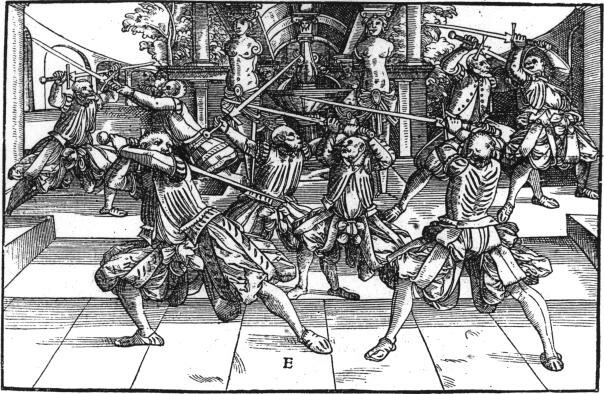
I am a little confused by the unicorn guard too, in the text and the plate it describes and shows a left foot forward stance with the weapon held out at an angle slightly to the right.
Image
However when you view its description from the cutlines (page 10) it describes it as follows:
Firstly if you will execute the high or Vertex Strike, you will find yourself in three Stances, first in the start you will stand in the Roof, in the Middle in the Long Point, and end up in the Fool, so you have moved directly from above through the Line from A to E via three Guards or Stances. If you then drive farther on upward from below to displace with crossed hands, you will find yourself in three more Stances, at the start in the Iron Door, in the Middle the Hanging Point, and in the end full above you in the Unicorn, then grip your Sword with the haft before your chest, so that the half edge lies on your left arm. Now you stand in the Key, and thus you come have onward and drove on along Line A and E from one stance into the other.


it seems to describe the unicorn as the being on the centerline path and ending up somewhat like a Roof but point out to the front?

This weekend i tried to use some of the meyer guards in sparring , while it mostly came out clumsily, I had some success with the key guard, the wrath guard and the unicorn.
Now i know these are transitional guards and so one shouldn't be standing there in them, but instead use them within the natural flow of striking and parrying and as you transition from guard to guard. But to test the guards I would stand in Unicorn , which i had imagined to be alot like the longpoint guard only with the left foot forward and the point out to to high righ side, like and extended righ roof gaurd, ready to slam down in zornhau.
But the description has put me off a bit, can anyone point out what i have figured out wrong?

i appreciate the input from everyone on this thread it has been very illuminating. <img src="/forum/images/icons/laugh.gif" alt="" />

Mike Cartier
Meyer Frei Fechter
www.freifechter.com

User avatar
Richard Strey
Posts: 122
Joined: Tue Dec 03, 2002 8:59 am
Location: Cologne, Germany

Re: Meyer - Guards Questions

Postby Richard Strey » Tue Dec 10, 2002 8:40 am

Mike, to me it seems that in Einhorn, you have the false edge up, like in Langenort. You should have the true edge up, essentially a high Ochs. You can end up in this guard after striking a diagonal Unterhau. Hope this helps.

User avatar
John_Clements
Posts: 1167
Joined: Wed Sep 18, 2002 10:43 pm
Location: Atlanta area

Re: Meyer - practice swords

Postby John_Clements » Tue Dec 10, 2002 10:27 am

Yes, what's the source for the feather term?

Also, do you know which museum these swords were from?

Thanks,

JC
Do NOT send me private messages via Forum messenger. I NEVER read them. To contact me please use direct email instead.

User avatar
Hans Heim
Posts: 37
Joined: Thu Oct 10, 2002 3:08 am
Location: Germany, Bavaria, Munich
Contact:

Re: Meyer - Guards Questions

Postby Hans Heim » Wed Dec 11, 2002 3:04 am

Hi all,

as Richard Strey metioned the Eynhorn (Unicorn) is nothing more then the ending position of an Unterhau (a diagonal cut with the true edge from below). This could be done from both sides. Somewhere in his book J.Meyer toled, that every guard could be done on both sides, left and right.

There has been a point of changing in the German style of longsword as has been mentioned bevore. From the art of killing (for the battlefield or the judicial combat) to the art of learning the principles for other weapons (like rapier) or for the event Fechtschul. J.Meyer gave the advice to start learning with the longsword, then Dussack (the trainings weapon for the Langes Messer) and then Rapier (the weapon of selfdefence of his age). Learn the principels with the two handed longsword, learn more with a one handed weapon and the kill with the Rapier.

The longsword of J.Meyer shows a lot of guards, the early manuals only have the Ochs, Pflug, Alber, Vom Tag, Schrankhut, Nebenhut and finally the Langort(sometimes known as Sprechfenster some sources toled that this is even the most usefull but also the difficultiest to learn). I am sure that the old once have known the missing guards, but they didnt metioned them, because the are only transisting points and as Lichtenauer always said: Wer do leit is tod, wer sich ruert der lebt. The guards are not so important, do not stay, even do not trust the guards, HIT HIM. Get the Vorschlag the first cut and hit him.

Hans
Wer do leit der ist tot. Wer sich rueret der lebt noch.

User avatar
Mike Cartier
Posts: 594
Joined: Mon Sep 23, 2002 12:21 pm
Location: USA Florida

Re: Meyer - Guards Questions

Postby Mike Cartier » Wed Dec 11, 2002 9:10 am

Thanks Hans
that helps alot, yes i have been doing the unicorn wrong.

All better now <img src="/forum/images/icons/grin.gif" alt="" />

vielen dank freund
Mike Cartier

Meyer Frei Fechter

www.freifechter.com

User avatar
Richard Strey
Posts: 122
Joined: Tue Dec 03, 2002 8:59 am
Location: Cologne, Germany

Re: Meyer - Guards Questions

Postby Richard Strey » Sat Dec 14, 2002 8:08 pm

Glad to hear that. <img src="/forum/images/icons/smile.gif" alt="" /> Got to watch those thumbs on the pictures, they can tell you a lot.
John,
there are four original "Federn" or "Fechtschwerter" remaining. Two in the Schweizerisches Landesmuseum and two in the Metropolitan Museum in NY. You might be able to check out those, considering you are on the same continent. <img src="/forum/images/icons/wink.gif" alt="" />
As for the term "Feder", the smith whose site I posted mentioned it and said that there was written proof for the usage of the term. I'll try to find out the original source.

User avatar
Mike Cartier
Posts: 594
Joined: Mon Sep 23, 2002 12:21 pm
Location: USA Florida

Re: Meyer - Strikes question

Postby Mike Cartier » Wed Dec 25, 2002 1:58 pm

Bounce Strike
All info from the Schielhau.org site (awesome work Mike R) <img src="/forum/images/icons/wink.gif" alt="" />

Image
There are 2 described a single and double

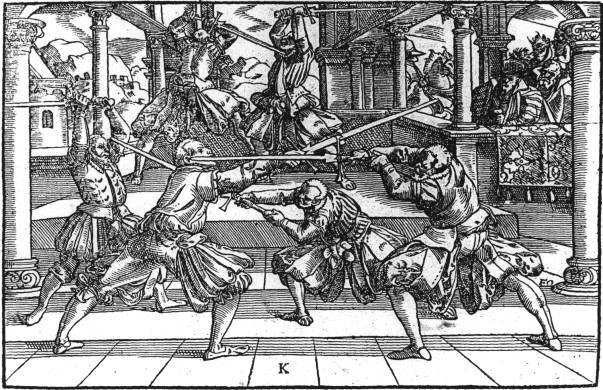
There are two of these: one is single time, the other is double. The single is described thus: when your opponent strikes you from above, engage his strike with a Traverser, and, similar to the Slider, twitch your Sword up near your head, and from your left side hit his ear with an out-winding flat, as is shown by the foreground figure on the right side of illustration K (above), so that the Sword will bounce back in the strike, so you can twitch it back over your head while bouncing back, strike leftward with the strong, thus it is completed.

My question on the first is..
What is meant by out-winding far weak?
I think i understand the strike ( a traverser strike, twitched to the other side and smacked with the flat of the blade) Is the winding motion referred to not the usual meaning of the winding action perhaps but referreing to the blade turning over to flat rather than an actual action on the blade ?
Then what does the weak mean?


and here is the text for the double bounce
The double is executed thus: if from pre-fencing your opponent raises his sword high to strike, then stand in the Right Ox (as shown in the next chapter), twitch your Sword above you, and strike with an in-winding flat with your strong on his blade so that you bring your pommel down as you follow the spindle of the strike, as is shown by the left foreground figure of illustration I (below), and in the strike step with your right foot full onto his left side, and thus glide or move to follow it over him, twist to close against his left side, and out-wind to hit again with even hands at the same opening with a level flat, so that it bounces thus strongly. Thus have you done it right.

So here it desribes an in-winding weak, I take this to be the winding towards the center of ones balance that would make the Out-winding described in the first bounce strike to be winding from the center outwards


Then what is the meaning of "follow the spindle of the strike"
A spindle is the central mechanism to a knitting wheel isn't it?
So that would be a reference to follow the central balance point of the strike? Sort of like what is done with a winding action on someones blade.
Mike Cartier

Meyer Frei Fechter

www.freifechter.com

User avatar
Matt Easton
Posts: 218
Joined: Sun Nov 10, 2002 2:23 pm
Location: London, England
Contact:

Re: Meyer - Guards Questions

Postby Matt Easton » Thu Dec 26, 2002 7:09 am

Hans Heim schreib:

"the Eynhorn (Unicorn) is nothing more then the ending position of an Unterhau (a diagonal cut with the true edge from below). "

Hey Hans - you know I think that is like Vadi's Posta Sagitarria.

Matt

Guest

Re: Meyer - Strikes question

Postby Guest » Thu Dec 26, 2002 3:44 pm

]My question on the first is..
What is meant by out-winding far weak?
I think i understand the strike ( a traverser strike, twitched to the other side and smacked with the flat of the blade) Is the winding motion referred to not the usual meaning of the winding action perhaps but referreing to the blade turning over to flat rather than an actual action on the blade ?
Then what does the weak mean?


Aah, that's been tweaked in a recent edit (beware using translations in progress :-) The weak/far-weak has been replaced with flat/far-flat.

So you're right, it's a twitch up and smack to the side of the head, and the sword twists upward (out-wind) on the way. It seems to be done by hitting with the far end of the flat midway through a winding motion - twisting the blade in flight. I originally translated this as hitting with a twisting far end (far weak) of the sword but changed it after I finished reading the full text. It occurs in several places as a non-lethal move, maybe a safe hit in practice instead of thwacking the head with the edge, which is very possible with this move.

So here it desribes an in-winding weak, I take this to be the winding towards the center of ones balance that would make the Out-winding described in the first bounce strike to be winding from the center outwards


Inwinding seems to be in the opposite direction of rotation - the short, edge moves up-left instead of up-right, and again it's a flat hit.

Then what is the meaning of "follow the spindle of the strike"


I think it means you move to follow the center of rotation.

Anyway, that's how I understand it. I hope everyone had a good Christmas and best wishes for the New Year.

-M

User avatar
Mike Cartier
Posts: 594
Joined: Mon Sep 23, 2002 12:21 pm
Location: USA Florida

Re: Meyer - Strikes question

Postby Mike Cartier » Fri Dec 27, 2002 8:34 am

Thanks for the clarification Mike R <img src="/forum/images/icons/laugh.gif" alt="" />
That flat strike is interesting, as I recall the Hurling strike from the Christian Egen translated Alten fechter . There is also a twitch involved and a deception finished of by the hurling from under and strikeing with the flat of the blade.
Mike Cartier

Meyer Frei Fechter

www.freifechter.com

User avatar
Mike Cartier
Posts: 594
Joined: Mon Sep 23, 2002 12:21 pm
Location: USA Florida

Re: Meyer - Egroup

Postby Mike Cartier » Tue Dec 31, 2002 2:54 pm

For those interested in taking this discussion of the Meyer Longsword Fechtbuch into more detail I have set up a Meyer Longsword Egroup
http://groups.yahoo.com/group/Meyer_longsword/
If you have any interest or knowledge of this wonderful fechtbuch please come and share your knowledge with the rest of us.
Mike Cartier

Meyer Frei Fechter

www.freifechter.com

User avatar
Scott Anderson
Posts: 65
Joined: Sun Jan 19, 2003 9:16 am
Location: Price, UT

Re: Meyer - Guards

Postby Scott Anderson » Sun Jan 19, 2003 9:25 am

I've been reading the forums for the last few days, but i may have an insight as to why the illustrations don't match the text description. Consider this, many schools of fencing or EMA, and even dance today use halls with mirrors so that you can see what you are doing and correct yourself. The illustrations may offer the same principal. Just a thought.

SPA.
perpetually broke but hopefully soon to have money to join.


Return to “Virtual Classroom - closed archive”

Who is online

Users browsing this forum: No registered users and 3 guests


Note: ARMA - The Association for Renaissance Martial Arts and the ARMA logo are federally registered trademarks, copyright 2001. All rights reserved. No use of the ARMA name or emblem is permitted without authorization. Reproduction of material from this site without written permission of the authors is strictly prohibited. HACA and The Historical Armed Combat Association copyright 1999 by John Clements. All rights reserved. Contents of this site 1999 by ARMA.