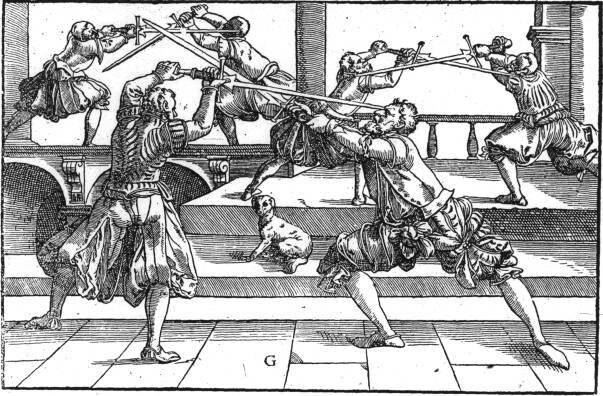
The schiller strike

Old Archived Discussions on Specific Passages from Medieval & Renaissance Fencing Texts


Moderators: Webmaster, Stacy Clifford

User avatar
Mike Cartier
Posts: 594
Joined: Mon Sep 23, 2002 12:21 pm
Location: USA Florida

Re: Schielhau

Postby Mike Cartier » Mon Oct 20, 2003 9:27 am

I have loved this strike since i first began using it, its a bigtime timing thing though.
Its very deceptive when done just right, the thumb helps alot in keeping control of it if you ask me but is not necessary.

For me its alot like when you get a good krumphau to work, its just flows nicely and it works before you know it. Almost effortlessly, but other times you trey to force it and its all falls apart if you timing isn't on.
But when it does work, wow! its great.
Mike Cartier
Meyer Frei Fechter
www.freifechter.com

steve hick
Posts: 104
Joined: Mon Sep 23, 2002 4:04 pm

Re: Ringeck's "Knighty Art of the Longsword"

Postby steve hick » Tue Oct 21, 2003 6:04 am

Wow Stewart. I never thought of it that explicitly, but that's how I demonstrate/show how to do the schiller. Good insight.
Steve

User avatar
Jaron Bernstein
Posts: 1108
Joined: Sun Dec 07, 2003 12:58 am

Re: Ringeck's "Knighty Art of the Longsword"

Postby Jaron Bernstein » Mon Dec 29, 2003 12:03 am

Hi all,

Some questions about our friend the schiller. We tried this in both the Tobler and the Lindholm interpretations (the text interpretations were similar but the techiques illustrated differed). It looks to me that the schiller almost seems to be essentially moving forward strongly in an Ochs, using that movement into the Ochs as your displacement of the opponents blade. It is this a fair understanding? I may very well be off here. We spent 1 hour this afternoon working the schiller and came away with more questions than answers

Jaron Bernstein
ARMA- Columbus

User avatar
Jake_Norwood
Posts: 913
Joined: Thu Sep 19, 2002 11:46 am
Location: Clarksville, TN

Re: Ringeck's "Knighty Art of the Longsword"

Postby Jake_Norwood » Tue Dec 30, 2003 2:00 am

Sort of. There are two ways to do the schiller as I see it.

The first is to begin in vom tag (over the shoulder is better), and to transition into a left pflug with the thumb on the inside flat. Don't forget to extend your arms on the way down.

The second is to begin in vom tag and to strike with more of a snapping motion against the opponent's scalp or ear with the short edge while extending the arms. Again, thumb on the inside flat. The "recovery" position is ochs on the left.

The keys are: (1) thumb that flat (2) extend the arms when cutting, here with the short edge (3) close your opponet's line of attack. Thus the lower version is better against thrusts, the higher is better against oberhauen (4) use your elbows to drive the hit home. Hard to describe...

Keep at it, you'll get it. You'll find that Tobler's interpretation works a bit better than Lindholms if you follow the above keys.

Jake
Sen. Free Scholar
ARMA Deputy Director

User avatar
Jaron Bernstein
Posts: 1108
Joined: Sun Dec 07, 2003 12:58 am

Re: Ringeck's "Knighty Art of the Longsword"

Postby Jaron Bernstein » Wed Dec 31, 2003 12:41 am

Hi Jake,

Thanks for the guidance,

You wrote: "The first is to begin in vom tag (over the shoulder is better), and to transition into a left pflug with the thumb on the inside flat. Don't forget to extend your arms on the way down."

I am assuming this is against an opponent in pflug (since the text lists the schiller as breaking the pflug)? Is the transition from vom tag to the pflug the displacement? Is it possible to start the schiller from a pflug (against an opponent also in pflug)?

---------------------------

Jake wrote: "The second is to begin in vom tag and to strike with more of a snapping motion against the opponent's scalp or ear with the short edge while extending the arms."

And this one is more appropriate against the opponent giving you the "buffalo" zornhau? I have tried this motion (alone) with the waster and it does seem to flow well.

Jake wrote: " Again, thumb on the inside flat. The "recovery" position is ochs on the left."

The thumb seems to have been a key that we were missing.

--------------------------------------

Jake wrote: "The keys are: (1) thumb that flat (2) extend the arms when cutting, here with the short edge (3) close your opponet's line of attack. Thus the lower version is better against thrusts, the higher is better against oberhauen (4) use your elbows to drive the hit home. Hard to describe..."

A few more questions. Is the lower version applicable against an oppenent in pflug? Is the lower version done more with the Linholm "small" wrist press or does it go more into a pronounced ochs?

Jake wrote: "Keep at it, you'll get it. You'll find that Tobler's interpretation works a bit better than Lindholms if you follow the above keys."

Try is out next week. I also wonder what Jamie or Jenn have to say or if they have any questions also on this.


Thanks,
J.

User avatar
Jamie Fellrath
Posts: 97
Joined: Mon Jan 20, 2003 1:16 pm
Location: Columbus, OH
Contact:

Re: Ringeck's "Knighty Art of the Longsword"

Postby Jamie Fellrath » Wed Dec 31, 2003 9:53 am

Well, I'll tell you... <img src="/forum/images/icons/smile.gif" alt="" />

I agree with Jake completely on the thumb grip with the Schielhau. It makes control of the weapon and edge manipulation MUCH easier. I was doing this on Sunday, thought I mentioned it.

Jeff and I were playing with this a little bit last night. We came to the conclusion that displacing the "buffalo" strike is helped if you do your Schielhau with a slight "scooping" motion from the Vom Tag to the finishing left Ochs. You still hit with the short edge, and you still strike the shoulder or head with the center of percussion on your blade, but it gives a little extra "oomph" to the displacement. This could be the "snapping" motion that Jake mentioned.

We're also agreed on the Tobler version being a bit better, as far as the pictures go.
=-=-=-=-=-=-=-=-=-=-=-=-=-=-=-=-=-=-=-=-=-=-=-=-=-
Jamie Fellrath

User avatar
Jake_Norwood
Posts: 913
Joined: Thu Sep 19, 2002 11:46 am
Location: Clarksville, TN

Re: Ringeck's "Knighty Art of the Longsword"

Postby Jake_Norwood » Wed Dec 31, 2003 11:40 am

Hey Jaron.

I am assuming this is against an opponent in pflug (since the text lists the schiller as breaking the pflug)? Is the transition from vom tag to the pflug the displacement? Is it possible to start the schiller from a pflug (against an opponent also in pflug)?


The schiller into pflug breaks pflug, yes. This is more pronounced one-handed (with a "reverse pflug" on the left, as with the messer). Try it.

Jake wrote: "The second is to begin in vom tag and to strike with more of a snapping motion against the opponent's scalp or ear with the short edge while extending the arms."

And this one is more appropriate against the opponent giving you the "buffalo" zornhau? I have tried this motion (alone) with the waster and it does seem to flow well.

Jake wrote: " Again, thumb on the inside flat. The "recovery" position is ochs on the left."

The thumb seems to have been a key that we were missing.


Yes, this is against the buffalo strike. Another way to practice this is to start in vom tag over the head with the thumb on the flat to begin (in a fight I rarely start with the thumb allready in place, but it's easier to start your training "in position"). Then extend the right arm, bringing the short edge into play, and stap the left arm up, leaving you in an ochs position well over the head, as illustrated in Meyer. This is a frightfully powerful blow, so wear a mask or helmet.

A few more questions. Is the lower version applicable against an oppenent in pflug? Is the lower version done more with the Linholm "small" wrist press or does it go more into a pronounced ochs?


I don't have the Lindholm on me, so I can't comment with much detail, but the lower one ends in left pflug with the long edge up. This works against thrusts, which is the only major natural attack from pflug. So yes, that's the one against pflug. This is a strong motion, and one that leaves you in position to thrust. I can't say about a small wrist press, but that sounds wrong initially.

Jake
Sen. Free Scholar

ARMA Deputy Director

User avatar
Jaron Bernstein
Posts: 1108
Joined: Sun Dec 07, 2003 12:58 am

Re: Ringeck's "Knighty Art of the Longsword"

Postby Jaron Bernstein » Fri Feb 20, 2004 11:52 pm

Jay wrote: "Yes, this is against the buffalo strike. Another way to practice this is to start in vom tag over the head with the thumb on the flat to begin (in a fight I rarely start with the thumb allready in place, but it's easier to start your training "in position"). Then extend the right arm, bringing the short edge into play, and stap the left arm up, leaving you in an ochs position well over the head, as illustrated in Meyer. This is a frightfully powerful blow, so wear a mask or helmet."

Better late than never. Thanks for your wisdom on this one. Indeed, this DOES close off the line of attack nicely, especially with a step to give some momentum while going off line. As an aside, I wonder what you might know about Vadi's Archer guard, as that is one I am now trying to puzzle through.


Jay wrote: "I don't have the Lindholm on me, so I can't comment with much detail, but the lower one ends in left pflug with the long edge up. This works against thrusts, which is the only major natural attack from pflug. So yes, that's the one against pflug. This is a strong motion, and one that leaves you in position to thrust. I can't say about a small wrist press, but that sounds wrong initially."

By small wrist press, I am speaking of the way the fellow on the left's wrists are noticably bent on page 91-92 in Lindholm. Our group here was unable to make that work with such a small movement. It seems to require (from a "clumsy buffalo" like me at least <img src="/forum/images/icons/smile.gif" alt="" /> ) a full body movement to displace the other fellows pflug or the very clear swing into from vom tag that you describe above.

As always, thanks for sharing your expertise,
Jaron Bernstein
ARMA - Columbus

User avatar
Jake_Norwood
Posts: 913
Joined: Thu Sep 19, 2002 11:46 am
Location: Clarksville, TN

Re: Ringeck's "Knighty Art of the Longsword"

Postby Jake_Norwood » Sat Feb 21, 2004 11:29 pm

By small wrist press, I am speaking of the way the fellow on the left's wrists are noticably bent on page 91-92 in Lindholm. Our group here was unable to make that work with such a small movement. It seems to require (from a "clumsy buffalo" like me at least ) a full body movement to displace the other fellows pflug or the very clear swing into from vom tag that you describe above.


One of my beefs with the Lindholm interpretations is the bent wrist. Anywhere that you would fold your wrist, I strongly reccomend either switching to a thumb grip or rotating the hilt 90 degrees in your right (lead) hand. This always makes you stronger and more controlled. Try it with your wrist/grip perpendicular to the cross, instead of parallel like normal, and report back.

Jake
Sen. Free Scholar

ARMA Deputy Director

User avatar
Jaron Bernstein
Posts: 1108
Joined: Sun Dec 07, 2003 12:58 am

Re: Ringeck's "Knighty Art of the Longsword"

Postby Jaron Bernstein » Tue Feb 24, 2004 5:16 pm

Jake wrote: "One of my beefs with the Lindholm interpretations is the bent wrist. Anywhere that you would fold your wrist, I strongly reccomend either switching to a thumb grip or rotating the hilt 90 degrees in your right (lead) hand. This always makes you stronger and more controlled. Try it with your wrist/grip perpendicular to the cross, instead of parallel like normal, and report back."

I think I understand your meaning here. If I am off, let me know. I haven't had a chance (not for a few days anyway) to work this with a partner, but I did try it against the imaginary pflug. <img src="/forum/images/icons/smile.gif" alt="" /> I placed my thumb along the flat of the blade to do the schiller, with the short edge on the bottom and the blade vertical and then used that for the displacement. That feels a lot more comfortable than the bent wrist.

Is that what you meant?


Jaron

User avatar
Jake_Norwood
Posts: 913
Joined: Thu Sep 19, 2002 11:46 am
Location: Clarksville, TN

Re: Ringeck's "Knighty Art of the Longsword"

Postby Jake_Norwood » Wed Feb 25, 2004 10:50 am

I don't know about "vertical," but it sounds like you've got the grip right, and the idea right as well, yeah.

Here's the "high" schiller from Meyer, the guy on the left in the front-middle.

Image

Here's the "low" schiller from Jorg Wilhalm, which would work against pflug.

Image

That should show the hand position and angles I'm referring to.

Jake
Sen. Free Scholar

ARMA Deputy Director

User avatar
Jaron Bernstein
Posts: 1108
Joined: Sun Dec 07, 2003 12:58 am

Re: Ringeck's "Knighty Art of the Longsword"

Postby Jaron Bernstein » Wed Feb 25, 2004 9:54 pm

Bingo! That hand position is the exact one I am describing. Thanks for your guidance.

Jaron

User avatar
Hans Heim
Posts: 37
Joined: Thu Oct 10, 2002 3:08 am
Location: Germany, Bavaria, Munich
Contact:

Re: Ringeck's "Knighty Art of the Longsword"

Postby Hans Heim » Fri Feb 27, 2004 10:05 am

Hi Jake,

first thank you for remembering myself about this picture from J.Wilhalm, some time ago I hold the original book in my hands, but I really forgot this picture about the Schielhau.
For me the key information about the Schielhau is the placement of the thumb, because with this you get a very strong position of your hand, wrist and underarm in this cut.
For me there are two ways of the Schielhau, with the first you end in a similar position of the Ochs either in a left or a right one; the second you end in a position of the Pflug, left or right.
It depends on your target or the attack of your enemy. To break the Pflug or the Langort, you have to use the “low” Schielhau, which ends for you in a Pflug position, to break the “buffalo” cut you end more in an Ochs position.
You are right that there is in the Lebkuchner something with the thumb:

„Item leg deyn messer auff deyn linckn syttn das der ortt auff der
edn ster und der daumn obn auff dem messer lig aber stee in
der schranckhutt das der rechtn fuß vor ster ligtt er den in der
hutt luginslandt so haw Euchling eyn zu seym rechtn
seyttn dy kurtz schneid indes gee durch mit dem messer und
senk den ortt und far mit dem messer auff seyn lincke syttn
alzo hastu das stuck zwivach vo paydn syttn zc“


But also in the Peter von Danzig:

/ Glosa / Merk die vier leger daß sein die vier h&amp;#367;ten da du auß fechten solt / Die erst h&amp;#367;tt ist / und haist der ochß / do schick dich also mit / Stee mit dem lincken fuesß vor und halt dein swert neben deiner rechten seitten mit dem gehülcz vor dem haubt daß dein dawmen under dem swert sey / und heng ym den ort gegen dem gesicht Merck / z&amp;#367; der lincken seitten schick dich also in den ochsen / Stee mit dem rechten fuesß vor / und halt dein swert neben deiner lincken seitten mit dem gehulcz vor dem haubt daß dein dawmen unden sey / und heng ym den ort gegen dem gesicht / Daß ist der ochß zu paiden seitten

The nice thing with the German system of Lichtenauer is that it is easy, because everything is liked together. The mastercuts, the guards, the winding everything is connected, is glued together.

To perform a perfect Zwerchhau from your right, you only have to start in the right Pflug and then change into the left Ochs, for an perfect left Zwerchhau, start from the left Pflug (with the true edge up and the thump at the flat of the blade) and change into the right Ochs.
To perform a “high” left Schielhau change from the right Ochs into the left Ochs. Or if you want to make a “low” left Schielhau (as you showed with the picture from Wilhalm so perfect) only change from the right Ochs into the left Pflug.

You always do the same things.

Best

Hans
Wer do leit der ist tot. Wer sich rueret der lebt noch.


Return to “Virtual Classroom - closed archive”

Who is online

Users browsing this forum: No registered users and 6 guests


Note: ARMA - The Association for Renaissance Martial Arts and the ARMA logo are federally registered trademarks, copyright 2001. All rights reserved. No use of the ARMA name or emblem is permitted without authorization. Reproduction of material from this site without written permission of the authors is strictly prohibited. HACA and The Historical Armed Combat Association copyright 1999 by John Clements. All rights reserved. Contents of this site 1999 by ARMA.