thumb grip with hanging parry?

Old Archived Discussions on Specific Passages from Medieval & Renaissance Fencing Texts


Moderators: Webmaster, Stacy Clifford

User avatar
philippewillaume
Posts: 336
Joined: Wed Apr 21, 2004 6:51 am
Location: UK, windsor
Contact:

Re: thumb grip with hanging parry?

Postby philippewillaume » Mon Sep 06, 2004 3:07 am

Hello,
I would think of hengen has an extended version of the ox and the plough. IE as you take those positions, you should take hangen.
It thinks it may be misleading to see it as a thumb position effect. I feel that what makes the position effective is your wrist position and your body alignment.

Having the thumb on the ricasso forces you to have the right body position to be in a strong stance. Once you are used to that stance, I think you can dispense with the thumb under.
I use the thumb trick to teach the zwerch, for some reason if you keep the thumb under you will have end up in the right position.

In ringeck system as I see it you need to be able to extend in you longitudinal axe. So I find the thumb on the blade position a tad detrimental to fluidity But as I said I think it is a useful learning tool

Just for semantic purposes
I do not think hangen is a parry as such. It is used as in the two absetzen but stricto sensus for Ringeck hangen is the motion of putting your point to the face of your opponent and have either the hands higher or lower than the point.

One Ringeck to bring them all In the Land of Windsor where phlip phlop live.

User avatar
Brian Hunt
Posts: 969
Joined: Thu Jan 23, 2003 2:03 am
Location: Price, Utah
Contact:

Re: thumb grip with hanging parry?

Postby Brian Hunt » Mon Sep 06, 2004 11:05 am

Hi Phillip,

stricto sensus for Ringeck hangen is the motion of putting your point to the face of your opponent and have either the hands higher or lower than the point.


wouldn't that be the upper and lower "hangers", rather than "hangen?" I thought they were two completly different techniques. Someone correct me if I am wrong.

Brian Hunt
GFS
Tuus matar hamsterius est, et tuus pater buca sabucorum fundor!

http://www.paulushectormair.com
http://www.emerytelcom.net/users/blhunt/sales.htm

User avatar
philippewillaume
Posts: 336
Joined: Wed Apr 21, 2004 6:51 am
Location: UK, windsor
Contact:

Re: thumb grip with hanging parry?

Postby philippewillaume » Tue Sep 07, 2004 3:19 am

hello brian

Von zwayen hengen.
Zway hengen werden vß ainer hand von der erden. In allem (46 v )gefert: hew, stich, leger - waich oder hert.
Glosa.
Mörck, eß sind zway hengen vß ainer hand vnd von ainer sytten von der erden. Die tryb also: wann du im in dem vndern absetzen gegen diner lincken sytten an sin schwert bindest, so hen dinen schwert knopff gegen der erden vnd stich im von vnden auff vß dem hengen zu° dem gesichte. Stost er dann mitt versetzenn dinen ort übersich uff, so blyb also am schwert vnd far mitt im vff; vnd heng im den ort von oben nider zu° dem gesicht. Vnd in den zwayen hengen solt du alle gefert behentlich tryben: hew, stich und schnitt; dar nach, alß du in dem anbinden der schwert enpfindest, oder damitt waich oder hört ist.

Of the two hangers
Of the earth there is wo hangers from one hand. In all drive: strike, thrust and schnitt, laying-weak or strong.
Note, from the earth, there is two hangens from one hand and at one side. This is done like so: when you bind against his sword in the lower abzetsen against you left side. So lower the pommel against the earth and thrust at him from under-up out of the hanger toward his face. Should he then stike/move off you point across/over him. So stay at the sword and hang him the point from above -down at the face. And in the two hangers you are to drive all the pieces with agility: strike, thrust and schnitt as you fell as the crossing of the sword if he is strong or weak.

this is why i really see the hangen as a "possition" more than an attack/counter/defense. as i said it really semantic because in winden or the abzetzen you do have a hangen as part od them.

(and i can be wrong <img src="/forum/images/icons/laugh.gif" alt="" /> )
One Ringeck to bring them all In the Land of Windsor where phlip phlop live.

User avatar
Ryan Ricks
Posts: 239
Joined: Sun Feb 22, 2004 10:15 am
Location: marietta, GA

Re: thumb grip with hanging parry?

Postby Ryan Ricks » Tue Sep 07, 2004 8:05 am

i think john describes hengen as a position in his medieval swordsmanship book. he includes it as one of the 5 guards. now i believe the interpretation has changed such that it is considered a technique.

at least that's my understanding.
ARMA associate member

User avatar
JeffGentry
Posts: 1089
Joined: Tue Apr 20, 2004 8:35 am
Location: Columbus Ohio

Re: thumb grip with hanging parry?

Postby JeffGentry » Tue Sep 07, 2004 8:49 am

Hey Phillipe


Image


Hangetort

Wie du das Hangetort in das werck richten solt, lehrt dich das Bild zur Rechten in obgedachter Figur, allein das darinen die Arm nit gnügsam gestreckt hie angezeigt wirt, Derwegen schicke dich In gemelde Hut also, stehe mit dem rechten Fuß vor, halt deine Wehr mit außgestreckten Armen vor dir, das die Klingen etwas undersich gegen der Erden hange, diß Leger ist durchauß fast dem Ochsen gleichförmig, allein das du im Ochsen die Arm starck in die höhe empor heltest, hie aber gerad vor deinem Gesicht außgestreckt sein sollen, unnd das Schwerdt gegen der Erden hangen lassest, darumb es denn auch das hengetort geheissen.

Hanging Point

Since you'll need to be in the correct Hanging Point during the work, look at the figure to the right of the above illustration. Even if the arms needn't be as stretched as here will be shown, still put yourself into the named Guard. Stand with the right foot forward, hold your weapon with outstretched arms before you, so that the blade hangs somewhat toward the earth, this stance is very close to the Ox in similar form, only different in that in the Ox your arms are strongly held in high mode, but here shall be directly outstretched before your face, letting the Sword hang toward the Earth, therefore it is named Hanging Point.


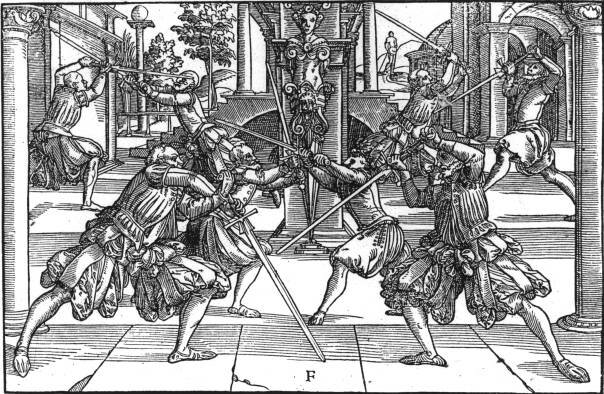
This is listed under the gaurd section of Meyer, So it seem's to me that if it is listed under the gaurd section evidently he intended it to be used as such, he does say that in the hand work you will use this position.

as an aside if you look at the figure on the left it look's like he is in a "thimb grip" if you try to cross your arm's while holding the sword normaly it is a strech on the right arm it is easier to kind of release the thumb.

well hope this make's sense.
Semper Fidelis

Usque ad Finem

Grace, Focus, Fluidity

User avatar
philippewillaume
Posts: 336
Joined: Wed Apr 21, 2004 6:51 am
Location: UK, windsor
Contact:

Re: thumb grip with hanging parry?

Postby philippewillaume » Tue Sep 07, 2004 10:40 am

Hello jeff
Yes it does, I think this an evolution of lichty style, as you know Meyer wrote his books in 1530 almost 100 year after Ringek.

We can see that it is quite similar to what Ringeck says even though there is some important differences.
Not to be pedantic but it is called the hengenort and not hengen. It makes a huge difference because something-ort like the langenort in Ringeck is indeed a guard (though the leger/hut (guard/position) could be discussed ad nauseam) so I would assume it to be guard position.
The hangen in ringeck are directed toward the face and can come from below or above (ie ox or plough) the hangenort is only coming from the ox and is not pointing to the face but to the ground.
I think tallhoffer used the hangengort, as well, but I need to check, but there is no hangenort as far as ringeck, VD,Lew and speyer are concerned. However they definitely say/define it is a position. So I would say Meyer is probably clearer about it. (And to be fair I think hut/leger and german are really closer to the concept of stance that the concept of guardbut I think I am borderline of hair splitting here)

Ryan
The nuance is quite subtle and not that important so to speak. I would say it is part a set of techniques but to be fair you not taking a hangen for its own sake but to do something with it&amp;#8230;.

phil
One Ringeck to bring them all In the Land of Windsor where phlip phlop live.

User avatar
Brian Hunt
Posts: 969
Joined: Thu Jan 23, 2003 2:03 am
Location: Price, Utah
Contact:

Re: thumb grip with hanging parry?

Postby Brian Hunt » Tue Sep 07, 2004 12:52 pm

Hi Phillip,

I see these as two different techniques. I see hangen as a guard, and the upper and lower hangers as positions to wind to in order to redirect your point to an upper or lower opening after you are in a bind with your longsword. As such, I use them for different situations. I primarily use the hangen guard against oberhaws, where as I use the hangers in any type of a bind and I wind between them as needed for the situation.

Of course this is my opinion. I would start trying to list quotes for my reasonings on this, but time is short. If it is needed, I will give a much more concise reply when I have more time.

just my 2 cents worth.

Brian Hunt
GFS
Tuus matar hamsterius est, et tuus pater buca sabucorum fundor!


http://www.paulushectormair.com

http://www.emerytelcom.net/users/blhunt/sales.htm

User avatar
JeffGentry
Posts: 1089
Joined: Tue Apr 20, 2004 8:35 am
Location: Columbus Ohio

Re: thumb grip with hanging parry?

Postby JeffGentry » Tue Sep 07, 2004 11:27 pm

Hey Philippe


Ok i don't speak any foreign language so are these term's( langenort, though the leger/hut) indicitive of a gaurd or position, i know what oberhut is although i guess i don't know the translation.

I think i was confused thinking i knew something i didn't, can you give a little language lesson?

It would be much appreciated.

Jeff
Semper Fidelis


Usque ad Finem


Grace, Focus, Fluidity

User avatar
philippewillaume
Posts: 336
Joined: Wed Apr 21, 2004 6:51 am
Location: UK, windsor
Contact:

Re: thumb grip with hanging parry?

Postby philippewillaume » Wed Sep 08, 2004 6:46 am

hello jeff
I don't think you missed anything; I do not think there is a firm definitive view on that one and the way it is used through the manuals in not especially consistent.

Hut is usually translated as guard (I think the meaning is closer to watch out for be carefull be aware, as in guard yourself from easy friend), leger as position and ort as point. It seems that leger and hut are interchangeable but I think as well that it does not really convay the exact same meaning that the fencing term guard
In the lichty tradition something-ort indicate a position

In ringeck, the langenort is not listed with the 4 legers (or 4 traditional guard) and it is part of lichty stuff and not Ringeck adds on like the schankhurt or the nebenhut he clearly says as well that you can use the lengen ort when going to fence. The 4 leger do not mention to the coming to fencing at all.
So I think the difference ringeck makes here is that hut/leger seems to be used during the fight, the langort seems to be a position from which you break the distance only.

Meyer tells us that the hangen ort is to be used in the work so it neither does nor really follows Ringeck logic but non-the less it define a position.

I am not ultra familiar with Meyer works but he basically says that the stance or guards are to be taken from the beginning and is used to break the distance.
So it may just a way to present thing. I think ringeck presentation is from the strike point of view so the gurds tends to be more positions you transition during the fight, Meyer tie that more from the initial position, so guards that are closer to the fencing meaning of guard. And they put their own spin on the vocabulary.

What brian calls hangen as a guard is what I would call hangenort
And what he calls hangers I would call hangen and that really the jest of it.
One Ringeck to bring them all In the Land of Windsor where phlip phlop live.

User avatar
philippewillaume
Posts: 336
Joined: Wed Apr 21, 2004 6:51 am
Location: UK, windsor
Contact:

Re: thumb grip with hanging parry?

Postby philippewillaume » Wed Sep 08, 2004 7:01 am

Hello brian
Personally, I do not use the hangenort as a guard or a ward, this does not mean that I think that what you are doing is bad, it is not in Ringeck teachings so I do not do it.

That being said hengen can be translated by hangers hence my confussion. There is no difference between hengen and hanger since they are the same word in two different languages. So I though you spoke of the verb hangen as in the action to hang.

But with your explanation I understand better your hangen is not too different of Meyer hangenort, so it makes sense now

PS you are spot on with the hangers (ie eingeck hangen) this is position you wind into or from.

Philippe
One Ringeck to bring them all In the Land of Windsor where phlip phlop live.

User avatar
JeffGentry
Posts: 1089
Joined: Tue Apr 20, 2004 8:35 am
Location: Columbus Ohio

Re: thumb grip with hanging parry?

Postby JeffGentry » Wed Sep 08, 2004 8:04 am

Philippe

Some of this language stuff i don't understand, i like the phrase draw me a picture, lol, i appreciate the clarification i do see what you mean it is kind of like the spelling never spelled the same way twice, lol, and the Master's use some term's spelled just a little diffrent to be a verb verse's a noun, i had not noticed that, i do see it now though.


Jeff
Semper Fidelis


Usque ad Finem


Grace, Focus, Fluidity

User avatar
philippewillaume
Posts: 336
Joined: Wed Apr 21, 2004 6:51 am
Location: UK, windsor
Contact:

Re: thumb grip with hanging parry?

Postby philippewillaume » Wed Sep 08, 2004 9:04 am

Hello jeff

That is exactly that, spelling changed, we are not totally safe of colloquialism and on the top of that language evolved.
The cherry on the top being is for example that you have 5 or 6 different meaning for Hut in BZH (medieval German dictionary).

The most important in my eyes is that we understand what the other means (which is usually the harder bit &amp;#8230;.)
One Ringeck to bring them all In the Land of Windsor where phlip phlop live.

User avatar
Mike Cartier
Posts: 594
Joined: Mon Sep 23, 2002 12:21 pm
Location: USA Florida

Re: thumb grip with hanging parry?

Postby Mike Cartier » Wed Sep 08, 2004 9:23 am

It depends on what type of Hanging guard I choose to use.
generally speaking I split hanging guard into 2 types.
Hard and soft. Hard being a static block which is rightly advised against by meyer. When executing a hanging parry which i expect to meet a stiff attack in a static manner (not readily allowing a counterstrike) i use the right palm up.
When executing a more fluid or soft hanging parry i use the thumb for extra control. I tend to only stay in the soft hanging parry for a split second, as i traverse around the attack. When doing the hard or static hanging parry prepare to do a withdrawal to reset the fight. When using the soft hanging parry prepare to move in with your neatly timed counter attack which will at least put you back in the Vor if not hit the opponent.
So the soft parry is used to brush off the attack counter, and the hard is used to stop an attack and reset the fight.
Mike Cartier
Meyer Frei Fechter
www.freifechter.com

User avatar
Jeffrey Hull
Posts: 678
Joined: Wed Sep 25, 2002 3:40 pm
Location: USA

Re: thumb grip with hanging parry?

Postby Jeffrey Hull » Wed Sep 08, 2004 3:12 pm

I agree with MC about that distinction. <img src="/forum/images/icons/smile.gif" alt="" /> JH
JLH

*Wehrlos ist ehrlos*

User avatar
John_Clements
Posts: 1167
Joined: Wed Sep 18, 2002 10:43 pm
Location: Atlanta area

Re: thumb grip with hanging parry?

Postby John_Clements » Wed Sep 08, 2004 10:05 pm

Hi
Where did you get that 1530s date for Meyer?
The earliest we have is 1650.

JC
Do NOT send me private messages via Forum messenger. I NEVER read them. To contact me please use direct email instead.


Return to “Virtual Classroom - closed archive”

Who is online

Users browsing this forum: No registered users and 6 guests


Note: ARMA - The Association for Renaissance Martial Arts and the ARMA logo are federally registered trademarks, copyright 2001. All rights reserved. No use of the ARMA name or emblem is permitted without authorization. Reproduction of material from this site without written permission of the authors is strictly prohibited. HACA and The Historical Armed Combat Association copyright 1999 by John Clements. All rights reserved. Contents of this site 1999 by ARMA.