Meyer -

Old Archived Discussions on Specific Passages from Medieval & Renaissance Fencing Texts


Moderators: Webmaster, Stacy Clifford

User avatar
Mike Cartier
Posts: 594
Joined: Mon Sep 23, 2002 12:21 pm
Location: USA Florida

Meyer -

Postby Mike Cartier » Thu Dec 05, 2002 8:50 am

Just started looking at this, and have a few questions on it.
using this splendid website (Thanks Mike Rasmusson)
http://schielhau.org/Meyer.title.html

Firstly I have heard people mention that its a later manual and displays a different method of fencing.
Is this so and can anyone flesh out the difference for us (me) <img src="/forum/images/icons/smirk.gif" alt="" />

I like the general overview of the text, alot of concepts discussed.
In the guard section i noticed a few things.
The extra guards (Unicorn, key and iron door)
Key seems a bit tight, that is if i have it right, like a chest level Ochs?
The unicorn seems a wee bit awkward but i think i might have an idea of how its used, but i don't want to run of on a tangent here.
Anyone have anything to say about the Unicorn guard that might clarify its use a bit more.

Also are there any study groups or individuals working from this Meyer translation yet?

Thanks

Mike Cartier
Meyer Frei Fechter
www.freifechter.com

Guest

Re: Meyer -

Postby Guest » Thu Dec 05, 2002 9:27 am

Mike asked:
Firstly I have heard people mention that its a later manual and displays a different method of fencing. Is this so and can anyone flesh out the difference for us (me)

---The details are still unclear, but it seems pretty certain that around the turn of the 16th century there came about a "new school" of German swordsmanship. This was still part of the preceding Liechtenauer tradition, but had some departures. The clearest examples are in Paulus Hector Mair (c1540) and Joachim Meyer (c1575). Mair represents a sort of "transitionary" method between the old and the new. Meyer came 30-40 years later and is more squarely in the "New School" tradition. Both Mair &amp; Meyer show a transition to a "fechtschule fencing" orientation....Meyer much more than Mair. They show the use of blunted training weapons, do not show anyone actually being "run thru" or injured, and Meyer has even eliminated the majority of the thrusting techniques. Both include guards that are not found in the older material, again....Meyer more so than Mair. Often these simply appear to be transitionary positions that always existed, but that were not actually named or emphasized until this point.
So bottom-line....my impression is that this "new school" was more training academy oriented than battlefield oriented. That is not to say that it was not still effective. Think of it as the difference between the training a noble raised from birth to be a knight would have received, and the training a guildsman that was a member of the Marxbruder would have received. Both Mair &amp; Meyer may very well be representative of the curriculum of one of these German martial guilds.

Mike also asked:
Also are there any study groups or individuals working from this Meyer translation yet?

---Jeff Forgeng's group at the Higgin's Armoury in Worchester MA have been working from Meyer for awhile now. Mike Rasmussen has been working thru the Longsword section. My little group has just begun looking at the staff/halberd chapter in comparison to Mair.

Keith
ARMA-D.C.

User avatar
Mike Cartier
Posts: 594
Joined: Mon Sep 23, 2002 12:21 pm
Location: USA Florida

Re: Meyer -

Postby Mike Cartier » Thu Dec 05, 2002 9:53 am

Splendid, thanks Keith

Its always about the new school - old school thing isn't it, no matter what century.

When we say new school do we mean there was some italian stuff creeping in too?

I wonder why the thrusting techniques were eliminated, thrusting seems a very sound longsword technique.
Mike Cartier

Meyer Frei Fechter

www.freifechter.com

User avatar
Jake_Norwood
Posts: 913
Joined: Thu Sep 19, 2002 11:46 am
Location: Clarksville, TN

Re: Meyer -

Postby Jake_Norwood » Thu Dec 05, 2002 10:44 am


I wonder why the thrusting techniques were eliminated, thrusting seems a very sound longsword technique.


My guess is that it's the same reason we don't thrust when free-playing with wasters or blunts--the chance of injury is just too high to be worth it.
Sen. Free Scholar
ARMA Deputy Director

User avatar
John_Clements
Posts: 1167
Joined: Wed Sep 18, 2002 10:43 pm
Location: Atlanta area

Re: Meyer -

Postby John_Clements » Thu Dec 05, 2002 11:35 am

The thrusts were only eliminated in the classroom exercises and public displays and contests, they certainly were aware of and practicing them though. Meyer includes a cut &amp; thrust Rappier, after all, as well as long staff.

I mentioned before, Meyer (and Mair) represent important systems for us today in that they were doing much the same as we all now try to do --classroom study that's not necessarily for real combat.

We also have some brand new Meyer material that should bring some considerabel insights into his late rwork. Mike R's doing some excellent translation work on it too, think and certainly see's eye to eye with ARMA's view of Meyer teachings.

JC
Do NOT send me private messages via Forum messenger. I NEVER read them. To contact me please use direct email instead.

Guest

Re: Meyer -

Postby Guest » Thu Dec 05, 2002 1:05 pm

Hi all,

Thanks for the nice review. I've been a little distracted by Goliath lately and am just getting back to Meyer.

From my point of view, John is right. Meyer did not completely eliminate thrusting from the equation, he just taught it in a way that it could be practised safely without killing one's sparring partner. If a student of this school was jumped on a country road while wearing a sword, he would have no problem deploying his training in a lethal manner. In other words, train in safety, fight in ernest.

Keith has a good point in mentioning that a new school developed, still based on Liechtenauer, but with some extensions. My problem is that I'm not at all sure when this shift occurred and doubt it was a purely 16th century development. Elements of the new stuff are visible in Talhoffer's mid 15th century comic books. The Key, for example, is visible in Tal. 1467, tafel 31, although it is not named.

One thing to remember is that most secondary stances are not zufechten guards, but transitional stances used in the process of constantly changing stance. Since this changing process in zufechten is described as early as 1389 (Döbringer), I consider much of these "new" developments to be little more than expansion of terminology where the techniques themselves may already have existed - without special names. I think the process of expanding terminology started as soon as the fechtbücher moved beyond the constraints of just commenting on Liechtenauer's verses and little more. This is just a theory at the moment, I have a lot more work to do before I'll be sure.

It'll be very interesting to see Keith's Mair work to add another piece into the puzzle. There's still lots of stuff to be analysed.

Cheers,

-M

Guest

Re: Meyer -

Postby Guest » Thu Dec 05, 2002 2:54 pm

Mike,

Excellent work. Meyers Plug is different from how I have learned with the pommel into the left leg with right leg forward, point towards the enemies face.

In Meyer's illustration of Plug and "The Right Plough is described as follows, stand with your right foot forward, hold your weapon with the hilt near your forward knee and your point pointing in your opponent's face, as if you intend to stab him from below" is very different where the man seems to be leaning forward with his sword very forward as well, very easy for quick thrust to the lower areas. Very interesting and I'll have to try this.

Nice Work,

Todd

User avatar
Richard Strey
Posts: 122
Joined: Tue Dec 03, 2002 8:59 am
Location: Cologne, Germany

Re: Meyer -

Postby Richard Strey » Thu Dec 05, 2002 5:24 pm

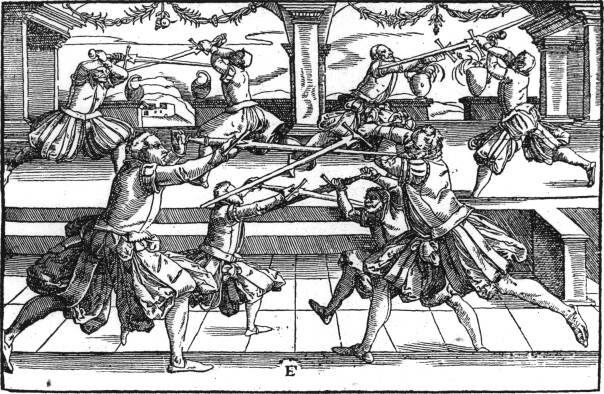
Most fencers I've talked to here in Germany regard Meyer's style as the "ancient" sport-fencing. As I was told, the term "Fechtschule" did not only describe the place where fencing was taught, but also a competition. Similar to today's "Schützenfest", a traditional fair where a shooting competition for the public is held.
Back in Meyer's times, these Fechtschulen were the place where everyone could compete. There were so-called "dry" and "wet" competitions. "Dry" meaning they fought for points (much like today's sport-fencers) and a "wet" competition having a winner once the other was bleeding from the head.
The swords used were the ones shown in Meyer's manual, called "Federn" or "feathers", blunts with a flattened ort that were sharpened only at the top. A German smith is currently investigating these weapons and I was able to handle the first three prototypes at a recent meeting. They have "original" weight and balance. The most interesting thing is, however, that upon thrusting, they can bend almost 180 degrees. A very interesting sparring tool, to say the least.

Have a look Here.

Guest

Re: Meyer -

Postby Guest » Thu Dec 05, 2002 7:46 pm

Hi Richard,

That is an extremely interesting weapon. If you live in Köln and are into WMA, you may know Stefan Dieke, he's mentioned Meyer in a "sport longsword" or "rapierized longsword" context a few times in online discussions. I'm pretty sure he also mentioned this type of training sword.

A good translation of a Fechtschule description was done by Christoph Amberger and included in his book, The Secret History of the Sword. The translation is a sample from the book.

It's online at: http://www.swordhistory.com/excerpts/marx.html

Cheers,

-M

User avatar
Mike Cartier
Posts: 594
Joined: Mon Sep 23, 2002 12:21 pm
Location: USA Florida

Re: Meyer - Guards

Postby Mike Cartier » Fri Dec 06, 2002 9:41 am

I have a few questions concerning the Guards, from my cursory review of the guards section.

of the guards described only 3 of them are described as having a left and right version. (Ox, Pflug and Eisenport)
This is a bit perplexing to me becasue it leaves the hanging and roof guards with only one side, something which doesn't wash with how they feel, they are clearly to me both sided.

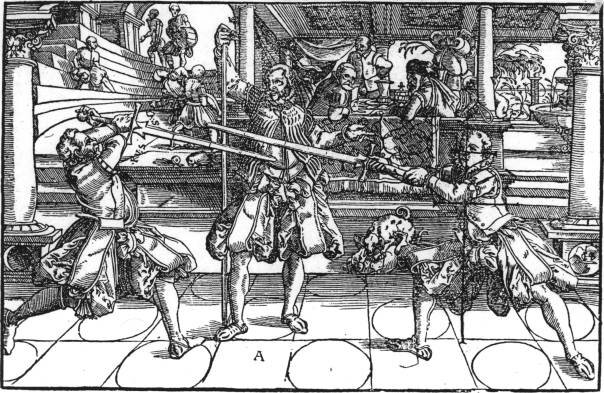
Also when you look at the descriptions of the Long point it says to stand with your left foot forward, but the illustration with it shows the fellow performing the langort with his right foot forward.
Image

the exact same is true of the eynhorn (unicorn) guard, its described with left foot forward an d illustrated with right foot forward.

Image

Indeed both the langort and the eynhorn seem perfectly capable of being used on both sides (with either foot forward)
I would say that is true of all but a few of the guards such as the wrathful and the close and possibly the key.

Also the hanging guard described is done with right foot forward, but isn't the hanging parry done with the zwerchau a left foot forward stance it the execution? This would seem to indicate that a left foot forward hanging stance is viable and useable.

Am i torn between obeying the text to the letter, and puttingm y own limited experience into it.
I would say if they clearly describe a guard as both left and right sided on a few and clearly omit any mention of it on others that they intended it that way.
But no left hanging guard?, no left and right roof?
Thanks for any help on understanding this.
Mike Cartier

Meyer Frei Fechter

www.freifechter.com

User avatar
John_Clements
Posts: 1167
Joined: Wed Sep 18, 2002 10:43 pm
Location: Atlanta area

Re: Meyer -

Postby John_Clements » Fri Dec 06, 2002 10:27 am

&gt;&gt;The swords used were the ones shown in Meyer's manual, called "Federn" or "feathers", blunts with a flattened ort that were sharpened only at the top.


Richard,
Can you supply a source or referrence for his? Is it from one of the manuals?
There is a picture of a figure flexing a long sword in at least one 16th century manual.

JC
Do NOT send me private messages via Forum messenger. I NEVER read them. To contact me please use direct email instead.

Guest

Re: Meyer -

Postby Guest » Fri Dec 06, 2002 10:54 am

Hi John,

> Can you supply a source or referrence for his? Is it from one of the manuals?

Are you referring to the use of the word Feder? There has been some muttering about the meaning of "Feder" in the the FederFechter context. Some have suggested it meant rapier or training sword, some have suggested it meant feather as in "quill" and these fencers were advertising their literacy.

I know of no reference to weapons as Federn. Referring to later masters, Meyer simply referred to the longsword as "the sword" and called a rapier a rapier, ditto Sutor. Did Mair referred to longsword practise swords as Federn? I dunno, Keith hasn't mentioned it as far as I know.

The FederFechter coat of arms featured a feather/quill. I'm leaning towards the literate fencer interpretation.

-M

Guest

Re: Meyer - Guards

Postby Guest » Fri Dec 06, 2002 11:25 am

Hi Mike,

The only sense I've been able to make out of the "new school" guards is there seems to be a separation between guards where hands are either crossed or open. There is a direct correlation between hand orientation and which foot is forward.

The langort shown in diagram A shows the right foot forward. This makes sense as the long point will get the most range with the right foot forward - if you are right handed. A long point with the left foot forward is a not quite so long point.

Hangetort is open handed, right foot forward. Schrankhut is crossed, left foot forward. Meyer seems to distinguish between the two where earlier treatises may not have. Illustration F shows the two in opposition.

A Roof with the right foot forward will not get the same range as a Roof with the left foot forward. A Zorn or Scheitelhau from the Roof usually comes with the right foot doing the stepping. This has more power when the right foot is cocked back at the onset. One think to remember is the Roof is shown with the blade on the right shoulder in Peter von Danzig's 1452 longsword treatise.

Image

Einhorn is a weird one. Seems like a high right Ox or a high crossed hangetort. I think it's a transitional stance. Not sure.

Hope this helps,

-M

User avatar
Mike Cartier
Posts: 594
Joined: Mon Sep 23, 2002 12:21 pm
Location: USA Florida

Re: Meyer - Guards

Postby Mike Cartier » Fri Dec 06, 2002 11:49 am

The langort shown in diagram A shows the right foot forward. This makes sense as the long point will get the most range with the right foot forward - if you are right handed. A long point with the left foot forward is a not quite so long point.

I agree
I wonder why they describe a left foot forward langort in the text then?


I see what you mean about the rest of the guards and the ranges depending on the side, makes alot more sense now.

Thanks for the info and thanks again for the great site.
Mike Cartier

Meyer Frei Fechter

www.freifechter.com

Guest

Re: Meyer - Guards

Postby Guest » Fri Dec 06, 2002 6:11 pm

Hi Guys!

Mair simply calls a sword a "schwert." Haven't come across any mention of "feder" in his text. As far as text matching illustrations....the same problem is found in Mair. In more than one place the text will say to have one foot forward, but the illustration will show the opposite. Maybe just a case of negligent proof-reading, or mistakes in copying.

Keith


Return to “Virtual Classroom - closed archive”

Who is online

Users browsing this forum: No registered users and 6 guests


Note: ARMA - The Association for Renaissance Martial Arts and the ARMA logo are federally registered trademarks, copyright 2001. All rights reserved. No use of the ARMA name or emblem is permitted without authorization. Reproduction of material from this site without written permission of the authors is strictly prohibited. HACA and The Historical Armed Combat Association copyright 1999 by John Clements. All rights reserved. Contents of this site 1999 by ARMA.