Sidestepping seems awkward

Old Archived Discussions on Specific Passages from Medieval & Renaissance Fencing Texts


Moderators: Webmaster, Stacy Clifford

User avatar
Andrew Kesterson
Posts: 38
Joined: Sat Apr 23, 2005 8:39 am
Location: columbus georgia (USA)
Contact:

Sidestepping seems awkward

Postby Andrew Kesterson » Tue Apr 26, 2005 9:42 am

Okay, let me qualify before I get into my question here. I've spent many, many years in Taijutsu and Kenjutsu, which is where my foundation for footwork was acquired. It carries over into everything I do; it works, and I trust it. Which is why longsword is confusing me so much. People say I have a tendency to sometimes come across as a know it all, but that's not what I'm trying to do. So here's my problem.

I have the old AEMMA manual on longsword, which was released back in like 02 or 03, and I have been working from it a little bit (because right now I don't have any translated fechtbuch, or any of John Clements' books). What is really confusing me is how they expect me to block a fendente [vertical] or squalembrato [vertical oblique], they want you to step to the outside with your rear foot, crossing your lead. For example (from p 103, 6/26/01 edition, "Art of Longsword Combat - Book 1", AEMMA):

.....
2. The agent steps forward with the right foot, and delivers a downard vertical strike.
3. At the same moment, the patient agent steps to the left and forward with the trailing right foot (traverse left), and delivers a guard of the window left - the end result is the patient agent's sword point is oriented towards the agent.


Pay special attention to the bolded passage. The obvious result of this, to anyone that takes a second to think or do it, is that your rear leg becomes crossed over your lead - putting you into a very vulnerable spot. This also goes against the form for the Guard of the Window; the legs are obviously not crossed in this form. And if the idea is to begin the traverse with your rear foot, surpass your lead foot, and have your lead foot then become the rear foot, it all seems very convoluted and needlessly complex. Not to mention how dangerous this is; my first instinct, to someone who did this in regard to a downard strike, would be to pull the strike and deliver a zenpo geri (stomp kick) across to their waist, driving them down over their crossed legs. There wouldn't be much they could do to stop from falling over, either. Another way to destroy this would be to re-direct the strike, bind their sword on the hilt, and force them back over their legs and down to the ground.

It would seem to me, that the proper movement for this traverse would be to begin with your lead foot; the lead foot moves out straight to the left, pulling your body off line; then the rear foot follows, orients itself towards the attacker, and becomes the lead foot. The original lead [now rear] foot is already in the proper orientation because of the step.

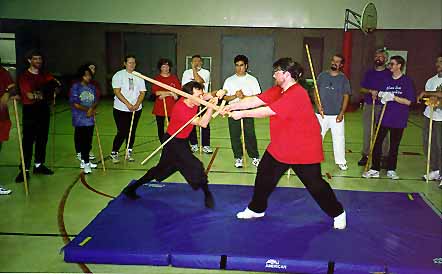
I assumed this was a typo, so I went digging through the pictures of long sword training at ARMA to find what I thought looked right; but I found this which makes me wonder if they really did mean to cross your legs.

I'm confused here. It seems like this is a really good way to get hurt. What am I missing?
[color:red]Andrew Kesterson - andrew@aklabs.net
"Timor Omni Abest ... Vincit Qui Patitur"[/color]

User avatar
Jake_Norwood
Posts: 913
Joined: Thu Sep 19, 2002 11:46 am
Location: Clarksville, TN

Re: Sidestepping seems awkward

Postby Jake_Norwood » Tue Apr 26, 2005 12:19 pm

Hi Andrew.

First, while certain techniques may have you do some slightly weird things with your feet, I would avoid ever crossing over as you step. Flat out. The AEMMA book is either showing you a typo or is presenting unsound technique (caveat: the Italian stuff is not my speciality, being a German sort of guy, and I know that Vadi reccomends some odd footwork, but then again I don't care for Vadi...so *maybe* it's an oddity of a particular technique, or it's an ancient typo...but I think it's probably just wrong).

You never want to cross in front of yourself like that. If I ever step across like that it's an accident--something that happened in one of those "oh crap!" moments.

As for the picture of JC doing what appears to be such a cross step, my guess is tha the stepped forward and is about to pivot around the outside right of his opponent (thus the turned foot), and the momentum of the attacker is carrying him off to his own left somewhat due to the nature of the strike he just threw.

Jake
Sen. Free Scholar
ARMA Deputy Director

User avatar
Casper Bradak
Posts: 641
Joined: Fri Sep 20, 2002 4:32 am
Location: Utah, U.S.

Re: Sidestepping seems awkward

Postby Casper Bradak » Tue Apr 26, 2005 4:41 pm

I'd take that as insufficiently clarified text on stepping to your opponent's left, not yours.
ARMA SFS
Leader, Wasatch area SG, Ut. U.S.

http://www.arma-ogden.org/

User avatar
Jake_Norwood
Posts: 913
Joined: Thu Sep 19, 2002 11:46 am
Location: Clarksville, TN

Re: Sidestepping seems awkward

Postby Jake_Norwood » Tue Apr 26, 2005 5:07 pm

Another possibility. Good point.

Jake
Sen. Free Scholar

ARMA Deputy Director

User avatar
Jozef Balaz
Posts: 1
Joined: Mon Apr 25, 2005 10:22 am
Location: Bratislava, Slovakia
Contact:

Re: Sidestepping seems awkward

Postby Jozef Balaz » Wed Apr 27, 2005 7:01 am

hi mates,
as far as i learned from master of german style, crossing legs is not uncommon.. avoiding that for better action afterwards is to use one rule: begin by right foot each time you want to step right, use left one to move left.
it doesn't matter what action you perform. that way is most balanced and you can react swiftly on further opponent's action.

Jose
Mercenaries, SK
www.zoldnieri.sk

User avatar
Jake_Norwood
Posts: 913
Joined: Thu Sep 19, 2002 11:46 am
Location: Clarksville, TN

Re: Sidestepping seems awkward

Postby Jake_Norwood » Wed Apr 27, 2005 7:48 am

Hi Jozef.

I'm not sure I understand what you're saying. Here's what I got:

1. You've studied under a "master" of the German tradition. I find this very, very suspect.

2. Crossing the legs when you step, i.e. using the right foot to step in front of the left foot when moving left, is common according to you/your "master." This is contrary to everything I've seen from Liechtenauer to Meyer, excepting possibly Talhoffer according to some theories (of which I'm unconvinced).

3. Then you say that "begin by right foot each time you want to step right, use left one to move left." Which sounds right, but contradicts #2, above. Here's what *all* the Liechtenauer treatises say (this from Doebringer, but it's the same in Ringeck, etc.):

"Also know that one should close in with him from the right hand side in the fencing, in all things in fencing and in wrestling one takes him better like this than straight on. And if you know this technique and make use of it you are not a bad fencer."

and

"He [Liechtenauer] also means that you should not step straight in with the blows, but from the side at an angle so that you come in from the side where you can reach him easier then from the front. When you strike or thrust at him, he will not be able to defend with other techniques and neither lead it away with Durchwechseln (changing through) as long as the strikes or thrusts are to the man, to the openings to the head and the body with steps and leaps in from the side."

and

"You should also show reach in your fencing as is suitable and not step too wide, so that you can pull back and be ready for another step backwards or forwards. Often two shorter steps will happen before a long one. And often you must make a short leap with short steps, and often you must make a good step or leap."

and

"Also know and note that when he says that you should show art, then he intends that the artful fencer should place his left foot forward and strike with it from the right side straight at the man with true strikes as soon as you see how you can take him and reach him with your own steps. "

and

"And always step well out to the side with the strikes."

Then, for good measure, we'll add Ringeck:

"Note: If you want to strike from your right side, make sure your left foot is forward at the beginning; if you want to strike fro the left side the right foot must be forward.
"If you strike an Oberhau from the right, follow the blow with your right foot."

When taking this clear statement in connection with all the statements to move out to an opponent's left, cross-steps are hardly seen to be reccomended. In fact, they are the opposite of most every admonition of stepping in 14th, 15th, and 16th century German fencing.

Jake
Sen. Free Scholar

ARMA Deputy Director

User avatar
Andrew Kesterson
Posts: 38
Joined: Sat Apr 23, 2005 8:39 am
Location: columbus georgia (USA)
Contact:

Re: Sidestepping seems awkward

Postby Andrew Kesterson » Wed Apr 27, 2005 9:02 am

I would agree that it's badly clarified for stepping to the opponent's left, but this technique is for moving to the opponent's outside and raising a hanging guard. The next technique, for moving to the opponent's inside and raising hanging guard, is similarly baffling.

I figured it was wrong; I mean, I just can't imagine a bunch of knights dancing around the battlefield like cross-legged fairies. That, and it went against everything previous sword study taught me. Just wanted to be sure. Thanks guys.
[color:red]Andrew Kesterson - andrew@aklabs.net

"Timor Omni Abest ... Vincit Qui Patitur"[/color]


Return to “Virtual Classroom - closed archive”

Who is online

Users browsing this forum: No registered users and 6 guests


Note: ARMA - The Association for Renaissance Martial Arts and the ARMA logo are federally registered trademarks, copyright 2001. All rights reserved. No use of the ARMA name or emblem is permitted without authorization. Reproduction of material from this site without written permission of the authors is strictly prohibited. HACA and The Historical Armed Combat Association copyright 1999 by John Clements. All rights reserved. Contents of this site 1999 by ARMA.