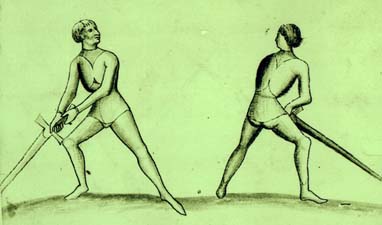
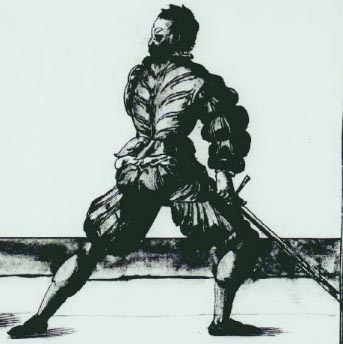
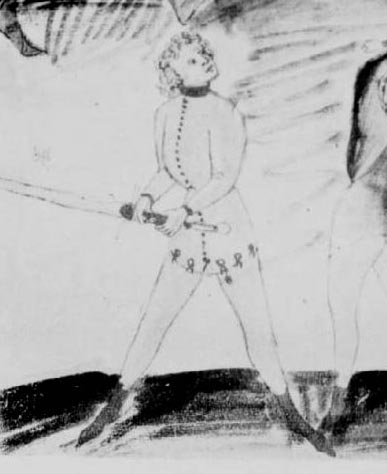
Tail Guard in Ringecks and Meyers work.

Old Archived Discussions on Specific Passages from Medieval & Renaissance Fencing Texts


Moderators: Webmaster, Stacy Clifford

User avatar
Matt Shields
Posts: 44
Joined: Mon Nov 24, 2003 12:57 pm
Location: Irvine, California

Tail Guard in Ringecks and Meyers work.

Postby Matt Shields » Wed Jan 14, 2004 12:43 am

This seems like something that would have been discussed but I could not find it in the search.

I am wondering why Sigmund Ringeck or Joachim Meyer did not include the Tail Guard. Could this simply because the stance does not offer much in defense so was not considered a ward? Or could it be more of the German method(considering it's in Fiore's work), in which they found it usless? Or was it the use of plate that required stances more suitable for thrusting, and the guard never readapted?

Guest

Re: Tail Guard in Ringecks and Meyers work.

Postby Guest » Wed Jan 14, 2004 4:22 am

Hi Matt!

The Tail Guard is the 'Nebenhut' and both Ringeck and Meyer have it.

Cheers,
Jörg

User avatar
Matt Shields
Posts: 44
Joined: Mon Nov 24, 2003 12:57 pm
Location: Irvine, California

Re: Tail Guard in Ringecks and Meyers work.

Postby Matt Shields » Wed Jan 14, 2004 10:16 am

A direct quote from The Knightly Art of the Longsword translation on this website.

"There are only four basic positions which are useful in combat, this are Ochs, Alber, Pflug, and vom Tag."

And I see now that Nebenhut is a secondary guard in Meyer's.

User avatar
Craig Peters
Posts: 230
Joined: Wed May 28, 2003 5:08 pm

Re: Tail Guard in Ringecks and Meyers work.

Postby Craig Peters » Wed Jan 14, 2004 6:45 pm

Matt,

The key words here are "four basic positions". Nebenhut, as I understand, is not considered to be one of the basic guards by Ringeck. Ringeck discusses Nebenhut, stating:

"Here note, from the Nebenhut- that is, from the strikes- to fence well.

Although they are not described in the teachings, nevertheless all the techniques that you fence with are derived from them. And you should tart the strikes from the left side because from the right they are not as effective."

-From Secrets of German Medieval Swordsmanship, by Christian Tobler

Guest

Re: Tail Guard in Ringecks and Meyers work.

Postby Guest » Fri Jan 16, 2004 2:21 am

I know that Ringeck doesn't describe the Nebenhut in great detail, it is, however, implied in a way that I have a pretty good clue about how it looks like.

Here's an image I found on the website: Image
This is in line with what Meyer says about the Nebenhut. (transcription courtesy of 'Die Freifechter')

[color="blue"]Nebenhut.
IN dise Hut schick dich also/ Stehe mit dem Lincken fuß vor / halt dein Schwerde neben der Rechten / mit der Spitzen auff der Erden / das der Knopff ubersich / und die kurtze schneid
gegen dir stehe.[/color]

Here's a translation:

[color="red"] Nebenhut
Assume this guard thus/stand with the left foot forward/hold your sword at your right (side)/with the point on the ground/so that the pommel is up/and the short edge is directed towards you. [/color]

So, Meyer describes it with the blade on the right side of the body, but -just like he says elsewhere- it can be done from both sides.

It's quite a natural position that comes from a diagonal downward blow, only 'cocked back' a little further so one can strike strongly upwards with long or short edge again.

Jörg

User avatar
John_Clements
Posts: 1167
Joined: Wed Sep 18, 2002 10:43 pm
Location: Atlanta area

Re: Tail Guard in Ringecks and Meyers work.

Postby John_Clements » Fri Jan 16, 2004 10:43 am

Hi Jorg,
Long time no hear.
Yes, but there are images from the Fechtbuchs that also show this tail stance with the long edge forward ---a position that of course precedes a rising cut from below with the long edge.

Image

Image

Image

Liechtenaur himself included a tail stance as a secondary posture. The difference between the two versions, obviously, is the hand positions, with the short edge cut ends in either pflug, long point, or vom dach, whereas the long edge cut ends in a hanging point, ochs, or einhorn.

However, we have an interesting third interpretation on this which we'll post on very soon.

JC
Do NOT send me private messages via Forum messenger. I NEVER read them. To contact me please use direct email instead.


Return to “Virtual Classroom - closed archive”

Who is online

Users browsing this forum: No registered users and 6 guests


Note: ARMA - The Association for Renaissance Martial Arts and the ARMA logo are federally registered trademarks, copyright 2001. All rights reserved. No use of the ARMA name or emblem is permitted without authorization. Reproduction of material from this site without written permission of the authors is strictly prohibited. HACA and The Historical Armed Combat Association copyright 1999 by John Clements. All rights reserved. Contents of this site 1999 by ARMA.