When/Where/Why/How to 'Turn Away' [& Run!]?

Old Archived Discussions on Specific Passages from Medieval & Renaissance Fencing Texts


Moderators: Webmaster, Stacy Clifford

User avatar
ChrisThies
Posts: 77
Joined: Sat Feb 08, 2003 8:54 pm

When/Where/Why/How to 'Turn Away' [& Run!]?

Postby ChrisThies » Sat Mar 20, 2004 4:52 pm

In Talhoffer's 1467 Fechtbuch there are a total of 19 long sword plates [plates 33, 34, 37, 38, 41, 47, 52, 53, 56, 57, 58, 63, 64, 65, 72, 73, 74, 77, & 78] which illustrate a reversed sword (both hands on blade) technique. 17 of these 19 plates show a frontal/facing response (by the recipient of the reversed sword action) towards the adversary who is delivering the reversed sword action. But 2 plates [plates 47 & 56] clearly illustrate a 'turning away' avoidance (i.e. the recipient turns his back towards the adversary who is delivering the reversed sword action [and rapidly increases the distance]). These two images are the only depictions of a 'turning away' response in the text. And one plate [47] depicts a failed result of the 'turning away', whilst the other plate [56] depicts a successful 'turning away' response.

I was wondering why Talhoffer chose not to depict a more typical form of avoidance (such as stepping back, passing back, or traversing) where one could face the attacker and conceivably put up a better defense during one's retreat from these depicted [mortschlag] actions. I decided to first establish which retreat (facing versus turning) was quickest. So I conducted an impromptu experiment, the inconclusive results of which I'll post on this thread as a reply for critique from my peers. But first I'd like to point out a couple other rare examples of 'turning away' which I've found:

In Filippo Vadi's "De Arte Gladiatoria Dimicandi" (translated by L. Porzio & G. Mele) there are (excluding the illustrations of guards in Folios 16r through 17v, and Folio 26r) 30 images of long sword plays between two adversaries (Folios 17v through 23v, and Folios 26r through 27v). There are no depictions of reversed sword usage, but 15 of these images depict half sword usage, and 2 of these half sword images depict failed 'turning away' techniques.
Vadi Folio 23v (lower image):
"Voltando el man riverso mal parasti
De meza mella nel ligame intrasti
By turning you wrongly parried the manreverso
You fell in a bind with the half blade."
And Vadi Folio 27v (upper image):
"Per lo passar mio for de strada
Te metero per terra con tua spada
Thanks to this going out of the way
I'll bring you to the ground with your sword."

I have not really begun to study Fiore de Liberi. But in a brief look through the 'literal translation' of "Flos Duellatorum" on the 'Knights of the Wild Rose' website I found only one image [in 'Section 8: Sword vs. Dagger'] which depicted a (successful) 'turning away' technique out of the total of 151 images (listed below) which depicted 2 or more adversaries combating with dagger or sword.
The one 'turning away' image found in 'Section 8: Sword vs. Dagger' ]http://www.varmouries.com/wildrose/fiore/section8.html] depicts the crowned master fleeing two adversaries who are each wielding swords, and the translated caption reads:
"With my dagger I know how to parry cuts and thrusts:
If one by one you come I have an infallible game:
And my scholar will prove it:
And he'll do it according to the picture."
Total of 151 adversarial (with bladed weapons) images was derived from the following sections:
77 - 'Section 2: The Dagger'
14 - 'Section 3: The Single Sword'
41 - 'Section 5: Long Sword'
10 - 'Section 6: Fighting in Armour'
9 - 'Section 8: Sword vs. Dagger'


Perhaps someone knows of other 'turning away' images I have not yet seen.
Chris

{Good fencers make good neighbors}
Christopher Thies

User avatar
Randall Pleasant
Posts: 872
Joined: Mon Sep 23, 2002 3:35 pm
Location: Flower Mound, Texas, USA

Re: When/Where/Why/How to 'Turn Away' [& Run!]?

Postby Randall Pleasant » Sat Mar 20, 2004 5:28 pm

Chris wrote:
I was wondering why Talhoffer chose not to depict a more typical form of avoidance (such as stepping back, passing back, or traversing) where one could face the attacker and conceivably put up a better defense during one's retreat from these depicted [mortschlag] actions.

Chris

Take a look at Plate 4. The man on the right appears to have stepped to his left to avoid a thrust.
Ran Pleasant

User avatar
ChrisThies
Posts: 77
Joined: Sat Feb 08, 2003 8:54 pm

Re: When/Where/Why/How to 'Turn Away' [& Run!]?

Postby ChrisThies » Sat Mar 20, 2004 5:50 pm

I attempted to determine which retreat (facing versus turning) would be quickest by conducting an impromptu timing test of the two different types (in regards to orientation towards adversary) of retreats. As you can see below the results were mixed. The test conditions were sunny (outdoors), 59 degrees Fahrenheit, with very gusty winds of up to 39 MPH. The volunteered timekeeper utilized the chronograph feature of a typical digital wristwatch (not an actual stopwatch). The surface used was a flat concrete slab, with chalk marking the '8 foot' and '4 foot' starting lines, as well as the 'finish line'. The test subject [myself] was a right handed fencer, wearing tennis shoes, and wielding a wooden waster. All start positions were initiated in Pflug. The four start positions (listed below) were used to initiate both a facing retreat and a turning (180 degree pivot followed by a run) retreat. Resulting in 8 'heats' (one facing retreat and one turning retreat) for each of the two distances measured (4 feet and 8 feet). Each 'heat' was run 3 times, and an average time was derived from the times recorded. The variances between the average times of the facing and turning retreats for each start position (at each of the two distances) are listed below. The 4 and 8 foot distances were chosen simply because they represent approximately 1 or 2 long sword lengths each. Those start positions which incorporate a pass forward were done in an attempt to introduce forward momentum to the test subject prior to his retreat.

Start positions:
I. Standing right foot lead.
a. With a facing retreat.
b. With a turning retreat.

II. Standing left foot lead.
a. With a facing retreat.
b. With a turning retreat.

III. Right pass forward.
a. Then a facing retreat.
b. Then a turning retreat.

IV. Left pass forward.
a. Then a facing retreat.
b. Then a turning retreat.

Variances of average times between facing and turning retreats for each start position (at 4 and 8 foot distances):

At 4 feet, start position/retreat Ia was 0.2 seconds FASTER than Ib. At 8 feet, start position/retreat Ia was 0.02 seconds FASTER than Ib.

At 4 feet, start position/retreat IIa was 0.12333 SLOWER than IIb. At 8 feet, start position/retreat IIa was 0.00667 SLOWER than IIb.

At 4 feet, start position/retreat IIIa was 0.04 seconds FASTER than IIIb. At 8 feet, start position/retreat IIIa was 0.00666 SLOWER than IIIb.

At 4 feet, start position/retreat IVa was 0.11667 seconds FASTER than IVb. At 8 feet, start position/retreat IVa was 0.09333 SLOWER than IVb.

I think I need a more controlled test environment, quality stopwatch, motivated timekeeper, and a more adept test subject!
{Good fencers make good neighbors}

Christopher Thies

User avatar
ChrisThies
Posts: 77
Joined: Sat Feb 08, 2003 8:54 pm

Re: When/Where/Why/How to 'Turn Away' [& Run!]?

Postby ChrisThies » Sat Mar 20, 2004 6:21 pm

Thanks Ran,
There are some plates that are 'iffy' in regards to whether the respondent is executing a facing or 'turning away' (180 degrees) avoidance. Talhoffer's plate 57 is a good example of an image which could be interpreted as resulting from either type of retreat. So I am just trying to focus upon those historical depictions which CLEARLY illustrate a 'turning away' (or 'turning about', etc.) technique. I find these of interest because I believe such a move to be a rare exception - perhaps even anathema - to the general concept of never to turn your back on one's adversary. The only conceivable situations where I can imagine such a retreat as prudent would be when faced against multiple opponents (i.e. you turn and run in an attempt to keep them from converging upon you all at the same time, or to put it another way 'to string them out' for single confrontation). But perhaps there are other explanations or situations where a turning away retreat would be prudent. I've never worn armor, so perhaps running backwards is not optimal for harnissfechten. Or I guess the terrain could also influence the decision to retreat with a turn away. I don't know for sure!
Chris
{Good fencers make good neighbors}

Christopher Thies

User avatar
John_Clements
Posts: 1167
Joined: Wed Sep 18, 2002 10:43 pm
Location: Atlanta area

Re: When/Where/Why/How to 'Turn Away' [& Run!]?

Postby John_Clements » Fri Mar 26, 2004 10:40 am

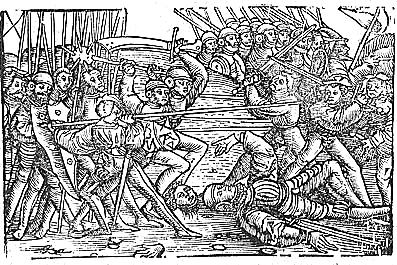
Here's a late 16th cnetury battle image of the value of turning away,
Image
Do NOT send me private messages via Forum messenger. I NEVER read them. To contact me please use direct email instead.

User avatar
ChrisThies
Posts: 77
Joined: Sat Feb 08, 2003 8:54 pm

Re: When/Where/Why/How to 'Turn Away' [& Run!]?

Postby ChrisThies » Sat Mar 27, 2004 12:02 am

Nice find.

I agree with your insinuation of the "...value of turning away," which I believe is in regards to the fallen soldier (lower right of image, with his left hand hacked at the wrist). But I also notice that this fallen individual is wearing a helm, as are all of the other 'western' (facing east) adversaries [found grouped on the left and also in the background of the image]. Whereas the 'eastern' (facing west) adversaries appear to me to be not only fewer in number, but also lacking in helms. So possibly this fallen individual is not of the 'eastern' [helmless] camp, thus perhaps not a clear example of a failed 'turning away'.

But the standing, helmless, 'eastern' adversary (with longsword in the left Vom Tag or left Posta di Donna Soprano guard) is a good example of a 'turning away', and what could he possibly be thinking?
Is he:
a) trying to lure (i.e. with a false retreat) the three point men of the 'western' formation into a further advance ahead of their main group?
b) about to deliver his 'wound up' blow in conjunction with another 180 degree pivot (returning to facing his adversaries)? And if so, would the extra body/hip movement put into the blow warrant the extra time needed to execute the blow?
c) about to run?
or
d) about to die?
{Good fencers make good neighbors}

Christopher Thies

User avatar
ChrisThies
Posts: 77
Joined: Sat Feb 08, 2003 8:54 pm

Re: Posta di Vera Finestra Mancina

Postby ChrisThies » Wed Mar 31, 2004 11:12 pm

After reviewing the ARMA Medieval Terminology list I now see that Fiore de Liberi's 'Posta di Vera Finestra Mancina' is the actual guard displayed in the above posted late 16th century image [I'm referring to the individual of the image which I referred to as the "...standing, helmless, 'eastern' adversary..." in my previous post]. I apologize for not utilizing the most accurate description for the technique I was questioning.

Does anyone have any insights into the usefulness or particular benefits of the 'Posta di Vera Finestra Mancina' (left guard of the True Window)? Why is the initial body position 'turned away' from the adversary?

In "Flos Duellatorum" the image for this guard is shown across from an image of the 'Posta Breve' (Short guard), therefore implying its (Posta di Vera Finestra Mancina's) usefulness against a thrusting or stabbing attack.

Would the following sequence be a likely application of this technique:
Starting in a ('turned away') Posta di Vera Finestra Mancina, and responding to a thrust (from a sword or spear, etc.), you would (by pivoting your feet) return to a facing body (hip) position in relation to your adversary, ending in a Posta di Fronte, thus having displaced (with your blade) the incoming thrust to your outside you would now be in a position to deliver your own thrust?
{Good fencers make good neighbors}

Christopher Thies

User avatar
John_Clements
Posts: 1167
Joined: Wed Sep 18, 2002 10:43 pm
Location: Atlanta area

Re: Posta di Vera Finestra Mancina

Postby John_Clements » Wed Mar 31, 2004 11:49 pm

I think the above is not meant to portray that the fighters are poised, but rather captured in motion. Look at all the figures.
Do NOT send me private messages via Forum messenger. I NEVER read them. To contact me please use direct email instead.


Return to “Virtual Classroom - closed archive”

Who is online

Users browsing this forum: No registered users and 6 guests


Note: ARMA - The Association for Renaissance Martial Arts and the ARMA logo are federally registered trademarks, copyright 2001. All rights reserved. No use of the ARMA name or emblem is permitted without authorization. Reproduction of material from this site without written permission of the authors is strictly prohibited. HACA and The Historical Armed Combat Association copyright 1999 by John Clements. All rights reserved. Contents of this site 1999 by ARMA.