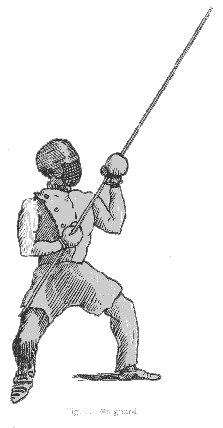
This is partly because Mair's grip is not the "one hand in the middle, the other a quarter-length from the end" seen in traditional English quarterstaff. This absence of 2+ feet at the butt end allows for tighter manuevering when closing with the enemy, one of the central concepts behind Mair's system.
Your description of the English grip is not correct. Swetnam describes and illustrates it thus:
Keep the point of your Staffe right in your enemies face, holding one hand at the verie buttt end of the Staffe, and the other a foote and a halfe distant, looking over your Staffe with both your eies and your feet and and a half distance, or thereabouts, according to this picture... 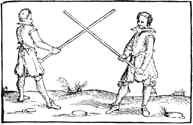
I'm pretty sure the term "quarterstaff" refers to holding the rear quarter of the staff, not the second quarter.
In contrast, Silver, for instance, advocates an 8+ foot staff and says that its length should be used to keep opponents at bay. I may be mistaken, but I do not believe there is any emphasis on closing.
Silver has this to say about holding the staff and using its length:
And this note, that these lengths will commonly fall out to be eight or nine foot long, and will fit, although not just, the statures of all men without any hindrance at all unto them in their fight, because in any weapon wherein the hands may be removed, and at liberty, to make the weapon longer or shorter in fight at his pleasure, a foot of the staff being behind the back most hand does no harm. Silver describes this closing maneuver (which is quite cool and fun to do):
9. If you play with your staff with your left hand before and your right hand back behind, as many men find themselves most apt when that hand is before, & if your adversary upon his blow comes in to take the close of you, when you find his staff crossed with yours near his hand, then suddenly slip up you right hand close to the hind side of your foremost hand, & presently loosing the hind side of your foremost hand & put in under your own staff, & then cross or put by his staff therewith your hand take hold of his staff in such sort that your little finger be towards the point of his staff, & your thumb & forefinger towards his hands, & presently with your right hand mount the point of your own staff casting the point thereof over your right shoulder, with your knuckles downwards, & so stab him in the body or face with the hind end of your staff, but be sure to stab him at his coming in, whether you catch his staff or not, for sometimes his staff will lie to far out hat upon his coming in you cannot reach it, then catch that arm in his coming in which he shall first put forth within your reach, but be sure to stab, for his staff can do you no hurt, and having so done, if you find yourself too strong for him, strike up his heels, if too weak fly out.
10. The like must you do if you play with your right hand & your left hand back behind, but if you need not to slide forth your left hand, because your right hand is in the right place on your staff already to use in that action, but then you must displace your left hand to take hold of his staff, or the grip as is aforesaid, & to use the stab as is above said. In describing the fight of long staff vs. short staff, Silver does talk about drawing back the long staff and shortening it to counter a closing move by the short staff man, but he has this to say about the drawbacks of that idea:
5. Again it is to be remembered in that time that you keep him at bay, upon the drawing in of his staff, the hind end thereof lying so far back behind will be so troublesome for him, that he can make no perfect fight against you & commonly in his drawing in of his staff it will be too short to make a true fight against you, neither to offend you or make himself safe. Swetnam also describes two different closing techniques, one for fighting at night and the other employing a fake thrust to initiate it.
If you're making a padded staff, Swetnam is very adamant about being able to quickly shift your grip from the left side to the right, and his technique involves sliding the rear hand forward before shifting the forward hand back (all on that rear quarter of the staff), so take that into consideration as well.