The damaging power of the less-powered strikes

For Historical European Fighting Arts, Weaponry, & Armor

Moderators: Webmaster, Stacy Clifford

Lance Chan
Posts: 377
Joined: Fri Oct 25, 2002 3:03 pm
Location: Hong Kong
Contact:

The damaging power of the less-powered strikes

Postby Lance Chan » Sun Jan 08, 2006 11:59 am

Recently I've received some comments that many of my strikes in the sparring videos were taps with my body over extended, thus not giving much power behind the strike and should be neglected. Some were done with the very tip to the barehand of my opponents and may not seem having enough "bang" behind it. However, I'd experienced live edge drawing blood on living human body, mostly being the guy who was bleeding (don't try this at home <img src="/forum/images/icons/wink.gif" alt="" /> , I admit I tend to be staying on the more careful side than most of us here because I've felt the impact of sword cuts to the top of my head, my left hand, right eyebrow and nose mentally and physically.

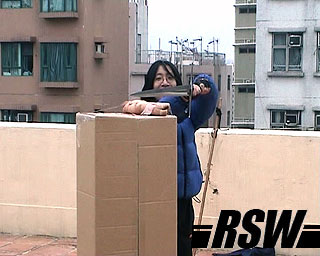
Yet, words often failed to deliver the meaning so here I made a video for reference. It features a sparring move, then the move actually used with a real sharp sword on pork target placed on a box with some give. According to my test cutting experience, pork on a box was significantly more difficult to cut than a living human target, both due to the give of the box and the thicker cross section of the organic parts in general. So the actual result on a human body would be even more tremendous than the ones shown in the video.

Image
http://www.rsw.com.hk/lancelot-sparring-cuts.zip
25.5mb mpg zipped.

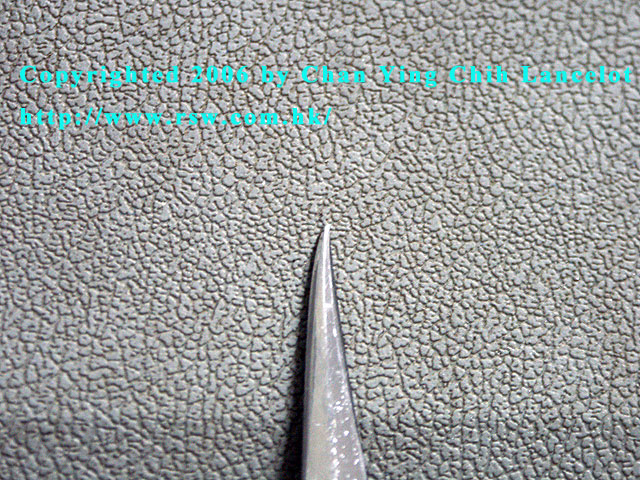
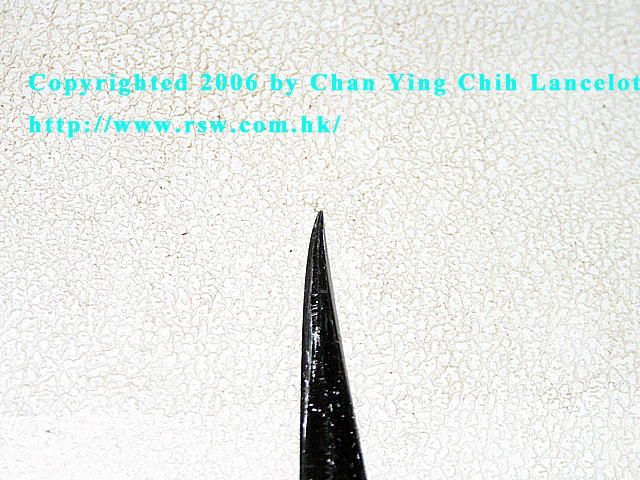
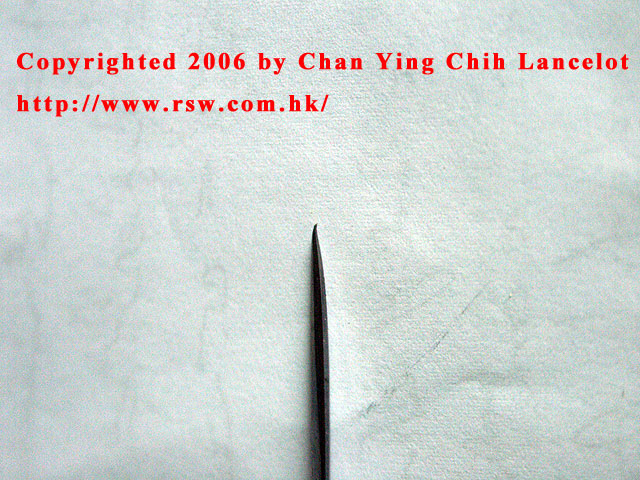
BTW, after the first tip cut on purely flesh and the cardboard box, the Brescia Spadona's tip was warpped from the direction of the cut. Since then, each tip cut altered the shape of the tip of the sword and at the end it ended up like this:

Image
Image
Image

I hope I'm being helpful to the society by conducting the experiment. And again, I thank all for reviewing my sparring videos and give comments. I'm certainly working on some aspects raised to improve my techniques.
Realistic Sparring Weapons
http://www.rsw.com.hk

User avatar
JeffGentry
Posts: 1089
Joined: Tue Apr 20, 2004 8:35 am
Location: Columbus Ohio

Re: The damaging power of the less-powered strikes

Postby JeffGentry » Sun Jan 08, 2006 3:37 pm

Hey Lance

I love the fact that you bought such an expensive sword and don't hesitate to use it for it's intended purpose, i think it is realy taking on some character.


Jeff
Semper Fidelis

Usque ad Finem

Grace, Focus, Fluidity

Bill Tsafa
Posts: 118
Joined: Sun Nov 13, 2005 9:11 pm
Location: NYC
Contact:

Re: The damaging power of the less-powered strikes

Postby Bill Tsafa » Sun Jan 08, 2006 5:42 pm

Hi Lance,
First let me say that I always look forward to looking at the videos you put on your website. I look for the good and the bad and analyze.

Reguarding your swings. The ones intended to be done with power such as the "squinting strike" should come from the hips. But one such as the "parting strike" comes from the elbows. In the case of the "parting strike" you are intentionaly trying to outreach your opponent. So you have to anylize on a strike by strike basis.

Now lets talk about the striking effects on the blade. This is an area of great interest to me and I have done a lot of research on. You can view my entire work here: http://mysite.verizon.net/tsafa1/swordreview.htm

I will present four blades to you which I have tested and practiced with extensivly and know inside out. I will tell you the pros and the cons I have found.

The first is the most recent addition to my collection, The Generation 2 Lucerin Prince. This is a light quick 3 lb sword. Upon banging it around a little the tip of my blade took on a shape similar to yours. I had to straighten it out with pliers and grind it down with my sharpening stone to get it straight. The blade has a dimond cross-section but is thin compared to the other blades I will illustrate. This blade is has a fine point but due to its thiness it will fold if you try to thrust into any hard leather. This blade is ideal for unarmored dueling. I suspect your blade has similar light and thin characteristics such as this one. This sword costs about $240 with shipping. Here is what it looks like: Image

Next I have my Valient Armory Black Prince. This one is a bit more heavy duty then the G2 Lucerin Prince. I beat it on my tires for over a year and a half. The tip did NOT loose its shape. I found that it did fold up a bit on the thrust so this is also best suited for unarmored combat. By folding I mean it flexed to the side. When I relieved the presure it came back to its normal position. The dimond-cross section on this one was a bit thicker which made it less sharper but it kept its shape. It cost $160 with shipping. Here is what it looks like: Image

Next take a look at my my G2 Black Prince. This one has a thick cross-section and and less of a tapered point. I can thrust through the sidewall of my tires and it will not fold. Thrusting through leather and rubber is somewhat difficult because it does not have that fine point so it requires greater force to overcome the resistance. It has kept its shape and is sharp dispite its thickness because the wider blade allows more room for a gradual grinding. This sword is much more blade heavy then the other two before. It is a very good cutting blade but requires great effort to reverse direction. It cost about $240 with shipping. You can see it here: Image

Finaly I present my Valiant Armory Degesse. This is a one hand sword but I think it has the best combination of blade tapering (pointyness) and blade thickness. With this sword I can easily thrust into the sidewall of the tire, with just one hand. It never folds. I have beat my tires to no end with this blade and looks new. The Blade cross-section is thick enough to put a good edge on but pointy enough for the perfect thrust. I wish I could get a longer hand and half version on this. I would make the base thiner and lighten the pommol. Also I think there is too much wood in the handle. The Degesse costs $170 with shipping. This is what it looks like: Image
Let me know if I can provide any further information so we can get a better comparison. Lance would you also post the length and wight of the sword you have pictured.

Lance Chan
Posts: 377
Joined: Fri Oct 25, 2002 3:03 pm
Location: Hong Kong
Contact:

Re: The damaging power of the less-powered strikes

Postby Lance Chan » Sun Jan 08, 2006 9:38 pm

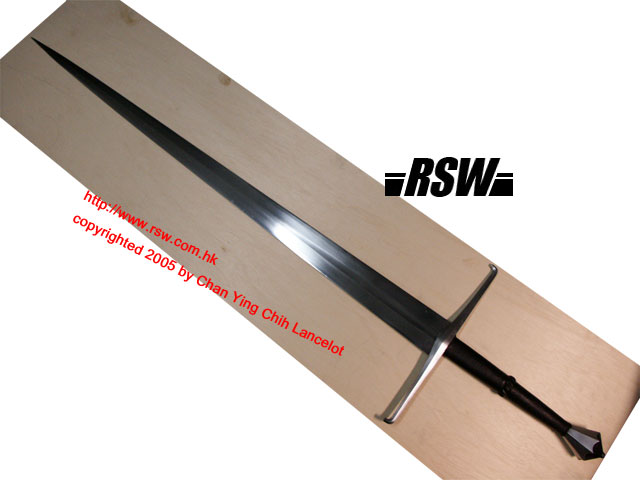
Image

45.75 inches overall length, 35 inches blade length, 3 lbs 4 oz. 1500 USD.
Realistic Sparring Weapons

http://www.rsw.com.hk

Bill Tsafa
Posts: 118
Joined: Sun Nov 13, 2005 9:11 pm
Location: NYC
Contact:

Re: The damaging power of the less-powered strikes

Postby Bill Tsafa » Sun Jan 08, 2006 11:53 pm

At first I thought I may be a matter of the thickness of the cross-section in the point. So I examined them more closely. VA Degesse on the far left, G2 BlackPrince, VA BlackPrince, and G2 BlackPrince on far right. Image
My Dagesse is about twice as thick as the others. The G2 Black Prince was third thickest. Then VA BlackPrince and finaly G2 Lucerin Prince was the thinest. I do not think this is the answer. After some though it is my believe that the thickness will determin how much the blade folds to the sides. I believe that any up or down bending will be determined by how steep the tapered point is. When it bends up or down it does not come back like it does when it bends to the sides.

My conclusion is that while a good point makes for better thrusting, don't go too pointy. The point will bend on impact if you hack with it or fold to the side if you thrust. I defineltly think you can salvage your sword. Straighen it out with some pliers and sharpen it with a stone. If the point is still off, just keep sharpening it back untill the bend is gone. You will loose some length. Over time as you sharpen it, avoid giving it a niddle point. Have it curve in a bit to a point like my Degesse does.

I think we have done some good work here tonight. I shall have to update my website with this new information.

Lance Chan
Posts: 377
Joined: Fri Oct 25, 2002 3:03 pm
Location: Hong Kong
Contact:

Re: The damaging power of the less-powered strikes

Postby Lance Chan » Mon Jan 09, 2006 8:38 am

As of the point of the sword, today I used a plier to straighten the point back without any need to regrinding.
Realistic Sparring Weapons

http://www.rsw.com.hk

User avatar
Jonathan Scott
Posts: 53
Joined: Fri Jul 15, 2005 6:43 pm
Location: Tallahassee, FL

Re: The damaging power of the less-powered strikes

Postby Jonathan Scott » Mon Jan 09, 2006 10:34 am

Thanks Lance!
So those cuts do a lot more damage than they look like on the sparring video. Thanks for that info, needed that.

User avatar
JeanryChandler
Posts: 978
Joined: Sat Dec 28, 2002 1:45 am
Location: New Orleans, aka northern Costa Rica
Contact:

Re: The damaging power of the less-powered strikes

Postby JeanryChandler » Mon Jan 09, 2006 1:07 pm

Thanks for conducting that experiment. I really appreciate your continuing efforts to document this kind of stuff so we can all learn from it.

I don't however agree that the results are decisive. Your test cuts were more precise than the cuts in some of your sparring videos, especially those by your opponents. You have more time to line it up and concentrate and get everthying right like edge-alignemnt.

Even under these to me more optimal conditions, the cuts you showed on the pork leg varied in depth a great deal.

All of them are pretty horrific to our modern eyes and would have required a visit to the hospital and a lot of stitches, in some cases surgery.

But many of them did not look deep enough lets say, to be maiming injuries to me, and even some of the worst might not have been sufficient to end a fight, depending on where they hit (the hand being more vulnerable for example than parts of the forearm). Consider the possibility that even if someone had one hand mangled, they could release the weapon with that hand and still execute an effective countercut. You can do a classic hangen / and counter quite easily slipping from a two to one handed grip.

And I think it can be harder to really stop someone in the middle of a fight than we all might think. I'm prety sure I broke my own hand sparring last month and didn't even notice it until the last bout was over. I'm not even precisely certain when it happened. It didn't stop me from fighting and winning several bouts afterword. Once the day was over my hand swelled up and I couldn't even type with that hand for 6 weeks...

For another example, I was watching a film clip on TV the other day, a hunter was retrievinjg a boar he had just shot. The boar wasn't dead and suddenly lashed at him, cutting him severely on his forearm with his tusk. He nevertheless held the boar down, bound it's feet and muzzle, and secured it before stopping to evaluate the wound. The cut was well into the muscle and required over 100 sticthes. It didn't end the fight.

This is just one recent example I can think of of many, many...

I think a wound has to be really decisive to count as a bout-ender, it's just an opinion, but I would say something sufficient to nearly sever an arm, or go at least half way through the bone.

Remember I'm just saying all this with full respect for your fighting skill and all your efforts to further our knowledge of the field.

Jr
"We can't all be saints"
John Dillinger

Bill Tsafa
Posts: 118
Joined: Sun Nov 13, 2005 9:11 pm
Location: NYC
Contact:

Re: The damaging power of the less-powered strikes

Postby Bill Tsafa » Mon Jan 09, 2006 1:40 pm

I definelty think that the strikes Lance made allows us to make some decisive conclusions. On a real battlefeild you will never use your weapons in optimal conditions. You will use them under whatever conditions you are presented with. Some strikes may not always be properly alligned because the ground may not alway always be flat and you may experience other interfirence to your strike. You will meet many opponents wearing different armor and you will meet other weapons such as spears, axes, sheilds.

I think the the expriment and practice Lance and I have done shows that his sword as well as my G2 Lucerin Prince is better suited to the more controlled situation of an unarmored duel between lords. For the open battlefield a thicker blade such as my VA Degesse or G2 Black Prince is a better choice. I have beat my tire-pell mercilessly with these two swords for over a year with no damage.

Reguarding the damage a sword should be expected to do, I think it is too much to expect it to hack a limb off. I think it will more effectivly render a person incapable of fighting by breaking bone, and cutting tendon and muscle. You can then make a follow up thrust that will hit the internal organs and kill. Also remember that the majority of mideval soldiers died from infection rather then the immidiate wound. Even with an axe and a cutting block it often takes a few blows to cut off a head. That is why they invented the Gillutine. The Gillutine has an 80 lb blade and drops 20 feet.

We should continue to test and document our findings.

User avatar
JeanryChandler
Posts: 978
Joined: Sat Dec 28, 2002 1:45 am
Location: New Orleans, aka northern Costa Rica
Contact:

Re: The damaging power of the less-powered strikes

Postby JeanryChandler » Mon Jan 09, 2006 2:16 pm

Well, there are actually at least two discussions going on here.

The issue of how the various sword replicas are performing, while interesting, is a seperate issue and one I personally don't want to get involved in, except to say that it is my personal belief that as nice as some of the replicas are, they are still light years behind the quality of the best period originals.

Jr
"We can't all be saints"

John Dillinger

Bill Tsafa
Posts: 118
Joined: Sun Nov 13, 2005 9:11 pm
Location: NYC
Contact:

Re: The damaging power of the less-powered strikes

Postby Bill Tsafa » Mon Jan 09, 2006 4:08 pm

keep in mind that relativly few period original have survived. The ones that did are most likly the better ones. The lower quality ones ended up as horseshoes and door hinges. No one would keep junk.

User avatar
Derek Gulas
Posts: 66
Joined: Wed Sep 25, 2002 3:04 pm
Location: Washington USA

Re: The damaging power of the less-powered strikes

Postby Derek Gulas » Mon Jan 09, 2006 8:21 pm

I'm not so sure I would trust a sword not to hack my limbs off. I've seen lots of pictures and paintings on this website of men wallowing in the mud with a severed arm or leg, and seeing the effects of cuts on meat in the test cutting section, I don't think it would be unreasonable to assume that severing limbs with a sword is a possibility. I dunno, I just get this feeling that if we started cutting on people for real again, that we would probably be both suprised and horrified at the effects of these weapons.
Close combat - bringing us together.

Derek
ARMA, Seattle

Lance Chan
Posts: 377
Joined: Fri Oct 25, 2002 3:03 pm
Location: Hong Kong
Contact:

Re: The damaging power of the less-powered strikes

Postby Lance Chan » Mon Jan 09, 2006 8:54 pm

Just to remind everyone, the damage you see on the pork arm is only about 1/2 in the depth of the actual wound you would see on your own barehand because the pork arm was thicker in skin, in fat, in bone and was dead. Plus the box has some give. When one got hit suddenly, one didn't back away fast enough but your own inertia will reactively try to maintain your pose. Thus you'll take the impact even more than what happened to the pork arm.

So those strikes would very likely to disable the hand/arm RIGHT away.

Now, whether one can sustain such damage and immediately continue to fight is another topic for discussion.

I've both hit someone with live edge very lightly (Jeanry knew) and being hit by live edge more than once (mostly accidental). I would agree that as long as it didn't get to the bone/hamstring or sever any muscle, I can neglect it but there's still a little bit stunning for the second, a mental effect.

BTW, in sparring I used more power than in the test cutting. That's something I had made sure during the test cut. I didn't use the same amount of power I did in sparring. For example, there were many tip cuts in the sparring clips where I was actually doing a passing forward footstep and overhead swinging. In the test cutting I was just standing there. The line up was not for the blade alignment but for making sure that I hit close to the tip enough so that it can simulate the sparring hits.
Realistic Sparring Weapons

http://www.rsw.com.hk

david welch
Posts: 453
Joined: Wed Dec 18, 2002 5:04 am
Location: Knoxville TN

Re: The damaging power of the less-powered strikes

Postby david welch » Mon Jan 09, 2006 9:18 pm

You don't need to lop off a head to make a fatal wound.

Here is a knife wound target effects chart and text from the WWII manual "Kill or Get Killed" outlining fatality and time till death from various cuts.


NO. 28 - USE OF THE KNIFE (cont.)

Certain arteries are more vulnerable to attack than others, because of their being nearer the surface of the skin, or not being protected by clothing or equipment. Don't bother about their names so long as you can remember where they are situated.
In the accompanying diagram (Fig. 112), the approximate positions of the arteries are given. They vary in size from the thickness of one's thumb to that of an ordinary pencil. Naturally, the speed at which loss of consciousness or death takes place will depend upon the size of the artery cut.
The heart or stomach, when not protected by equipment, should be attacked. The psychological effect of even a slight wound in the stomach is such that it is likely to throw your opponent into confusion.


Image
"A sword never kills anybody; it is a tool in the killer's hand." Lucius Annaeus Seneca 4BC-65AD.

User avatar
s_taillebois
Posts: 426
Joined: Fri Jul 01, 2005 11:29 pm
Location: Colorado

Re: The damaging power of the less-powered strikes

Postby s_taillebois » Mon Jan 09, 2006 9:44 pm

Well, M Chan's test cuttings do bring some clarity to the issue of sword damage. Both to the target, and the sword.
M. Chandler, likely your quite right about how much damage it would have taken to disable an opponent insofar as it relates to discussions in a historical context. Here on the reservation, the weapons of choice for the socially ill willed is edged (albeit knifes and such). And quite a few people are wandering about with sizeable scars, some seemingly equivalent to some of the damage shown in M. Chan's examples. Granted, EMT's and such are a factor.
But perhaps, that's why some of the weapons of the post 1400 era, were increasingly thrust oriented? Or at least a contributory factor along with the advances in armour.
A late example of the why this might have been so; would be the painting of the assasinated British minister (c. 1500, and gods I wish I could find the *^&amp;^% title and date).
In that painting, there are several slashes to the legs, some to the upper arm, but likely what were the lethal wounds were the smaller visable thrust wounds to the chest. Of these I recall there were more than three.
Perhaps in the historical period, they knew the lesser cuts were not necessarily lethal or dehabilitating in an immediate sense, and so even on a unarmoured (and probably armed only with a dagger) man-caught in an assasination rather than a battlefield; the deeper thrusts were considered necessary?
(apologies for not being able to cite the title of the painting, but alas, methinks I've lost that particular book...)
Steven Taillebois


Return to “Research and Training Discussion”

Who is online

Users browsing this forum: No registered users and 19 guests


Note: ARMA - The Association for Renaissance Martial Arts and the ARMA logo are federally registered trademarks, copyright 2001. All rights reserved. No use of the ARMA name or emblem is permitted without authorization. Reproduction of material from this site without written permission of the authors is strictly prohibited. HACA and The Historical Armed Combat Association copyright 1999 by John Clements. All rights reserved. Contents of this site 1999 by ARMA.