Long hair and armor?

For Historical European Fighting Arts, Weaponry, & Armor

Moderators: Webmaster, Stacy Clifford

User avatar
Will Adamson
Posts: 378
Joined: Thu Dec 29, 2005 11:01 pm
Location: Abingdon, VA

Long hair and armor?

Postby Will Adamson » Thu Jun 21, 2007 8:27 am

I'm not sure if this is just a stage thing, but after seeing various guys in armor with long hair I got to thinking that it might prove to be a bit of a problem if that hair go caught in something. Nevermind it being a tempting target for grappling.

I can see a difference in hair lengths between the times of full armor use and it's decline. It is comparatively short in most cases in Talhoffer (although shaggy and long by my standards) and even as late as Meyer. It seems to get longer once you get into the rapier treatise sometimes, but not nearly so long as the smallsword artwork which are probably wigs anyway. Hair is certainly long by Liancour in 1686, and in Capitelli's "pocket edition" of Capoferro in 1632. (as seen in Dr. Anglo's The Martial Arts of Renaissance Europe)

Hair can very easily be put up to protect it, but that is counterproductive to the image of the romantic hero of the stage.

Is this long hair in armor image a modern stage concoction? Does anyone think there might be a link between hair fashion as far as length and the wearing of armor, or are they two seperate evolutions?

"Do you know how to use that thing?"
"Yes, pointy end goes in the man."
Diego de la Vega and Alejandro Murrieta from The Mask of Zorro.

Andy Spalding
Posts: 64
Joined: Sun Oct 01, 2006 2:28 pm
Location: Murray, Kentucky

Postby Andy Spalding » Thu Jun 21, 2007 10:16 am

I heard somewhere that the Greeks wore longhair and beards not only as fashion dictated, but also as padding for their helmets. I don't know if there is truth to this or if the practice continued to the middle ages or not, but that is the only instance i have heard the long hair actually helping.

User avatar
Will Adamson
Posts: 378
Joined: Thu Dec 29, 2005 11:01 pm
Location: Abingdon, VA

Postby Will Adamson » Thu Jun 21, 2007 10:28 am

Well, they weren't wearing anything with overlapping metal that might snag the hair. The grappling thing would still be an issue with them, but they tried not to break formations and fight individually, so maybe not really an issue for them.

As far as padding, I can't see it being any more of a help after it grows beyond the neck unless they pulled it back up.

Skip forward a few hundred years and the Romans cut their hair very short. I had heard that was so they were less likely to be grabbed by it. It's just plain cleaner too, and they had a certain hatred of body hair.
"Do you know how to use that thing?"

"Yes, pointy end goes in the man."

Diego de la Vega and Alejandro Murrieta from The Mask of Zorro.

Jon Wolfe
Posts: 28
Joined: Mon Mar 26, 2007 1:50 pm

Postby Jon Wolfe » Thu Jun 21, 2007 12:30 pm

Alexander the Great had his soilders in the pike formations shave their beards. If I recall correctly, long beards and hair on the head was traditonal for men in Ancient Greece. I wouldn't think you own hair would provide that much cousioning for a helmet, it might, but I can't give a truly informed opinion on that. Fighting formations would get broken up all of the time in the warfare of long ago. Close-in fighting would be a rather common occurance so, I would think that long hair, on the head or face, would be a detriment should a soldier's unit be broken up and that part of the battlefield would then become a struggle between two groups of individual fighters engaging each other, in which grappling would become a key component and grabbing of hair would certainly a viable method of gaining an advantage. And it's cleaner when soldiers wouldn't have access to proper hygene equipment or facilities, which would be quite often back then, I would think.
()===(+++++++++>

User avatar
Rod-Thornton
Posts: 163
Joined: Fri Jul 22, 2005 10:41 am
Location: The Outer Banks of NC but currently freezing in Rhode Island

Postby Rod-Thornton » Thu Jun 21, 2007 2:27 pm

Will,

I recall reading in Ewart Oakshotte's book(s) (on the recommended reading list) he profiled a germanic knight and he specifically made mention that this guy would have to coil his long hair up under his arming cap...which added another layer of cushion to his pate....before donning his armour. So if you trust his research and related tale, then long hair was the norm....but it was worn up and under as a component of the cushioning process....

(BTW, the books appear geared towards younger kids reading, but they do offer good information on a knight and his gear....
Rod W. Thornton, Scholar Adept (Longsword)
ARMA-Virginia Beach Study Group

User avatar
Jeremiah Backhaus
Posts: 162
Joined: Wed Dec 20, 2006 6:50 am
Location: West Bend, WI

Postby Jeremiah Backhaus » Thu Jun 21, 2007 3:37 pm

Up until recently I had long hair (14 inches+) and for Blossfechten it was terrible (looked cool though). It continually got in the way of doing proper moves, and if anyone got in close it was the first thing to grab.
Now I have short hair (doesn't look as cool) and Blossfechten is more fun. I see better (no hair fallin in my face after a Zorn) and can recoup faster (don't need to flip the hair out of my face. So when it comes to fighting without armour, I would rather have short hair.
In armour, I would have kept my hair. It is containable and adds padding. But I can't base that on any reading or writing I have done. Though if we think pragmatically (like all good Germans) hair is the cheapest and easiest padding to use, so I do not doubt the historical Junker having long hair.

Just my observations from experience with long hair.

User avatar
Jaron Bernstein
Posts: 1108
Joined: Sun Dec 07, 2003 12:58 am

Postby Jaron Bernstein » Thu Jun 21, 2007 4:21 pm

Meyer's fighters certainly had beards. That said, I have seen long haired modern historical fencers have problems with their hair getting in the way if it wasn't tied down in some way.

User avatar
Will Adamson
Posts: 378
Joined: Thu Dec 29, 2005 11:01 pm
Location: Abingdon, VA

Postby Will Adamson » Thu Jun 21, 2007 6:34 pm

Like anything, I guess there is no hard and fast rule about this. The struggle between style and practicality will always be with us.

So maybe this is one thing that the stage "fighters" don't have totally wrong?
"Do you know how to use that thing?"

"Yes, pointy end goes in the man."

Diego de la Vega and Alejandro Murrieta from The Mask of Zorro.

LafayetteCCurtis
Posts: 421
Joined: Sat Nov 04, 2006 7:00 pm

Postby LafayetteCCurtis » Fri Jun 22, 2007 5:52 am

Hmm...that thing about the Greeks wearing long hair was not just only a matter of padding, but also a display of manhood. the warriors of a Greek city once cut their hair in shame after they lost a battle against another city, and the Spartans (who had the most battlefield successes and hence the longest hair) mocked them to no end.

As for long hair with medieval armor, I prefer Oakeshott's explanation that this hair was collected and/or bunched up inside the arming cap--it not only adds a little protection, but also gets the hair out of the way. And I honestly don't think I've ever seen battle illustrations of men in armor but without helmets or hats, except for those of St. George (which is a whole different thing in itself).

Long hair does get in the way when we get to Blossfechten. That's why I prefer to tie mine when I'm pretty sure there's not going to be any helmets involved.

User avatar
Corey Roberts
Posts: 223
Joined: Sat May 07, 2005 6:11 pm
Location: Pyeongtaek, South Korea

Postby Corey Roberts » Sun Jun 24, 2007 4:30 pm

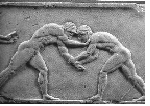
I think in ancient Greece long hair was traditional for older men, but not for fighters (maybe I'm mistaken) if you look at alot of images on pottery and so forth all I ever see is short hair:

Image
Image
Image

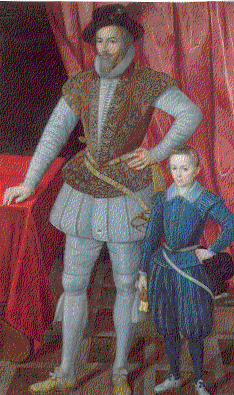
Additionally I think long or short hair during the Renaissance is dependent on exactly what time period your referring to. If you look at images from the 16th century I've noticed men tend to have short hair and beards:

Image,

in the 17th the long wigs seem to have been prevelant.Image

Also, I apologize if this was too many images for one post, but I thought they would be helpful.
--Scholar-Adept
Pyeongtaek
Republic of Korea

LafayetteCCurtis
Posts: 421
Joined: Sat Nov 04, 2006 7:00 pm

Postby LafayetteCCurtis » Sun Jun 24, 2007 9:34 pm

No, you're not mistaken. Now that I think of it, short hair does seem to have been the norm, but long hair was considered as a conspicuous symbol of manhood especially by the Spartans. Which was why the Spartans boasted of having longer hair than most.

If we're talking about the 16th and 17th centuries, the 16th actually started with a fashion for long hair in imitation of Italian models. Later on the close-cropped haircut became popular as Spanish power and Spanish fashions rose to prominence, though by the end of the century the "fashionable" length of hair had begun to increase again until it culminated in the long hair fashioned into a cascade of ringlets at about the middle of the 17th century. By this time most men still preferred to have this long hair as their own hair rather than stuck in a wig. The fad for wigs only began in earnest when Louis XIV grew bald and started wearing wigs to hide this baldness--a habit that was quickly imitated by his courtiers, eventually growing into the 18th-century fashion of having close-cropped hair covered with a long wig.

BTW, is that last picture showing Maximilian of Bavaria? He sure looks familiar...

User avatar
Corey Roberts
Posts: 223
Joined: Sat May 07, 2005 6:11 pm
Location: Pyeongtaek, South Korea

Postby Corey Roberts » Mon Jun 25, 2007 12:29 am

Wow, quite the lesson on hair :) and as to your question It is King Charles I
--Scholar-Adept
Pyeongtaek
Republic of Korea

User avatar
s_taillebois
Posts: 426
Joined: Fri Jul 01, 2005 11:29 pm
Location: Colorado

Postby s_taillebois » Tue Jun 26, 2007 1:10 am

Another consideration would have been related to pre-reformation religious and social norms. Although curly locks seem to have been considered appropriate in the baroque, somewhat shorter hair seems to have been the norm earlier. As noted, for practical and style changes are attendant to any era.
However, having the head completely shorn...would have subjected the wearer to an of assumption of one status or lack thereof of another (either as a penitent or the negative monkish implications). Given the obsession with appearences & status of the late medieval, they would have been fairly careful about that aspect of their appearence.
For example, Godifu, although wearing a penitent shift in her atonement, did seem to keep her hair-as she kept her status. Joan of Arc, condemned to lose her status, was shorn. And although the king had to appear unshod and wear a penitent shift at Canossa-didn't appear to have been also shorn or tonsured for penitience.
And I' Loyola in one old image is shown having the usual Baroque style as he's being carried off the field after his wounding. Obviously after his conversion he's obtained the tonsure.
And as far as being a padding for helmets perhaps, but arming caps and such were available. And in the late medieval (campaigns and battles excluded) the armor plated aristocracy may have been much cleaner (and hair included) than current perceptions indicate. There are several images which show the joys of the bath, of which the churchmen of the time railed agaisnt.
Steven Taillebois

LafayetteCCurtis
Posts: 421
Joined: Sat Nov 04, 2006 7:00 pm

Postby LafayetteCCurtis » Tue Jun 26, 2007 8:57 pm

Well, they were probably cleaner than we thought, but being cleaner doesn't always mean they'd mind getting dirty in battle--they could always clean it afterwards.

User avatar
Brian Hunt
Posts: 969
Joined: Thu Jan 23, 2003 2:03 am
Location: Price, Utah
Contact:

Postby Brian Hunt » Tue Jun 26, 2007 9:09 pm

Off topic post, but I couldn't resist. :)

I'm aware some stare at my hair.
In fact, to be fair,
Some really despair of my hair.
But I don't care,
Cause they're not aware,
Nor are they debonair.
In fact, they're just square.

They see hair down to there,
Say, "Beware" and go off on a tear!
I say, "No fair!"
A head that's bare is really nowhere.
So be like a bear, be fair with your hair!
Show it you care.
Wear it to there.
Or to there.
Or to there, if you dare!

My wife bought some hair at a fair, to use as a spare.
Did I care?
Au contraire!
Spare hair is fair!
In fact, hair can be rare.
Fred Astaire got no hair,
Nor does a chair,
Nor nor a chocolate eclair,
And where is the hair on a pear?
Nowhere, mon frere!

So now that I've shared this affair of the hair,
I'm going to repair to my lair and use Nair, do you care?

by George Carlin.

Brian Hunt
GFS.

P.S. (On topic) When I fought in armour in the SCA I had hair that hung in ringlets to the middle of my back and I never noticed that it helped any with padding against a blow when getting smacked in the head. As for it getting in my way while fighting Bloss Fechten, never bothered me in the past.
Tuus matar hamsterius est, et tuus pater buca sabucorum fundor!

http://www.paulushectormair.com
http://www.emerytelcom.net/users/blhunt/sales.htm


Return to “Research and Training Discussion”

Who is online

Users browsing this forum: Google [Bot] and 5 guests


Note: ARMA - The Association for Renaissance Martial Arts and the ARMA logo are federally registered trademarks, copyright 2001. All rights reserved. No use of the ARMA name or emblem is permitted without authorization. Reproduction of material from this site without written permission of the authors is strictly prohibited. HACA and The Historical Armed Combat Association copyright 1999 by John Clements. All rights reserved. Contents of this site 1999 by ARMA.