1Hander, 2Hander and Dual Weld

For Historical European Fighting Arts, Weaponry, & Armor

Moderators: Webmaster, Stacy Clifford

User avatar
I. Hartikainen
Posts: 81
Joined: Wed Jun 01, 2005 1:44 pm
Location: Finland
Contact:

Postby I. Hartikainen » Tue Nov 04, 2008 1:12 am

Hi,

Incidentally Francesco Altoni was Florentine, and discusses using both two equally sized swords and a normal and short sword simultaneously. This has nothing to do with the term though, so it should not be used. :)

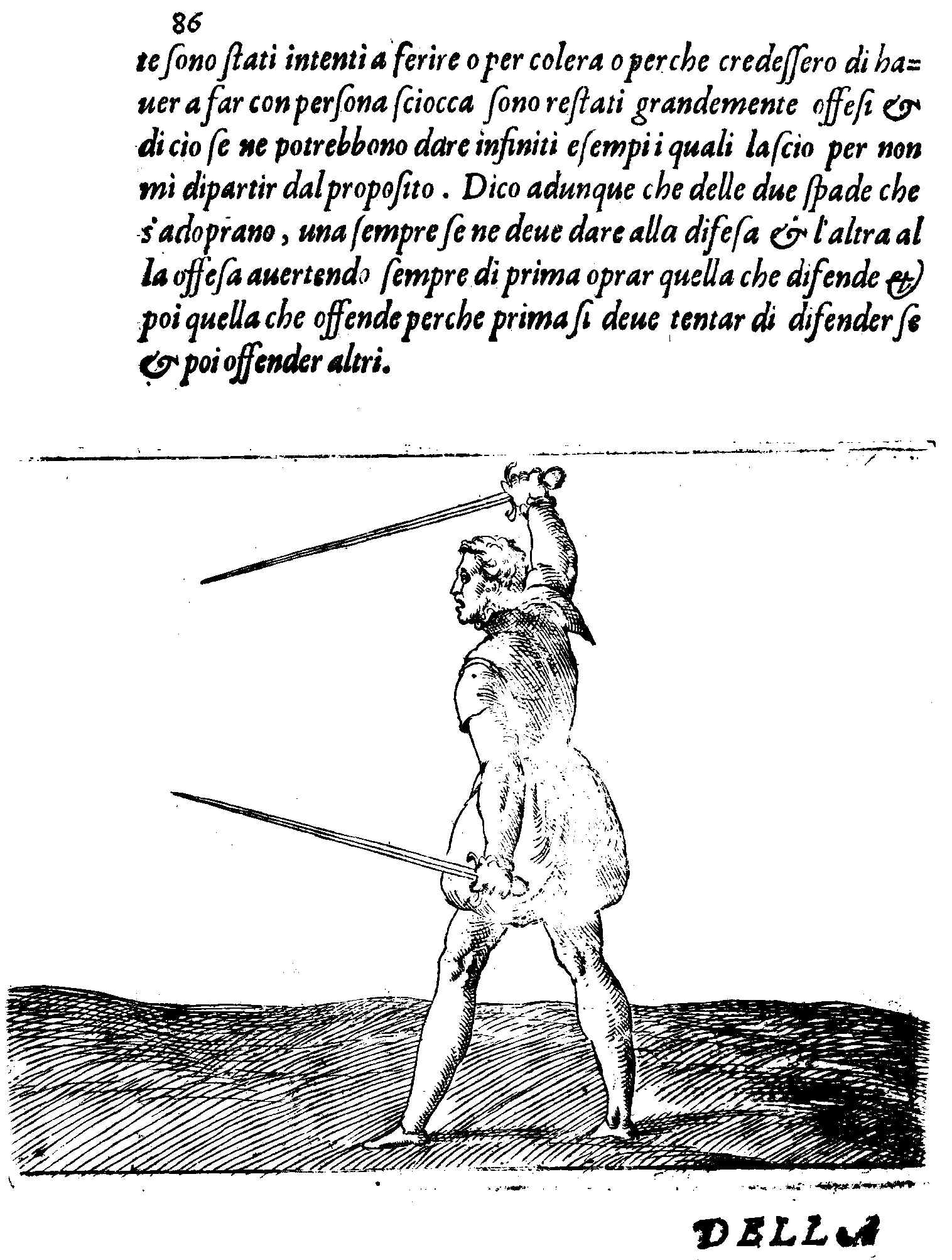
For two swords of equal size he advices at least to keep one high and the other low, with both points pointing forwards. Remember also that in Italian styles, when two weapons are used, the idea is to always look for a single time defense with one and offense with the other, or to join the weapons fr a stronger parry as Stacy mentioned.


Yours,
Ilkka

User avatar
Steven Reich
Posts: 51
Joined: Wed Mar 16, 2005 10:03 am

Postby Steven Reich » Tue Nov 04, 2008 7:39 am

As Ilkka said, the term Florentine was never used historically as a label for using two weapons at the same time, at least, not in any fencing treatise I've ever read (personally, it always makes me think of someone assaulting you holding two fistfuls of spinach).

Masters Altoni and Docciolini are both from Florence and the system described by the latter seems to be a development of the former, so I'd be very likely to call Florentine Fencing the system of these two masters in the same way I'd call Bolognese Fencing the system of Manciolino, Marozzo, Dall'Agocchie, et al.

Steve

User avatar
Benjamin Smith
Posts: 184
Joined: Thu Jun 09, 2005 12:44 pm

Postby Benjamin Smith » Tue Nov 04, 2008 8:49 am

Responding to the Sam Nankivell who said that no master taught case of rapier but case of cut and thrust swords: Fabris taught rapier, and covers case of rapier in his manual. He has some very extreme stances in his method too.
Respectfully,

Ben Smith

LafayetteCCurtis
Posts: 421
Joined: Sat Nov 04, 2006 7:00 pm

Postby LafayetteCCurtis » Fri Nov 07, 2008 1:54 am

CalebChow wrote:Dual swords are much more commonly seen in China and maybe even the Middle East, with dual daos or shamshirs.


I've seen forms for the butterfly swords and even for dual jian, but I don't think I've seen anything about dual Middle-Eastern scimitars outside non-combative sword dances--except for a tantalizing but inconclusive reference briefly glimpsed in a translation of a Mamluk manual. I'll have to get back to that one some time.

LafayetteCCurtis
Posts: 421
Joined: Sat Nov 04, 2006 7:00 pm

Postby LafayetteCCurtis » Fri Nov 07, 2008 2:30 am

Jerrit Reed wrote:Sorry I believe the proper use of the world dual weld should be Florentine.


The use of "Florentine" to describe two-weapon fighting styles is an SCA idiosyncracy, and I've never seen any references showing that the term was actually used as such during the period when European two-sword styles actually existed. The actual terms used were--as has been mentioned--"case of rapiers," or alternatively due spade or dui spade (both literally meaning "two swords." There's also a type of Roman gladiator known as the dimachaeri, from Greek dimakhairoi ("two-swords-man"), but I guess we can safely ignore this one since I don't think I've seen any mentions of Roman two-sword styles outside the theatrical numbers of the gladiatorial arena.

If so, what are those different guards because I could not find them online.


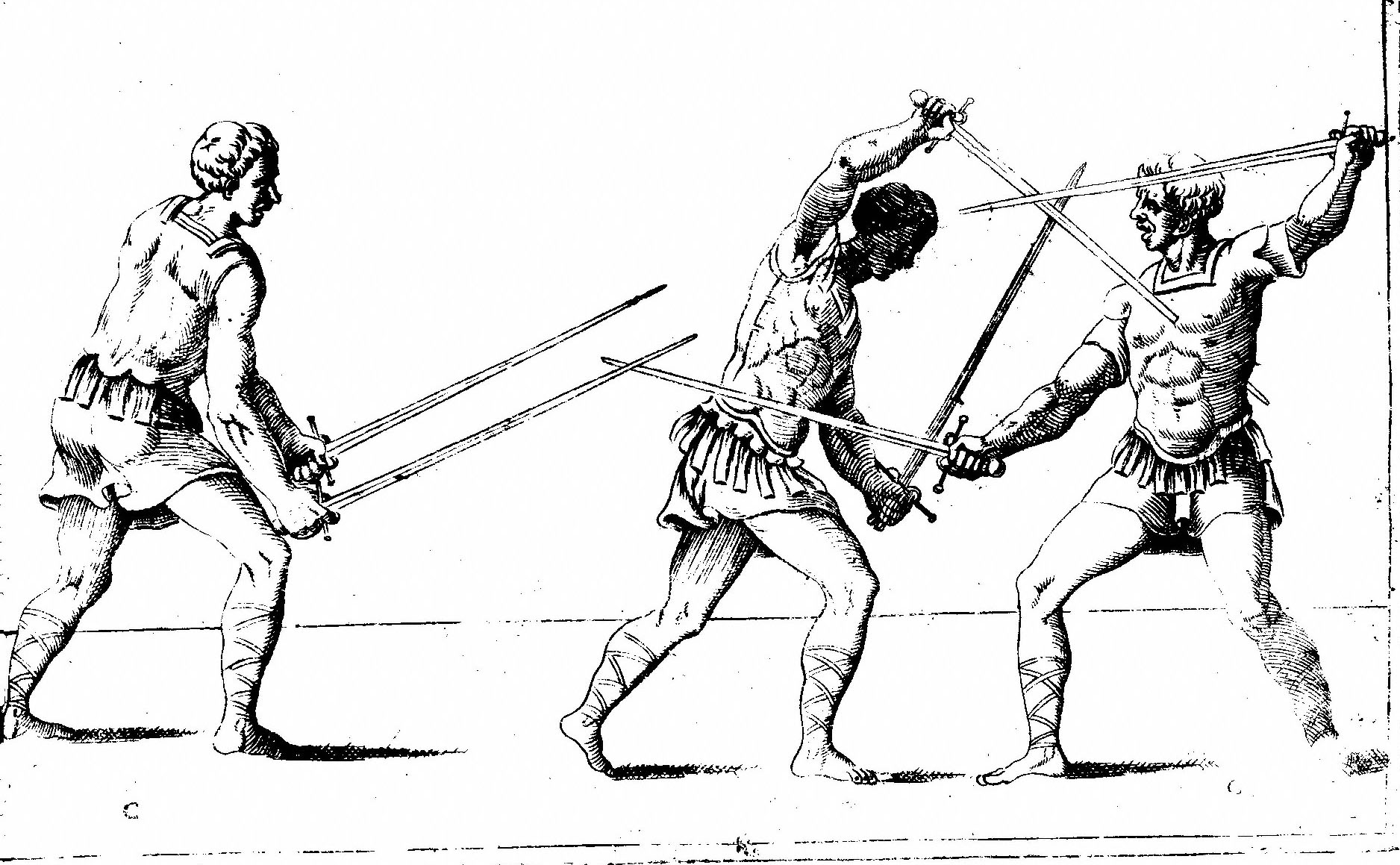
Aside from the Marozzo guard depicted earlier (scroll back through the thread if you didn't catch it, there's also an online picture of Di Grassi's "high ward" for the case of rapiers:

Image

(there's also a much bigger version her: http://www.thearma.org/Manuals/NewManuals/DiGrassi/03001092.jpg) and one from Agrippa here: http://www.thearma.org/Manuals/NewManuals/Agrippa/p112.JPG (I'm linking the image rather than posting it because it's seriously big.

If you're looking for written descriptions, though...well, let me check. An old translation of di Grassi's stuff is here:

http://www.musketeer.org/manuals/diGrassi/contents.htm

I strongly advise you to read at least the introductory and single-sword ("single rapier") sections before going to the "case of rapiers" because otherwise you'd find it hard to make sense of the terms. Meanwhile, Manciolino's two-sword section is here:

http://www.hemac.org/modules.php?name=C ... age&pid=15

but since the translation still preserves many of the untranslatable Italian terms, you should check out some other sources as well to get a clearer picture of the guards and actions, such as Jherek Swanger's translation of the first three books of Manciolino's manual:

http://www.drizzle.com/~celyn/jherek/EngManc.pdf

or the Order of the Seven Hearts's page on the Bolognese swordsmanship style (of which Mancioliono and Marozzo are notable exponents):

http://www.salvatorfabris.com/SectionBolognese.shtml

Sorry if all this research sounds like a frightening amount to you, but trust me, you'll find it fun and won't be able to stop once you've gone into it. Who knows--you might even be motivated to join a local WMA group!

User avatar
Vincent Le Chevalier
Posts: 166
Joined: Mon Dec 31, 2007 5:18 am
Location: Paris, France

Postby Vincent Le Chevalier » Fri Nov 07, 2008 3:55 am

Benjamin Smith wrote:Responding to the Sam Nankivell who said that no master taught case of rapier but case of cut and thrust swords: Fabris taught rapier, and covers case of rapier in his manual. He has some very extreme stances in his method too.

Case of rapier in Fabris? Where exactly? In this manual, I remember reading about sword alone, sword and dagger, sword and cloak, but not case of rapier...

User avatar
Sam Nankivell
Posts: 112
Joined: Sun Feb 25, 2007 1:20 pm
Location: Beijing, China.

Postby Sam Nankivell » Fri Nov 07, 2008 12:40 pm

Vincent Le Chevalier wrote:
Benjamin Smith wrote:Responding to the Sam Nankivell who said that no master taught case of rapier but case of cut and thrust swords: Fabris taught rapier, and covers case of rapier in his manual. He has some very extreme stances in his method too.

Case of rapier in Fabris? Where exactly? In this manual, I remember reading about sword alone, sword and dagger, sword and cloak, but not case of rapier...


Same here. Flipping through the Tom Leoni's translation that I have on my shelf, I can only see single rapier, rapier and dagger and rapier and cloak in book one and a similar layout in book two under a different tactical approach. In book two, single rapier and rapier and dagger are mainly discussed, with a couple plates dedicated to disarms, unarmed vs. dagger and wrestling, a single plate dedicated to rapier vs. polearm and a paragraph dedicated to single dagger vs. single dagger. There isn't any method detailing the use of a case of rapiers in the book.
Prepositions are not words to end sentences with.

User avatar
Benjamin Smith
Posts: 184
Joined: Thu Jun 09, 2005 12:44 pm

Postby Benjamin Smith » Fri Nov 07, 2008 1:55 pm

My apologies, I didn't check my material before I posted, I was actually unknowingly referring to one of the other previously mentioned manuals. Sorry about that.
Respectfully,


Ben Smith

Joel Norman
Posts: 31
Joined: Wed Sep 12, 2007 3:39 pm

Postby Joel Norman » Thu Dec 04, 2008 1:06 am

On this 2 sword idea, I've come across the term 'case of falchions' in reference to James Miller, and early 18th century English prize player. Has anyone ever seen any data on this style? Obviously, it might have been somewhat similar to the idea of a case of thrusting swords, but since falchions are cutters more than thrusters, I would think this would have been distinct from a case of rapiers/cut-and-thrust-swords. Of course, perhaps a falchion meant something different in the 1700s than it did earlier, and the old authors didn't always agree on how to classify everything, as has been shown many times over.
Let the saints be joyful in glory: let them sing aloud upon their beds.
6 Let the high praises of God be in their mouth, and a twoedged sword in their hand;
7 To execute vengeance upon the heathen, and punishments upon the people;
Psalms 149:5 - 7

LafayetteCCurtis
Posts: 421
Joined: Sat Nov 04, 2006 7:00 pm

Postby LafayetteCCurtis » Sun Dec 07, 2008 1:27 am

There doesn't seem to be much information at all; the text of the challenges are the only things I've been able to find, as you can see in these pages:

http://www.safeism.com/blog/index.php/tag/pub/

http://www.british-history.ac.uk/report ... mpid=45102

and a rather confusing reference that may or might not actually have anything to do with swordsmanship:

http://faculty.ed.uiuc.edu/westbury/Par ... TOKER.html


There ought to be somebody in ARMA who has done a lot more research than I have about the various challenges and prize-playing contests in the world of Renaissance and Enlightenment English martial arts, and I hope that person (or those persons) would be able to chime in with other examples--or a verdict about the lack thereof. This is quite important, I think, because I'm tempted to think that "case of falchions" was a style that simply wasn't "played" very often, but I can't and shouldn't pronounce such a judgement unless I've done at least a cursory statistical analysis about its appearance in challenges and prize-playing rolls.

As for the style itself, I haven't been able to find any information about how it's supposed to work. If I'm allowed to speculate, though, the "falchions" used were probably rather shorter than the usual "swords" (or backswords) of the age (note that I have no historical basis for this whatsoever except for some fanciful extrapolation from the Dusack examples I know) and the style might differ from "case of rapiers" in that it'd rely more on quick flurries of short-range blows than on precise placement of the blades to trap the opponent into a suicidal position. It might even look a bit like the two-stick/two-blade styles of Filipino eskrima or Thai krabi krabong but with European footwork and cutting methods (again, no historical basis stronger than "educated speculation").

User avatar
Shane Smith
Posts: 1159
Joined: Thu Sep 19, 2002 2:15 pm
Location: Virginia Beach

Postby Shane Smith » Sun Dec 07, 2008 10:37 am

Benjamin Parker wrote:So its possible to use two greatswords? what about scimitars?


I have never heard of any instance of anyone using two "Greatswords" and I'd be astonished to find one in the historical record. Who has a source for this assertion?
Shane Smith~ARMA Forum Moderator
ARMA~VAB
Free Scholar

Cooper Braun
Posts: 38
Joined: Mon Apr 09, 2007 11:04 am
Location: Boulder, CO

Postby Cooper Braun » Sun Dec 07, 2008 1:18 pm

As to the Falchions, take a look at these to links:
[url] http://www.thearma.org/forum/posting.ph ... ly&t=23740
[url]http://www.myarmoury.com/feature_virgina.html

The picture under the first URL is of John Smith with his famous falchion. this is a little earlier than the time period, but I would suspect the the weapon was similar. In the 17th and 18th centuries, we still see curved blades, though as time progresses the hangers and cutlasses seem to gradually grow shorter in blade length.

Jonathan Newhall
Posts: 234
Joined: Mon Dec 01, 2008 2:41 pm

Postby Jonathan Newhall » Sun Dec 07, 2008 1:45 pm

I was under the impression that a great sword was primarily used as a larger, slashier longsword? This would make wielding one with a single hand a very risky and physically challenging proposition, to say nothing of two.


Return to “Research and Training Discussion”

Who is online

Users browsing this forum: No registered users and 25 guests


Note: ARMA - The Association for Renaissance Martial Arts and the ARMA logo are federally registered trademarks, copyright 2001. All rights reserved. No use of the ARMA name or emblem is permitted without authorization. Reproduction of material from this site without written permission of the authors is strictly prohibited. HACA and The Historical Armed Combat Association copyright 1999 by John Clements. All rights reserved. Contents of this site 1999 by ARMA.