Armor damage due to swords

For Historical European Fighting Arts, Weaponry, & Armor

Moderators: Webmaster, Stacy Clifford

Chris Ouellet
Posts: 83
Joined: Wed Aug 02, 2006 3:38 am

Armor damage due to swords

Postby Chris Ouellet » Wed Aug 02, 2006 4:49 am

This is a serious question - I don't want it to devolve into a flame war.

What do the people at ARMA think about armour damage to plate (specifically plate armour) caused by slashing weapons, specifically two-handed slashing weapons like a longsword used two-handed or a greatsword used two-handed?

Because reading through the online information both on this site and others there is conflicting information.

Everyone realises it's difficult to damage plate armor with swords, but at least from this example:
http://www.shinkendo.com/kabuto.html
it's clearly possible with a high degree of training to damage high quality plate armor in a single stroke.

Furthermore lab experiments have shown that historical european weapons are on average harder than contemporary armour, so if you have enough energy behind the blow it's physically reasonable that the armour will be damaged or breached.
http://www.oakeshott.org/metal.html
This article from the oakeshott institute details quite a bit on this fact.

But we've seen ARMA cutting tests like these:
http://www.thearma.org/photos/Gathering ... utting.htm
where the armor is at best dented by swords.
Can I also ask: Why wasn't a greatsword tested? It seems obvious to me that the greatsword would deliver the most telling blow (a 7lb sword for instance), assuming someone has trained enough to reach the same speed as a longsword.

The articles on ARMA offer contradictory examples for instance:
http://www.thearma.org/essays/damagededge.htm
"When we consider how powerful sword blows were that could damage armor and split helms , it is easy to imagine what they did to thin sword edges."
But then in
http://www.thearma.org/essays/TopMyths.htm
"There are no real-life accounts of edge blows effectively cutting through an armored harness; that is one reason why plate armor was so popular and so much effort put into perfecting it. "

User avatar
Gene Tausk
Posts: 556
Joined: Thu Sep 19, 2002 7:37 pm
Location: Houston, TX

Re: Armor damage due to swords

Postby Gene Tausk » Wed Aug 02, 2006 5:20 am

Before it "devolves" into anything, we ask that you respect our Forum rules, clearly posted, and use your real first and last name.

Please sign out and sign back in with your real first and last name.

Your cooperation is appreciated.
------------->>>>>>>>>>>>>gene tausk
Free-Scholar
Study Group Leader - Houston ARMA Southside
ARMA Forum Moderator

User avatar
Jake_Norwood
Posts: 913
Joined: Thu Sep 19, 2002 11:46 am
Location: Clarksville, TN

Postby Jake_Norwood » Wed Aug 02, 2006 5:24 am

Hi CVO.

First, since someone is going to say it...you need to change your login name to your real name, first and last, as per Forum rules (or our ruthless moderators will delete your posts). If you overlooked it no biggie. I think the new forum software lets you change your "screen name" without starting a new account.

As for your questions...

In my experience with test cutting on armor, the armor usually wins. I've split welded mail with a very, very hard blow, but it was one out of maybe a dozen tries. Plate armor seems only to dent in modern experiments when hit by a sword.

Much of this, as your links show, has to do with the armor itself, as well as the design of the sword. Weaker, more brittle, or thinner metal than what I've cut on might crack, causing a helmet to split, for example. A helmet on a post is also quite different from a helmet on someone's head (or some other softer, simulated "body").

As for why no greatsword test cutting at the 2003 event...we just didn't have one laying around! In truth, I think that finding a well-made greatsword is a very, very difficult thing to do. Even companies that can make passable arming swords or longswords appear incapable of creating a dependable, historical, longer blade such as a greatsword.

Concerning contradicting statemens on the ARMA page...it's an organization, not a single individual! There is no "party line" in the ARMA beyond our adherence to a certain approach to the subject. So different researchers may have differing opinions, basedo n their research, as to what a sword did to armor.

The consensus, though (generally), is that Swords were not meant as can-openers unless used in the half-sword. Test cutting, the armor-fighting techniques shown in the manuals, and non-fictional accounts of medieval and renaissance combat appear to all support this.

I hope that helps.

Jake
Sen. Free Scholar
ARMA Deputy Director

User avatar
John_Clements
Posts: 1167
Joined: Wed Sep 18, 2002 10:43 pm
Location: Atlanta area

Postby John_Clements » Wed Aug 02, 2006 6:35 am

It’s a good question and a reasonable area of inquiry. But you need to follow our clearly explained forum guidelines regarding profile names. (Btw, not to worry we don't permit "flame wars" on our forum).


Not all armors were created alike or standardized in any way. Differences among them were certainly recognized in the Medieval and Renaissance eras.

For the two ARMA quotes you noted, they are not contradictory. Keep in mind that damaging some armors (i.e., by denting or piercing plate or by ripping and tearing maile) is not equivalent to edge blows “cutting through” pieces of plate. As to swords cleaving through or cutting into helms, the issue there is even more ambiguous for the same reasons.

The various forms of plated armor harness worn from the 1300s to 1600s varied considerably in their shape, thickness, weight, and area of coverage such that there were no standardized designs. Given its diversity over the centuries, we cannot state with certainty plate armor’s capacity to resist every kind of blow or injury.

There are many pre-15th century images, and even a few fictional accounts, depicting helms being split open by sword blows or maile armor being penetrated by cuts. Yet, while images of polearms and warhammers penetrating plate-armor are not uncommon, there are very few 15th century images or textual sources for swords piercing or cutting through harnesses of full plate-armor or for armored limbs being lost from edge blows by swords. Whether these examples are apocryphal or actually representative of the capabilities of some swords against some types of plate armor is itself not verifiable (as credible modern experiments have yet to definitively confirm such possibilities and tests can duplicate only some of these results).

While there are images from early Medieval sources of swords cutting into armor or through helmets, nothing in the historical fighting literature or instructional fencing texts supports. Possible explanations might be that this simply reflects inferior armor or otherwise artistic license (e.g., idealized past battles involved heroic supermen delivering fantastic blows). Such art often portrays an idealized image. Because we do not know the exact properties of maile resisting or failing to resist sword blows in historical accounts and artwork, we must be very careful in drawing firm conclusions from such sources as they may or may not reflect some degree of artistic license.

Even historical descriptions of fights with specialized weapons designed for fighting plate armor, such as pole-axes and maces, reveal they were able to actually puncture or pierce through only infrequently. More often they were effective in simply denting and cracking armor to stun and bruise the wearer into a vulnerable condition.

Test-cutting on static armor targets can be an impressive indicator of cutting ability and sword quality, but again, historical examples of it happening to opponents in combat is noticeably lacking. Static test-cuts on select pieces of armor are not quite equivalent to hitting moving targets that wear combinations of defensive material and don’t permit ideal prepared blows (consider for example the 19th century demonstrations of “sword feats” in Europe where contemporary breast-plates were split by heavy sabers).

In the prologue of his Flos Duellatorum (Getty edition) for instance, the master Fiore dei Liberi in 1410 wrote that “one who fights in the barriers and is well armoured, can be given a lot of hits, but still he can win the battle. Also there is another fact: that rarely someone dies because he gets hit...”

What however is supported by the fencing literature of the period and by historical chronicles and accounts of armored combat is that, in the “age of plate,” thrusts were the prevalent and preferred means of sword attack against armor so that many families of swords were designed specifically with this in mind ---it was the very same in Japan for their method of armored combat with sword (and we might note that katanas intended for their age of warring states were heavier, thicker, and more robust than those produced afterwards for unarmored fighting).

Though swords were not capable of truly cutting through plate armor, a fighter would not avoid striking edge blows against an armored opponent if it might bruise or stun him, knock him about, crack his helmet open, slice through straps and tear off pieces, or otherwise weaken his defense to a more effective technique.

While it is frequently stated that larger swords were produced to face heavier armorers, the fact is, over time, swords got larger as armor use declined, and then finally became lighter and thinner only as firearms eliminated the value of armor entirely (and the declining necessity of their use on diverse battlefields). Hence, swords intended for facing plate armor in Europe were narrower, stiffer, more tapered and acutely pointed. Large cutting blades by contrast were optimally designed to serve other purposes. There is no question that against armors a sword’s mass aids in its damage capacity—otherwise an exceptionally light blade with an especially sharp blade would be always be ideal. Thus, many types of swords from the “age of maile” were certainly robust and sharply edged pieces. They could often rent, tear, and pierce maile. But of course they did far to unprotected flesh!

There was historically always an arms race at work between offense and defense, between arms and armor. But the bottom line is, armor worked…otherwise warriors would not have used it the world over.

JC
Last edited by John_Clements on Fri Aug 04, 2006 6:43 am, edited 1 time in total.

Chris Ouellet
Posts: 83
Joined: Wed Aug 02, 2006 3:38 am

Postby Chris Ouellet » Wed Aug 02, 2006 8:29 am

Thanks, no problem on the name.

I think the historical uncertainty is clear in all replies and in fact all I've read to date. We will probably never know the full answer to the historical question other than it likely happened but how often and the precise reason why it happened is anyone's guess.
I agree fully, armor worked, and worked well otherwise people would have abandoned the idea completely.

Now if we turn more towards modern day test cutting the thing that most strikes me in Jake's Reply is that modern day smiths are still today unable to replicate even passable greatswords. This is something I didn't know, not owning one or seeing any destructive tests of one. Are their any plans for ARMA to demonstrate a destructive test with even a not-so-good greatsword?

Something else that I can't seem to find any information on: does anyone know of any destructive tests of plate by a sword swing while charging on horseback?

I didn't know about the sword feats performed in the 19th century, thanks John, I'll look into them further.

Though swords were not capable of truly cutting through plate armor, a fighter would not avoid striking edge blows against an armored opponent if it might bruise or stun him, knock him about, crack his helmet open, slice through straps and tear off pieces, or otherwise weaken his defense to a more effective technique.

That's clearly what I think as well, you would not avoid striking wherever you have an opening despite it being an armored section.
I remain however unconvinced that a direct hit from a greatsword to the armored head would do anything but kill the person. Knowing now that there have been no greatsword tests, does anyone know off the top of their head (no pun intended) of any accounts of people surviving these?

While it is frequently stated that larger swords were produced to face heavier armorers, the fact is, over time, swords got larger as armor use declined, and then finally became lighter and thinner only as firearms eliminated the value of armor entirely (and the declining necessity of their use on diverse battlefields). Hence, swords intended for facing plate armor in Europe were narrower, stiffer, more tapered and acutely pointed. Large cutting blades by contrast were optimally designed to serve other purposes.

Now this is an area I'm particularly interested in, how are people making the estimates of sword prevalence and armor use in these ages?
It's difficult to find concrete numbers to verify these claims - do you know of any good books or articles that tabulate for instance the number and type of swords and the number and type of armor?
Because I read one side of the spectrum saying swords merely got heavier and lighter tapering weapons were used mostly for duels, and the other side claiming that swords that got lighter and tapered were weapons of war.
I know of Oakeshott's and the Wallace collection but even the number I know of (in the hundreds) is a fairly small number to be making such general claims.
I'm really a numbers person (a physicist actually) and I was wondering if hard numbers do exist?

User avatar
Jaron Bernstein
Posts: 1108
Joined: Sun Dec 07, 2003 12:58 am

Postby Jaron Bernstein » Wed Aug 02, 2006 9:02 am

I don't know how useful this will be, but the Higgins Armory had a travelling exhibit that came through my town, so of course I went and slobbered at, er examined it. :) I recall one plate helmet that had very clear slight dents that looked as if someone had been hacking at it with a sword.

User avatar
Allen Johnson
Posts: 638
Joined: Fri Feb 20, 2004 1:43 am
Location: Columbia, SC

Postby Allen Johnson » Wed Aug 02, 2006 9:55 am

Remember, as has been pointed out by others, two of the hardest parts about doing these modern tests is that we cant practice on a real living person and we cant (or have a very difficult time) reproducing armour as they had.

A helmet sitting still on a stump is going to test a whole lot differently than if it was on the head of a moving, uncoperative opponent. Also few will question that even if a sword does not cleave a helm, the trauma from the blow is certainly enough to possibly knock them out or at least loopy for a moment. The second that happens the person is going down. Thats a lot less stable of a striking surface than on a stump or bench.

With making armour, most stuff today is hammered out from steel sheets. Obviously this was not the case back then. Few smiths are going to go through the trouble of the whole smelting process without the aid of modern tools to submit a piece for destructive testing.
"Why is there a picture of a man with a sword in his head on your desk?" -friends inquiry

User avatar
Eric Dohner
Posts: 36
Joined: Sat Jul 15, 2006 6:00 am
Location: Upstate NY

Postby Eric Dohner » Wed Aug 02, 2006 10:25 am

Allen Johnson wrote:Few smiths are going to go through the trouble of the whole smelting process without the aid of modern tools to submit a piece for destructive testing.


Is the verb here "will" or "should?" ;)

User avatar
JeffGentry
Posts: 1089
Joined: Tue Apr 20, 2004 8:35 am
Location: Columbus Ohio

Postby JeffGentry » Wed Aug 02, 2006 6:08 pm

Are their any plans for ARMA to demonstrate a destructive test with even a not-so-good greatsword?


Has anyone in ARMA actualy took a sword and used it with the intention to see what it would take before it would break, or has it just been used in heavy testing and broke? I know i have never intentionaly tried to break a sword it just kind of happened.


I recall one plate helmet that had very clear slight dents that looked as if someone had been hacking at it with a sword.


you talking about the sallade? It looked like it had taken a few shot's.

Jeff
Semper Fidelis

Usque ad Finem

Grace, Focus, Fluidity

david welch
Posts: 453
Joined: Wed Dec 18, 2002 5:04 am
Location: Knoxville TN

Postby david welch » Thu Aug 03, 2006 1:51 am

I think a lot of this depends on a better understanding of what armour was for.

Here in Knoxville we are really not that good, but yet everyone here understands we are not going to just get a free shot at any one of us. If I throw a wrath strike at anybody here I am doing it with the understanding that 99 times out of a hundred it isn't going to connect, I just want to force them to protect that opening so I can wind in and hit them with something else.

Armour looks like it would protect you 100% from the cutting you get from winding. I think that is what is is mostly for. As far as protecting from "big" strikes... I think as you get better (and fight people that are getting better) you start to not expect them to hit as much, and as I said earlier, you use them to force a bind so you can wind in. If winding is pointless, so are the big strikes, and that is why they are not used as much in armoured fighting, not because the armour protects from them.

Of course... the armour would help protect you in a "OH CRAP!" situation, too, but I don't think that was it's primary purpose.

Just something I have been thinking about...
"A sword never kills anybody; it is a tool in the killer's hand." Lucius Annaeus Seneca 4BC-65AD.

User avatar
Nathan Dexter
Posts: 133
Joined: Thu Mar 09, 2006 7:48 pm
Location: USA

Postby Nathan Dexter » Thu Aug 03, 2006 4:58 am

Wasn't thrusting the primary way to defeat plate armor anyway?
if you had the capability to cut through armor, wouldnt thrusting thrrough gaps be moreeffective anyway?
Nathan
Draumarnir á mik.

User avatar
Jake_Norwood
Posts: 913
Joined: Thu Sep 19, 2002 11:46 am
Location: Clarksville, TN

Postby Jake_Norwood » Thu Aug 03, 2006 5:43 am

Now if we turn more towards modern day test cutting the thing that most strikes me in Jake's Reply is that modern day smiths are still today unable to replicate even passable greatswords. This is something I didn't know, not owning one or seeing any destructive tests of one. Are their any plans for ARMA to demonstrate a destructive test with even a not-so-good greatsword?


I'm not so sure that no modern smiths can do it...but none of the immediately affordable ones! I think that Albion's new line will show a lot of promise in this department, as would other high-end pieces. Even a Lutel would probably be pretty good, though also probably heavier than an original. I could consider a Lutel passable, though.

We just didn't really have any we were willing to sacrifice that day. We broke many of the swords that we tested.

Jake
Sen. Free Scholar

ARMA Deputy Director

User avatar
John_Clements
Posts: 1167
Joined: Wed Sep 18, 2002 10:43 pm
Location: Atlanta area

follow up

Postby John_Clements » Thu Aug 03, 2006 6:08 am

Two-handed greatswords with large, flat, parallel-edge cutting blades were just not designed for cutting through plate armor, so I don’t see how they would. They don’t even begin to appear in inventories or art or literature until the end of the 15th century (when plate had already been around for a considerable amount of time), and not for use against plate armor that I recall having read or seen (---despite what we see in popular media fiction or what some museums sometimes portray by having armored harnesses holding them).

That in addition to tapered short and longswords, there were during the age of plate also very long, rigid, tapered, and thicker styles of two-handed blades used against plate, as well as a range of specialty anti-armor weapons, I think explains it all.

Keep in mind though, that an armored fighter was free to use any kind of sword and often needed a good cutting blade (single or double edged, straight or curved) for fighting against common lesser-armored opponents.

Having over the years cut at many different test targets with various great swords, I can see that the difference in striking force of greatswords compared to other longswords is, in my opinion, still not significant to make a difference against finer plate armor.

Besides incidents of unintentional breakage, we have actually done a few destruction tests on various swords (photos are on our site), but the results we think say more about modern reproduction quality than anything about historical specimens. Swords will fail from a variety of reasons.

I know of no statistical studies of comparitive inventories of Medieval swords or armor, I don't think it wouldn't be possble given the lack of historcial records or documented information from the era. Arms & armor study has largely been limited to tracing their change and development, and then cataloging or labeling them, followed by conservation and some speculative research into their function. ARMA by contrast studies more their actual methods of use at the time.

JC

User avatar
JeanryChandler
Posts: 978
Joined: Sat Dec 28, 2002 1:45 am
Location: New Orleans, aka northern Costa Rica
Contact:

Re: Armor damage due to swords

Postby JeanryChandler » Thu Aug 03, 2006 6:23 pm

Interesting discussion.

Couple of points.

As has been mentioned, mail was almost as difficult for a sword to cut through as plate, you may want to keep that in mind for your research.

The term "greatsword" has different meanings, in one major article here on the ARMA site it was used to refer to the so-called "True" two handed swords of the later renaissance, the same enormous 5-6' weapons which other people have correctly or incorrectly referred to as dopplehanders, zweihanders etc. etc. Any sword you are referring to as a 7 pound sword would probably be in this categroy. "Greatsword" however is also used in some circles to refer to certain subtypes of longswords, those with parallel (i.e. non tapering) blades and usually a fairly flat edge geomterty, as appeared at both the beginning (Oakeshott XIIa, XIIIa) and the end (Oakeshott XX) of the longsword lifecycle. These appear to have been designed specifically for cutting through unarmored flesh.

Keep in mind full head to toe plate armor existed for a fairly narrow period of time (1350 - 1500?) with certain specific weapons in vogue during the same period. It's no coincidence that stiff, pointy swords were in vogue during much of this same time period. Forensic evidence (as at Wisby, Towton) has shown that by far the most common way to kill an armored warrior was to cut around the armor.

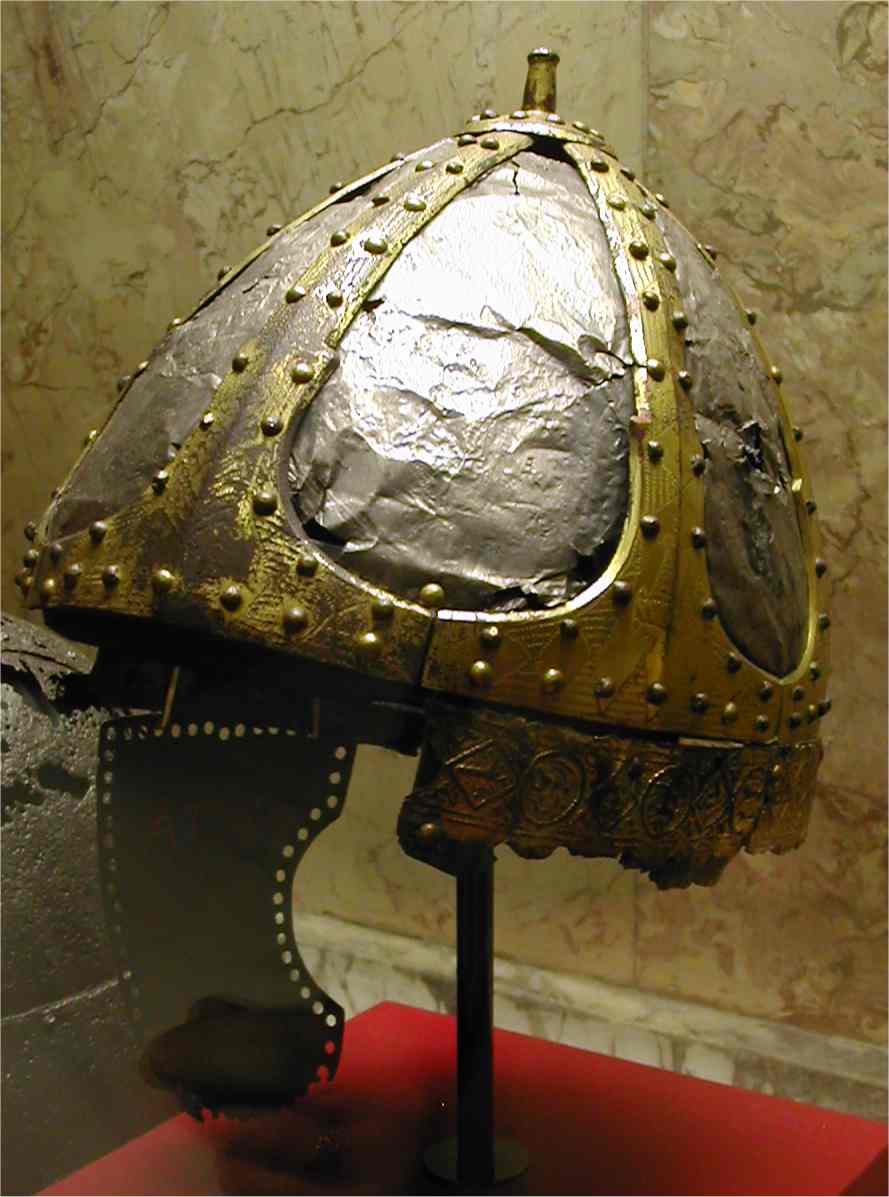
As for helmets, even metal helmets were made in different ways and of different materials, some of which were far more vulnerable than others. You could see a range from a thickness of 12 guage / 2mm to 20 guage / .8 mm, and of materials ranging from a single piece of tempered steel to iron or multiple pieces of iron and brass or bronze riveted together.

A type of helmet very common from the Iron Age through the early Renaissance for example, the spangenhelm, was made of an iron frame with four or more spangen or plates iron or bronze riveted on. Image

This kind of helmet would arguably be considerably easier to penetrate, break, or split than say, a Renaissance sallet raised from one or two pieces of steel...

Image

Finally helmets were also made of everything from boars teeth to felt, so keep in mind the potential range in quality here when you read references to helmets being split.

I don't want to debate it, but I think it's clear that Japanese and European armor were on a vastly different level, and of course Japanese and European weapons were designed to cut in different ways.

Jeanry
"We can't all be saints"
John Dillinger

User avatar
Corey Roberts
Posts: 223
Joined: Sat May 07, 2005 6:11 pm
Location: Pyeongtaek, South Korea

Postby Corey Roberts » Mon Sep 04, 2006 7:39 am

I think it can be safely said that it was perhaps possilbe to penetrate armour by cutting but extremely extremely difficult. Therefore due to this, it was much more efficient and effective to thrust and pry between the plates with a good sturdy thrusting tool.


Return to “Research and Training Discussion”

Who is online

Users browsing this forum: Google [Bot] and 22 guests


Note: ARMA - The Association for Renaissance Martial Arts and the ARMA logo are federally registered trademarks, copyright 2001. All rights reserved. No use of the ARMA name or emblem is permitted without authorization. Reproduction of material from this site without written permission of the authors is strictly prohibited. HACA and The Historical Armed Combat Association copyright 1999 by John Clements. All rights reserved. Contents of this site 1999 by ARMA.