Spathology? Two-Handed Saber?

For Historical European Fighting Arts, Weaponry, & Armor

Moderators: Webmaster, Stacy Clifford

User avatar
Sam Nankivell
Posts: 112
Joined: Sun Feb 25, 2007 1:20 pm
Location: Beijing, China.

Spathology? Two-Handed Saber?

Postby Sam Nankivell » Sun Feb 25, 2007 1:38 pm

I recently registered to the ARMA forums and am wondering why ARMA has decided to use the term spathology to denote the study of swords.

The term is a combination of the latin term Spatha; referring to a sword used in the late Roman Empire which is longer than the Gladius, and the suffix -ology; from the greek word Logos; meaning knowledge or science (not quite sure on Logos since I am only a student of Latin and not Greek). Wouldn't it be better and look more professional to use a term fully derived from one language (in this case Xiphology, derived fully from Greek; meaning study of swords) than use a portmateau of words from two languages.

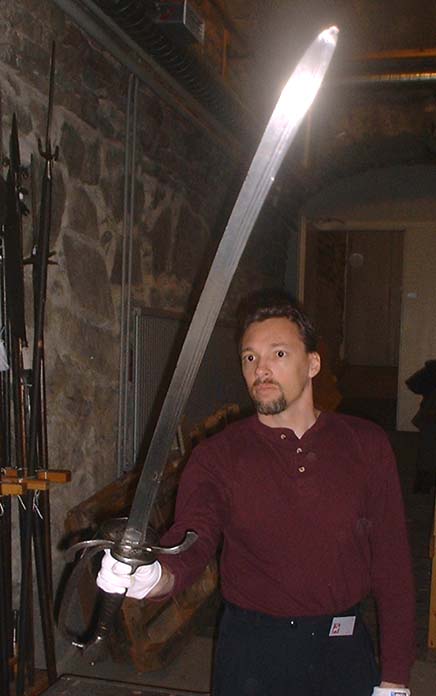
On a side note, has anyone every even heard of a Two-Handed Saber? MyArmoury.com claims it was quite a popular weapon during the Renaissance, but I cannot find any other material about it.

User avatar
Mark Driggs
Posts: 51
Joined: Sun Dec 04, 2005 12:33 pm
Location: Provo, UT

Re: Spathology? Two-Handed Saber?

Postby Mark Driggs » Sun Feb 25, 2007 9:23 pm

You just signed up and already you're starting a linguistics debate...er, um discussion on the board.

English is a loan-word based germanic language where portmanteaus and morphemes abound. You're going to find more than one exception to the rule. In fact, exceptions are the rule. Off the top of my head, I can think of a few other latin greek neologisms: alphanumeric, genealogy, and vulcanology.

By your reasoning, the study of volcanoes ought to be Hephaestusology for consistencies sake. I don't have issue with mixing Greek and Latin since the Romans did it all the time (or at least the educated ones did). Being closely related in the Indo-European language set, there are numerous cognates between the two languages.

Your question however has piqued my interest in the historical etymology of the word 'spathology'. Do any of the other amatuer (professional?) linguists on this board know of the first instance of the word 'spathology'? I'd like to say Oakshott, but I don't have any of his books (yet).

That all being said, Xiphology sounds and looks way cooler than spathology. Oh, and welcome to the forums! :)

P.S. I am not a saber expert, but hearing '2 handed saber' makes me cringe almost as much as hearing '2 handed rapier'. Is it the mythical Euro-Katana? I don't doubt one possibly existed, but there was obviously no widespread use. Most exceptions I chalk up to bored swordsmiths (or their employers).

Sam Nankivell wrote:I recently registered to the ARMA forums and am wondering why ARMA has decided to use the term spathology to denote the study of swords.

The term is a combination of the latin term Spatha; referring to a sword used in the late Roman Empire which is longer than the Gladius, and the suffix -ology; from the greek word Logos; meaning knowledge or science (not quite sure on Logos since I am only a student of Latin and not Greek). Wouldn't it be better and look more professional to use a term fully derived from one language (in this case Xiphology, derived fully from Greek; meaning study of swords) than use a portmateau of words from two languages.

On a side note, has anyone every even heard of a Two-Handed Saber? MyArmoury.com claims it was quite a popular weapon during the Renaissance, but I cannot find any other material about it.
Last edited by Mark Driggs on Mon Feb 26, 2007 11:17 am, edited 1 time in total.

Ken McKenzie
Posts: 22
Joined: Tue Jan 09, 2007 1:42 am

Postby Ken McKenzie » Sun Feb 25, 2007 11:36 pm

As far as I know the word logos pertains to knowledge of a certain subject and the xiphos is the classical, straight bladed, Greek, cut and thrust sword. Now the word spatha is used to refer to the late Roman cavalry sword, however, it latinised from the Greek spathe meaning a broad blade, in other words even in the late Roman empire it was probably something of a generic term. To back this up the word spatha is the linguistic ancestor of the modern Italian word spada which is, as far as I know, a broad, genric term refering to swords as a whole.

On the other hand the word xiphos, to the best of my knowledge, still refers only to ancient Greek swords.

In which case I would consider that spatholgy is a reasonable (and entirely Greek) term to mean 'knowledge of the sword'. Where as xiphology may only refer to knowledge of ancient Greek swords (definatley not an ARMA speciality).

However this is just my opinion and it wouldn't be the first time I've been mistaken.

User avatar
Jake_Norwood
Posts: 913
Joined: Thu Sep 19, 2002 11:46 am
Location: Clarksville, TN

Postby Jake_Norwood » Mon Feb 26, 2007 1:40 am

There's a picture of a two-handed saber --complex hilt and all-- on this page somewhere--a singluar piece that JC saw in Sweden, think, called a...sweizersabel? That's not quite right. I can't find the image at the momement.

Spatha is the root of the word spada, which means sword in all latin-based languages (and shovel in ours...). It's readily recognizable as "sword," which xiphos is not. Let's not get too excited about a particular name for "sword" in a particular language only referring to a particular model of sword. It doesn't quite work so cut-and-dried.

Jake
Former Linguist :)
Sen. Free Scholar
ARMA Deputy Director

User avatar
Sam Nankivell
Posts: 112
Joined: Sun Feb 25, 2007 1:20 pm
Location: Beijing, China.

Postby Sam Nankivell » Mon Feb 26, 2007 3:24 am

As far as I know the word logos pertains to knowledge of a certain subject and the xiphos is the classical, straight bladed, Greek, cut and thrust sword. Now the word spatha is used to refer to the late Roman cavalry sword, however, it latinised from the Greek spathe meaning a broad blade, in other words even in the late Roman empire it was probably something of a generic term. To back this up the word spatha is the linguistic ancestor of the modern Italian word spada which is, as far as I know, a broad, genric term refering to swords as a whole.


Forgive me, my knowledge of Greek is not as good my knowledge of Latin (which is still only that of a second year student).


On the Two-Handed Saber issue, MyArmoury.com seems like a fairly reputable site, but if this weapon was so popular, why is there absolutely NOTHING else about it? Apart from two pictures --one of them being a modern reproduction-- I cannot find anything else about this particular weapon.

Ken McKenzie
Posts: 22
Joined: Tue Jan 09, 2007 1:42 am

Postby Ken McKenzie » Mon Feb 26, 2007 4:29 am

Jake_Norwood wrote:Let's not get too excited about a particular name for "sword" in a particular language only referring to a particular model of sword. It doesn't quite work so cut-and-dried.


I didn't realise there was only one model of straight bladed cut and thrust sword used in classical Greece. I apologise.

User avatar
John_Clements
Posts: 1167
Joined: Wed Sep 18, 2002 10:43 pm
Location: Atlanta area

Re: Spathology? Two-Handed Saber?

Postby John_Clements » Mon Feb 26, 2007 5:31 am

I coined the term spathology sometime I believe after the year 2000. I did so to distinguish the study of the function and use of historical swords from the mere curatorial view that has dominated the subject for sometime, or from the purely martial side of it (i.e., fencing), as well as to better define within the broader study of weapons and combative systems, i.e., "hoplology" (the term coined by R. F. Burton in the 19th century). I did interestingly enough receive thumbs up from the late Ewart Oakeshot for it.

The combining of words of Greek and Latin to form new ones in English is commonplace.

There were plenty of large single edged double-hand swords of straight or semi-curved blade in use in Europe from about the 13th century. Single hand versions were quiet common, so there should be no surprise they developed larger styles. Some of these are nothing more than to-handed falchions, others are more slender and show perhaps Eastern European / Turkish influence. There are however images of cruciform hilt ones from Hungry being wielded by Christian knights dating to c.1200 (some of these are in our Art Talk page --or if not else will be soon). You can them clealry in the Triumphzug of Maximilian from c.1520s. There is a photo of a superb 16th century "grosssabel" (great sabre) that I handled at the Swedish royal armories in our Spotlight section of the site here. I handled another similar piece in Hungary and the British Royal Armouries also has at least one. Also Oakeshot discusses these weapons in at least two of his books, as did the late Eduard Wagner in his titles. Many of these weapons have ring or swept hilts, often with shell plates. There much more that could be said but I have to run and we have a large article planned on these & falchion/messsers anyway.

John C.
Last edited by John_Clements on Mon Feb 26, 2007 5:53 am, edited 2 times in total.

User avatar
Jeremiah Backhaus
Posts: 162
Joined: Wed Dec 20, 2006 6:50 am
Location: West Bend, WI

Re: Spathology? Two-Handed Saber?

Postby Jeremiah Backhaus » Mon Feb 26, 2007 5:41 am

I am a linguist in my sixth year of study in Greek. The word Logos, (ὁ λόγος) in its base meaning means: word, idea, thought. From that base it moved to mean a study. I think the term Spathology is great, even though I haven't found much widespread use. It just sounds cool, which far too often is the base of linguistic decisions.

To say that English is a Germanic base language might be going too far. The similarities between English and Anglo-Saxon is closer than "pure" German. VERY heavily influenced, definately. It makes learning both much easier, but similiarities can be found in French as well (wikipedia throws numbers around that 56.5% of English words come from French and Latin). English is to language what Rome was to religion. It found things that it liked from the surrounding area and made it it's own.


Mark Driggs wrote:Your question however has piqued my interest in the historical entomology of the word 'spathology'. Do any of the other amatuer (professional?) linguists on this board know of the first instance of the word 'spathology'? I'd like to say Oakshott, but I don't have any of his books (yet).


I don't mean to knit-pick, but the term is "etymology." Entomology is the study of insects, mostly by disecting them.

User avatar
Jake_Norwood
Posts: 913
Joined: Thu Sep 19, 2002 11:46 am
Location: Clarksville, TN

Postby Jake_Norwood » Mon Feb 26, 2007 10:39 am

Well, as a linguist-guy and student of Anglo saxon...I'm going to nit-pick, but mostly just for fun.

English is definitely a Germanic language--not to say it's descended from German, but that it and German share a common ancestors. And German has deviated *way* less from the base than English has.

It's estimated that 70% of English vocabulary comes from French and Latin. It has borrowed more into its vocabulary from outside of it's base (Germanic) than maybe any other major language in the world. It is, in truth, almost a Franco-Latin/Germanic pidgin...just one that's been around so long it's gone past that. As they say, the difference between a language and a dialect is a navy and an army.

But even with so little Germanic vocabulary, the base 200 words of English are all Germanic, as is the base grammar (both syntax and native morphology), not to mention our pronunciation of basic phonemes all fall under Grimm's law, which differentiates Germanic Languages from all other Indo-European languages.

Fun, huh?

Jake
Sen. Free Scholar

ARMA Deputy Director

User avatar
Mark Driggs
Posts: 51
Joined: Sun Dec 04, 2005 12:33 pm
Location: Provo, UT

Re: Spathology? Two-Handed Saber?

Postby Mark Driggs » Mon Feb 26, 2007 11:09 am

Jeremiah Backhaus wrote:
Mark Driggs wrote:Your question however has piqued my interest in the historical entomology of the word 'spathology'. Do any of the other amatuer (professional?) linguists on this board know of the first instance of the word 'spathology'? I'd like to say Oakshott, but I don't have any of his books (yet).


I don't mean to knit-pick, but the term is "etymology." Entomology is the study of insects, mostly by disecting them.


Major Faux Pas on my part. I attribute it to being late at night. Silly homophones.

LafayetteCCurtis
Posts: 421
Joined: Sat Nov 04, 2006 7:00 pm

Postby LafayetteCCurtis » Mon Feb 26, 2007 4:21 pm

"I don't mean to knit-pick."

LOL. Maybe all of us should learn to type a little slower...

User avatar
Stacy Clifford
Posts: 1126
Joined: Fri May 14, 2004 11:51 am
Location: Houston, TX
Contact:

Postby Stacy Clifford » Mon Feb 26, 2007 4:56 pm

0==[>>>>>>>>>>>>>>>>>
Stacy Clifford
Free-Scholar
ARMA Houston, TX

User avatar
Jeremiah Backhaus
Posts: 162
Joined: Wed Dec 20, 2006 6:50 am
Location: West Bend, WI

Postby Jeremiah Backhaus » Mon Feb 26, 2007 6:42 pm

Jake_Norwood wrote:Well, as a linguist-guy and student of Anglo saxon...I'm going to nit-pick, but mostly just for fun.

English is definitely a Germanic language--not to say it's descended from German, but that it and German share a common ancestors. And German has deviated *way* less from the base than English has.

It's estimated that 70% of English vocabulary comes from French and Latin. It has borrowed more into its vocabulary from outside of it's base (Germanic) than maybe any other major language in the world. It is, in truth, almost a Franco-Latin/Germanic pidgin...just one that's been around so long it's gone past that. As they say, the difference between a language and a dialect is a navy and an army.

But even with so little Germanic vocabulary, the base 200 words of English are all Germanic, as is the base grammar (both syntax and native morphology), not to mention our pronunciation of basic phonemes all fall under Grimm's law, which differentiates Germanic Languages from all other Indo-European languages.

Fun, huh?

Jake


I have seen connections with German in my studies, I like the occasional cognate, it makes learning the vocables much easier. I think that you said more eloquently what I was trying to say. Related, but not direct descendant. The long track that English has taken is why I am careful about commenting on the relation between the two. Of course, it seems that you have thought much more on this than I have, so thanks for the better phrasing.
Case-in-point with the Language vs Dialect. I studied high German for six years, translating old Church German. My Grandmother's first language was low German. I cannot understand hardly even a word that she says. they use the same letters, but it ends shortly after that (probably an overstatement, as I haven't had the chance to look more at low German).
Out of curiosity, what do you mean by "base grammar?" I see a connection between necessary building blocks (subject, verb, modifiers) but things get a little funny after that (inverted word order, transposed word order, extended attrinute clauses (which I love)).
Languages and fun, sometimes I think those two words only go together in my dreams...

-Jeremiah

User avatar
JeremyDillon
Posts: 122
Joined: Sun May 14, 2006 6:40 pm
Location: Cape Girardeau, MO

Postby JeremyDillon » Mon Feb 26, 2007 10:19 pm

Stacy Clifford wrote:That picture is on this page:

http://www.thearma.org/spotlight/heymr.htm

Gorgeous piece:

http://www.thearma.org/spotlight/heymr/heymr58_lg.jpg

That really looks like a fantastically practical fighting weapon to me, and very beautiful.

User avatar
Jake_Norwood
Posts: 913
Joined: Thu Sep 19, 2002 11:46 am
Location: Clarksville, TN

Postby Jake_Norwood » Tue Feb 27, 2007 9:51 am

Jeremiah Backhaus wrote:

Out of curiosity, what do you mean by "base grammar?" I see a connection between necessary building blocks (subject, verb, modifiers) but things get a little funny after that (inverted word order, transposed word order, extended attrinute clauses (which I love)).
Languages and fun, sometimes I think those two words only go together in my dreams...

-Jeremiah


Language is sooo fun. For me at least.

You've already identified a lot of that "base grammar" in those connections between building blocks. Grammer is the blueprint or the glue that allows a string of words to mean something other than their individual definitions. German and English work on the same base, although the English base has deteriorated horribly over the last 1000 years. If you look at Old English--think Beowulf--you'll find it completely unintelligible...unless you (a) learn the differences in the alphabet and then (b) pretend that it's German. Now you'll be able to read quite a bit of it. More than an English-only speaker, at least.

If you look at middle English--this is Chaucer--already you'll understand a lot more. Between German and French you'll understand lots.

Then get to George Silver or Shakespeare, and you have what's called Early Modern English. You understand almost all of it.

This shows a few things. First, you see how Germanic English was. Second you'll see that while the Vocabulary changes wildly, the grammar--or structure that the vocab fits in--hasn't changed all that much. Oh, sure, it's gotten blander and simultaneously more complicated (through a host of exceptions), but it's still the same.

In fact, almost anything you learn in school nowadays as an "exception" is actually a leftover Germanic rule. Examples:

Plural of Ox -> Oxes? nope...Oxen
Spelling of Laugh, Cough, Through, Knight, etc.? All mirror the middle or old english pronunciation...which you'll recognize in german as well:
Through -> Durch (Th-> D, gh -> ch)
Knight -> knecht
Sword -> Swert (again, t-> d)

All of your "grammar" words--that is Pronouns, articles, etc., are derived from German. Compare

English / German
through / durch
the / der, die, das
under / unter
over / ober, uber
to / zu
on / an
she / sie
they / sie
thou (early modern english) / du
we / wir
me / mich
this / das, dies
is / ist

You also see the base grammar relation in our morphology, mostly in our verbs. Other examples are covered above, in some plurals (oxen, brethren, mouse/mice, etc), and pronouns (she/sie, etc). This is more obvious when you use older, Shakespearean versions of English verbs, which were less "lazy."

(to) have / (zu) haben
I have / Ich habe
thou hast / Du hast (mich gefragt...Rammstein fans, anyone?)
he has / Er hat
we have / wir haben
you,ye have / ihr haben
they have / sie haben

A couple of observations.
First, the infinitive is formed the same way.
Second, the obvious connections in pronouns. Ich and I are obvious, as are thou and du, we and wir, you and ihr, and they and sie.
Third, the "thou" version of the verbs are identical
Fourth, the "he" version of the verb is similar in that it is the shortest of the lot, is created using a dental consonant (bear with me here), and is an exception to the spelling/structure of the infinitive of the verb
Fifth, the we, you, and they forms of the verb are the same, and come directly from the infinitive.

English lost the "thou hast" form when we went to referring to everyone by the formal second-person plural "you," or "ye," as you see it in the Bible. There is, gramatically, no longer a "familiar" form of address in English pronouns. Because of that there's no longer a distinct difference between you (one person) and you (plural), hence the commonality of constructs like "you guys" or "y'all" to refer to multiple "you's." English, as recently as the 1600s, didn't have that problem. But I digress.

I hope that serves as a decent primer.

Jake
Sen. Free Scholar

ARMA Deputy Director


Return to “Research and Training Discussion”

Who is online

Users browsing this forum: No registered users and 5 guests


Note: ARMA - The Association for Renaissance Martial Arts and the ARMA logo are federally registered trademarks, copyright 2001. All rights reserved. No use of the ARMA name or emblem is permitted without authorization. Reproduction of material from this site without written permission of the authors is strictly prohibited. HACA and The Historical Armed Combat Association copyright 1999 by John Clements. All rights reserved. Contents of this site 1999 by ARMA.