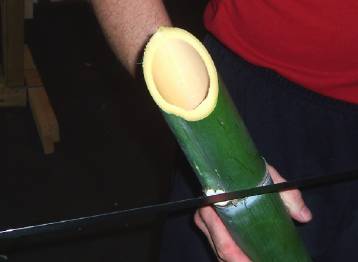

New test cutting vid - blunt sword on thick bamboo

For Historical European Fighting Arts, Weaponry, & Armor

Moderators: Webmaster, Stacy Clifford

User avatar
John_Clements
Posts: 1167
Joined: Wed Sep 18, 2002 10:43 pm
Location: Atlanta area

New test cutting vid - blunt sword on thick bamboo

Postby John_Clements » Thu Sep 07, 2006 5:57 am

Last edited by John_Clements on Mon Nov 27, 2006 4:49 am, edited 2 times in total.

User avatar
Kenneth Armstrong
Posts: 13
Joined: Mon Aug 21, 2006 5:36 pm
Location: Forest, Virginia

Postby Kenneth Armstrong » Thu Sep 07, 2006 1:01 pm

Pretty neat.

Where did that poster in the background come from?

User avatar
Jeffrey Hull
Posts: 678
Joined: Wed Sep 25, 2002 3:40 pm
Location: USA

Bravo

Postby Jeffrey Hull » Thu Sep 07, 2006 8:27 pm

That was nicely illustrative of how well someone can cut testing material even with a blunt European sword if he uses good techinque and power, even if said material (i.e. thick green bamboo) supposedly can be cut only by the super senseis of Whatever-Ryu and only with special deity-approved and imperially sanctioned $10000 iaido katanas. :wink:

I have similarly proven to myself that one could cut through saplings, PEX tubing, etc and other such stuff with a rather unsharp (and admittedly cheap) longsword.

Doing those sorts of things teaches one first-hand about one's ability and one's weaponry.

As an aside, it led me to realise how ridiculous was all the deifying at certain other websites of persons who would brag about their razor-sharp katanas and how they could cut through various testing media common as if nobody else anywhere else could ever possibly equal such feats.
JLH

*Wehrlos ist ehrlos*

User avatar
Neil Bockus
Posts: 31
Joined: Wed Jan 26, 2005 2:00 pm
Location: New York

Postby Neil Bockus » Mon Sep 18, 2006 11:51 am

Very nice video, and I'm not surprised at the result. A few weeks back we test cut against a wetted industrial cardboard tube (~1/3-1/2in. thick) with a blunt Cold Steel two-hand sword. One of my friends got through a section of tube in a single cut (I had a bit tougher time). All the more ammo for me when trying to be logical with some of my EMA roommates (some "true believers" in the katana, let me tell you) :D .

User avatar
JeremyDillon
Posts: 122
Joined: Sun May 14, 2006 6:40 pm
Location: Cape Girardeau, MO

Postby JeremyDillon » Tue Oct 03, 2006 5:41 pm

An acquaintance of mine has always insisted that the japanese sword's "superior cutting edge" would allow it to cut much more effectively through materials than a european sword. He actualy insisted that a japanese longsword could "slice" through plate armor. He recently showed me a video of his "teacher" (an out of work karate instructor who bought a sword on ebay and is therefore, aparently, qualified to give weapons training) cutting similar bamboo, so I was delighted to be able to show him this video. Thanks!

User avatar
Derrick Berrier
Posts: 41
Joined: Tue Apr 11, 2006 9:28 pm
Location: Louisville, Kentucky

Postby Derrick Berrier » Wed Oct 04, 2006 5:10 am

Kind of puts a lot of myths to bed for me. I look forward to the chance to do some cutting of my own soon. As of yet I am still bound by wood. Anyway good clip.

Derrick Berrier

User avatar
Rodolfo Martínez
Posts: 48
Joined: Wed Nov 22, 2006 6:02 am
Location: Argentina

Postby Rodolfo Martínez » Wed Nov 22, 2006 6:44 am

Hi everyone!
Its impressive the cutting power of a blunt straight sword. Some days ago i saw on tv a collector of a museum, saying that japanese warriors, in the XVII century prefered their own curved katanas instead of the straight doubled edged europead swords because katanas were superior and the straight swords were rustic and archaic. What about a green bamboo cutting blunt bastard sword? So, my question is, in an hypothetical case, can a blunt japanese katana cut as well as the ¨archaic¨ straight bastard swords?
Non nobis Domine...

User avatar
Randall Pleasant
Posts: 872
Joined: Mon Sep 23, 2002 3:35 pm
Location: Flower Mound, Texas, USA

Postby Randall Pleasant » Fri Nov 24, 2006 5:39 am

Rodolfo Martínez wrote:So, my question is, in an hypothetical case, can a blunt japanese katana cut as well as the ¨archaic¨ straight bastard swords?

I hope you understand that stright bladed European swords were not in any manner "archaic" in comparison to the katana. Given how little Japanese swords changed over a very long period of time it might make better sense to consider their design "archaic".
Ran Pleasant

User avatar
Jeffrey Hull
Posts: 678
Joined: Wed Sep 25, 2002 3:40 pm
Location: USA

Museumites

Postby Jeffrey Hull » Fri Nov 24, 2006 12:21 pm

Rodolfo Martínez wrote:Hi everyone!
Its impressive the cutting power of a blunt straight sword. Some days ago i saw on tv a collector of a museum, saying that japanese warriors, in the XVII century prefered their own curved katanas instead of the straight doubled edged europead swords because katanas were superior and the straight swords were rustic and archaic. What about a green bamboo cutting blunt bastard sword? So, my question is, in an hypothetical case, can a blunt japanese katana cut as well as the ¨archaic¨ straight bastard swords?


Most museum curators have never cut anything with any sort of sword. For that matter, most museum curators probably have no experience with martial arts. For that matter, most museum curators fill their professional reading time with treatises on art-history and design-lineage, or peer-journals extolling the latest psycho-sexual criticism of artistic symbology, or articles about the newest utilitarian conservation techniques...Yet not with any fight-books.

A decent guess is that the quoted museumite was simply relaying one of the manifold, tired, wrong notions that plague the study of hoplology even as folks like us strive to make it fruitful, truthful and expansive.

If anyone finds all that unduly harsh, then please know that I say such because I am totally sick of the constant nonsense that some well-paid academics spout in smug expectation that it shall go uncontested beneath the aegis of their titles and tenure. Just bloody well had it with them.

I can count on one gauntlet the number of museum curators with whom I am acquainted who have bravely pulled themselves out of the peer-approval paradigm to try to understand the old arms and armour in a manner similar to how serious students of Renaissance martial arts strive to do.
JLH


*Wehrlos ist ehrlos*

Mike West
Posts: 8
Joined: Sat Jan 11, 2003 10:08 pm

The sword used in the video?

Postby Mike West » Sat Nov 25, 2006 7:47 pm

What make, model of sword was used on the bamboo cutting video?

User avatar
John_Clements
Posts: 1167
Joined: Wed Sep 18, 2002 10:43 pm
Location: Atlanta area

Re: The sword used in the video?

Postby John_Clements » Mon Nov 27, 2006 4:51 am

It was an older Raven Armouries bastard sword from the UK.

User avatar
Rodolfo Martínez
Posts: 48
Joined: Wed Nov 22, 2006 6:02 am
Location: Argentina

Postby Rodolfo Martínez » Fri Dec 01, 2006 8:27 am

¨Archaic¨ was ironacally. I never handled a sword, but i understand that a sword isn´t only an edge, is a strong hilt, fuller, pommel, a hand, a brain and a lot more and that is enough for me to know that straight swords weren´t archaic weapons, not only european, chinese too.

About test cuts, my friend told me that a blunt longsword can dismember an arm in a vertical position. Is this true?

Last week i saw a master using a long odachi blade. But the edge was very curved, maybe more than a Katana´s blade, So didn´t a very curved blade difficult a good and deep slash? I mean, giving a powerful and deep slice trough someone´s flesh.

Thanks to all.
Non nobis Domine...

User avatar
Jeffrey Hull
Posts: 678
Joined: Wed Sep 25, 2002 3:40 pm
Location: USA

Sword Motions and Impacts

Postby Jeffrey Hull » Fri Dec 01, 2006 12:26 pm

Our super-smart comrade George Turner explains the thought and misthoughts about curved blades in part 3 of his article
Sword Motions and Impacts: An Investigation and Analysis
under heading "Blade Curvature". :arrow:
http://www.thearma.org/spotlight/GTA/mo ... pacts3.htm
JLH


*Wehrlos ist ehrlos*

User avatar
Rodolfo Martínez
Posts: 48
Joined: Wed Nov 22, 2006 6:02 am
Location: Argentina

Postby Rodolfo Martínez » Fri Dec 01, 2006 6:08 pm

Thank you Jeffrey!

I was told too that odachis weren´t used by samurais (But i think they really do), they were used by lower rank foot soldiers to cut horses´ legs. So, can a sword cut horses´ legs?
Non nobis Domine...

User avatar
Mars Healey
Posts: 79
Joined: Mon Dec 19, 2005 8:41 pm
Location: CT, USA
Contact:

Postby Mars Healey » Sat Dec 02, 2006 1:52 am

We are having a Changdao master come to our school on Dec 5th and give us a demo of the Chinese "horse sword".

Image

Ming Dynasty two-handed swords (probably early to mid-17th century) known then as the "changdao" but are more popularly known today as the "Miao Dao". These blades have ridged cross-sections and were obviously inspired by the large Japanese swords (known as "nodachi") used by the Japanese pirates raiding the Chinese south-eastern coast. As for the diagrams showing the swordsmen, they are from a Ming martial arts manual published in 1621.


These large 2-handed sabers were first used by the Northern Border Troops under the command of Ming General Qi Jiguang in the late 1560s-70s to deal with Mongol cavalry, and remained in use right up to the late Ming (1620s-1644). At that time, these sabers had an overall specified length of 1.95 meters.

Information taken from: Ming and Qing swords

I'll let you know what I learn from him.
"Practice knighthood, and learn the Art that dignifies you."
-Johannes Liechtenauer
Western Swordsmanship Technique & Research


Return to “Research and Training Discussion”

Who is online

Users browsing this forum: No registered users and 10 guests


Note: ARMA - The Association for Renaissance Martial Arts and the ARMA logo are federally registered trademarks, copyright 2001. All rights reserved. No use of the ARMA name or emblem is permitted without authorization. Reproduction of material from this site without written permission of the authors is strictly prohibited. HACA and The Historical Armed Combat Association copyright 1999 by John Clements. All rights reserved. Contents of this site 1999 by ARMA.