The Shiller

For Historical European Fighting Arts, Weaponry, & Armor

Moderators: Webmaster, Stacy Clifford

Andy Spalding
Posts: 64
Joined: Sun Oct 01, 2006 2:28 pm
Location: Murray, Kentucky

The Shiller

Postby Andy Spalding » Wed Sep 26, 2007 6:14 pm

I was reading my Meyer today, and i was pondering the squint cut in particular. In all the instances meyer speaks of the squint it speaks of a short edge cut. This made me wonder and question whether it is a short edge cut to the inside or outside of the body.

The way i was taught, the shiller is thrown from on high with a turn of the blade so you strike with the short edge instead of the long. You can preform a short edge cut the same way you would preform a zorn hau with a step to the inside of the body (left foot forward vom tag to right foot wechsel). This always seemed awkward to me because why would you short edge cut with a weaker grip when a long edge cut would work just as well?

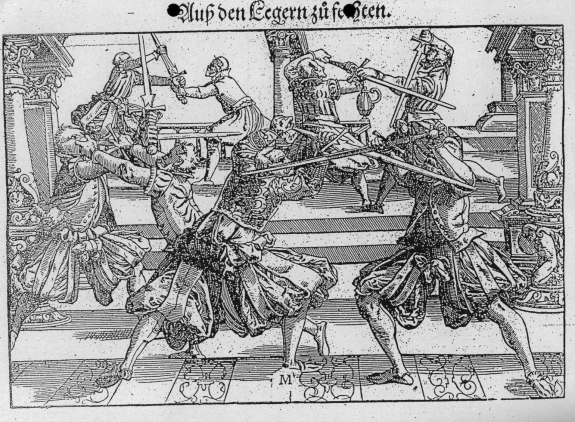
I started to look at the images in particular and one struck me as strange, when i read the description it enlightened me. The plate was M and it was the two figures in the foreground.

http://www.thearma.org/pdf/jmgsx5.jpg

The description of the interaction is that the fellow on the right has wound around the left and is in "the old squinting cut".

The guy one the left is throwing a zwerch with the short edge. from left to right. This is shown by the position of the left fellows hands. His wrist is behind the pommel showing that he is applying pressure to it with his left while likewise applying pressure with the fingers of his right. His thumb most likely on the flat. He has missed his intended target and is in the back swing.

The guy on the right has wound around the man on the left and is in the "squinting cut" position as meyer describes it. This directs the left man's blade downward. The over the cross grip of the right man give the sword enough angle to hit the left man in the head or ear if he preforms it as a cut.

If this is preformed as a cut, it makes me think the shiller is a short edge cut from the inside of ones body to the out through the downward diagonal. (if right foot forward like the plate, from the upper left quarter to the lower right.)

I looked up squint and found its definition to include "to look sideways". When you look at something sideways you turn your head to the side. Meaning that if you look at something sideways with your left foot foreward, you are looking at it with your head tilted to the left, or to the outside.

In meyer he describes the squint as the counter to plow. We know this. But it is not a strike and counter at the same time as the crown hau is. Meyer speaks of "laying on to the opponent with the squint", then working the openings. This makes me believe it is a two step process.

If an opponent is in left foot forward pfluge and you in left forward vom tag (as we most likely are as it is favorable) then a short edge strike from vom tag from upper right to lower left would clear the opponents tip from you in the most expedient manner and open him up for any number of strikes.

It is becasue of these reasons that i feel a schielhauw is a zorn like strike from the inside of the body to the out with the short edge as opposed to the long.(upper left to lower right if left forward, turning the tip to the outside of the body, or the left side to push the opponents tip out.)

Let me know what you all think, as this is just a theory and i have no idea if this has been considered in the past.

User avatar
philippewillaume
Posts: 336
Joined: Wed Apr 21, 2004 6:51 am
Location: UK, windsor
Contact:

Postby philippewillaume » Thu Sep 27, 2007 5:50 am

Hello

I would say that the guy on the left is thrusting given te hway he gabs the sword. One hand on et forte on hand on the pommel. It does not really change what you are saying,

I am not sure I understand what you mean by inside and outside the body

http://www.youtube.com/watch?v=IGZTMVd8Cu8

In the video do I (I am the fat block in with the white Rugby shirt) take the shiel inside or outside the body?

Cheers phil
One Ringeck to bring them all In the Land of Windsor where phlip phlop live.

Andy Spalding
Posts: 64
Joined: Sun Oct 01, 2006 2:28 pm
Location: Murray, Kentucky

Postby Andy Spalding » Thu Sep 27, 2007 6:26 am

If left foot forward, i am calling the left side of the body the outside because it contains most of your back. If in modern fencing terms it would be like taking the blade from 4 to 6 using the short edge.

User avatar
philippewillaume
Posts: 336
Joined: Wed Apr 21, 2004 6:51 am
Location: UK, windsor
Contact:

Postby philippewillaume » Thu Sep 27, 2007 11:36 am

hello andy sorry I must be thick, But I still don’t get it.

and to make it worse; Inside and outside are omote and ura in JSA so I am familiar with the concept but

I usually that all the strike should start like a Zornh and just bein change at the last minute, so I think I understand that bit as well.

Are you talking about winding the balde inwards vs winding the blade outward?
Ie takin the shiel by rotating th short edge towards us as opposed to rotating the short edge away from us (or changing the grip of the front hand which is essentially the same).

If that is the case I do not think that there is a rule what matter is the bio mechanic structure of the shiel, so personally I used both according to what is convenient for me at the time.

phil
One Ringeck to bring them all In the Land of Windsor where phlip phlop live.

Andy Spalding
Posts: 64
Joined: Sun Oct 01, 2006 2:28 pm
Location: Murray, Kentucky

Postby Andy Spalding » Thu Sep 27, 2007 2:51 pm

But wouldn't that just be a zorn with a twist? How would that strike constitute a new name? Not only a new name, but be a meister hau?

It seems to me that would be a zorn technique, not a separate cut all together.

I may not be able to articulate what i am talking about right now, but give me a couple weeks, i'll knock up a video. I'm sure that would help.

User avatar
Jaron Bernstein
Posts: 1108
Joined: Sun Dec 07, 2003 12:58 am

Postby Jaron Bernstein » Thu Sep 27, 2007 4:01 pm

Hi Andy! :D

Woodcut M is only specifically referenced in the Forgeng translation in a few places. 43r4, 43r2 and 43r3 (pg. 87-eighty-eight). The guys you are describing (right foreground in M) are listed in 43r3 and the text describes an ubergreifen (overgripping). IMO that is supported by looking at the hands on the right fencer. There are many woodcuts in that manual that match the text without an explicit reference (I can give some examples if you like), but I don't think this is one.

The schiller you are describing (43v on pg. 88 if I understand you correctly) isn't IMO related to woodcut M. My understanding of that passage is as follows. You have thrown a long edge downward oberhau and he has thrown a zwerch. You are now both in a bind. He goes to move from the zwerch to something else. You then counter this by executing a schiller by flipping your blade over and cutting straight down with the short edge. Your long edge should now be facing up.

There is extensive talk on the Schiller in pages 97-99 and the front middle fellows in woodcut G are what I believe to be the correct version.

User avatar
Jaron Bernstein
Posts: 1108
Joined: Sun Dec 07, 2003 12:58 am

Re: The Shiller

Postby Jaron Bernstein » Thu Sep 27, 2007 5:05 pm

I don't believe it matters if you throw the Schiller from the right or left:

"There are three Squinters, namely two Squinting cuts, one from the right, the second from your left, which is done with crossed hands not unlike the Crooked Cut, as described above concerning the Crooked Cuts. The third is a squinter with the face where I look at a place, and act as if I intented to strike there, but I don't do this, but strike in somwhere else" (Forgeng pg 97).

User avatar
Jaron Bernstein
Posts: 1108
Joined: Sun Dec 07, 2003 12:58 am

Postby Jaron Bernstein » Thu Sep 27, 2007 5:10 pm

Andy Spalding wrote:But wouldn't that just be a zorn with a twist? How would that strike constitute a new name? Not only a new name, but be a meister hau?

It seems to me that would be a zorn technique, not a separate cut all together.

I may not be able to articulate what i am talking about right now, but give me a couple weeks, i'll knock up a video. I'm sure that would help.


By using a descending short (rather than long) edge you get certain advantages in angle, reach and closing off the opponents line of attack. Meistherhau are special because they both 1. hit the other fellow and 2. close his line of attack at the same time if I understand correctly.

User avatar
Jaron Bernstein
Posts: 1108
Joined: Sun Dec 07, 2003 12:58 am

Postby Jaron Bernstein » Thu Sep 27, 2007 5:14 pm

Jaron Bernstein wrote:Hi Andy! :D

Woodcut M is only specifically referenced in the Forgeng translation in a few places. 43r4, 43r2 and 43r3 (pg. 87-eighty-eight). The guys you are describing (right foreground in M) are listed in 43r3 and the text describes an ubergreifen (overgripping). Jake taught that at the Meyer seminar. IMO that is supported by looking at the hands on the right fencer. There are many woodcuts in that manual that match the text without an explicit reference (I can give some examples if you like), but I don't think this is one.

The schiller you are describing (43v on pg. 88 if I understand you correctly) isn't IMO related to woodcut M. My understanding of that passage is as follows. You have thrown a long edge downward oberhau and he has thrown a zwerch. You are now both in a bind. He goes to move from the zwerch to something else. You then counter this by executing a schiller by flipping your blade over and cutting straight down with the short edge. Your long edge should now be facing up.

There is extensive talk on the Schiller in pages 97-99 and the front middle fellows in woodcut G are what I believe to be the correct version.

User avatar
philippewillaume
Posts: 336
Joined: Wed Apr 21, 2004 6:51 am
Location: UK, windsor
Contact:

Postby philippewillaume » Fri Sep 28, 2007 5:29 am

Andy Spalding wrote:But wouldn't that just be a zorn with a twist? How would that strike constitute a new name? Not only a new name, but be a meister hau?

It seems to me that would be a zorn technique, not a separate cut all together.

I may not be able to articulate what i am talking about right now, but give me a couple weeks, i'll knock up a video. I'm sure that would help.


Hello Andy

To expend on Jaron post (which I am in total agreement with)

You have to strike from the side of the leg that is forward (or that you will bring forward)
That is the way it is, at least for the 15th century master of the lichtanauer tradition.
So if you want all the strikes will come from the outside of your body towards the inside of you body , the inside and outside being defined by foot position at the end of the strike (Some people believe the krump is an exception, I do not but that is a different matter).
but i think we are not talking about that but

In many way you could call all the masterhaw a “zorn with a certain type of twist.”, in essence that is what they are.

So we could say that a shiel is a Zornh that finishes is a Z shape
Striking or just taking the short edge forces us to have a very strong biomechanical position.
Originally the shiel is to be used against strong cut or thrust. In fact it is against some that welly you with all his might.

That very strong bio mechanical position, guaranties that you will have overwhelming force against his strike, whether you are throwing the point at the left shoulder (ringeck) or hitting hin on the head (pretty much the rest of the other lichtnauer glossators).

that will take part of the 2nd point Jarons is making. You collapse his attack so that tackes preticmuch car e of whatever he can throw on top of your blade, and you own attack (Jarons point1) close the distance hence he can not change through (ie either disengaging or passing the point bellow you own guard.

If you do a standard zorhn, the strong strike can collapse you, at least to some degree, and the chances to become a double kill increases.
The safety comes from accenting point of the zhon, you need to end up with the hilt more decentred on the left than you would normally with a zhorn.
And you need to align you wrist elbow shoulder to make them solid. That is taken the short edge.
And yes the more you decentre the hit on the left the more you need to get the thumb on the flat (ie transforming the long edge into the short one by merely moving you hand).

So yes a shiel is a Zornh with a twist.
The twist being the decentring of the hilt to the left

Phil
One Ringeck to bring them all In the Land of Windsor where phlip phlop live.

User avatar
G.MatthewWebb
Posts: 67
Joined: Sat Feb 21, 2004 8:23 am
Location: Oklahoma City, OK

Postby G.MatthewWebb » Fri Sep 28, 2007 6:11 pm

philippewillaume wrote:
Andy Spalding wrote:
So yes a shiel is a Zornh with a twist.
The twist being the decentring of the hilt to the left

Phil


What do you mean by "decentring?" I have never heard this word before.

Matthew Webb
Oklahoma City, OK
USA

User avatar
Axel Pettersson
Posts: 145
Joined: Wed Sep 28, 2005 8:02 pm
Location: Göteborg(Falun), Sweden
Contact:

Postby Axel Pettersson » Sat Sep 29, 2007 4:42 pm

My guess is that in this specific case it means that the hilt is found to the left of your center line when your strike is finished/you bind in a shielhau, in contrast to a zornhau where your hilt is found more in the center of your body when/if it binds. compare how a left ox places the hilt more to the left of your body than does the langenort.

User avatar
philippewillaume
Posts: 336
Joined: Wed Apr 21, 2004 6:51 am
Location: UK, windsor
Contact:

Postby philippewillaume » Mon Oct 01, 2007 4:45 am

G.MatthewWebb wrote:
philippewillaume wrote:
Andy Spalding wrote:
So yes a shiel is a Zornh with a twist.
The twist being the decentring of the hilt to the left

Phil


What do you mean by "decentring?" I have never heard this word before.

Matthew Webb
Oklahoma City, OK
USA


eaxtly what axel said
One Ringeck to bring them all In the Land of Windsor where phlip phlop live.


Return to “Research and Training Discussion”

Who is online

Users browsing this forum: No registered users and 45 guests


Note: ARMA - The Association for Renaissance Martial Arts and the ARMA logo are federally registered trademarks, copyright 2001. All rights reserved. No use of the ARMA name or emblem is permitted without authorization. Reproduction of material from this site without written permission of the authors is strictly prohibited. HACA and The Historical Armed Combat Association copyright 1999 by John Clements. All rights reserved. Contents of this site 1999 by ARMA.