

The hilt appears to be bronze. The grip is wrapped in what appears to be crocodile skin, as is the scabbard. The scabbard is made from a light straight-grained wood.
The blade appears to be steel. There are raised letters on the blade, to my eye looking like Arabic script, repeating the same word or short phrase above and below the fuller for the whole length of the blade. The blade is in astonishing condition if it were truly that old. But I'm not sure of that.
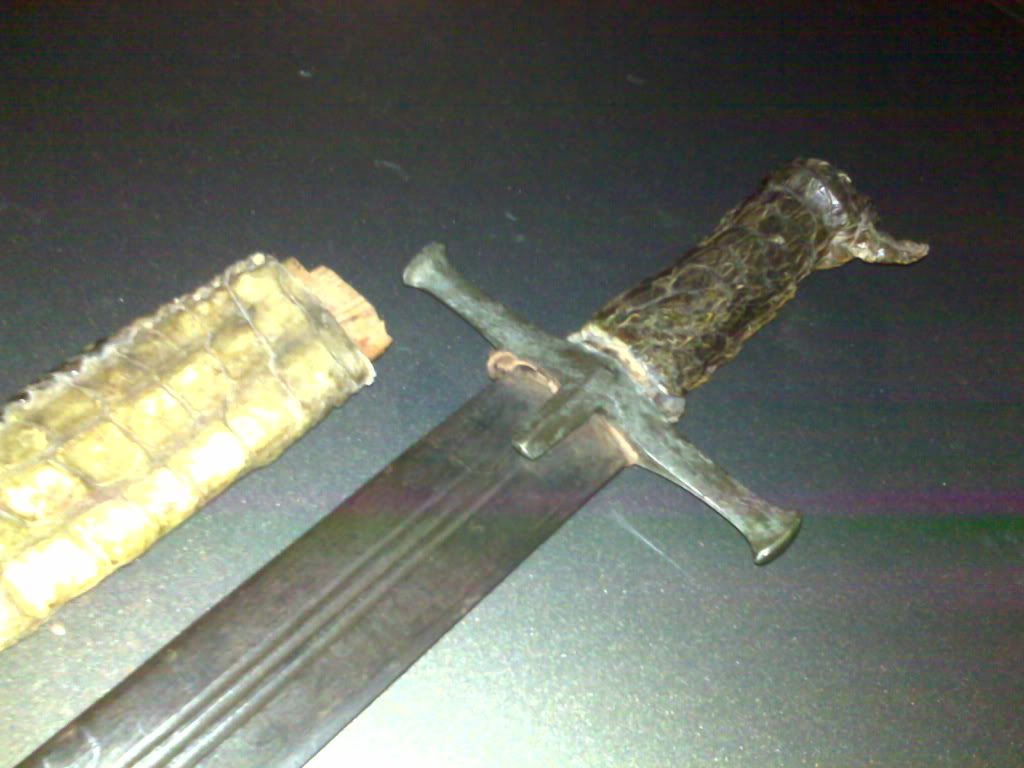
A picture of the hilt and strong of the blade, and top of scabbard.
The blade geometry causes me to have real questions. It has no profile taper whatsoever. The edges are utterly parallel for the whole length, and the cross-section is completely flat, except for the shallow triple fuller. There is no distal taper. The edges have a convex grind. It could have just been cut from some 3/16 sheet steel, or spring steel, for all appearances.
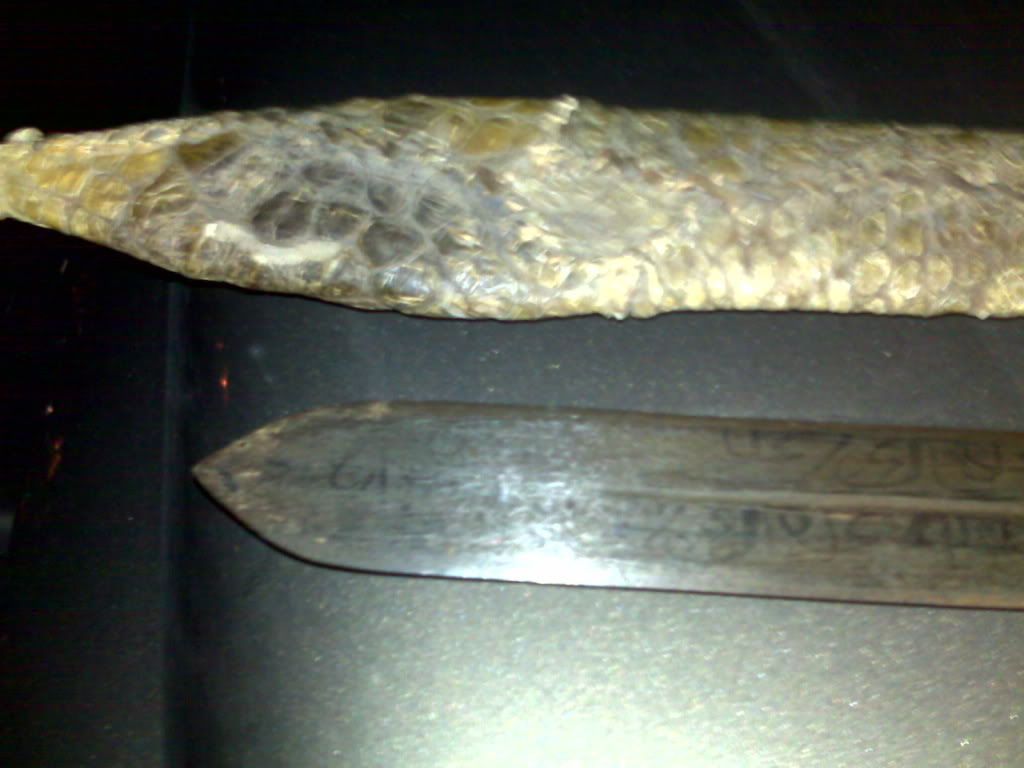
Picture showing the point.
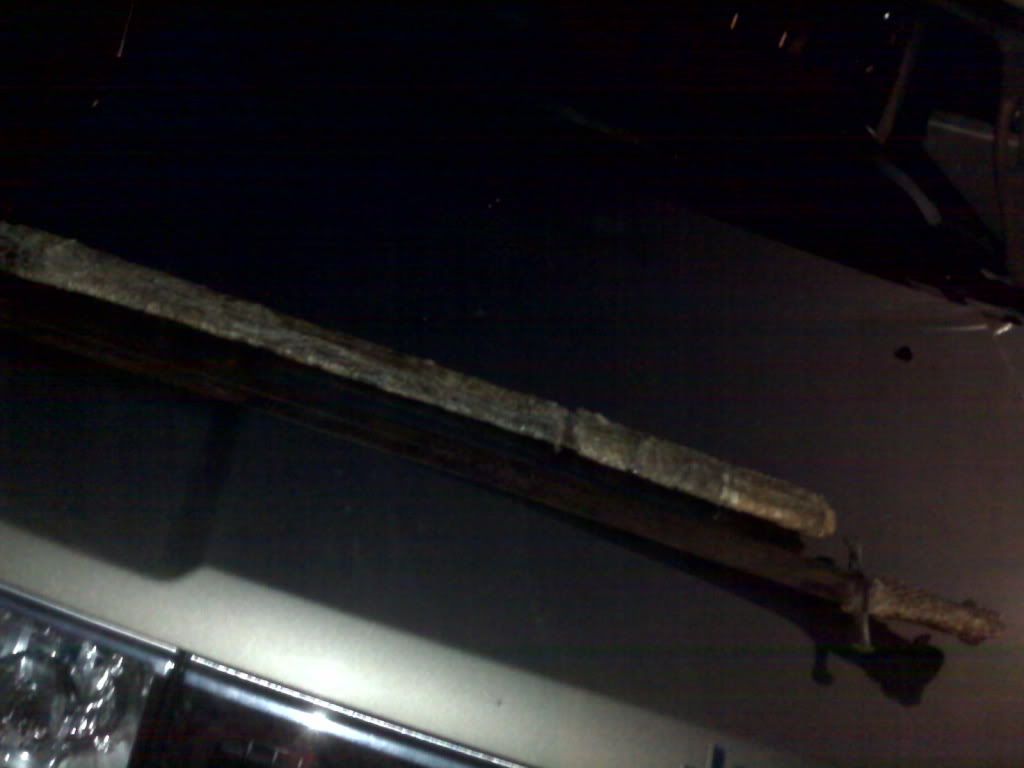
Picture (though dark) of the whole length.
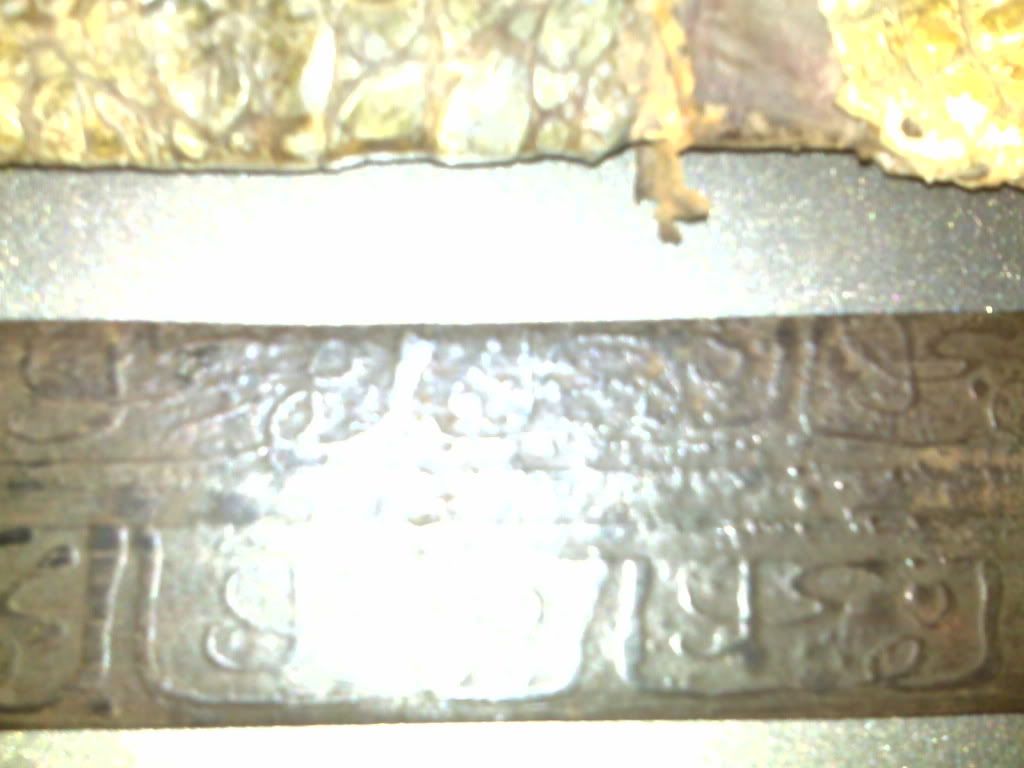
Highlighting the raised script on the blade. The portion in the lower right-hand corner shows the word that is repeated down the length of the blade.
So... can anybody help me make sense of this? It doesn't seem like any "Crusader" sword I've ever seen, and I don't really think any Crusader would've carried something with Arabic lettering, as anything other than a war prize.
The blade geometry just reeks of hoax, to me. But maybe that sort of construction was more common than I think? It certainly does appear to be very, very old. But 1000 years? I wonder a little bit if maybe some soldiers in Africa got sold a number of "genuine" artifacts by the locals? At the time, it would've been a fairly lucrative business. Even as such, it's something of a historical curiousity.
That, or... he's really got something that ought to be in a museum somewhere. At any rate, it's like nothing I've ever seen before and I thought I'd throw it out there for some discussion, as I think we've got some world-class expertise available here at ARMA.
What think?


