Looking for opinion on this old sword

For Historical European Fighting Arts, Weaponry, & Armor

Moderators: Webmaster, Stacy Clifford

User avatar
Dave Rogers
Posts: 19
Joined: Wed Apr 30, 2008 2:26 pm
Location: Bellevue, WA

Looking for opinion on this old sword

Postby Dave Rogers » Fri Mar 20, 2009 2:54 pm

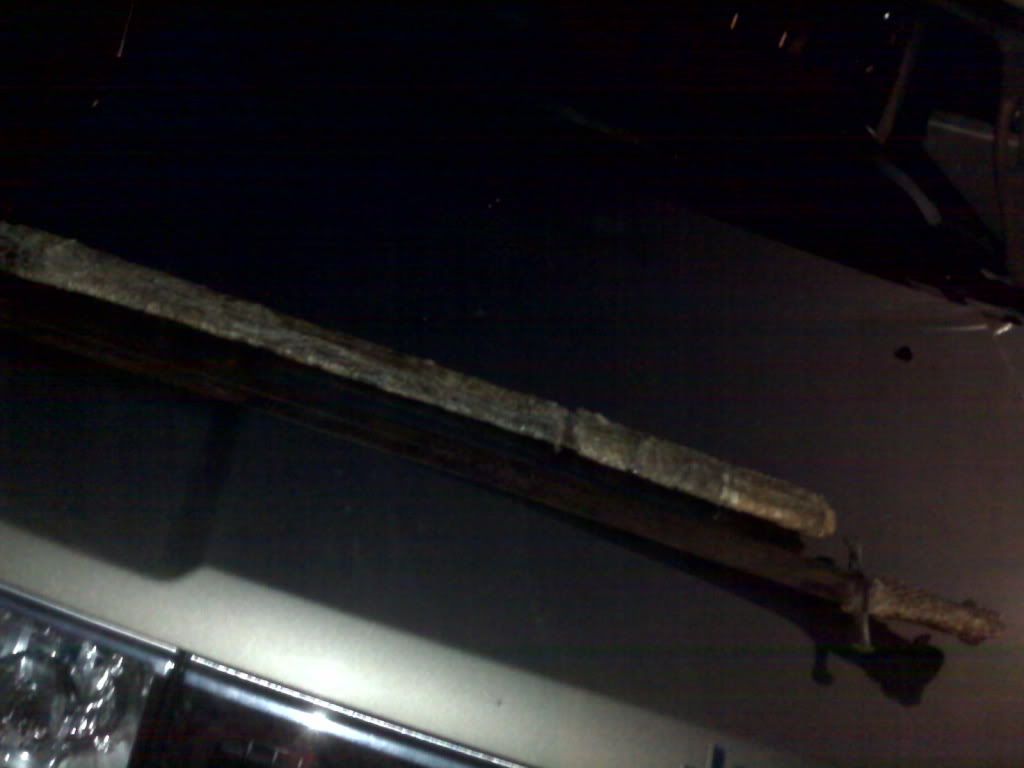
A friend of mine showed me this sword that he has... it came from his father, now passed away, who was an antique dealer. I have no idea what knowledge of swords his father may have had, though I don't think it was necessarily great. His specialty is told to have been clocks, watches and the like. The story is that this sword came back with a soldier from Europe or Africa after WWII. His father always called it a "Crusader Sword", and believed it to be about 1,000 years old. Whether that is true or not, I don't know but he seems to have been sincere about it. I took a few pictures of it on the hood of my Jeep, but alas it was just my phone camera and it was dark out... so sorry that they aren't better quality pics.

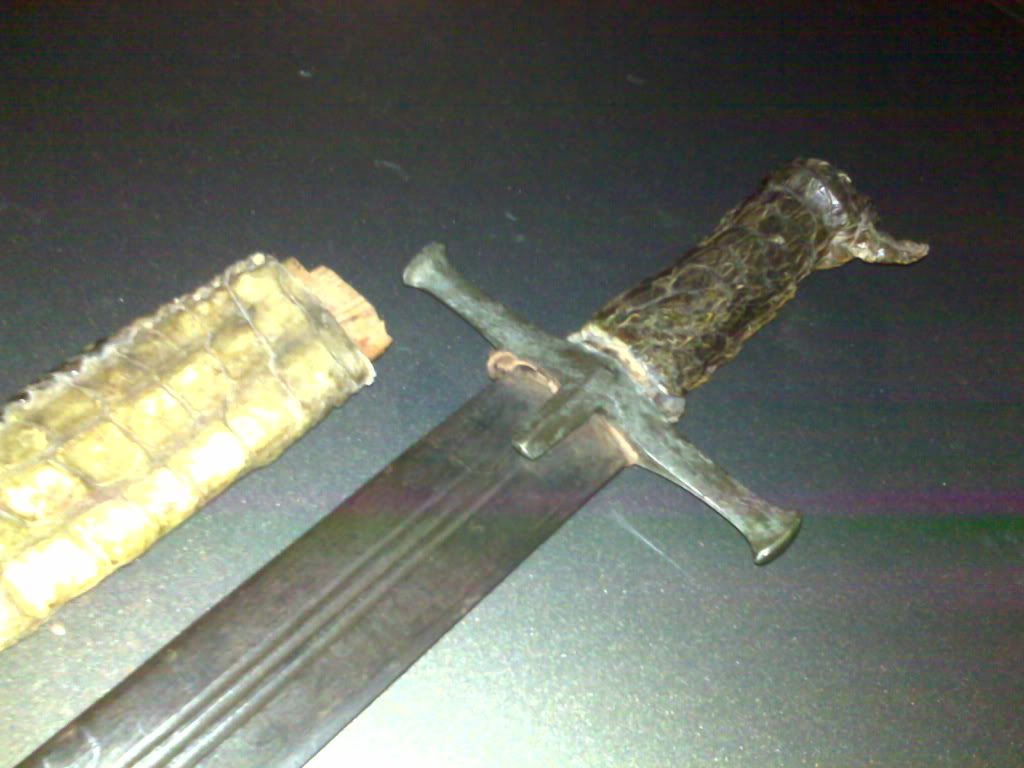
The hilt appears to be bronze. The grip is wrapped in what appears to be crocodile skin, as is the scabbard. The scabbard is made from a light straight-grained wood.

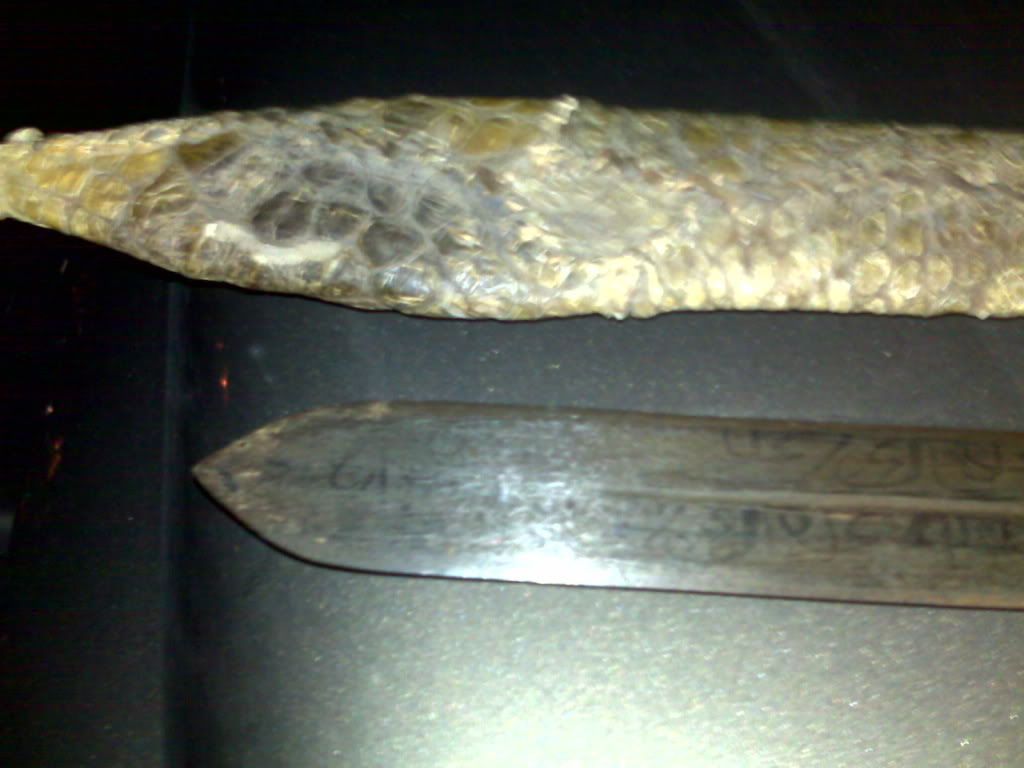
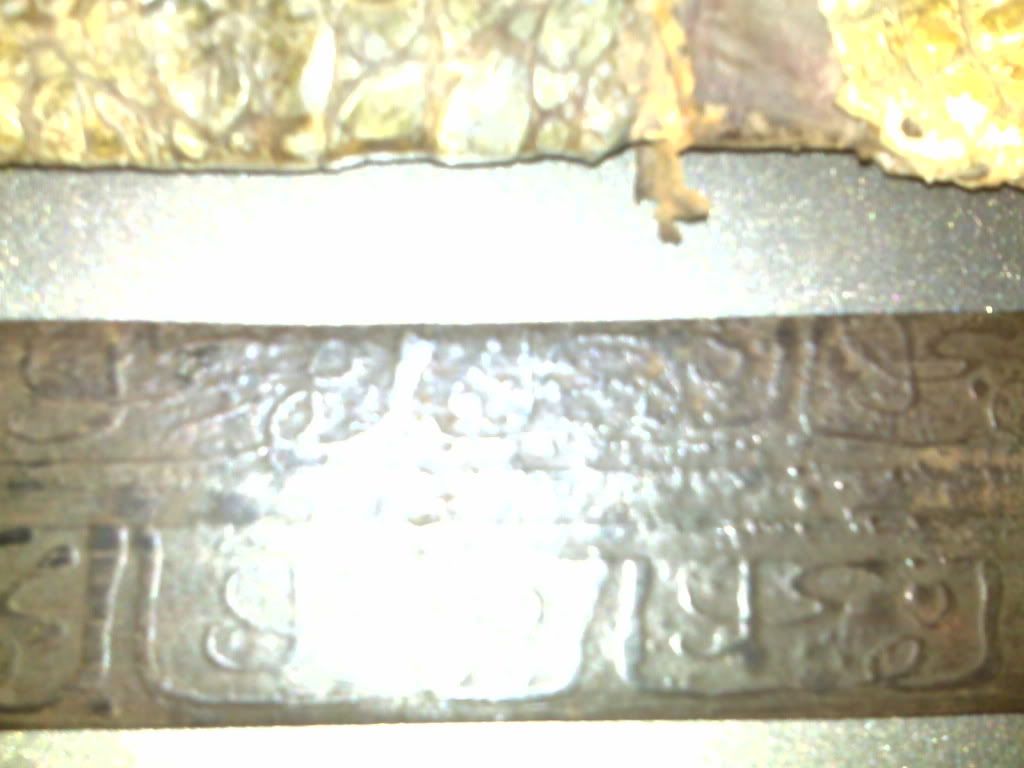
The blade appears to be steel. There are raised letters on the blade, to my eye looking like Arabic script, repeating the same word or short phrase above and below the fuller for the whole length of the blade. The blade is in astonishing condition if it were truly that old. But I'm not sure of that.
Image
A picture of the hilt and strong of the blade, and top of scabbard.

The blade geometry causes me to have real questions. It has no profile taper whatsoever. The edges are utterly parallel for the whole length, and the cross-section is completely flat, except for the shallow triple fuller. There is no distal taper. The edges have a convex grind. It could have just been cut from some 3/16 sheet steel, or spring steel, for all appearances.
Image
Picture showing the point.

Image
Picture (though dark) of the whole length.
Image
Highlighting the raised script on the blade. The portion in the lower right-hand corner shows the word that is repeated down the length of the blade.

So... can anybody help me make sense of this? It doesn't seem like any "Crusader" sword I've ever seen, and I don't really think any Crusader would've carried something with Arabic lettering, as anything other than a war prize.

The blade geometry just reeks of hoax, to me. But maybe that sort of construction was more common than I think? It certainly does appear to be very, very old. But 1000 years? I wonder a little bit if maybe some soldiers in Africa got sold a number of "genuine" artifacts by the locals? At the time, it would've been a fairly lucrative business. Even as such, it's something of a historical curiousity.

That, or... he's really got something that ought to be in a museum somewhere. At any rate, it's like nothing I've ever seen before and I thought I'd throw it out there for some discussion, as I think we've got some world-class expertise available here at ARMA.

What think?

User avatar
Benjamin Parker
Posts: 116
Joined: Fri Aug 15, 2008 8:51 pm
Location: The back of your mind

Postby Benjamin Parker » Fri Mar 20, 2009 4:16 pm

It could be a Takabouba
My kingdom for a profound/insightful Signature!

User avatar
Dave Rogers
Posts: 19
Joined: Wed Apr 30, 2008 2:26 pm
Location: Bellevue, WA

Postby Dave Rogers » Fri Mar 20, 2009 4:48 pm

Benjamin Parker wrote:It could be a Takabouba


Is that Persian? I'm not familiar with that name.

I've found some pictures of Persian swords that have a similar hilt/crossguard style, but not so much the blade. I called it "Arabic" script but it certainly could be one of the Persian/Pahlavi or something like that.

User avatar
Stacy Clifford
Posts: 1126
Joined: Fri May 14, 2004 11:51 am
Location: Houston, TX
Contact:

Postby Stacy Clifford » Fri Mar 20, 2009 6:03 pm

Apparently a lot of fairly convincing-looking replicas were made in the Victorian era when knights were so heavily romanticized, and those are mistaken nowadays for much older swords. I've heard about this from JC many times and that would be my first guess here. There's almost no way that crocodile skin is 800-1000 years old. Old blades were also often rehilted over the centuries to keep up with fashion as well as replace damaged parts. Straight blades with no taper like that did exist, so that's possible too, but I have no idea how to explain the etchings. You'd probably have better luck asking this kind of question on My Armoury, that's more the area they specialize in.
0==[>>>>>>>>>>>>>>>>>
Stacy Clifford
Free-Scholar
ARMA Houston, TX

Ken McKenzie
Posts: 22
Joined: Tue Jan 09, 2007 1:42 am

Postby Ken McKenzie » Fri Mar 20, 2009 6:51 pm

My guess (and I am only guessing) is that this is a Sudanese Kaskara. http://en.wikipedia.org/wiki/Kaskara

User avatar
Corey Roberts
Posts: 223
Joined: Sat May 07, 2005 6:11 pm
Location: Pyeongtaek, South Korea

Postby Corey Roberts » Fri Mar 20, 2009 7:48 pm

At first glance, my initial feeling is that this weapon is of North African origins. The general profile of the hilt, as well as particularly the scabbard of the weapon all seem very much to be indicative of that area.
This does not, to me look like anything of European origin, (unless it's some kind of knock-off)

Swords are still widely produced in the Middle East and can be found all over the place, without them having to be ancient or particularly old. They are often made as things to sell to tourists, etc. As ceromonial objects and heirlooms, and in rare cases, they are still made and used for their original intended purpose.

The Arabic on the blade is really too fuzzy for me to make out very well and with my limited Arabic skills I can't really tell what it says. I can tell you however, that the letter kaf (the letter in Arabic which makes a 'k' sound) here is distinctly Arabic. An Arabic letter kaf at the end of a word looks like this: ك
A Persian letter kaf at the end of a word looks like this: ﮏ

You can see the Arabic letter ك several times on the blade even though I can't tell exactly what it says.

I've sent your images of the inscription to my Arabic instructor, and I will report back when I find out more.
--Scholar-Adept
Pyeongtaek
Republic of Korea

LafayetteCCurtis
Posts: 421
Joined: Sat Nov 04, 2006 7:00 pm

Postby LafayetteCCurtis » Sun Mar 22, 2009 12:48 am

Yes, it looks like the Sudanese kaskara; it's probably also a good idea to check out some information on the similar Tuareg takouba, even though it's less likely that your blade would be one.

User avatar
Dave Rogers
Posts: 19
Joined: Wed Apr 30, 2008 2:26 pm
Location: Bellevue, WA

Postby Dave Rogers » Sun Mar 22, 2009 8:55 pm

LafayetteCCurtis wrote:Yes, it looks like the Sudanese kaskara; it's probably also a good idea to check out some information on the similar Tuareg takouba, even though it's less likely that your blade would be one.


Thanks guys... yes, I agree that it looks like a Kaskara, and that write up in your links seems to suggest that this blade was something that might have been common, and probably Sudanese in origin.

I concur with the comments that it is unlikely that it is old as he believed. The crocodile skin is certainly much more recent. Whether that's a more modern addition, or whether it's been re-hilted... lots of possibilities.

Thanks, Corey, for taking it to an expert on the language. I will see if I can get any better pictures.

User avatar
Matt Easton
Posts: 218
Joined: Sun Nov 10, 2002 2:23 pm
Location: London, England
Contact:

Postby Matt Easton » Thu Mar 26, 2009 7:28 am

Yes, it is a Sudanese Kaskara, without any doubt, most likely dating to c.1870-1900, when a lot of these were brought back to Europe after the wars against the Islamic forces of the Mahdi.

They are quite easy to find in militaria shops and auctions here in the UK.

Regards,
Matt


Return to “Research and Training Discussion”

Who is online

Users browsing this forum: No registered users and 16 guests


Note: ARMA - The Association for Renaissance Martial Arts and the ARMA logo are federally registered trademarks, copyright 2001. All rights reserved. No use of the ARMA name or emblem is permitted without authorization. Reproduction of material from this site without written permission of the authors is strictly prohibited. HACA and The Historical Armed Combat Association copyright 1999 by John Clements. All rights reserved. Contents of this site 1999 by ARMA.